Munster Migration(c.1590s)
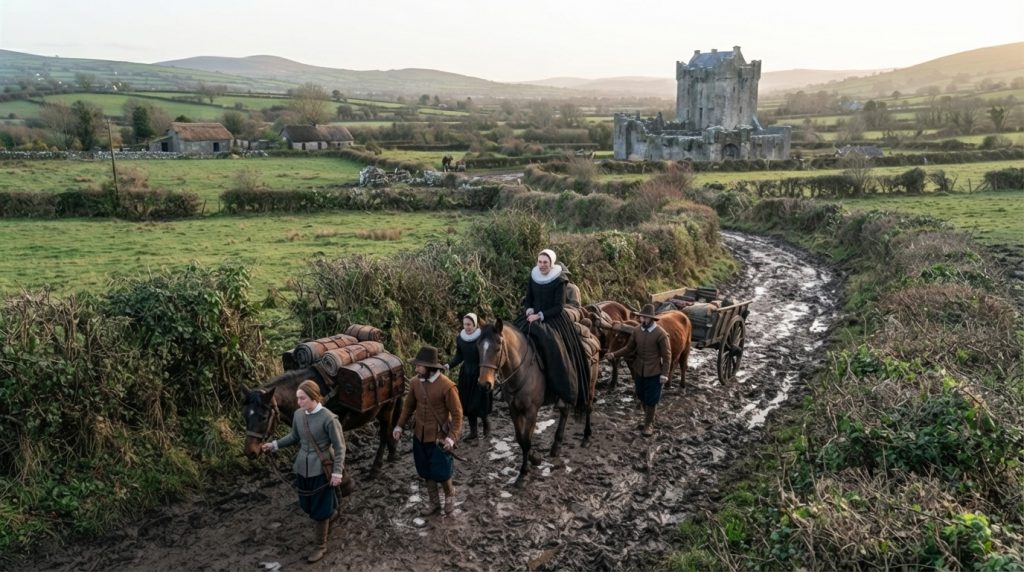
Lady Elizabeth Dowdall’s Limerick story began before Kilfinny Castle, with the Southwell family’s movement from England into Ireland. Born in England during the 1590s, Elizabeth was the daughter of Sir Thomas Southwell and the poet Anne Southwell. Sir Thomas was knighted in 1603, after which the family settled in County Cork during the seventeenth century. That relocation placed Elizabeth within Munster’s developing networks of landholding, marriage and administration. Her later union with Sir John Dowdall carried her northwards into County Limerick, where Kilfinny became her household and, eventually, the setting for the episode that preserved her name in Irish history.
The Southwells entered Ireland during a period when English families were establishing estates and political connections across Munster. Such migration reshaped local society through new patterns of ownership, religious allegiance and service to the Crown. Elizabeth’s upbringing therefore occurred within a household connected to both English literary culture and Irish landed life. Her mother wrote poetry and assembled manuscripts, while her father’s status provided access to gentry networks. Although little is certain about Elizabeth’s childhood, the family’s movement to Cork gave her an enduring Irish connection and created the circumstances in which her marriage into the Dowdall family became possible.
After Sir Thomas Southwell died in 1626, Anne Southwell returned to England, but Elizabeth remained in Ireland. Her decision or circumstances are not explained in the surviving account, so motives should not be invented. What is known is that she married Sir John Dowdall and had five daughters: Anne, Elizabeth, Jane, Bridget and Honora. Through marriage, residence and motherhood, Elizabeth became firmly rooted in Munster. Kilfinny Castle in County Limerick was not simply a temporary refuge; it represented the centre of her family life, social position and responsibilities before rebellion transformed it into a defended stronghold before the rebellion began.
For Limerick history, Elizabeth’s path demonstrates how personal mobility connected counties and kingdoms. Her life joined an English birthplace, a Cork upbringing and a Limerick marriage within one seventeenth-century biography. These movements reflected the wider circulation of families, property and influence through Munster. They also shaped the local balance of power that rebellion later disrupted during this period. When Kilfinny came under attack, Elizabeth defended a place to which she had become connected through marriage and household authority. Understanding that longer settlement story prevents her from appearing suddenly in 1642 and restores the years of family formation preceding the siege.
Elizabeth Dowdall’s migration and settlement complicate any simple division between English and Irish history. She was English-born, raised partly within an Irish environment, married into an Irish family and remembered through events in County Limerick. Her identity was formed across these relationships rather than by birthplace alone. The surviving evidence remains incomplete, especially regarding her early years and later whereabouts, yet the broad chronology is clear. The Southwell move to Cork, Elizabeth’s continued residence after 1626 and her marriage to Sir John Dowdall created the foundation for everything that followed. Kilfinny’s history began with that personal journey into Limerick society.
Primary Sources
- Anne Southwell and Henry Sibthorpe, The Workes of the Lady Ann Southwell, manuscript commonplace book assembled principally between 1626 and 1636, Folger Shakespeare Library, MS V.b.198.
- Manuscript writings attributed to Anne Southwell, British Library, Lansdowne MS 740, folios 143r–155r.
- Official record of the knighting of Sir Thomas Southwell in 1603. Primary source requiring further verification.
- Marriage settlement or register concerning Elizabeth Southwell and Sir John Dowdall. Primary source requiring further verification.
- Dame Elizabeth Dowdall, sworn deposition concerning Kilfinny Castle, her family and losses during the rebellion, 1642, Trinity College Dublin, 1641 Depositions. Precise folio and archival identifier require further verification.