
Limerick Soviet(c.1910s)
The Limerick Soviet arose in April 1919 after the attempted rescue and subsequent death of Robert Byrne. On 6 April 1919 Byrne was mortally wounded during an IRA attempt to free him from custody at the Union Workhouse Hospital, and a Royal Irish Constabulary constable died in the affray. In response British military authorities declared most of Limerick city a Special Military Area on 9 April 1919 under the Defence of the Realm Act. The Limerick Trades and Labour Council called a general strike that developed into a workers’ council administering civic and economic measures across the city and solidarity.
They issued proclamations, ran organised food distribution, printed strike bulletins and locally produced one shilling notes and passes to control movement. Printers kept producing daily bulletins informing citizens about shop closures, rationing, prices and sanctions against supplies to military forces. Food shops, bakeries and milk supplies were organised through union committees, while volunteers enforced the boycott of goods associated with the garrison. The strike committee attempted to maintain public order and essential services without relying on state institutions, using trade union networks, cooperative societies and sympathetic small businesses to keep the city functioning during this period of industrial self management.
Contemporary newspapers provided extensive coverage and international interest followed the unusual events in Limerick, with journalists describing closed shops, printed notices and crowded meetings of delegates. The Limerick Leader produced special editions and other newspapers reproduced strike committee proclamations while foreign press reported workers’ run administration. Local political figures, the Catholic bishop and Sinn Féin mayor intervened to seek a negotiated end, concerned by economic strain and the risk of wider confrontation. After roughly a fortnight of strike action the committee issued a proclamation on 27 April 1919 declaring the general strike over and urging restoration of normal civic life.
Historians have debated whether to call the Limerick action a soviet in the strict Russian sense, yet contemporary participants frequently used the term and the episode reflected wider labour radicalism alongside national struggle in 1919. For a short period workers led institutions exercised practical authority, demonstrating organisational capacity and solidarity in administering services and enforcing boycotts. The event underlined overlap between republican militancy and organised labour in Limerick. Its cancellation reflected pressures from civic leaders worried about economic hardship and clerical opposition; the strike committee bowed to appeals for restoration of municipal and commercial life and to prevent further bloodshed.
The Limerick Soviet left enduring legacies in local memory, surviving printed ephemera and banknotes that appear in museum collections and private archives. Its story is preserved in original strike bulletins, trade union minutes, contemporary newspaper files and photographs of meetings and printed slogans that blanketed the city. For archival researchers useful sources include coroner reports, military proclamations, Royal Irish Constabulary incident logs, municipal council minutes, trade union files and oral histories recorded from participants or their families. Remembering the Soviet calls for careful use of primary documents to understand motives, organisation, contested meanings and the dramatic fortnight in Limerick history.
Primary Sources
- Limerick Leader, special editions and issues covering 14 April, 16 April and 18 April 1919; local newspaper coverage of the strike committee proclamations and city notices.
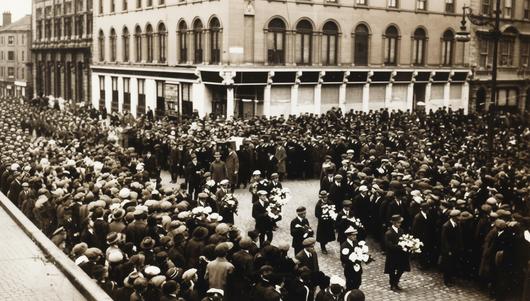
- Funeral and contemporary coverage: Photographs and press reports of the funeral of Robert Byrne, 10 April 1919, held at the Union Workhouse Hospital and local cemeteries; contemporary photo captions in local papers.
- Limerick United Trades and Labour Council: Strike Committee proclamations and printed strike bulletins issued 15 April to 27 April 1919; original printed leaflets and daily bulletins produced by printers in Limerick.
- Defence of the Realm Act proclamation: British military declaration of Limerick as a Special Military Area, 9 April 1919; relevant military orders and permits issued to control movement in the city (Dublin Castle/Military papers, April 1919).
- Coroner and inquest records concerning the death of Robert Byrne, April 1919; coroner’s findings and any witness statements taken at inquest proceedings.
- Royal Irish Constabulary incident logs and reports for Limerick, April 1919, including reports of the attempted rescue at the Union Workhouse Hospital and subsequent policing actions.
- Limerick City municipal council minutes and civic correspondence, April–May 1919, recording mayoral and civic interventions during and following the strike period.
- Trade union records: Minutes and correspondence of the Limerick United Trades and Labour Council and affiliated unions (postal workers, printers, bakery and dairy unions), April 1919 strike minutes and membership lists.
- Contemporary national press reports: coverage in the Freeman’s Journal and The Irish Times during April 1919 reporting the Special Military Area order, the strike and official responses.
- Oral histories and witness statements recorded by participants or family members collected in local archives and manuscript collections, including later recorded testimonies concerning organisation of food supplies, printing and enforcement of the boycott during April 1919.