
Peter Tait(c.1850s)
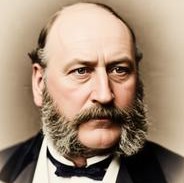
Peter Tait was born in Lerwick, Shetland, on 8 August 1828 and emigrated to Limerick in the 1850s where he established himself in the clothing trades. With experience in garment manufacture, he founded the Limerick Clothing Factory to meet demand for ready made garments and military clothing. The factory adopted mechanised production, employed hundreds of local workers, and drew on skilled operatives from Scotland and England. Tait’s enterprise helped diversify Limerick’s nineteenth century economy beyond port trade. He married into an established local family and rose in civic and commercial circles, becoming locally respected. His firm became a prominent employer.
Contemporary directories and town plans place Tait’s factory complex on Edward Street within Newtown Pery and show its footprint alongside William Street and Baker Place. Municipal minutes and local newspapers record involvement in the erection and dedication of the Baker Place clock tower, with fundraising and design recorded in civic papers. Ordnance Survey maps and nineteenth century plans confirm the factory’s position in the urban street pattern. Illustrated press and period caricature depict Tait’s public persona during his civic activity. Trade directories, advertisements and commercial notices further corroborate the factory address and public profile associated with his firm in Limerick.
Business papers, company ledgers and wage books attributed to the Limerick Clothing Factory and successor firms document employment, contracts and manufacturing for civilian and military clothing. Surviving account books indicate mechanised processes, payroll entries for hundreds of operatives, and procurement of cloth and fittings. Contract notices and commercial advertisements in period newspapers record supply agreements and workforce recruitment. Successor firm references appear in commercial records and later company filings, linking the factory’s output to broader industrial networks. These primary sources are essential for reconstructing labour numbers, working conditions and the factory’s role in supplying ready made garments and uniforms locally.
Legal and civil records provide further primary evidence of Tait’s life and estate. Probate and will entries record estate valuation, executors and inventories of property and business interests, while parish registers and civil registration note marriage and death events for Tait and immediate family. Census returns for Limerick City (1871) offer household and occupation entries that corroborate residence, household composition and links to the factory workforce. Together these records allow researchers to trace family relationships, property holdings and the disposition of business assets. Researchers should consult original probate bundles, parish volumes and certified civil registration copies for authoritative details now.
Contemporary newspapers, commercial advertisements and trade directories remain rich sources for reconstructing Tait’s public profile and business operations. Press notices, illustrated periodicals and caricature reveal public perceptions while advertising and contract notices document commercial reach and clients. Large scale town plans and Ordnance Survey sheets permit spatial analysis of factory buildings and associated street addresses such as Edward Street, William Street and Baker Place. Researchers compiling a portrait of Peter Tait should cross reference newspaper archives, company ledgers, municipal minutes, census returns and parish registers listed among primary sources. Together these materials create a multilayered evidential basis for local industrial.
Primary Sources
- Limerick Chronicle, December 1868: contemporary report of knighthood and mayoral functions (contemporary issue covering December 3–12 1868).
- Limerick Clothing Factory employment and contracts notices in Limerick commercial advertisements, Limerick Chronicle and Freeman’s Journal, 1853–1870 (advertisements and contract notices across multiple issues).
- Trade directory entry for Peter Tait and Limerick Clothing Factory, Thom’s or Slater’s Irish commercial directories, 1858 and 1866 editions (directory listings and factory address on Edward Street).
- Census return of Limerick City, 1871 (household and occupation entries recording Peter Tait and factory workforce details where available).
- Baker Place Clock Tower erection records and dedication notice, Limerick municipal minutes and local newspapers, 1866–1867 (minutes of Limerick Corporation and press reports covering the fundraising, design and unveiling of the memorial).
- Company records and ledgers of the Limerick Clothing Factory and successor firms (including Cannocks and Auxiliary Forces Uniform and Equipment Company) ledger entries, wage books and contracts, 1860s–1890s (catalogued business papers in local and national archives).
- Probate and will of Peter Tait, 1890: estate valuation, executors and inventory of property and business interests (civil probate records, 1890).
- Contemporary illustrated press and caricature in Donaghmore or Dublin illustrated newspapers reporting on Tait’s public persona during his mayoralty, 1866–1869 (illustrations and commentary in periodicals).
- Ordnance Survey and nineteenth century town plans of Limerick (large scale town maps showing Edward Street, William Street, Baker Place and the footprint of the Tait factory complex), c. 1860–1880.
- Parish registers and civil registration entries: marriage and death entries for Peter Tait and immediate family (civil death registration 1890 and parish register entries for marriage and baptisms, where applicable).