Castlepook Reindeer Butchery31992 BCE
About 31,992 BCE, Ireland was entering a severe glacial phase during the later Upper Palaeolithic, although ice extent varied regionally and chronology remains uncertain. Castlepook Cave in north County Cork provides a possible early human trace: a reindeer femur, dated to roughly 33,000 years ago, bears probable stone-tool butchery marks. If confirmed, it indicates brief human presence, not permanent settlement or continuous occupation. Animal remains suggest a cold, open, changing landscape supporting reindeer and other Pleistocene fauna, but deposits span long periods. Later ice, erosion, submerged coastlines and antiquarian excavation have left an exceptionally sparse record, requiring cautious interpretation overall.

Dateline
The label 31,992 BCE is a modern chronological convenience, not a date that people living in prehistoric Ireland could have named or recorded. Nothing in the evidence can be fixed to that individual calendar year. The responsible approach is therefore to look at the calibrated ranges and geological sequences that bracket it. This was the later part of the Upper Palaeolithic, within Marine Isotope Stage 3 and close to the long climatic deterioration that led into the Last Glacial Maximum. For Ireland, it was a world without farming, writing, towns, named rulers or recoverable political communities. What can be investigated is a changing Ice Age landscape, the animals which used it, and one exceptionally early but still limited indication that humans may have entered it.
A Date Beyond Annual History
At this depth of time, even apparently exact scientific ages need careful handling. Radiocarbon laboratories produce ages in radiocarbon years before present; archaeologists then calibrate them against changing atmospheric carbon levels, producing probability ranges rather than a single true year. Geological reconstructions add further uncertainty because they combine dates from caves, sediments, landforms and marine cores. Accordingly, 31,992 BCE should be read as “about 34,000 years ago”, not as a point at which a specific event happened. It belongs to a broad interval in which Ireland’s climate, ice cover and coastlines were changing, sometimes rapidly by Pleistocene standards.
The period matters because it falls near the beginning of the final great expansion of the British–Irish Ice Sheet. Reconstructions do not give a single, uncontested picture of Ireland at precisely this moment. Some evidence indicates that much of the island remained ice-free until roughly 32,000 years ago, followed by swift ice-sheet growth; other reconstructions model substantial ice in the north-west and smaller ice fields or glaciers in several upland districts by about 31,000 years ago. The defensible conclusion is regional rather than absolute: Ireland was entering a severe glacial phase, with expanding mountain and ice-sheet ice, but not necessarily an island uniformly buried beneath it on every day or in every locality.
A Northern Cork Clue
The closest archaeological evidence relevant to this era comes from Castlepook Cave, near Doneraile in north County Cork. Its limestone passages yielded a large collection of Pleistocene animal remains during antiquarian excavations, much of it now held in museum collections. Reassessment of such collections has transformed the study of Ice Age Ireland: individual bones can now be identified more securely, examined microscopically and directly dated by accelerator mass spectrometry. Castlepook is especially valuable because its deposits preserve evidence from before and after the Last Glacial Maximum, although the early digging and the complicated cave sediments mean that associations must be treated with restraint.
A reindeer femur from Castlepook, reported in 2021 as about 33,000 years old, bears deep marks interpreted as having been made during butchery with a stone tool. If that interpretation is sustained by further analysis, it is the earliest known sign of human activity in Ireland and lies very close to the broad timespan represented by 31,992 BCE. It would demonstrate that people handled and processed a reindeer on, or after reaching, the island. It does not demonstrate a permanent settlement, a family group, a camp at the cave, or continuous occupation of Ireland. The bone dates the animal’s death, while the old collection’s archaeological context is not equivalent to a modern, tightly excavated living floor.
That distinction is crucial. Ireland’s first securely documented substantial settlement belongs far later, in the Mesolithic. Mount Sandel on the River Bann, County Londonderry, has dated huts, pits and stone artefacts from around 9,800–9,600 calibrated years before present. The intervening gulf is immense. A possible Upper Palaeolithic visit at Castlepook should not be turned into an unbroken ancestry for later Irish populations, still less into a story of an established “first Irish” society. It is better understood as evidence for an episode of human presence—or perhaps repeated brief presences—that remains archaeologically elusive.
Landscape, Ice and Animals
For the living landscape around this time, animal remains offer firmer evidence than human artefacts. The Irish Quaternary Fauna Project established that a varied mammal fauna occupied Ireland during parts of the period between at least about 45,000 and 20,000 years ago. Castlepook has produced remains attributed to reindeer, brown bear, giant deer, woolly mammoth, wolf, Arctic fox, lemmings and spotted hyaena. Yet this is not a ready-made list of creatures seen together in 31,992 BCE. Cave deposits can contain material from many millennia, and improved pretreatment and redating have shown some earlier dates to be significantly too young. Several species, including giant deer and spotted hyaena, may have disappeared locally before the later growth of the ice sheet.
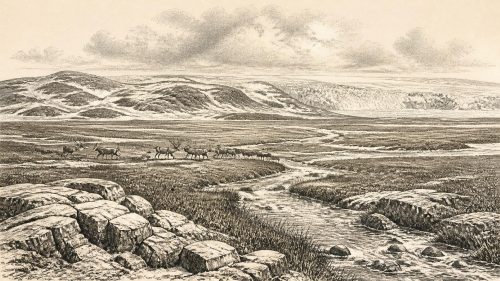
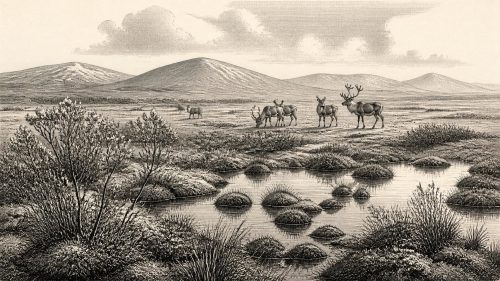
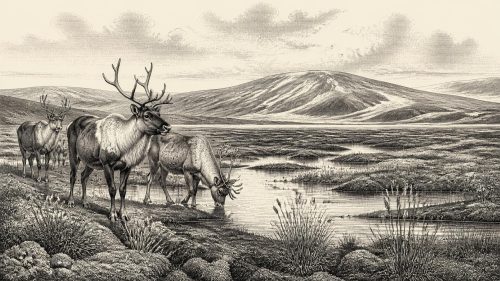
The most defensible scene is therefore a cold, open and variable environment, not a cinematic parade of every Ice Age animal. Reindeer are directly relevant because of the Castlepook femur; their presence would fit a landscape with productive seasonal grazing. Brown bears, carnivores and scavengers also used caves and their surroundings, while some bones may have been carried into caves by animals rather than people. Tree cover was greatly restricted in colder phases, and exposed ground, grasses, herbs, sedges, rock and patches of snow would have shaped many areas. Sheltered valleys and southern lowlands could have differed markedly from high mountains and the expanding ice margins.
Sea level was lower than today because so much water was locked in northern ice sheets, altering the outline of the Irish coast and extending the continental shelf. But lower sea level does not solve the practical question of human arrival. The evidence does not permit a confident reconstruction of the route taken by whoever butchered the Castlepook reindeer. They may have crossed short stretches of water, travelled along changing coasts, or reached Ireland during a particular configuration of ice and sea. Later glaciation, erosion and post-glacial marine inundation have destroyed or concealed much of the landscape in which any such journey occurred.
Society Without Institutions
There is no evidence for political affairs, diplomacy, warfare, territorial states, chiefs or named communities in Ireland at this time. It would be misleading to imagine tribes occupying fixed borders merely because a single animal bone may record human work. Similarly, there are no excavated houses, hearths, burials, tool-making floors, clothing, art objects or deposits that can securely reveal religion, language, teaching, kinship or customary law around 31,992 BCE. The silence is archaeological, not a claim that visiting people lacked culture. Any Upper Palaeolithic people who reached Ireland would necessarily have possessed knowledge, skills and social relationships; the problem is that those qualities cannot yet be described from Irish evidence.
The possible cut-marked femur nevertheless allows one modest economic inference. If the marks are indeed human-made, they show practical knowledge of carcass processing: meat, sinew, marrow, hide or bone may all have been useful. Reindeer itself was a mobile resource, so the find may point to hunting or opportunistic use of a carcass rather than a settled food economy. There is no basis for identifying specialised exchange networks, regular maritime trade, or sustained exploitation of particular territories in Ireland. Nor can the femur establish whether the animal was killed nearby, brought to the cave, or encountered after death. The evidence supports careful possibilities, not a detailed reconstruction of an Ice Age household.
Why the Record Is So Thin
Ireland’s Upper Palaeolithic record is unusually fragile. Much was overwritten by later ice movement; caves were repeatedly used by animals, disturbed by natural processes and excavated before modern recording standards; former coastlines now lie offshore; and any lightly built camps on exposed ground had poor prospects of survival. The absence of sites is therefore not proof that no people ever entered Ireland. Equally, a sparse record cannot be made to prove large populations. This preservation problem is why re-examining museum collections, applying improved radiocarbon methods and investigating undisturbed cave sediments remain so important.
Thus the principal Irish development appropriate to this date is not a reign, battle or foundation, but a threshold in deep history. Around the broad span represented by 31,992 BCE, Ireland was becoming a harsher glacial landscape and may have received brief human visitors. Castlepook Cave offers a tantalising indication of reindeer butchery close to this era; its significance is great precisely because the surrounding evidence is so slight. The responsible historical picture is one of uncertainty bounded by material facts: a changing island landscape, Ice Age animals, expanding ice, and the possibility—rather than the demonstrated permanence—of human presence.
Primary Sources
- First Evidence of a Late Upper Palaeolithic Human Presence in Ireland
- New Insights on the Fauna of Ireland's Younger Dryas and Early Holocene from Alice & Gwendoline Cave
- A Reconsideration of the Radiocarbon Dating of the Marine Isotope Stage 3 Fauna from Southern Ireland
- The Irish Quaternary Fauna Project
- The Last Irish Ice Sheet: Extent and Chronology
- Growth and Retreat of the Last British–Irish Ice Sheet, 31,000 to 15,000 Years Ago: the BRITICE-CHRONO Reconstruction
- Trimlines, Blockfields and the Vertical Extent of the Last Ice Sheet in Southern Ireland
- The Deglaciation of the Western Sector of the Irish Ice Sheet from the Inner Continental Shelf to its Terrestrial Margin
- Stratigraphic and Palaeo-Geomorphological Evidence for the Glacial-Deglacial History of the Last British-Irish Ice Sheet in the North-Western Irish Sea
- Modelled Relative Sea-Level Histories for the Northwest Coast of Ireland
- Ireland: Submerged Prehistoric Sites and Landscapes
- Ireland: Submerged Prehistoric Sites and Landscapes
- The Mesolithic in Ireland: When Was It?
- A New Bayesian Chronology for Mesolithic Occupation at Mount Sandel, Northern Ireland
- Archaeological Excavations at Killuragh Cave, Co. Limerick: A Persistent Place in the Landscape from the Early Mesolithic to the Late Bronze Age
- Revisiting Alice and Gwendoline Cave, Co. Clare: New Light on the 1902 Excavations
- The Exploration of the Caves of County Clare: Introduction, Remarks on Animal Remains (Except Birds) and Summary of Results
- 2022:564 – Castlepook Cave, Castlepook South, Cork
- Ireland Through Geological Time
- What Was on the Menu in Prehistoric Ireland?