Ireland Before Settlement31993 BCE
Around 31,993 BCE, Ireland was a cold, unstable landscape during the later Last Glacial Period, not a documented human society. Calendar-year precision is impossible: radiocarbon and geological evidence provide only broad, uncertain ranges. Fermanagh deposits indicate open tundra, severe seasons and sparse vegetation, while changing ice and lower seas altered terrain and coastlines. Castlepook Cave preserves diverse Late Pleistocene fauna, including mammoth, giant deer, reindeer, predators and smaller mammals, demonstrating connections with north-west Europe, though not their presence in one year. No securely dated Irish settlement, tools or burials exist from this period. Later glaciation reshaped landscapes and obscured evidence.
Dateline
“31,993 BCE” is a modern calendar label, not a date that can be matched to a documented Irish event. At this depth of time, archaeological and environmental evidence is dated in broad calibrated ranges, often with sizeable uncertainty. In conventional terms this year falls roughly 33,900 years before AD 1950, within the later part of Marine Isotope Stage 3, a cold and highly variable phase of the Last Glacial Period. It was long before the Last Glacial Maximum, when ice later covered much or all of Ireland, and long before the island’s securely evidenced human settlement.
The responsible history of Ireland at this point is therefore not a story of named rulers, battles, settlements or monuments. It is a history reconstructed from cave deposits, animal bone, pollen, plant remains, sediments and glacial landforms. These sources can illuminate the physical world that later Irish history inherited. They cannot tell us what happened in one numbered year, nor support a claim that a particular person or community was living in Ireland in 31,993 BCE.
Dating a Deep Past
Calendar-year precision disappears rapidly in the Upper Palaeolithic. Radiocarbon measurements are reported as years “BP” — before AD 1950 — and must be calibrated against changing atmospheric carbon levels to estimate calendar ages. Near 34,000 years ago, dates may carry uncertainties of centuries or more; cave deposits can also contain bones accumulated at different times and later disturbed by water, animals or excavation. A specimen dated to a broad interval around this period is evidence for that interval, not for an event occurring on 1 January or any other day in 31,993 BCE.
For Ireland, the relevant archaeological-geological setting is usually called the Midlandian glaciation, the local expression of the last glacial cycle. The island’s ice history was not a simple advance followed by a simple retreat. Ice expanded and contracted asynchronously across Ireland, Britain and the surrounding continental shelf. Modern reconstructions place the full, shelf-edge-reaching maximum considerably later, broadly between about 27,000 and 23,000 calibrated years BP in many sectors. Around the date considered here, Ireland was approaching rather than inhabiting that later maximum, and regional conditions could have differed sharply between uplands, interior basins and coasts.
A Cold, Open Ireland
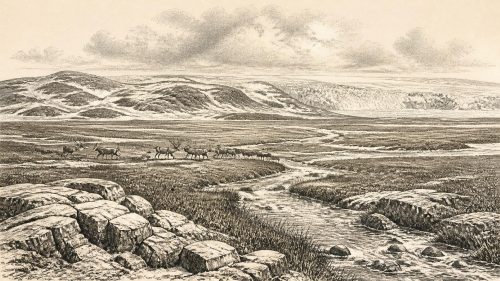
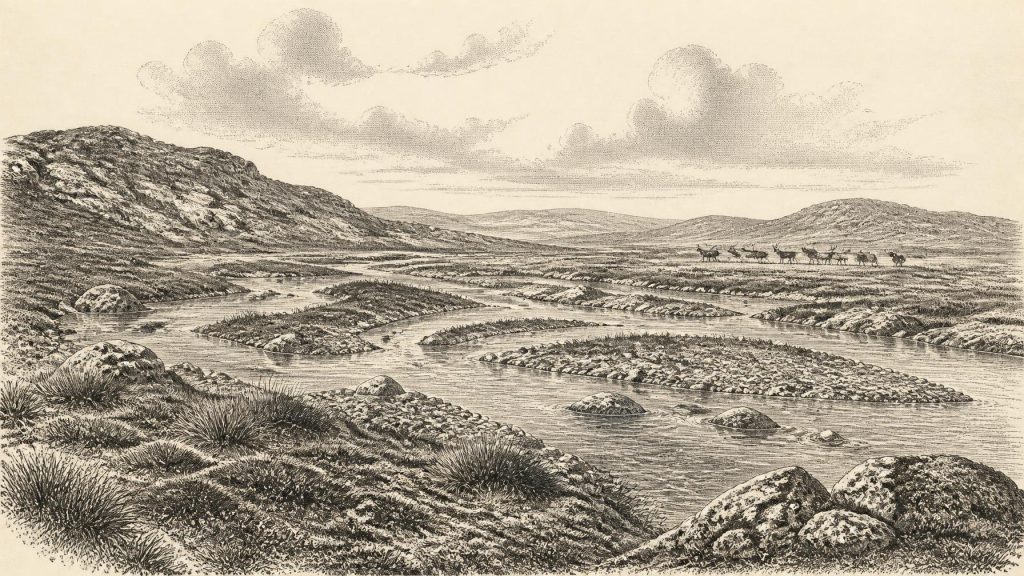
The best direct environmental comparison comes from Derryvree in south Fermanagh. There, freshwater silts and sands preserved beneath later glacial deposits produced a radiocarbon determination of about 30,500 BP, with a substantial error range. The plants and small animals recovered from it indicate a periglacial environment with open tundra vegetation. Mosses and herbaceous plants survived in a landscape where dry ground could be sparsely vegetated; pollen of pine and hazel is interpreted cautiously because it may have travelled long distances rather than proving local woodland.
That evidence cautions against imagining a familiar green Ireland. At this broad stage of the glacial cycle, temperatures were low, seasons severe and trees locally scarce or absent in exposed regions. Frost action, seasonal thaw and sediment movement shaped slopes and valleys. Rivers carried meltwater and sediment, while lakes and wetlands formed in favourable hollows. The coastline was also unlike today’s: global sea level was much lower because vast quantities of water were stored in ice sheets. Yet it would be misleading to draw a fixed shoreline for this single year. Relative sea level around Ireland depended both on global ocean volume and on the changing weight and movement of nearby ice.
Animals in a Connected Landscape
Ireland was not biologically empty. The extraordinarily important cave complex at Castlepook, near Doneraile in County Cork, has yielded the island’s richest assemblage of Late Pleistocene vertebrate remains. Its Ice Age fauna includes woolly mammoth, giant deer, reindeer, brown bear, wolf, Arctic fox and spotted hyena, alongside lemmings and other smaller animals. The assemblage demonstrates that Ireland formed part of a wider north-west European world in which animals could disperse during favourable phases, rather than being an isolated Atlantic refuge throughout the glacial period.
But Castlepook is not a census of one moment. Bone deposits represent repeated episodes, some material was moved by water, and carnivores themselves helped accumulate remains. Recent redating has shown that several specimens once treated as broadly contemporary are older than previously thought. Research has consequently suggested that some animals, including giant deer and spotted hyena, may have disappeared locally before the Last Glacial Maximum. New sedimentary ancient-DNA work strengthens the case for faunal connections between Ireland and Eurasia before that maximum, but it remains a preprint and should be treated as developing evidence. The defensible conclusion is broad: cold-adapted mammals moved through Ireland during parts of this era; it is not possible to assign every species to 31,993 BCE.
No Demonstrated Human Community
There is presently no securely dated settlement, hearth, stone-tool assemblage, human burial or built structure in Ireland that can be assigned to around 31,993 BCE. Accordingly, no political affairs, diplomacy, warfare, trade network, language, religion or local culture can responsibly be described for Irish people in this year. The absence of evidence is especially significant because later glaciation eroded, buried and rearranged much of the earlier landscape. It does not prove that no person ever entered Ireland during the wider Middle or Upper Palaeolithic, but it means that sustained occupation at this date has not been demonstrated.
The earliest published evidence interpreted as human activity in Ireland comes vastly later: cut marks on a brown-bear kneecap from Alice and Gwendoline Cave, County Clare, dated to approximately 10,800–10,500 BCE. That find has transformed discussion of the island’s Late Palaeolithic, though its archaeological context has been carefully re-examined. Clearer, more substantial evidence for settlement belongs to the Mesolithic, beginning around 8000 BCE, with sites such as Mount Sandel in County Londonderry. Even those pioneering hunter-gatherer communities were separated from 31,993 BCE by more than twenty-three millennia of climatic upheaval, ice advance, retreat and changing sea routes.
Claims that humans were present in Ireland around 33,000 years ago require particular restraint. Some recently discussed animal bones from Castlepook may show possible human modification, and work at the cave continues. Possible cut marks or a single altered bone, however, do not establish a settlement, a population, or a year-specific episode. Archaeologists distinguish between a suggestive trace, a reproducible identification of butchery, and a contextualised assemblage of tools, food remains and occupation surfaces. For this year, Ireland’s human story remains unproven rather than merely incomplete.
Society, Economy and Belief: What Cannot Be Claimed
It is tempting to fill this silence with a generic picture of “Ice Age hunters”. That would confuse evidence from continental Europe and Britain with evidence from Ireland. Upper Palaeolithic people elsewhere in Europe made sophisticated stone and bone tools, travelled long distances, hunted and scavenged large animals, created art and maintained social relationships across extensive territories. Such comparisons help explain what human life could have involved at the north-western edge of Europe. They do not show that such people were living on the Irish landmass at this time.
There is likewise no basis for describing Irish houses, clothing, food preparation, exchange, ritual practice or learning in 31,993 BCE. No Irish cave art, portable art, burial, ceremonial deposit or domestic assemblage of this age is known. The cave evidence instead speaks most clearly about animal ecology and geological preservation. Castlepook may at times have been used by hyenas, which helps explain why it contains so many bones; it should not be represented as a human camp without corroborating artefacts and securely associated deposits.
Regional Change and Historical Importance
The great development of this period was environmental instability. Cold open habitats could permit large herbivores and their predators to range across connected territories, while later ice growth would radically reduce habitable ground and reshape drainage, soils and coasts. The eventual maximum of the British-Irish Ice Sheet scoured landscapes and deposited till, moraines and outwash sediments that remain visible in Ireland today. This later glacial transformation also helps explain why evidence for earlier people, if it ever existed, is so elusive.
Thus Ireland in the vicinity of 31,993 BCE should be understood as a changing Pleistocene landscape, not yet a historical society. Fermanagh’s tundra deposits and Cork’s cave fauna offer rare windows onto its plants and animals; glacial research places them within a dynamic North Atlantic climatic system. The most important fact is also the simplest: this was Ireland before demonstrated settlement. Its record is one of environments, animals and geological processes, awaiting further discoveries that may refine the broad ranges but will never turn this modern numbered year into an exact prehistoric anniversary.
Primary Sources
- Growth and Retreat of the Last British–Irish Ice Sheet, 31 000 to 15 000 Years Ago: the BRITICE-CHRONO Reconstruction
- New Data for the Last Glacial Maximum in Great Britain and Ireland
- Dimensions and Chronology of the Last Ice Sheet in Western Ireland
- The Deglaciation of the Western Sector of the Irish Ice Sheet from the Inner Continental Shelf to Its Terrestrial Margin
- Timing and Pace of Ice-Sheet Withdrawal Across the Marine–Terrestrial Transition West of Ireland During the Last Glaciation
- Stratigraphic and Palaeo-Geomorphological Evidence for the Glacial-Deglacial History of the Last British-Irish Ice Sheet in the North-Western Irish Sea
- Ireland: Submerged Prehistoric Sites and Landscapes
- Late Pleistocene Chronostratigraphy and Ice Sheet Limits, Southern Ireland
- Palaeoecology
- Lateglacial Vegetation and Environment in Ireland: First Results from Four Western Sites
- A Reconsideration of the Radiocarbon Dating of the Marine Isotope Stage 3 Fauna from Southern Ireland
- Pleistocene Vertebrates in the British Isles
- Occurrence of Mammalia Relicts at Site Castlepook Cave
- Castlepook Cave
- Castlepook Caves
- Sedimentary Ancient DNA Reveals Late Pleistocene Faunal Connectivity Between Ireland and Eurasia
- First Evidence of a Late Upper Palaeolithic Human Presence in Ireland
- New Insights on the Fauna of Ireland's Younger Dryas and Early Holocene from Alice & Gwendoline Cave
- The Mesolithic in Ireland: When Was It?
- Climate Change and Hunter Gatherers in Ireland: Problems, Potentials and Pressing Research Questions
- Ireland's Palaeolithic Archaeology – Fleeting Footprints in a Frozen Land
- 32564: Castlepook Cave, County Cork
- Learn About: The Ice Age
- Advice to the Public