Doneraile Reindeer Bone31978 BCE
Around 31,978 BCE, Ireland lay in a cold, changing Pleistocene environment before the Last Glacial Maximum, when expanding ice later reshaped much of the island. Evidence is chiefly geological and faunal, with Castlepook Cave near Doneraile providing a significant but uncertain clue to human presence. A reindeer femur, dated roughly 33,000 years ago, bears a possible butchery mark, suggesting intermittent Upper Palaeolithic visitors rather than settlement. Cave remains reveal open tundra-steppe supporting reindeer, giant deer, predators and Arctic mammals. Poor excavation records and disturbed deposits prevent certainty. No camps, tools, hearths, political institutions or specifically Irish cultural practices are known.
Dateline
Modern calendar-year precision cannot be applied to Ireland in 31,978 BCE. The number is a retrospective label, not a date that anyone living then could have recognised, and evidence from this depth of time is normally expressed as calibrated ranges rather than single years. In archaeological terms, this point falls in the later part of the Pleistocene, before the Last Glacial Maximum, during the Upper Palaeolithic world of north-west Europe. For Ireland, it is a period illuminated chiefly by geology, animal remains and a small, contested-looking but important body of evidence from caves. There is no written record, no known settlement, and no secure basis for narrating a year-specific Irish event.
An Island on the Edge of Change
About 34,000 calendar years before present, the land now called Ireland stood in a colder, unstable North Atlantic environment. This was not yet the peak of the last great glaciation. Reconstructions differ in local detail, but they agree that the British–Irish Ice Sheet expanded dramatically afterwards, reaching or approaching its greatest extent between roughly 27,000 and 23,000 calibrated years ago. By the height of that episode, much or perhaps nearly all of Ireland was under ice. In 31,978 BCE, therefore, the central historical fact is not an Irish kingdom, migration or monument, but a changing physical landscape on the threshold of severe glaciation.
That distinction matters. It would be misleading to imagine the whole island as a single, static white wilderness or to project the familiar green Ireland backwards into this period. Ice margins advanced and retreated over long timescales; conditions varied by region, altitude and proximity to the Atlantic. Much of the evidence used to reconstruct this world lies offshore or in landforms shaped and later overprinted by ice: sediment fans, moraines, streamlined terrain, erratic boulders and glacial deposits. These preserve the movements of ice rather than a photograph of one particular year. They nevertheless show that Ireland’s geography, coastlines, drainage and soils were being profoundly prepared by the glacial processes that followed.
Lower global sea levels altered surrounding seaways, but they do not license an easy claim that a permanent, open land bridge joined Ireland to Britain or continental Europe at this precise moment. The Irish Sea basin, ice cover, changing shorelines and routes available to animals and people remain subjects of active reconstruction. What can responsibly be said is that the island’s relation to neighbouring lands was different from today and that animal populations had reached it during favourable phases of the Ice Age. Whether humans travelled by the same routes, and how often, are separate questions.
Castlepook’s Elusive Clue
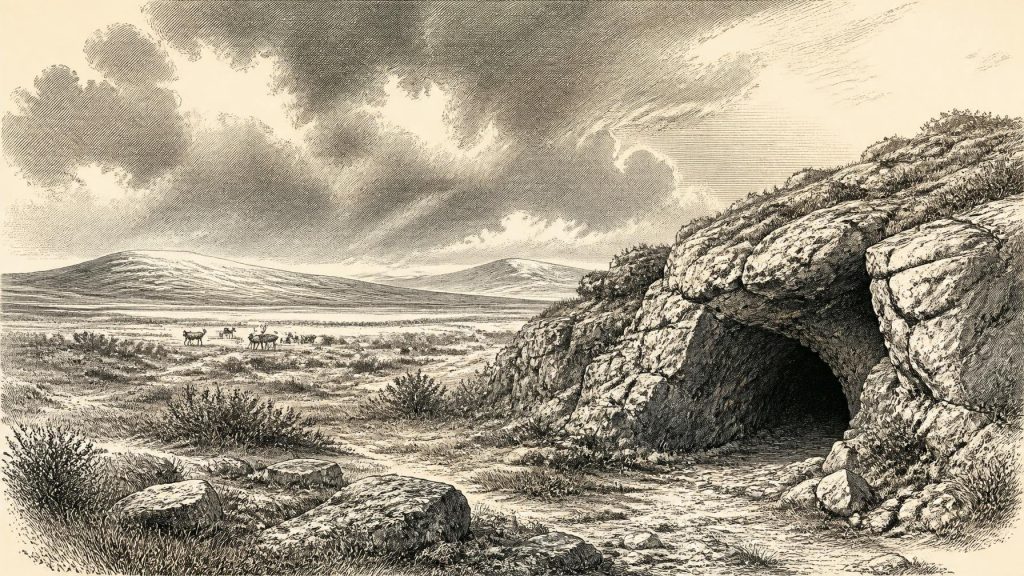
The closest evidence to this nominal year comes from Castlepook Cave near Doneraile, County Cork. Caves there produced a rich collection of Pleistocene animal bones during excavations in the late nineteenth and early twentieth centuries. Modern re-examination and radiocarbon work have shown that some of the fauna are very old, including material from before the Last Glacial Maximum. A reindeer femur has been reported as dating to around 33,000 years ago and bearing a mark interpreted as having been made by a sharp stone tool during butchery. A County Cork heritage publication accordingly places the object broadly around 31,000 BCE, close to the date considered here.
This is potentially momentous evidence, but it must be handled with care. The bone is not a settlement floor with tools, hearths, shelters and securely associated food debris. It derives from an old cave collection whose original excavation methods did not provide the stratigraphic control expected today. Carnivores could drag carcass parts into caves; water and sediment movement can mix deposits; and a cut-like mark requires microscopic and contextual assessment before it can demonstrate human action beyond reasonable doubt. Recent fieldwork at Castlepook has specifically sought intact deposits and clearer archaeological context. Its purpose is not merely to repeat an exciting claim, but to test it.
Thus the reindeer bone is best described as evidence consistent with a possible human visit or butchery episode in pre-glacial Ireland, not proof of a settled Ice Age population. If the modification is confirmed as anthropogenic, it would suggest that Upper Palaeolithic people entered Ireland at least intermittently far earlier than the long-established Mesolithic colonisation. It cannot tell us the visitors’ names, language, group size, season of arrival or length of stay. Nor can it demonstrate uninterrupted ancestry between such visitors and Ireland’s much later inhabitants. The ice advance that followed would have erased landscapes and disrupted any short-lived occupation.
Animals and Open Country
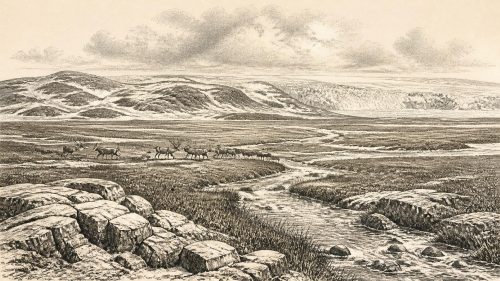
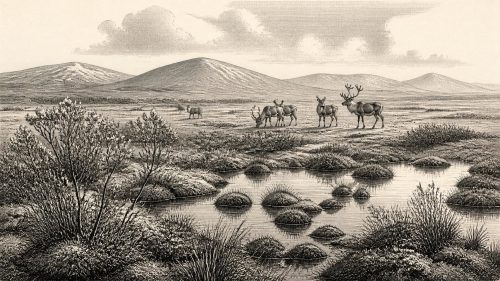
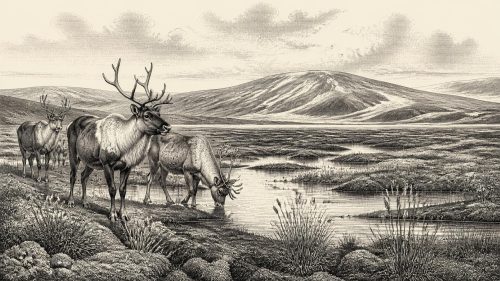
The cave fauna provide the clearest picture of everyday ecology. Castlepook has yielded remains attributed to animals including reindeer, giant deer, brown bear, Arctic fox, wolf, cave hyena, hare, lemming and, in older collections, mammoth. Not every species necessarily lived there at the same time, and not every bone represents a local death. Yet together they show that Ireland could support a cold-stage fauna very unlike that of the modern island. Reindeer are especially important: they indicate open environments capable of sustaining grazing herds, while Arctic small mammals point to severe climatic conditions.
Rather than dense woodland, parts of the landscape would have supported tundra-like or steppe-tundra vegetation: grasses, sedges, herbs, dwarf shrubs and sparse tree cover where conditions allowed. Such country was shaped by cold, wind, seasonal scarcity and mobile animals. Caves were useful traps in the archaeological record because they sheltered and accumulated bone, but that does not mean they were routinely inhabited by people. Indeed, predators may account for much of the assemblage. Hyena, wolf and bear behaviour is central to interpreting what survives. The cave record is a record of ecological interaction, scavenging and natural deposition as much as of human activity.
For a hypothetical visiting human party, reindeer would have been a valuable resource: meat, fat, hide, sinew, antler and bone each had practical potential in Upper Palaeolithic lifeways elsewhere in Europe. But that is an interpretation based on wider comparison, not something directly demonstrated at Castlepook. Ireland has not yielded a securely dated stone-tool assemblage, camp, weapon point or hearth from around 31,978 BCE. The responsible conclusion is narrower: a dated animal bone may preserve a trace of carcass processing, while the wider faunal assemblage establishes a challenging but biologically productive Ice Age setting.
People Without a Society?
No. Even if people did reach Ireland, they had society, knowledge and culture; archaeology simply cannot recover their particular Irish forms from the present evidence. Across Upper Palaeolithic Europe, Homo sapiens groups used sophisticated stone technologies, organised hunting and food sharing, made ornaments and images, and transmitted practical knowledge over generations. It is reasonable to regard any visitors to Ireland as participants in this broad human world. It is not reasonable to assign them a named archaeological culture, a particular tool kit, cave art, burial custom or ethnic identity on Irish evidence alone.
There is consequently no identifiable political affair for this date. No chiefdom, territory, alliance, diplomatic exchange or organised conflict can be demonstrated in Ireland. A cut-marked bone does not reveal a hunting party’s internal leadership, still less warfare. Equally, there is no evidence for a settled economy, farming, markets or long-distance trade on the island. Any people present were most plausibly highly mobile foragers making short, opportunistic use of a changing landscape, but even this is an inference rather than an excavated campsite.
The same restraint applies to religion, culture and learning. There are no known Irish ritual sites, graves, carvings or portable artworks securely dated to this period. The absence is not proof that visitors lacked beliefs, storytelling, ritual or technical expertise; all human groups possess cultural knowledge. It means that no specifically Irish expression can yet be identified. Ireland’s later prehistoric tombs, rock art and farming communities belong tens of millennia in the future and should not be anticipated here.
What This Date Means
31,978 BCE is important because it directs attention to a deep and difficult chapter in Irish history: not an empty preface before “real” settlement, but a landscape where climate, ice, animals and perhaps occasional people interacted. Its evidence is fragmentary precisely because later glaciation remodelled the land and because the most revealing finds often came from antiquarian cave excavations. Re-dating old museum collections, analysing cut marks, mapping caves and searching for undisturbed sediments are therefore historical work of the first importance.
The balanced picture is one of possibility bounded by uncertainty. Ireland around this point may have received Upper Palaeolithic hunters following or exploiting animal resources, as the Castlepook reindeer bone has been interpreted to suggest. It was not, on present evidence, a known permanent homeland with villages, political institutions or a recoverable cultural tradition. Soon afterwards, the expanding ice sheet transformed the stage. The story of this date is ultimately the story of a fleeting human question set against an overwhelming environmental change.
Primary Sources
- A reconsideration of the radiocarbon dating of the Marine Isotope Stage 3 fauna from southern Ireland
- Rewilding the Irish landscape: the role of reintroductions in restoring biodiversity and ecosystem services
- Archaeology Research Excavation Grant 2022: Final Report
- 2022:564 – Castlepook Cave, Castlepook South, Cork
- Heritage Artefacts of County Cork 2021
- First evidence of a Late Upper Palaeolithic human presence in Ireland
- New insights on the fauna of Ireland's Younger Dryas and Early Holocene from Alice & Gwendoline Cave
- Trimlines, blockfields and the vertical extent of the last ice sheet in southern Ireland
- Extent and deglacial chronology of the last British–Irish Ice Sheet: implications of exposure dating using cosmogenic isotopes
- Response of the Irish Ice Sheet to abrupt climate change during the last deglaciation
- Deglaciation chronology of the Donegal Ice Centre, northwest Ireland
- Dimensions and chronology of the last ice sheet in Western Ireland
- Maximum extent and dynamic behaviour of the last British–Irish Ice Sheet west of Ireland
- Anthropogenic changes to the Holocene nitrogen cycle in Ireland
- The Mesolithic in Ireland: when was it?
- The colonization of Ireland: A human ecology perspective
- The Antiquity of Man in Ireland
- A Review of Research Needs in Irish Archaeology
- Archaeological excavations at Killuragh Cave, Co. Limerick
- Growth and retreat of the last British-Irish Ice Sheet, 31,000 to 15,000 years ago