Ice Age Threshold31997 BCE
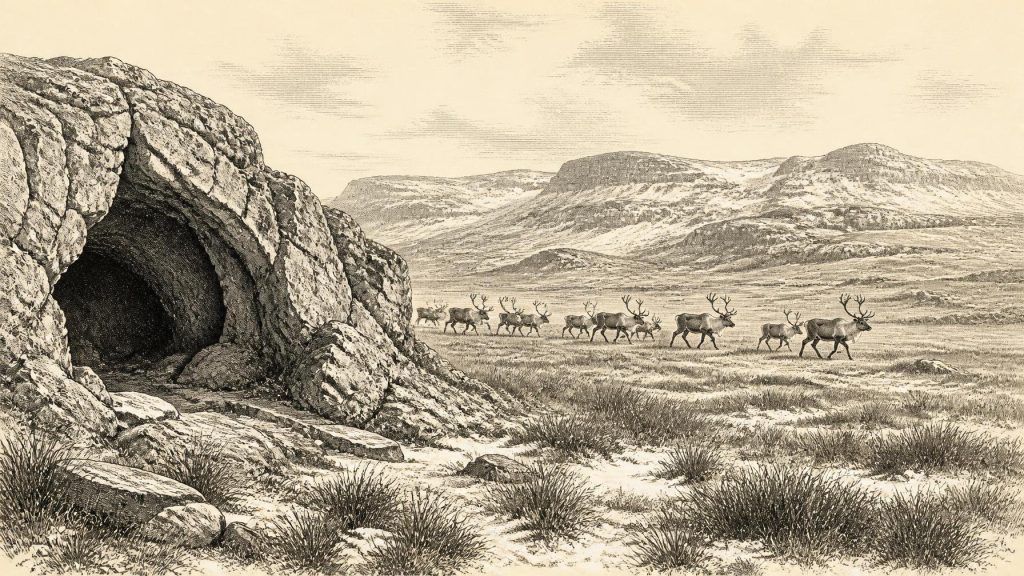
Around 31,997 BCE, Ireland’s history cannot be reconstructed as a dated event, because no written or securely associated archaeological evidence survives. The period, roughly 34,000 years ago, preceded the Last Glacial Maximum and featured changing, regionally variable environments. Castlepook Cave in County Cork preserves remains of reindeer, mammoth, giant deer, bears, wolves and hyenas, indicating productive open habitats. A reported cut mark on a reindeer femur may represent Upper Palaeolithic butchery, but cannot demonstrate permanent settlement or continuous occupation. No tools, hearths, human remains, political structures or cultural traditions are securely known. Ireland’s possible human presence remains tentative and episodic.
Dateline
Modern calendar-year precision cannot be recovered for 31,997 BCE. The label is a retrospective point on a calendar created millennia later, rather than a date that Ice Age people could have recognised or recorded. In archaeological terms, it lies roughly 34,000 years before the 1950 reference point used for radiocarbon dating, within the Upper Palaeolithic and during the long build-up towards the Last Glacial Maximum. The responsible history of Ireland at this point is therefore not a narrative of a particular year, ruler or event. It is a carefully bounded account of a changing Ice Age landscape, its animals, and the very slight, still-developing evidence that people may have reached the island.
A Date Without Annals
There are no written sources, inscriptions, graves, houses, hearths or securely excavated tool assemblages from Ireland that can be assigned to 31,997 BCE. Nor can conventional radiocarbon ages be converted into a single historical year without qualification. Radiocarbon results must be calibrated against changing atmospheric carbon levels, and their outcomes are ranges of probability, not anniversary dates. For this early period, a cautious phrase such as around 34,000 years ago is more meaningful than an apparently exact year.
That caution matters especially in Ireland. The archaeological record has been repeatedly damaged, buried or redistributed by later ice advance, erosion, rising seas and the long history of cave disturbance. What survives is exceptionally uneven. Caves preserve animal bone better than exposed campsites; meanwhile, the most likely open-air places used by mobile hunters may lie beneath later sediments, offshore, or have been removed by glacial action. Absence of a settlement is not proof that no person ever arrived, but it does mean that permanent occupation, population size and duration cannot responsibly be asserted.
Castlepook and a Tentative Human Trace
The closest evidence to this horizon comes from Castlepook Cave near Doneraile in north County Cork, one of Ireland’s most important Ice Age fossil localities. Excavated principally in the late nineteenth and early twentieth centuries, it produced a huge, mixed collection of animal remains. Scientific reassessment has identified a rich pre-Last Glacial Maximum fauna: reindeer, woolly mammoth, giant deer, brown bear, wolf and the island’s only known spotted hyena remains, among others. The cave was not a neat prehistoric floor sealed at one moment in time. Carnivores, water movement, earlier digging and later disturbance all helped create its complicated deposits.
A reindeer femur from Castlepook has been reported as bearing a cut mark consistent with butchery by a sharp stone tool, and has been presented in local heritage research as dating to about 31,000 BCE. If that identification and association are sustained by full specialist publication, it would indicate that people handled a reindeer in Ireland during the Upper Palaeolithic, vastly earlier than the long-established Mesolithic record. It would not, however, prove a village, a continuous population or even that hunters killed the animal at the cave. The bone may have been discarded elsewhere and subsequently dragged into the cave by scavengers. No securely associated stone tools, fire remains or human bones have yet established the character of this possible visit.
The distinction is important. Cut marks are physical evidence on a bone; interpreting them as the work of a travelling hunting party is a reasonable hypothesis, but remains an interpretation. At present, Castlepook offers a promising indication of brief human activity, not a detailed portrait of an Irish Upper Palaeolithic society. Future excavation, microscopic study of bone surfaces, new direct dates and the discovery of artefacts in undisturbed context could substantially alter that judgement.
Land Before the Ice Maximum
Ireland was not yet the familiar green and wooded island. It stood within the Late Pleistocene, an era of pronounced climatic swings. The British–Irish Ice Sheet was growing, but the evidence and ice-sheet modelling show that expansion was regionally asynchronous rather than a single instant when every part of Ireland vanished beneath ice. The greatest extent of the last ice sheet came later, broadly around 26,000–19,000 calendar years ago. Around the notional date of 31,997 BCE, conditions could vary greatly by region, altitude and century; it is misleading to picture either an entirely ice-covered island or a uniformly hospitable plain.
Castlepook’s fauna nevertheless demonstrates that, in suitable intervals before the maximum cold, substantial herbivores and predators lived in, or moved through, parts of Ireland. Reindeer point to open, cold-adapted habitats with grasses, sedges, herbs, mosses and lichens rather than dense forest. Mammoth and giant deer reinforce the image of broad, productive open country in at least some periods, while brown bear, wolves and hyenas reveal a more complex food web. These animals should not be treated as a single snapshot: fossils accumulated over many thousands of years, and each species had its own ecological range. Yet together they overturn an older assumption that Ice Age Ireland was simply empty wilderness.
Sea levels were lower globally because vast quantities of water were held in ice sheets, changing the outlines of the surrounding shelf and coastal plains. But the precise practical routes between Ireland, Britain and continental Europe remain disputed, because ice cover, relative sea level, islands, channels and shorelines changed rapidly. It is safest not to imagine a straightforward dry road into Ireland. Any people represented by the Castlepook bone may have crossed a variable northern and western seaway or an ice-influenced landscape; the available evidence cannot choose confidently between routes.
People, If Present
If people did reach Ireland around this broad timeframe, they belonged to the wider world of Upper Palaeolithic hunter-gatherers, not to a known Irish tribe, kingdom or later ethnic community. There is no evidence from Ireland for an Aurignacian or Gravettian tool industry, language, personal name, artistic tradition or ancestry at this date. Such labels describe archaeological traditions recognised elsewhere in Europe; applying one to Ireland without diagnostic tools would turn possibility into fiction.
The reindeer evidence permits only modest inferences about everyday practice. Butchery implies knowledge of animal anatomy, cutting tools and the value of meat, hide, sinew, marrow and bone. A hunting party operating in a cold, open landscape would have needed portable clothing, effective shelters and close co-operation, as comparable Upper Palaeolithic groups elsewhere did. None of those items has been recovered from Ireland for this period, so they describe general human requirements rather than excavated Irish possessions. Nor is there evidence that people exploited mammoth, giant deer or hyena at Castlepook; their bones document fauna, not necessarily human prey.
No Politics, No Monuments
Political affairs, diplomacy and warfare cannot be reconstructed for 31,997 BCE. Those terms presume institutions, territories and relationships for which there is no Irish evidence. A small, seasonal party might have shared food, labour and knowledge, and may have moved within wider kin networks beyond the island, but this is an inference from hunter-gatherer lifeways rather than a documented Irish social order. There are likewise no grounds for identifying chiefs, alliances, territorial boundaries or conflicts.
Religion and culture are equally beyond direct recovery. Ireland has no securely dated Upper Palaeolithic cave art, carved object, burial or ritual feature from this horizon. Caves can acquire spiritual significance in many societies, but Castlepook’s role as a bone repository does not make it a shrine. The most striking cultural fact is instead methodological: early excavators collected remarkable material, but their techniques did not provide the stratigraphic control expected today. Modern archaeologists, zooarchaeologists and geochronologists are extracting new history from those legacy collections while being frank about their limits.
Economy and Settlement
There was no farming, herding, metalworking, pottery production, market exchange or permanent settlement evidenced in Ireland at this date. If humans were present, their economy was foraging: hunting and processing wild animals, supplemented in principle by whatever plant, bird, fish or small-game resources the local season offered. The direct Irish evidence supports only the possibility of reindeer butchery. It cannot tell us whether people stayed for hours, days or a season, how many came, or whether they returned.
This makes 31,997 BCE a threshold rather than a foundation year. It belongs before the later climatic deterioration that would cover much of Ireland with ice, and tens of millennia before the clear post-glacial settlement record, including the Mesolithic site at Mount Sandel. Its importance lies in recognising that the deep history of people in Ireland may be older and more episodic than once thought. The evidence is tantalising but narrow: a landscape inhabited by Ice Age animals, and a single reported human modification that invites further investigation rather than final certainty.
Primary Sources
- First Evidence of a Late Upper Palaeolithic Human Presence in Ireland
- New Insights on the Fauna of Ireland’s Younger Dryas and Early Holocene from Alice & Gwendoline Cave
- Revisiting Alice and Gwendoline Cave, Co. Clare: New Light on the 1902 Excavations
- The Irish Quaternary Fauna Project
- Castlepook Cave: County Geological Site Report
- Heritage Artefacts of County Cork 2021
- 2022:564 – Castlepook Cave, Castlepook South, Cork
- Archaeology Research Excavation Grant 2022: Final Report
- Growth and Retreat of the Last British–Irish Ice Sheet, 31,000 to 15,000 Years Ago: The BRITICE-CHRONO Reconstruction
- Behavioural Tendencies of the Last British–Irish Ice Sheet Revealed by Data–Model Comparison
- Maximum Extent and Dynamic Behaviour of the Last British–Irish Ice Sheet West of Ireland
- Dimensions and Chronology of the Last Ice Sheet in Western Ireland
- The Island of Ireland: Drowning the Myth of an Irish Land-Bridge?
- The Problem of a Late Quaternary Landbridge Between Britain and Ireland
- Deglaciation, Earth Crustal Behaviour and Sea-Level Changes in the Determination of Insularity: A Perspective from Ireland
- The Colonization of Ireland: A Human Ecology Perspective
- Prehistoric Details: Mell Flint Flake
- Learn About: The Ice Age
- Ice Age Ireland: Cool Fossils!
- Ice Age Ireland: Woolly Mammoth Activity Sheet