Cork Reindeer Butchery31995 BCE
Although labelled 31,995 BCE, this period cannot be tied to an Irish event. Around 34,000 years ago, during Marine Isotope Stage 3, Ireland contained cold open landscapes and diverse fauna before the Last Glacial Maximum. Castlepook Cave, County Cork, preserves bones of reindeer, mammoth, giant deer and predators. A reindeer bone reportedly bearing stone-tool butchery marks offers possible evidence of brief Upper Palaeolithic human activity, but not permanent settlement. Deposits, dates and marks remain uncertain because caves were disturbed and later glaciation damaged evidence. No associated tools, hearths or cultural remains establish communities, trade, politics, or continuity with later populations.

Dateline
“31,995 BCE” is a modern calendar label, not a date at which archaeology can identify an event in Ireland. There are no written records, named people, political communities or year-by-year chronologies for this depth of time. In radiocarbon and environmental terms, the label falls broadly around 34,000 years before present, within the Late Pleistocene and the Middle Upper Palaeolithic of north-west Europe. Any responsible account must therefore use ranges, deposits and individual specimens rather than pretend that a particular winter, journey or killing happened in this numbered year.
That caution matters especially in Ireland. The island’s archaeological record for this period is exceptionally thin, much of it disturbed by later ice, erosion and nineteenth- or early twentieth-century cave excavation. Yet a small body of faunal evidence, above all from Castlepook Cave near Doneraile in north County Cork, shows that parts of Ireland supported Ice Age animals during Marine Isotope Stage 3, before the Last Glacial Maximum. A reindeer bone from the Castlepook collection has been reported as bearing marks consistent with stone-tool butchery and as dating to about 33,000 years ago. It is an important claim, but it is not a fully excavated habitation floor with tools, hearths and human remains. It is best treated as evidence for a possible brief human presence or animal processing episode, not proof of a permanent Irish population or a settled community in 31,995 BCE.
Dating a Deep Past
The apparent precision of 31,995 BCE can be misleading. Archaeologists normally date this era in radiocarbon years before present (BP, where “present” is conventionally 1950), then calibrate those measurements against independent records of past atmospheric carbon. A radiocarbon result is not automatically a calendar date: calibration can produce a range, sometimes a broad or discontinuous one. The most secure chronological language for Ireland at this point is consequently “about 34,000 years ago” or “during MIS 3”, not an exact annual anniversary.
There is a further distinction between the date of a bone and the date of human activity. A radiocarbon assay establishes when the animal died, within statistical limits; it does not by itself establish who handled it, where it was killed, or whether people lived nearby. Cut, chop or percussion marks may support an interpretation of butchery when their form and placement are persuasive, but cave deposits can be mixed by scavengers, water, sediment movement and excavation. Improved pretreatment and redating of bones from Castlepook and other southern Irish caves have substantially revised earlier results, in some cases making them thousands of radiocarbon years older. That is a reminder that the chronology is advancing, not closed.
An Ice Age Landscape, Not Yet the Maximum
At about 34,000 years ago Ireland was in the last glacial cycle, but it was not necessarily under a uniform, island-wide sheet of ice at every moment. The maximum expansion of the last British–Irish Ice Sheet came later, broadly between about 27,000 and 20,000 calendar years ago, with considerable regional variation in advance and retreat. Research on southern Ireland indicates that parts of the south coast remained ice-free until an advance after about 24,200 calibrated years BP. It follows that the Irish landscape around the date considered here cannot simply be imagined as a featureless white cap. Conditions changed sharply through time and differed between uplands, coasts and lowlands.
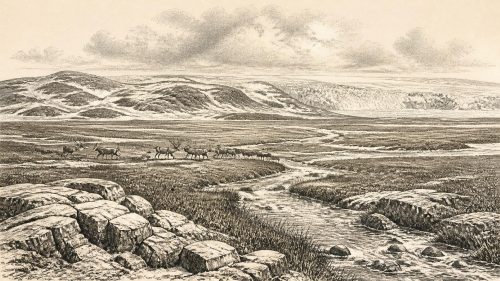
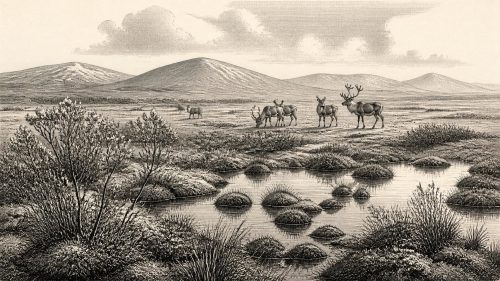
Where ground was exposed, the climate was cold and unstable by modern standards. Open vegetation, rather than the familiar Irish patchwork of woodland, pasture and fields, is the safest broad reconstruction. Grassland, herb-rich steppe-tundra and sparse shrub cover would have provided grazing and browsing, while frost, wind and seasonal scarcity shaped animal and human movement. Rivers carried sediment across valleys; sea level was far lower because vast quantities of water were locked in continental ice. Coastlines and the Irish Sea basin therefore looked very different, although lowered seas did not automatically create an easy, continuous dry route between Ireland and Britain at every stage.
Glacial action is itself part of the historical legacy of this period. Later ice eroded older surfaces, reworked sediment and removed or buried many sites that might otherwise have preserved camps, tools or bones. The scarcity of evidence is thus not evidence that nothing happened. It means that archaeology is working with a damaged and uneven archive. Caves, where bone can be protected from weathering, and offshore sediments, where ice-sheet movements can be reconstructed, are unusually valuable windows onto this lost world.
Castlepook and the Animals of Ireland
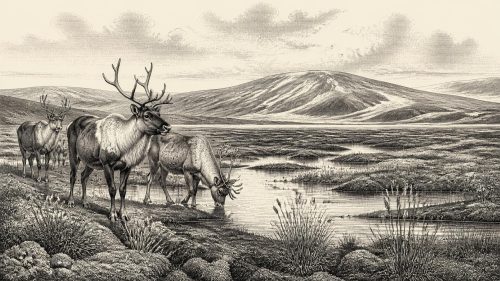
Castlepook Cave is central because it has yielded a rich assemblage from old excavations: remains attributed to woolly mammoth, reindeer, giant deer, brown bear, wolf, Arctic fox, hare, lemmings and spotted hyaena, among others. Not all of those remains belong to one moment, and not all are equally well dated. Nonetheless, red deer from Shandon and Ballynamintra caves have produced pre-Last Glacial Maximum calibrated ranges of about 32,930–29,594 cal BP, while reassessment of southern cave faunas points to a more substantial MIS 3 animal presence than older dating programmes had indicated. Ireland at this time was ecologically connected, at least intermittently, to wider north-west European faunal worlds.
The dramatic names need careful handling. “Irish elk” is the traditional name for Megaloceros giganteus, giant deer, an extinct Eurasian species rather than a species unique to Ireland; woolly mammoth and spotted hyaena likewise belong to a wider Pleistocene fauna. Their bones demonstrate that suitable habitats and movement routes existed at some points in the glacial cycle. They do not establish a single harmonious herd roaming every Irish county in 31,995 BCE. A cave bone assemblage may reflect animals that died naturally, were dragged in by carnivores, used a cave as shelter, or were deposited over many millennia.
Predators and scavengers are especially significant. Hyaena activity can accumulate and modify bones, creating deposits that may look superficially like the debris of a human meal. That makes the reported marks on the Castlepook reindeer femur consequential: if securely anthropogenic, they indicate skilled use of a sharp stone edge on fresh carcass tissue. If future study revises that judgement, the wider faunal evidence will remain, but the human story will become less certain. The difference is fundamental. The animals are directly evidenced; the exact nature, duration and frequency of human visits remain interpretation.
People: A Fleeting Possibility
If the Castlepook marks were made by people, the most economical interpretation is not a village but a small, mobile Upper Palaeolithic foraging party. Across north-west Europe before the Last Glacial Maximum, modern human occupation was generally sparse and often focused on landscapes that offered predictable game, stone, shelter and routes of movement. Reindeer could provide meat, marrow, fat, hides, sinew, antler and bone. A femur carrying butchery marks would fit carcass processing, perhaps after a hunt or after recovering an animal killed elsewhere. It cannot tell us whether the hunters arrived by sea, crossed temporary exposed landscapes, or made a longer stay in the region.
No securely associated lithic assemblage, hearth, dwelling, burial, personal ornament or rock art currently allows us to describe their language, kin groups, clothing, ritual practices or social rank in Ireland. It would be wrong to transfer the cave art, grave customs or elaborate ornaments known from other European Upper Palaeolithic regions directly onto Castlepook. Comparisons can suggest what was possible for contemporary hunter-gatherers, but they are not evidence that Ireland possessed the same traditions. Nor is there evidence here for farming, herding, pottery, metalworking, monuments, territorial states or named peoples.
For the same reason, political affairs, diplomacy and organised warfare cannot be recovered for Ireland in this year. There is no evidence for polities to negotiate, borders to defend or leaders to identify. Small foraging groups elsewhere could have maintained social networks over wide areas, exchanged knowledge and moved with seasons and prey; but in an Irish context at this date even that is an inference, not a documented fact. The most that can responsibly be said is that human survival, if people were present, depended on co-operation, knowledge of animals and landscapes, and flexible responses to climate.
Economy Without Agriculture
The economy suggested by the evidence is one of wild resources, not production. Reindeer is the only animal directly implicated in the reported human modification at Castlepook, so it should take precedence over a generic catalogue of Ice Age hunting. The marks may indicate the removal of meat or other soft tissues. Bone-breaking for marrow, hide-working, antler preparation and transport of selected carcass parts are all plausible Upper Palaeolithic activities, but none has yet been demonstrated from an undisturbed Irish assemblage of this age.
Trade, in the later sense of regular exchange between communities, is equally invisible. A future discovery of imported stone raw material or a recognisable tool tradition might illuminate routes and contacts, but no such evidence is presently tied securely to this horizon in Ireland. The low sea levels of the glacial world altered distances and coastlines, yet water crossings, islands, ice margins and shifting channels still mattered. Ireland’s position at Europe’s north-western edge may help explain why evidence of occupation is so rare compared with Britain, northern France or Belgium, where Upper Palaeolithic sites are better represented.
What This Year Can Mean
The importance of 31,995 BCE is therefore not an event but a question. Ireland was an Ice Age land with an animal community far richer and stranger than the later historical fauna. Some areas could sustain reindeer, mammoth and carnivores before the last ice sheet reached its greatest extent. Castlepook Cave offers a tantalising indication that people may have entered that world and butchered reindeer there or nearby. But the evidence does not yet reveal a continuous human settlement, a culture name securely rooted in Ireland, or an ancestral line leading straightforwardly to later Irish populations.
That uncertainty is not a failure of history; it is the history. Each re-dated bone, microscopic study of a surface, carefully excavated cave sediment and reconstruction of an ice margin has the potential to alter the picture. Around 31,995 BCE, Ireland should be understood as a changing northern landscape at the edge of human and animal ranges: inhabited certainly by Ice Age fauna, possibly visited by Upper Palaeolithic people, and still awaiting the discoveries that could turn a fleeting footprint into a clearer human story.
Primary Sources
- A Reconsideration of the Radiocarbon Dating of the Marine Isotope Stage 3 Fauna from Southern Ireland
- New Insights on the Fauna of Ireland's Younger Dryas and Early Holocene from Alice & Gwendoline Cave
- The Irish Quaternary Fauna Project
- Growth and Retreat of the Last British–Irish Ice Sheet, 31,000 to 15,000 Years Ago: the BRITICE-CHRONO Reconstruction
- Late Pleistocene Chronostratigraphy and Ice Sheet Limits, Southern Ireland
- Response of the Irish Ice Sheet to Abrupt Climate Change During the Last Deglaciation
- Maximum Extent and Readvance Dynamics of the Irish Sea Ice Stream and Irish Sea Glacier Since the Last Glacial Maximum
- Maximum Extent and Dynamic Behaviour of the Last British–Irish Ice Sheet West of Ireland
- Landform Modification by Palaeo-Ice Streams in East-Central Ireland
- Dimensions and Chronology of the Last Ice Sheet in Western Ireland
- Phylogeographic, Ancient DNA, Fossil and Morphometric Analyses Reveal Ancient and Modern Introductions of a Large Mammal: the Complex Case of Red Deer in Ireland
- Palaeobiology of an Extinct Ice Age Mammal: Stable Isotope and Cementum Analysis of Giant Deer Teeth
- Terra Incognita: The Palaeolithic Record of Northwest Europe and the Information Potential of the Southern North Sea
- The Southern North Sea and the Human Occupation of Northwest Europe After the Last Glacial Maximum
- A North-Western Habitat: the Paleoethology and Colonisation of a European Peninsula
- Ireland's Palaeolithic Archaeology – Fleeting Footprints in a Frozen Land
- 2022:564 – Castlepook Cave, Castlepook South, Cork
- Prehistoric Details: Stone Age
- The Mesolithic in Ireland: When Was It?
- Geology of Ireland
- Heritage Artefacts of County Cork
- Archaeological Impact Assessment: Gortnahomna More, Castlemartyr, County Cork