Castlepook’s Pleistocene Fauna31990 BCE
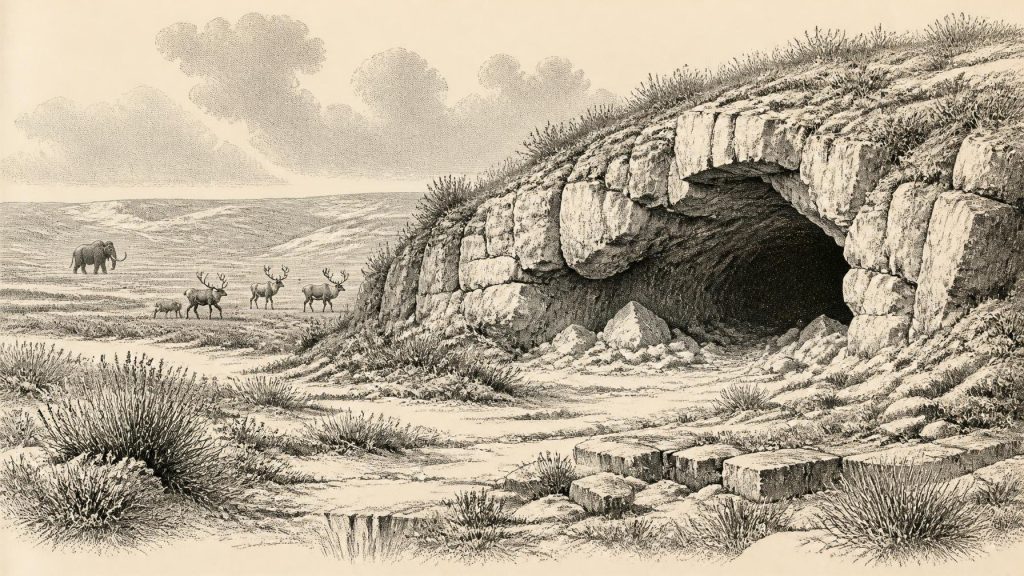
31,990 BCE is an imprecise modern label for Ireland during Marine Isotope Stage 3, as no annual chronology or written evidence exists. Approaching the Last Glacial Maximum, Ireland experienced worsening, variable cold conditions, altered coastlines and uncertain land connections. Castlepook Cave in County Cork preserves Ireland’s richest pre-glacial vertebrate assemblage, including mammoth, giant deer, reindeer, bear and hyaena, accumulated across millennia. A possibly butchered reindeer bone may indicate a human visit around 33,000 years ago, but remains unconfirmed. No secure settlement or occupation is known. Glaciation and sea-level change destroyed evidence; firm colonisation occurred much later, during the Mesolithic period.
Dateline
“31,990 BCE” is a modern calendar label, not a date at which an Irish event can be placed. No written record, settlement sequence or annually resolved chronology exists for Ireland at this depth of time. In archaeological terms, the label points only broadly to the middle of the Late Pleistocene, within Marine Isotope Stage 3 (MIS 3), roughly 57,000–29,000 years ago. Calendar conversion is itself approximate: radiocarbon results require calibration, and calibrated age ranges—not a single BCE year—are the responsible language for this period. The question is therefore not what happened in Ireland in one numbered year, but what the fragmentary evidence permits us to say about the island and its inhabitants, if any, around the equivalent of about 34,000 calibrated years before present.
An Island on the Edge
Ireland then lay at the far north-western edge of the European world. It was not yet in the full Last Glacial Maximum, conventionally dated to about 26,500–19,000 years ago, when an Irish sector of the British–Irish Ice Sheet covered the island and much of its surrounding shelf. Ice-sheet reconstructions instead indicate a complex, uneven build-up: the wider ice sheet expanded rapidly between roughly 31,000 and 26,000 years ago, while different regions reached their maxima at different times. It would be unsafe to draw a sharp ice margin across a map for 31,990 BCE. Nevertheless, the date belongs to the climatic deterioration before the maximum glaciation, when northern environments were becoming more severe and ice was an increasingly decisive force in shaping the region.
The familiar outline of modern Ireland is also an unreliable guide. Sea level was much lower globally because enormous quantities of water were locked in ice. Continental shelves now beneath the Atlantic, Celtic Sea and Irish Sea were exposed or differently configured, while crustal movement under the changing weight of ice complicates every reconstruction of former coasts. Ireland’s precise connection or separation from neighbouring land at this early point remains a matter for palaeogeographical reconstruction, not an assumption that can be read from a modern map. What is clear is that its western location made it ecologically peripheral: any animals or people reaching the landmass had done so within a changing northern European landscape, whose routes, shorelines and barriers repeatedly altered over millennia.
Castlepook and the Animal Record
The strongest evidence relevant to this date comes from caves rather than settlements, above all Castlepook Cave—also called Mammoth Cave—near Doneraile in north County Cork. Excavations undertaken mainly between 1904 and 1918 produced more than 2,000 animal bones, later supplemented by radiocarbon programmes and renewed investigation. Geological Survey Ireland describes Castlepook as Ireland’s richest known site for vertebrate fauna in the period before the Last Glacial Maximum. Individual dated bones span a very long interval, approximately 45,700–19,950 years before present. That range is a warning as well as an opportunity: the cave preserves a time-depth, not a single frozen moment.
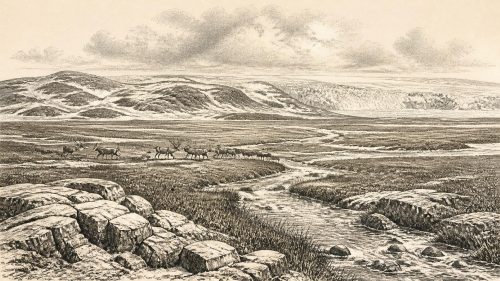
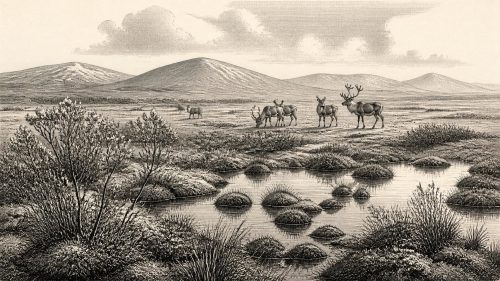
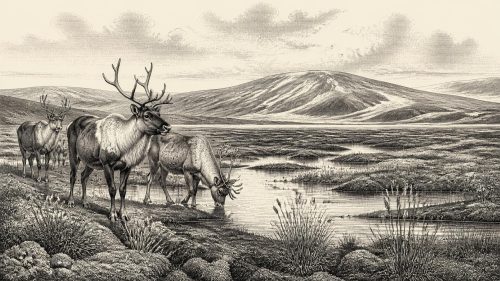
Its assemblage demonstrates that animals associated with Ice Age environments reached Ireland during the wider period. Recorded species include woolly mammoth, giant deer (Megaloceros giganteus), reindeer, brown bear and spotted hyaena; later cold-stage deposits include Arctic fox, wolf, mountain hare and lemmings. The giant deer is often called the “Irish elk”, but it was neither confined to Ireland nor closely related to living elk. These animals do not license a cinematic reconstruction in which every species grazes together outside Castlepook on one day. Some bones may be separated by thousands of years; carnivores, water movement and early excavation methods affected how remains accumulated. But they do establish the broad fact that, before the final ice-sheet maximum, southern Ireland could support or receive a varied cold-climate mammal fauna.
The cave itself was not necessarily a human dwelling. Spotted hyaenas were important bone accumulators, and the site’s deposits were disturbed by water as well as by antiquarian excavation. Re-dating has shown that older radiocarbon determinations from southern Irish caves can require substantial revision, sometimes by thousands of radiocarbon years. Such findings make Castlepook exceptionally important for reconstructing Irish Pleistocene ecology, but they also require restraint. A bone date tells us when an animal lived or died; it does not, by itself, prove when the bone entered a chamber, which predator moved it, or whether people were present.
Were People Here?
This is the central uncertainty. A reindeer femur fragment from Castlepook has been publicised as bearing chop marks consistent with butchery by a stone tool and as dating to roughly 33,000 years ago. If that interpretation is confirmed, it would place a human incursion into Ireland in the general era addressed by this article and far earlier than the traditionally accepted evidence. It would not prove a permanent population, a village or a lasting line of descent; it could represent a short visit by a very small hunting party. The find deserves attention precisely because it is potentially transformative.
Potential is not the same as consensus. Castlepook’s relevant material derives from old excavations with compromised contextual information, and recent project reporting has stressed that no stone or bone tool can yet be identified with certainty as human-made. The National Museum of Ireland likewise continues to state that no clear evidence has emerged for human presence in Ireland during the Palaeolithic. In contrast, the more securely argued evidence for a late Upper Palaeolithic human visit is a cut-marked brown-bear kneecap from Alice and Gwendoline Cave in County Clare, calibrated to about 12,800–12,600 years ago—more than nineteen millennia later than the nominal year considered here. Responsible history must therefore distinguish a dated animal bone with a proposed human modification from demonstrated occupation.
Life Beyond the Evidence
Because no secure camp, hearth, tool assemblage, human burial or dwelling is known from Ireland around this time, there is no evidential basis for describing an Irish population’s family life, language, dress, seasonal round, artistic practice or foodways. Nor can political affairs be recovered. There were no states, named peoples, rulers, treaties or frontiers in the historical sense that can be attributed to Ireland in 31,990 BCE. Conflict and diplomacy are equally invisible. It would be misleading to supply them merely because hunter-gatherer societies elsewhere in Europe possessed social networks, traditions and rivalries.
A cautious comparison can still provide context, provided it is labelled as comparison rather than Irish fact. Elsewhere in north-western Europe, Upper Palaeolithic Homo sapiens groups lived by flexible hunting, gathering and movement through seasonal landscapes; animal hides, wood, bone and stone were important materials. They had sophisticated cultural lives, including personal ornament and art in some regions. Yet no securely dated Irish artefacts tie Castlepook to a particular technological tradition, and no Irish cave art, structured hearth or worked stone implements of this age has been established. The culture and learning of any visitors to Ireland remain unknown, not primitive or absent by default.
Economy and trade must be treated with the same discipline. The Castlepook fauna implies ecological movement and possible predation, not exchange. If humans did reach Ireland, they may have travelled from Britain or the European mainland by routes now transformed or submerged, but neither the route, technology nor frequency of contact is demonstrated for this early period. Later evidence shows that Mesolithic settlers reached an island by sea and that movement across water was possible in prehistoric north-west Europe. That later achievement cannot simply be projected backwards by more than 20,000 years. Around 31,990 BCE, the safe conclusion is that the evidence does not yet reveal an Irish trade network or a settled maritime community.
Landscape, Change and Loss
The environmental story is more substantial than the human one. Ireland was undergoing the long climatic transition towards the Last Glacial Maximum. Periglacial processes—repeated freezing and thawing, sparse vegetation, exposed ground and severe winters—would have affected soils, slopes and watercourses. The mammal record indicates landscapes capable, at intervals, of supporting grazing and browsing animals as well as large carnivores. It does not support the image of a uniformly forested island, nor that of an unbroken desert of ice at every moment. Conditions varied by region, altitude, season and climatic oscillation; southern cave deposits offer only a partial window onto a much larger landmass.
Regional change would soon become overwhelming. As ice expanded, it eroded and buried earlier surfaces, while later sea-level rise drowned many lowland and coastal landscapes where people, if present, might once have left traces. This helps explain the contrast between Ireland’s exceptionally sparse Palaeolithic record and Britain’s much richer one. Glacial destruction and submerged landscapes are important explanations, but not complete ones: scholars also point to Ireland’s peripheral position and a comparatively restricted animal resource base. Absence of evidence cannot prove absence of people, but neither can it be converted into a settled Ice Age population.
What This Year Can Mean
For Ireland, 31,990 BCE is best understood as a threshold of possibility rather than a chapter of documented human history. The land was part of a changing Ice Age world, inhabited at least intermittently by a striking fauna and approaching a period of major glaciation. Castlepook Cave preserves rare evidence of that world, especially in County Cork, while its proposed butchered reindeer bone keeps open the prospect of an early human visit. But archaeology has not yet demonstrated a community, settlement or continuous occupation at this date. The first incontrovertible large-scale colonisation belongs much later, in the Mesolithic, with Mount Sandel dated to around 9,800 calibrated years before present. The most honest account of 31,990 BCE is therefore one of deep environmental history, difficult evidence and questions still being tested.
Primary Sources
- A Reconsideration of the Radiocarbon Dating of the Marine Isotope Stage 3 Fauna from Southern Ireland
- The Irish Quaternary Fauna Project
- Phylogeographic, Ancient DNA, Fossil and Morphometric Analyses Reveal Ancient and Modern Introductions of a Large Mammal: The Complex Case of Red Deer (Cervus elaphus) in Ireland
- First Evidence of a Late Upper Palaeolithic Human Presence in Ireland
- New Insights on the Fauna of Ireland's Younger Dryas and Early Holocene from Alice & Gwendoline Cave
- Growth and Retreat of the Last British–Irish Ice Sheet, 31,000 to 15,000 Years Ago: the BRITICE-CHRONO Reconstruction
- Trimlines, Blockfields and the Vertical Extent of the Last Ice Sheet in Southern Ireland
- Maximum Extent and Dynamic Behaviour of the Last British–Irish Ice Sheet West of Ireland
- Stratigraphic and Palaeo-Geomorphological Evidence for the Glacial-Deglacial History of the Last British-Irish Ice Sheet in the North-Western Irish Sea
- The Colonization of Ireland: A Human Ecology Perspective
- The Mesolithic in Ireland: When Was It?
- Ireland: Submerged Prehistoric Sites and Landscapes
- Ireland: Submerged Prehistoric Sites and Landscapes
- Prehistoric Details
- Castlepook Cave
- 2022:564 – Castlepook Cave, Castlepook South, Cork
- Archaeology Research Excavation Grant 2022: Castlepook Caves Project Final Report
- The Dungarvan Valley Caves Project First Interim Report
- The Antiquity of Man in Ireland
- The IntCal20 Northern Hemisphere Radiocarbon Age Calibration Curve (0–55 cal kBP)
- Composition and Consequences of the IntCal20 Radiocarbon Calibration Curve
- Pleistocene Vertebrates in the British Isles