Ice-Age Threshold31983 BCE
About 31,983 BCE, Ireland lay in the later Marine Isotope Stage 3, a cold, variable period before the Last Glacial Maximum, rather than beneath uniform ice. Castlepook Cave in County Cork preserves mixed, imperfectly excavated animal remains including reindeer, mammoth, giant deer, predators and Arctic species, demonstrating an Ice-Age fauna. Revised dating places some bones in this era. Cut marks on a reindeer femur may indicate stone-tool butchery and intermittent human presence around 33,000 years ago, but prove neither settlement nor society. Subsequent glaciation and rising seas obscured evidence; sustained settlement is documented only much later, at Mesolithic Mount Sandel.

Dateline
A Date Without a Year
“31,983 BCE” is a useful modern label, not a date that people or landscapes in prehistoric Ireland could have recognised. At so great a distance, archaeology cannot identify a particular season, event or community in one named calendar year. The label corresponds only approximately to about 34,000 years before AD 1950, the conventional reference point used in radiocarbon work; it must not be treated as a precisely calibrated archaeological timestamp. The responsible scale is therefore a broad one: later Marine Isotope Stage 3, within the Last Glacial Period, and several millennia before the climatic nadir conventionally called the Last Glacial Maximum. The available evidence is uneven, mostly environmental or animal-bone evidence, and comes chiefly from caves in southern Ireland rather than from settlements.
This uncertainty matters. Ireland has no excavated village, graveyard, tool-making floor or monument securely dated to this notional year. There are no names, rulers, polities, religious rites, treaties or battles. Indeed, there is no evidence for a permanent human population. What can be investigated is the physical Ireland through which animals moved, the changing climatic setting, and one unusually important but limited clue that people may have reached the island intermittently: a reindeer bone from Castlepook Cave in north County Cork reported to bear fresh-bone cuts consistent with stone-tool butchery.
Before the Glacial Maximum
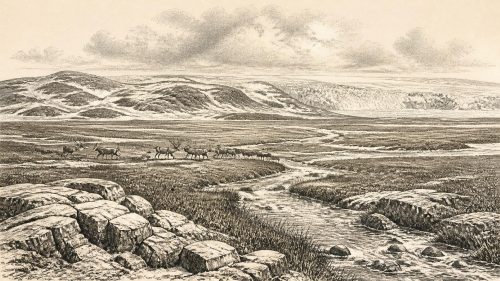
Ireland at roughly this time was not yet the uniformly ice-covered island of the later Last Glacial Maximum. Reconstructions differ in local detail, especially over high ground and the south-west, but they agree that the major ice-sheet maximum lay later, broadly between about 26,500 and 19,000 years ago. Studies of the Irish Ice Sheet show both the scale of later glaciation and the complexity of its growth, with some uplands possibly retaining cold-based ice or standing above erosive ice at different moments. It would therefore be misleading to picture 31,983 BCE simply as an endless white ice cap, yet equally misleading to imagine a modern green Ireland.
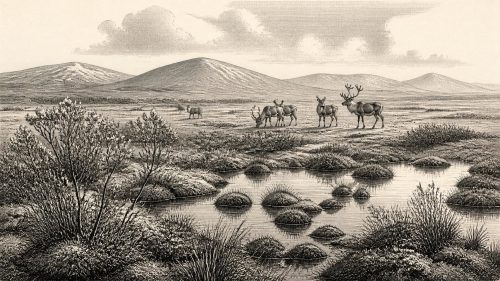
Instead, the best-supported picture is of a cold, unstable Ice-Age environment. During milder intervals of Marine Isotope Stage 3, open grassland, herb-rich steppe-tundra, patches of scrub and exposed ground could support large grazing animals. Conditions changed repeatedly over centuries and millennia, and a cave collection cannot produce a single island-wide weather report. The word “landscape” should also be used cautiously: later glaciers eroded, transported and redeposited vast quantities of material, so much of the terrain visible today is the outcome of ice advances after this period. Drumlins, eskers, glacially scoured valleys and widespread tills are legacies principally of those later stages.
Castlepook’s Fragmentary Record
The strongest directly relevant archive is Castlepook Cave near Doneraile, County Cork. Excavations undertaken in the early twentieth century recovered a very large mixed collection of animal remains from the limestone cave system. Much material was lost, and the original digging methods did not meet modern archaeological standards of recording. This is crucial: individual bones can now be directly dated, identified and examined microscopically, but the collection does not represent a carefully excavated, intact occupation layer. Bones of different ages, animals and depositional histories may have been brought together in the same cave passages.
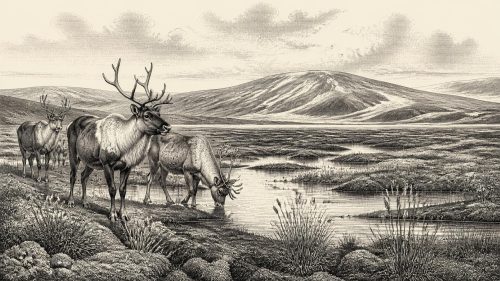
Even with that limitation, Castlepook demonstrates that Ice-Age Ireland supported a markedly different fauna. The cave’s dated and identified assemblage includes reindeer, giant deer, woolly mammoth, brown bear, wolf, Arctic fox, lemmings and spotted hyaena. Some of these animals may have used caves; others were probably dragged in as carcasses or fragments by carnivores and scavengers. Earlier observers noted the predominance of reindeer remains and interpreted the cave as a place where predators consumed prey. It is evidence for an ecological community, rather than proof that every listed species encountered one another on the same day or occupied every region of Ireland simultaneously.
Modern redating has sharpened, but also complicated, the chronology. A 2020 reassessment found that some older Irish cave radiocarbon determinations had underestimated the age of the bones, in part because techniques for cleaning and pretreating bone samples have improved. The revised results place some Castlepook fauna firmly in Marine Isotope Stage 3 and suggest that giant deer and spotted hyaena may have disappeared locally before the Last Glacial Maximum. Such findings make a cold, animal-rich southern Irish landscape plausible around the broad timeframe represented by 31,983 BCE, but they do not date a whole cave deposit—or a human visit—to one exact calendar year.
A Possible Human Visit
The most consequential human clue is a reindeer femur from Castlepook. It has been described by zooarchaeologist Ruth Carden as carrying marks made when fresh bone was cut or chopped with a stone tool, and the animal’s death has been reported as approximately 33,000 years ago, or around 30,000 BCE in broad historical language. If that diagnosis is upheld, it is evidence that people processed reindeer in Ireland tens of millennia earlier than the island’s long-established Mesolithic settlement record. It is not, however, evidence for a town, a tribe with a known territory, or continuous habitation.
The distinction between presence and settlement is central. No associated hearth, worked-flint assemblage, dwelling, human burial or securely defined living surface has been recovered from Castlepook for this period. The bone alone cannot tell us whether one hunting party made a short landfall, whether a small group ranged through the region for a season, or whether such visits happened repeatedly. Nor can it identify the visitors’ language, kinship system, beliefs or political organisation. Archaeological interpretation can reasonably suggest mobile hunter-gatherers taking advantage of reindeer and other large animals; it cannot responsibly fill the gap with an invented Ice-Age Irish society.
Life, Risk and Mobility
If people did butcher the reindeer, the action implies practical knowledge rather than a settled economy. A carcass offered meat, fat, hide, sinew, bone and antler—valuable materials in a cold environment. Butchery marks demonstrate processing, not necessarily hunting: people may have killed the animal, found it freshly dead, or taken it from carnivores. The surrounding faunal record gives good reason for caution. Wolves, bears and spotted hyaenas formed part of the wider ecological setting, and cave deposits themselves may record their feeding and denning behaviour. In such circumstances, a cave was not automatically a human home; it could be a dangerous animal refuge or a place where remains accumulated naturally.
There can be no meaningful account of Irish political affairs, diplomacy or warfare for this period. Those categories require evidence of enduring communities and social institutions that is absent here. Likewise, there is no Irish evidence for shrines, formal burial, visual art, writing or organised learning at this date. Across Europe, Upper Palaeolithic people created sophisticated tools, art and long-distance social networks, but those continental achievements cannot be transferred automatically to Ireland. The safe conclusion is narrower: a stone-tool-marked bone, if correctly interpreted, would show skilled human action on Irish ground, not the full cultural life of the people responsible.
Sea, Land and Connection
Lower global sea levels altered the geography of north-west Europe, exposing broad shelves now beneath the Atlantic and Irish Sea. Ireland’s later isolation was important to the make-up of its post-glacial fauna, but the exact routes and connections available around 34,000 years ago remain matters of reconstruction rather than observed fact. Ice, sea level, coastlines and land corridors altered through time; a map for the later glacial maximum should not be projected unchanged onto this earlier stage. For a small party, the Irish Sea region was a formidable, shifting frontier rather than a modern national boundary.
That geography helps explain why evidence is scarce. Later ice could destroy or bury open-air sites, while rising seas submerged former coastal plains where people and animals may have travelled. Caves preserve bones exceptionally well, but often preserve them out of original context. The archaeological silence of much of Ireland therefore cannot prove that nobody ever crossed it; neither can it turn one possible butchery trace into proof of a widespread population. Research on submerged prehistoric landscapes and refined dating of cave bones are essential because both address these biases in the surviving record.
What Followed
The period around 31,983 BCE did not lead straightforwardly to later Irish history. As climate deteriorated, the Last Glacial Maximum transformed the island, and later ice cover and retreat reshaped its surfaces. Plant and animal recolonisation followed deglaciation, while the first robust evidence for sustained human settlement belongs far later to the Mesolithic. At Mount Sandel on the River Bann, excavations revealed huts, hearths, pits and abundant stone tools, with occupation conventionally placed around 7900–7500 calibrated BCE. This is the point at which the archaeological record begins to support a fuller account of everyday life in Ireland.
For 31,983 BCE, then, the most important development is not a recorded Irish event but the possibility of a fleeting human encounter with an Ice-Age landscape. Castlepook Cave preserves a fragile connection between reindeer, predators, changing climate and perhaps a hunter’s stone tool. It offers a compelling beginning to Ireland’s human story precisely because it is so incomplete. The evidence illuminates a moment of opportunity on the north-western edge of Europe; interpretation must stop short of turning that moment into an imagined nation, settlement or calendar-year drama.
Primary Sources
- A Reconsideration of the Radiocarbon Dating of the Marine Isotope Stage 3 Fauna from Southern Ireland
- First Evidence of a Late Upper Palaeolithic Human Presence in Ireland
- New Insights on the Fauna of Ireland's Younger Dryas and Early Holocene from Alice & Gwendoline Cave
- New Insights on the Fauna of Ireland's Younger Dryas and Early Holocene from Alice & Gwendoline Cave
- Castlepook Cave, County Cork: County Geological Site Report
- Heritage Artefacts of County Cork
- The Archaeological Heritage of County Cork
- On the Cave of Castlepook, Near Doneraile, Co. Cork
- The Irish Quaternary Fauna Project
- Pleistocene Vertebrates in the British Isles
- Ireland: Submerged Prehistoric Sites and Landscapes
- Dimensions and Chronology of the Last Ice Sheet in Western Ireland
- Last Glacial Maximum Cirque Glaciation in Ireland and Implications for Reconstructions of the Irish Ice Sheet
- Trimlines, Blockfields and the Vertical Extent of the Last Ice Sheet in Southern Ireland
- Oscillating Retreat of the Last British-Irish Ice Sheet on the Continental Shelf Offshore Galway Bay, Western Ireland
- Timing and Pace of Ice-Sheet Withdrawal Across the Marine-Terrestrial Transition West of Ireland During the Last Glaciation
- Maximum Extent and Readvance Dynamics of the Irish Sea Ice Stream and Irish Sea Glacier Since the Last Glacial Maximum
- Quaternary
- Ireland Through Geological Time
- Anthropogenic Changes to the Holocene Nitrogen Cycle in Ireland
- 1974:0011 – Mount Sandel, Derry
- The Archaeology of Ireland: From the Mesolithic to the Modern Era