Castlepook Reindeer Cut Mark31984 BCE
About 31,984 BCE, Ireland lay within the Late Pleistocene, as cold, open steppe-tundra environments developed before the Last Glacial Maximum. Ice expansion was uneven, and access from Britain or Europe remains uncertain despite lower sea levels. Castlepook Cave, County Cork, preserves a diverse Marine Isotope Stage 3 fauna, including reindeer, mammoth, giant deer, hyena and Arctic species. A reindeer femur, dated roughly 33,000 years ago, bears a possible stone-tool butchery mark and may represent Ireland’s earliest human trace. However, its disturbed cave context, lacking tools or camps, cannot prove settlement. Advancing ice erased evidence, leaving only a tentative Palaeolithic visitation.

Dateline
31,984 BCE is not a date at which Ireland can be assigned a recorded event. It is a modern calendar label imposed on a period for which neither written testimony nor year-by-year archaeology exists. At such depth in time, even very good radiocarbon measurements normally produce calibrated probability ranges rather than a single historical year. The responsible question is therefore not what happened in Ireland in this particular year, but what the archaeological, faunal and glacial evidence can reveal about the island at approximately 34,000 calibrated years before present.
A Landscape Before the Great Advance
This was the Late Pleistocene, within the last glacial cycle, and close to the beginning of the major growth phase of the British–Irish Ice Sheet. It was not yet the Last Glacial Maximum, the period of most extensive late Ice Age ice cover, generally placed much later, around 26,000–20,000 years ago. Reconstructions of the ice sheet show that expansion was regionally uneven: ice masses grew, merged and advanced at different times across Ireland, Britain and the surrounding shelf. Evidence from southern Ireland also indicates that some ground in north-central Ireland had remained ice-free until at least about 34,000 years ago, before the later build-up of the Irish ice sheet.
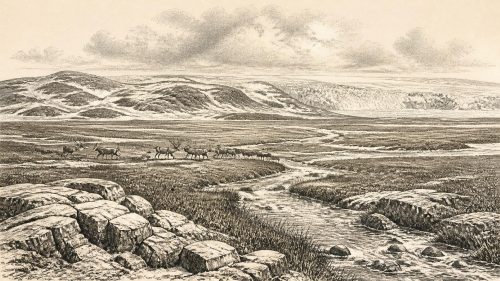
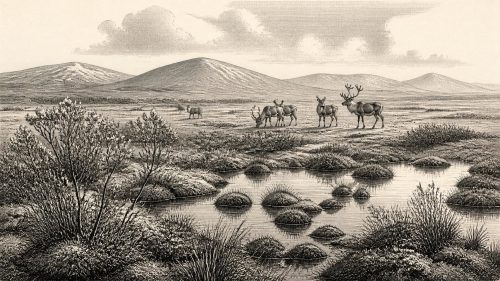
That distinction matters. It would be misleading to picture all of Ireland in 31,984 BCE as a single, uniform white wilderness buried beneath an ice cap. Equally, it would be wrong to imagine a hospitable green island. The climate was cold, variable and increasingly severe on a scale far beyond later historical experience. Open habitats dominated wherever ice had not overwhelmed the terrain: a patchwork broadly comparable to steppe-tundra, with grasses, sedges, herbs, low shrubs and exposed mineral ground rather than closed woodland. Wind, frost, seasonal snow, sparse vegetation and unstable ground would have shaped both animal movement and any human journey.
Sea levels were much lower globally because vast volumes of water were stored in northern ice sheets, and the outlines of coasts and shelves differed greatly from those of today. Yet lower sea level does not demonstrate a straightforward walkable route into Ireland. The changing Irish Sea, ice margins, shallow basins and crustal movement make the palaeogeography complicated. Scholarship has long challenged simple claims of a durable Ireland–Britain land bridge. For this earlier Ice Age phase, the route by which animals—and, if present, people—reached the island remains unresolved. They may have moved across exposed or ice-bound terrain during particular conditions, but the evidence does not permit certainty.
Castlepook and a Fragile Human Trace
The most important evidence relevant to this date comes from Castlepook Cave near Doneraile in north County Cork. Antiquarian excavations there between the late nineteenth and early twentieth centuries recovered a very large assemblage of animal bones, though much contextual information and many finds were lost by modern standards. Renewed study by the Irish Quaternary Fauna Project and later researchers has used improved identification and radiocarbon pretreatment to reassess surviving material. The revised dates established that parts of the Castlepook fauna belong to Marine Isotope Stage 3, the middle portion of the last glacial cycle, rather than only to its final stages.
Among the finds is a reindeer femur reported as bearing a deep cut mark consistent with the use of a sharp stone tool in butchery. It has been presented as dating to roughly 33,000 years ago—approximately the early thirty-second millennium BCE in conventional calendar terms, rather than an exact equivalent of 31,984 BCE. County Cork heritage publications identify it as Ireland’s earliest potential evidence of human activity. If the mark is correctly interpreted, it demonstrates that people reached the island during the Ice Age, more than 20,000 years before the previously accepted Late Upper Palaeolithic evidence from County Clare.
Its importance should not conceal its limits. The bone is an isolated find from an old cave collection, not a stone-tool assemblage recovered in a sealed occupation floor. No hearth, dwelling, human bone, securely associated weapon point or recognisable camp has yet been found in Ireland for this period. Nor does the reindeer bone prove permanent settlement. The animal could have been killed or processed elsewhere; its remains may subsequently have been dragged into the cave by scavengers. Castlepook’s bone accumulations include carnivores and evidence of their activity. The most careful conclusion is that the find offers a serious, potentially transformative indication of short-lived human presence, but not a basis for describing a settled Irish population.
The Animal World
Even without assuming people were present, Castlepook supplies vivid evidence for the ecological world around this broad date range. Its pre-Last Glacial Maximum fauna includes reindeer, woolly mammoth, giant deer, brown bear, wolf, Arctic fox, mountain hare, stoat, collared lemming, Norwegian lemming and spotted hyena. Not every species need have lived there at the same moment, and radiocarbon ranges must be considered individually. Nevertheless, the assemblage shows that southern Ireland supported, at intervals during Marine Isotope Stage 3, a strikingly diverse cold-climate mammal community.
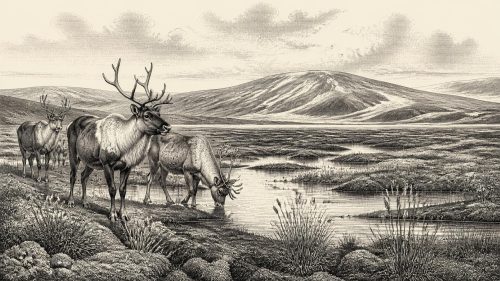
Reindeer are particularly significant. Their presence implies grazing country and seasonal mobility, not a featureless ice desert. Mammoth and giant deer point towards open forage-rich landscapes, while lemmings and Arctic fox indicate cold conditions. Hyenas complicate any simple hunting narrative: caves were often dens, shelters and places where carnivores accumulated prey remains. A reindeer bone within a cave therefore tells archaeologists several possible stories—natural death, scavenging, predator transport or human butchery—before microscopic examination of surface damage and dating can narrow the possibilities.
Brown-bear remains add another layer to the evidence. Genetic studies show that Late Pleistocene Irish brown bears had a remarkable history of admixture with polar bears. That discovery is important for Ice Age population history, but it cannot be used to reconstruct daily life in 31,984 BCE. It demonstrates long-term biological connections across north-west Europe, not an encounter witnessed by a particular community. Later modelling suggests that brown bears were very unlikely to have survived continuously in Ireland through the much harsher Last Glacial Maximum; populations probably disappeared and recolonised after the ice retreated.
People, If They Came
If hunter-gatherers did visit Ireland at this time, they belonged to the Upper Palaeolithic world of north-western Europe. Across neighbouring regions, Homo sapiens communities used carefully made stone tools, managed fire, processed animal carcasses and travelled through large territories in response to season, prey and raw materials. But there is no securely diagnostic Irish lithic assemblage that permits an archaeological culture—Aurignacian, Gravettian or another label—to be attached to the Castlepook evidence. Applying one of those names to Ireland would turn continental comparison into unsupported identification.
The likely scale of any presence is likewise unknown. A small hunting party could leave almost no durable trace, particularly in a landscape subsequently reshaped by advancing ice, erosion, rivers and sea-level change. Later glaciation was capable of stripping, transporting and burying sediments on a vast scale. This helps explain why Ireland’s Palaeolithic record is exceptionally sparse compared with Britain and continental Europe. Absence of camps cannot prove absence of people, but neither can one modified bone establish repeated occupation, family life or a lasting population.
There is no evidence for political institutions, territorial states, diplomacy, warfare, named leaders, formal religion, monuments, farming, pottery, textile production, metalworking or long-distance trade networks within Ireland at this date. Those are not missing chapters awaiting recovery from written sources; they are questions beyond what the evidence can responsibly answer. Any visitors were mobile foragers, not farmers, and their economy—if the Castlepook interpretation is accepted—would have centred on acquiring and processing wild animals and perhaps other seasonally available resources.
Caves, Knowledge and Memory
Caves such as Castlepook are crucial archives, but they should not automatically be treated as homes or sacred places. They can preserve bones because sheltered limestone chambers protect material that open ground would lose. They may also collect animals carried in by predators, water or people over thousands of years. The cave’s scientific value lies partly in this complexity: modern archaeology combines zooarchaeology, taphonomy, radiocarbon dating, sediment study, spatial recording and cave survey to separate the histories mixed within it.
At this time there is no direct Irish evidence for cave art, personal ornaments, ritual practice or teaching traditions. It is reasonable to infer that any Homo sapiens visitors possessed social knowledge, language and learned survival skills comparable in broad capacity to contemporary people elsewhere in Europe. It is not reasonable to infer the content of their beliefs, language or artistic life in Ireland. The evidence supports a possible moment of human action on a reindeer carcass; it does not preserve the stories people may have told about it.
An Island Rewritten by Ice
The chief historical development illuminated by 31,984 BCE is therefore environmental, with a tantalising human possibility embedded within it. Ireland was entering the long transformation that would culminate in widespread glaciation. Animal communities that had occupied open cold landscapes would be disrupted, and any human use of the island was unlikely to be continuous across the later ice maximum. Much later, after deglaciation, reindeer, giant deer and bears reappeared in changing combinations, while the first substantial archaeological record of people in Ireland belongs to Mesolithic hunter-gatherers after about 10,000 years ago.
Castlepook has altered the terms of debate. Ireland can no longer be discussed simply as a land first visited after the Ice Age without acknowledging the possibility of far earlier Palaeolithic incursions. Yet the correct picture remains one of uncertainty, not a newly populated prehistoric nation. Around 31,984 BCE, the island was a cold, dynamic and ecologically rich edge of north-west Europe. A marked reindeer bone may preserve the faintest evidence that people briefly shared that landscape with mammoth, hyena and reindeer before the advancing ice erased almost everything else.
Primary Sources
- A Reconsideration of the Radiocarbon Dating of the Marine Isotope Stage 3 Fauna from Southern Ireland
- The Irish Quaternary Fauna Project
- First Evidence of a Late Upper Palaeolithic Human Presence in Ireland
- New Insights on the Fauna of Ireland's Younger Dryas and Early Holocene from Alice & Gwendoline Cave
- Heritage Artefacts of County Cork
- Archaeological Heritage of County Cork
- Castlepook Cave Excavation Collaborative Team 2022
- Growth and Retreat of the Last British–Irish Ice Sheet, 31,000 to 15,000 Years Ago: the BRITICE-CHRONO Reconstruction
- Trimlines, Blockfields and the Vertical Extent of the Last Ice Sheet in Southern Ireland
- Dimensions and Chronology of the Last Ice Sheet in Western Ireland
- Radiocarbon Constraints on the History of the Western Irish Ice Sheet Prior to the Last Glacial Maximum
- Response of the Irish Ice Sheet to Abrupt Climate Change During the Last Deglaciation
- The Deglaciation of the Western Sector of the Irish Ice Sheet from the Inner Continental Shelf to its Terrestrial Margin
- Could Brown Bears (Ursus arctos) Have Survived in Ireland During the Last Glacial Maximum?
- Ancient Hybridization of Brown and Polar Bears
- The Problem of a Late Quaternary Landbridge Between Britain and Ireland
- Deglaciation, Earth Crustal Behaviour and Sea-Level Changes in the Determination of Insularity: A Perspective from Ireland
- Ireland: Submerged Prehistoric Sites and Landscapes
- The Island of Ireland: Drowning the Myth of an Irish Land-Bridge?
- The IntCal20 Northern Hemisphere Radiocarbon Age Calibration Curve (0–55 cal kBP)
- The Mesolithic in Ireland: When Was It?
- The Burren
- Lateglacial Vegetation and Environment in Ireland: First Results from Four Western Sites
- The Behavioural Ecology of Reindeer (Rangifer tarandus) During the Last Glaciation