Maguirebridge’s Treeless Fen30285 BCE
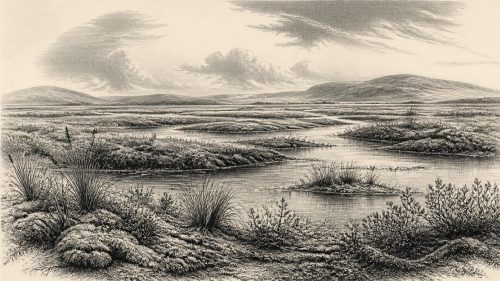
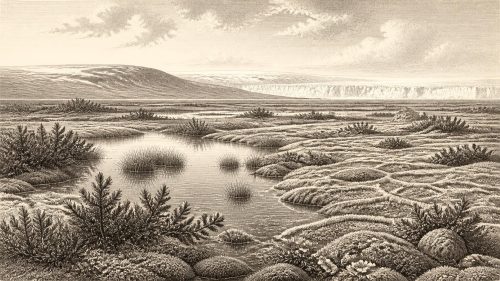
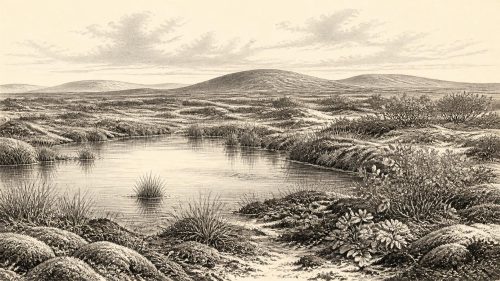
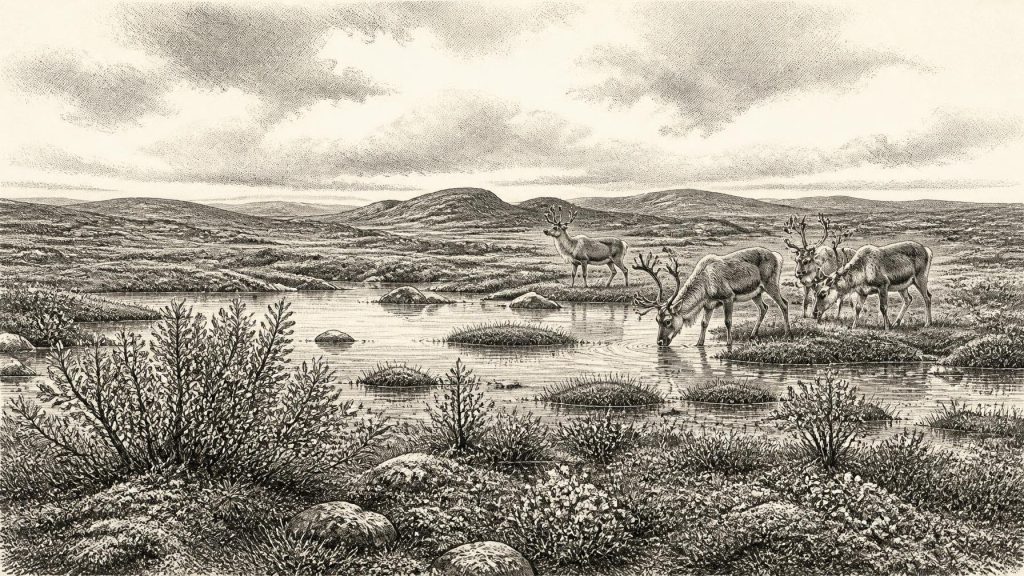
Around 30,285 BCE, Ireland was a cold, changing Late Pleistocene landscape, rather than a place documented by calendar years or historical communities. At Derryvree, near Maguiresbridge, freshwater sediments between glacial tills record an ice-free interval with shallow pools, sedges, mosses, herbs and treeless periglacial vegetation. Later ice advances buried and reshaped this environment. Castlepook Cave fauna, including mammoth, reindeer, giant deer, predators and Arctic species, demonstrates intermittent animal connections with north-west Europe, but not a single contemporary ecosystem. A possibly cut-marked reindeer bone suggests brief early human activity, yet permanent settlement, tools, hearths and social organisation remain still entirely unproven.
Dateline
“30,285 BCE” is a modern way of indexing deep time, not a date that can be recovered as a single Irish year. No calendar, written record, named community or event can be assigned to it. In archaeological terms it falls roughly 32,235 years before AD 1950, within the Late Pleistocene and Marine Isotope Stage 3, long before the Last Glacial Maximum. The responsible approach is therefore to use broad calibrated ranges and to distinguish the evidence for an Irish environment from interpretations about animals or people within it.
The most illuminating Irish record for this horizon lies at Derryvree near Maguiresbridge, County Fermanagh. There, roadworks exposed a sequence in which freshwater sediments were sealed between two deposits of glacial till. Organic, moss-rich mud and fine sand within that sequence produced the conventional radiocarbon determination BIRM-166, 30,500 ± 1,100 radiocarbon years BP. Modern calibration does not turn that into one exact date: published treatments place the deposit within a broad window of roughly 36,900–31,700 calibrated years BP. The nominal year considered here sits towards the younger end of that range, but it cannot be isolated within the deposit. Derryvree is evidence for a long phase of cold, ice-free or locally ice-free ground in part of Fermanagh, not a snapshot of one season.
A Wetland Between Ice Advances
That distinction matters because the Derryvree layers are both revealing and incomplete. Their position beneath a later till shows that ice subsequently advanced across the locality, while the older till below records an earlier glacial episode. Between them, however, a small freshwater landscape existed. Plant macrofossils, pollen, mosses and insect remains indicate shallow pools, sedge-rich margins, wet mossy ground and open vegetation. The published plant assemblage includes grasses and sedges, herbs, juniper, dwarf willow, mountain avens, buckbean and lesser clubmoss. Such species do not conjure a modern bog or woodland. They point instead to a cold, treeless, periglacial mosaic: damp ground with standing or slowly moving fresh water, short growing seasons and exposed mineral soils.
It would be wrong to picture Fermanagh as uniformly frozen desert. The very existence of freshwater deposits, aquatic plants and organic matter demonstrates liquid water and productive summer conditions. Yet it would be equally wrong to imagine a sheltered green Ireland. Trees were absent from the Derryvree record, and the ecological combination is consistent with severe winters and a landscape in which frost, snow cover, wind and seasonal thaw shaped everyday survival for every animal present. The wetland’s vegetation probably formed in patches, responding to local drainage and shelter rather than spreading as a continuous cover across the island.
Derryvree is especially valuable because Ireland’s older Pleistocene evidence is scarce and unevenly preserved. Most exposed ground of this age has been eroded, buried by later ice or drowned beneath the post-glacial sea. A sediment layer caught between tills can preserve pollen grains, seeds and small invertebrates that would otherwise vanish. Its importance is not that it tells a complete story of Ireland, but that it demonstrates ecological complexity in one northern inland basin before the main Late Midlandian ice expansion.
Ice Was Building, Not Yet at Its Greatest
At about 32,000 calibrated years ago, Ireland stood in a changing glacial world. The British–Irish Ice Sheet did not reach its principal Last Glacial Maximum extent until later, conventionally placed around 27,000–21,000 years ago, although its growth and earlier advances remain subjects of active research. The Derryvree evidence places limits on simple maps: north-central Ireland could retain an ice-free freshwater environment during part of the preceding cold phase, even though other sectors may have been influenced by glaciers or nearby ice margins.
Accordingly, no single claim about an island-wide coastline, ice cover or temperature is secure for 30,285 BCE. Sea level was lower than today because much water was stored in continental ice sheets, so the outlines of Ireland and the Irish Sea basin differed greatly from modern maps. But connections and barriers changed through time, and the precise route between Ireland, Britain and continental Europe cannot be assumed from a general sea-level curve alone. The later ice sheet would further remodel the terrain, scouring bedrock, depositing till and obscuring older land surfaces. Much of the evidence from this period therefore comes from survivals in caves, basins and sediments rather than from recognisable living landscapes.
Mammals in a Fragmentary Record
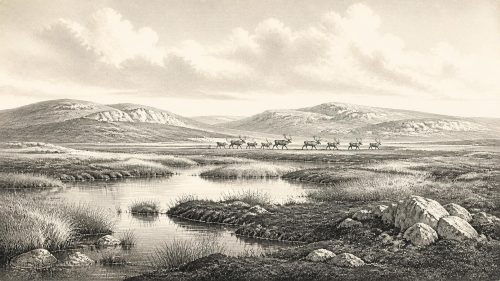
County Cork’s Castlepook Cave, also called Mammoth Cave or Doneraile Cave, supplies a different kind of evidence. Antiquarian excavations and later reassessment recovered remains attributed to woolly mammoth, reindeer, giant deer, brown bear, wolf, mountain hare, Arctic fox, lemmings and spotted hyaena. Direct dates on some Castlepook specimens indicate that a range of cold-stage mammals reached Ireland during the wider period from at least about 45,000 to 20,000 years ago. A mammoth bone and hyaena material have produced ages broadly relevant to the earlier part of that span.
These finds establish that Ireland was not biologically empty. Reindeer especially suit an image of open, cold country, while lemmings and Arctic fox indicate northern conditions. Mammoth and giant deer show that large herbivores could reach at least some Irish landscapes; hyaenas, wolves and bears show that they occupied food webs containing formidable scavengers and predators. Yet a cave bone assemblage is not a census. Carnivores accumulate bones, water moves sediments, excavators disturb deposits, and specimens collected more than a century ago often lack the stratigraphic precision expected today. The faunal list should be read as evidence of presence across intervals, not as proof that every species met at one place in one year.
The same caution applies to the relationship between Cork and Fermanagh. Castlepook’s cave fauna and Derryvree’s wetland do not document a single simultaneous national ecosystem. Taken together, they make a defensible broader point: Ireland around this stretch of the Late Pleistocene contained cold but habitable ecological niches, and its animal populations were repeatedly linked to the wider north-west European world. Those connections were intermittent and vulnerable to climatic deterioration, advancing ice and changing coasts.
The Human Question
There is no securely excavated camp, house, hearth, stone-tool assemblage, human burial or settlement surface in Ireland that can be assigned to 30,285 BCE. Nor is there evidence for a permanent population, territory, language, political leadership, trade network, religion or diplomacy. Such absences are historically important: they prevent a richly peopled story from being projected backwards onto a very thin record.
One find nevertheless makes the question of people impossible to dismiss. A reindeer femur from Castlepook has been reported as bearing a deep incision interpreted by palaeozoologist Ruth Carden as a stone-tool cut mark made during butchery. County Cork heritage material has associated the bone with an age of about 31,000 BC, close in broad terms to the date considered here. If the mark is confirmed as humanly made, it would be a remarkable indication that one or more Upper Palaeolithic people handled a reindeer in Ireland tens of millennia earlier than the well-established terminal-Pleistocene evidence from County Clare.
But the inference must remain narrow. A radiocarbon measurement dates the animal bone, not necessarily the exact moment of cutting, and a surface modification has to be distinguished from carnivore damage, sediment abrasion or other processes. More importantly, one modified bone does not demonstrate how many people arrived, whether they killed the animal, where they came from, how long they stayed or whether they returned. Castlepook has not yet produced securely associated tools, fire features or an occupation floor of this age. The prudent conclusion is that a brief human incursion and carcass processing are possible; continuous settlement is unproven.
What Cannot Be Recovered
For this reason, political affairs and conflict cannot be described in the ordinary historical sense. There were no known Irish kingdoms, alliances or diplomatic communities. Competition between carnivores, or a possible human party’s pursuit of game, belongs to ecology rather than documented warfare. Likewise, no Irish evidence supports claims about ritual, art, formal learning, family organisation, exchange or long-distance trade at this date. Upper Palaeolithic societies elsewhere in Europe made sophisticated tools, images and social connections, but analogy cannot substitute for an Irish find.
If people did reach Ireland, their most likely economic relationship to the land was highly mobile foraging: knowledge of animal movement, fresh water, sheltered ground and workable stone would have mattered more than farming or permanent buildings. That is an interpretation drawn from the possible cut-marked reindeer and from wider European comparison, not a demonstrated Irish way of life. At Derryvree, the firmer history is environmental. A treeless wetland supported plants and small animals between episodes of glaciation; elsewhere, large mammals entered a shifting island landscape; and later ice buried or erased much of the evidence.
That is enough to make this period consequential. Around the modern label 30,285 BCE, Ireland was neither the familiar Atlantic island of later history nor merely an empty stage awaiting human settlement. It was a fluctuating, cold Pleistocene landscape, connected ecologically to lands beyond the sea, inhabited at intervals by specialised fauna and preserving a tantalising but still unconfirmed possibility of exceptionally early human activity. Its history survives not in annals, but in mud, moss, bone and the stratigraphy of ice.
Primary Sources
- A Middle Midlandian Freshwater Series at Derryvree, Maguiresbridge, County Fermanagh, Northern Ireland
- Exploring Controls of the Early and Stepped Deglaciation on the Western Margin of the British–Irish Ice Sheet
- Trimlines, Blockfields and the Vertical Extent of the Last Ice Sheet in Southern Ireland
- Growth and Retreat of the Last British–Irish Ice Sheet, 31,000 to 15,000 Years Ago: the BRITICE-CHRONO Reconstruction
- Extent and Timing of the Last Glacial Maximum (LGM) in Britain and Ireland: a Review
- The Timing and Magnitude of the British–Irish Ice Sheet Between Marine Isotope Stages 5d and 2
- Radiocarbon Constraints on the Age of the Maximum Advance of the British–Irish Ice Sheet in the Celtic Sea
- Stratigraphic and Palaeo-Geomorphological Evidence for the Glacial-Deglacial History of the Last British-Irish Ice Sheet in the North-Western Irish Sea
- Dimensions and Chronology of the Last Ice Sheet in Western Ireland
- Episodic Speleothem Deposition Tracks the Terrestrial Impact of Millennial-Scale Last Glacial Climate Variability in SW Ireland
- The Irish Quaternary Fauna Project
- First Evidence of a Late Upper Palaeolithic Human Presence in Ireland
- New Insights on the Fauna of Ireland’s Younger Dryas and Early Holocene from Alice & Gwendoline Cave
- Heritage Artefacts of County Cork
- Ireland’s Palaeolithic Archaeology – Fleeting Footprints in a Frozen Land
- The Mesolithic in Ireland: When Was It?
- The IntCal20 Northern Hemisphere Radiocarbon Age Calibration Curve (0–55 cal kBP)
- Marine20—The Marine Radiocarbon Age Calibration Curve (0–55,000 cal BP)
- Independent Tephrochronological Evidence for Rapid and Synchronous Oceanic and Atmospheric Temperature Rises Over the Greenland Stadial-Interstadial Transitions Between ca. 32 and 40 ka b2k
- Conserving Quaternary Geoheritage in Northern Ireland
- Lesser Clubmoss in Fermanagh
- Dwarf Willow in Fermanagh
- The Late Quaternary History of East-Central Ireland