

Derryvree’s Two-Till Freshwater31028 BCE
31,028 BCE is not a recoverable Irish historical year but a broad Late Pleistocene interval within Marine Isotope Stage 3. Derryvree, County Fermanagh, preserves freshwater sediments between two tills, demonstrating locally ice-free, cold wetland conditions between glacial advances. Its plants, insects and sediments indicate treeless muskeg, pools and short growing seasons. Castlepook Cave, County Cork, records varied fauna, including mammoth, reindeer and hyaena, showing intermittent animal migration during favourable phases. Cave remains need not be contemporaneous. A possibly tool-marked reindeer bone suggests, but cannot confirm, early human activity. No evidence supports settlement, politics or later prehistoric practices; archives reconstruct environments.
Dateline
The label 31,028 BCE cannot be treated as a recoverable year in Irish history. No calendar, written record, settlement sequence or securely dated human action lets us identify what occurred in Ireland in that particular twelve-month span. It is a modern chronological convenience, equivalent to roughly 32,978 years before AD 1950, the reference point used in “BP” dating. The responsible subject is therefore a broad Late Pleistocene horizon: an unstable part of Marine Isotope Stage 3, before the Last Glacial Maximum, reconstructed from buried sediments, pollen, plant remains, insects, animal bones and glacial landforms.
The closest unusually informative Irish evidence is the Derryvree freshwater series near Maguiresbridge in County Fermanagh. It does not provide an annual chronicle, but it does illuminate the sort of landscape that existed in at least part of Ireland during a cold, ice-free interval overlapping the broad timescale in which 31,028 BCE falls. Farther south, the mixed animal-bone collection from Castlepook Cave near Doneraile, County Cork, demonstrates that large mammals and carnivores reached Ireland during episodes of the same general pre-maximum world. Together, these records reveal a country that was neither permanently entombed by ice nor comfortably temperate: a harsh, open and changing Atlantic-edge landscape.
Dating a Landscape, Not a Day
Derryvree was exposed in a road cutting in 1969, when investigators found freshwater silts, fine sand and organic material enclosed between two thick layers of till, the unsorted debris deposited by glacier ice. The stratigraphy is the essential evidence. A glacier had crossed the area and laid down the lower till; later, water and vegetation accumulated in a non-glacial interval; finally, renewed ice advance buried the deposit beneath the upper till. This is an exceptionally valuable sequence because later ice sheets destroyed or disturbed much older evidence across Ireland.
Organic material from the series produced the conventional radiocarbon determination BIRM-166 of 30,500 ± 1,100 radiocarbon years BP. Radiocarbon years are not identical to calendar years. Atmospheric carbon-14 has varied through time, and measurements must be calibrated against internationally maintained curves. Published discussions have placed the Derryvree age broadly at about 36,900–31,700 calibrated years BP; calibration methods and resulting boundaries can be refined, but the important point remains the breadth of the range. The modern date 31,028 BCE falls within this kind of chronological resolution. It cannot be assigned to the formation of a particular pool, plant, animal death or human visit.
That distinction matters. A named BCE year encourages false precision, while the actual evidence records episodes, deposits and ecological conditions accumulated over far longer periods. It can show that north-central Ireland was locally ice-free late in MIS 3. It cannot prove that all of Ireland was ice-free at once, nor that every region experienced the same weather, vegetation or animal population. The Derryvree deposit is a local archive with national importance, not a photograph of the whole island.
Wet Ground Between Ice Advances
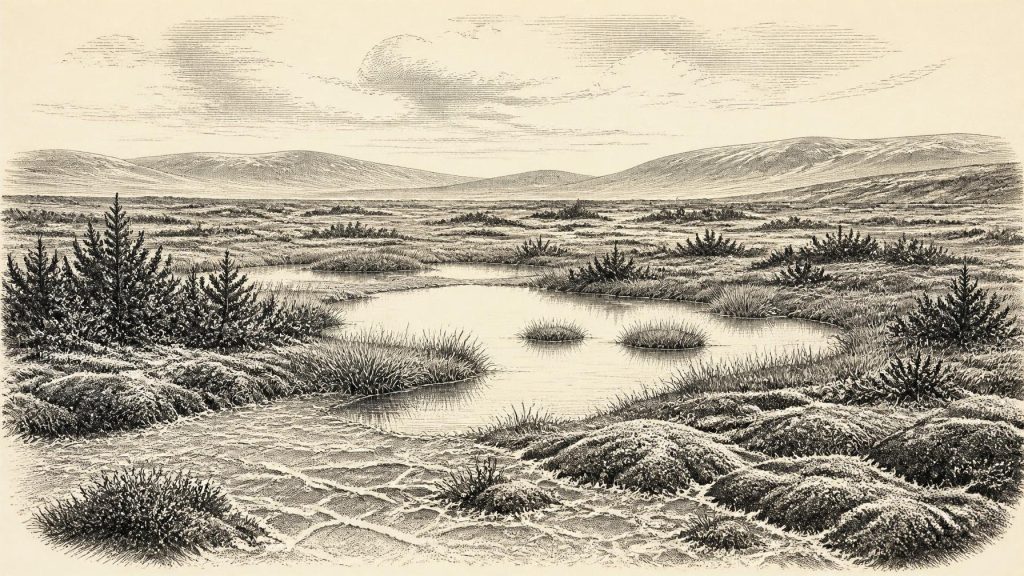
The Derryvree fossils point to a treeless, cold-stage wetland often described as muskeg: waterlogged ground with mosses, sedges, low herbs, dwarf shrubs and open pools. Plant evidence includes grasses and sedges, juniper and other herbs, together with mosses; aquatic and wet-ground plants indicate standing or slow-moving freshwater. Insects reinforce the interpretation of damp, organic-rich ground rather than a dry, featureless plain. This was not a forested Ireland of oak woods and enclosed fields, but a patchwork of wet hollows, shallow water, saturated vegetation and exposed mineral ground.
Such a setting could still be biologically productive in the brief growing season. Pools and margins offered plant matter, invertebrates and shelter at a small scale; sedge-rich ground could support grazing animals where snow cover, wind and season allowed. Yet productivity should not be mistaken for abundance in the modern sense. The evidence suggests severe winters, short summers and a landscape vulnerable to frost, flooding and abrupt shifts in temperature. There is no basis for imagining permanent villages beside Derryvree. The surviving record is environmental, not domestic.
The deposits also illuminate regional change. The lower and upper tills show that the wetland belonged between glacial advances, while broader reconstructions indicate that the principal expansion of the last Irish sector of the British–Irish Ice Sheet occurred after roughly 34,000 years ago and reached much farther south only later. Thus 31,028 BCE belongs to a long period of ice-sheet build-up rather than to the Last Glacial Maximum itself, conventionally placed around 27,000–23,000 BP. In this earlier interval, ice margins, meltwater systems and habitable terrain could all change substantially over comparatively short geological timescales.
Animals on an Atlantic Margin
Castlepook Cave supplies a different kind of evidence. Its old excavations produced a notable Late Pleistocene faunal collection, including remains attributed to woolly mammoth, reindeer, giant deer, brown bear, wolf, Arctic fox, mountain hare, lemmings and spotted hyaena. Recent redating has been especially important: improved pretreatment of bone samples showed that some earlier radiocarbon results from southern Irish caves had made animals appear younger than they were. The outcome is a stronger case for a varied MIS 3 fauna in Ireland, with some species apparently gone locally before the Last Glacial Maximum.
But Castlepook must not be read as a single living scene. Cave deposits may combine remains accumulated during different visits and periods; carnivores can drag in prey and scatter bones; water, slopewash and earlier excavation can disturb original relationships. Spotted hyaena is particularly significant because it warns against treating a cave-bone assemblage as human refuse. The assemblage demonstrates intermittent animal movement through and into Ireland, but does not establish that every species coexisted at Castlepook, or anywhere else, in 31,028 BCE.
Even so, the fauna has major implications. Reindeer, lemmings and Arctic fox fit cold, open habitats, while mammoth and giant deer indicate that routes existed through which large grazing mammals could reach the island during favourable phases. Ireland was not then isolated in the modern geographical sense. Lower sea levels altered coastlines and narrowed crossings, although the precise availability of land, ice or water routes varied through time. Migration was possible; it was not necessarily easy, continuous or equally feasible for all species.
The Unsettled Human Question
A reindeer femur from the historic Castlepook collection has been publicly presented as roughly 33,000 years old and as bearing a deep mark made while the bone was fresh, possibly by a sharp stone tool during carcass processing. If that interpretation is confirmed, it would be exceptionally early evidence for human handling of an animal in Ireland. It would suggest a brief episode of mobile hunter-gatherer activity within the wider north-west European Upper Palaeolithic world, rather than the beginning of a documented Irish population.
The limits are as important as the possibility. The bone is not from a modern excavation of a sealed occupation floor accompanied by a stone-tool assemblage, hearth, shelter, food-processing area, burial or repeated habitation layers. A radiocarbon date can date the animal, not automatically the maker of a surface mark. Nor can one modified specimen establish a settlement, seasonal territory, language, kin group or cultural tradition. The securely dated evidence for later terminal-Pleistocene human activity at Alice and Gwendoline Cave in County Clare is far younger, around 12,810–12,590 calibrated BP; it demonstrates how rare direct evidence remains even much closer to the end of the Ice Age.
Accordingly, political affairs, diplomacy and organised warfare are beyond the evidence for this date. There are no known chiefs, polities, boundaries, treaties or battle sites. Nor is there support for farming, herding, pottery, monuments, metalworking or trade in the later prehistoric sense. If people did enter Ireland during this period, their movements would most plausibly have been small-scale and environmentally constrained, but that is an inference from wider Upper Palaeolithic patterns, not a fact demonstrated by an Irish camp.
Culture Without a Chronicle
Religion, art, learning and everyday social customs likewise leave no identifiable Irish record around this point. The absence is not evidence that such capacities were absent among people elsewhere in Europe; it reflects the absence of securely associated Irish human material. The cultural history that can responsibly be written is instead one of scientific learning: palaeobotany reconstructs vegetation from minute remains, entomology identifies ecological conditions from insects, zooarchaeology evaluates bone accumulations and radiocarbon science tests their chronology. Each method contributes part of the picture; none supplies a lost narrative whole.
Ireland around 31,028 BCE was therefore a place of cold wetlands, open ground, shifting ice margins and episodic animal movement. Derryvree’s freshwater sediments show that life persisted locally between glacial advances. Castlepook’s bones show that a substantial Ice Age fauna reached the island during the wider period. A single marked reindeer bone raises an important question about human presence, but cannot settle it. The historical value of this date lies not in an invented event, but in recognising how much of Ireland’s deepest past survives in a narrow band of silt between two tills.
Primary Sources
- A Middle Midlandian Freshwater Series at Derryvree, Maguiresbridge, County Fermanagh, Northern Ireland
- Middle Midlandian Interstadial Deposits at Greenagho, Near Belcoo, County Fermanagh, Northern Ireland
- Trimlines, Blockfields and the Vertical Extent of the Last Ice Sheet in Southern Ireland
- A Reconsideration of the Radiocarbon Dating of the Marine Isotope Stage 3 Fauna from Southern Ireland
- Irish Pleistocene Biostratigraphy
- The Irish Quaternary Fauna Project
- New Insights on the Fauna of Ireland’s Younger Dryas: A Multi-Proxy Study of Alice and Gwendoline Cave, County Clare
- 2022:564 – Castlepook Cave, Castlepook South, Cork
- Heritage Artefacts of County Cork
- Quaternary Geological Map of Ireland
- Figure 6: The Subdivision of the Quaternary Period in Ireland
- Quaternary Site Descriptions
- The IntCal20 Northern Hemisphere Radiocarbon Age Calibration Curve (0–55 cal kBP)
- IntCal Publications
- IntCal History
- Growth and Retreat of the Last British–Irish Ice Sheet, 31,000 to 15,000 Years Ago: the BRITICE-CHRONO Reconstruction
- The Timing and Magnitude of the British–Irish Ice Sheet Between Marine Isotope Stages 5d and 2
- First Evidence of a Late Upper Palaeolithic Human Presence in Ireland
- First Evidence of a Late Upper Palaeolithic Human Presence in Ireland
- Irish Quaternary Association