Castlepook Cave Assemblage31917 BCE
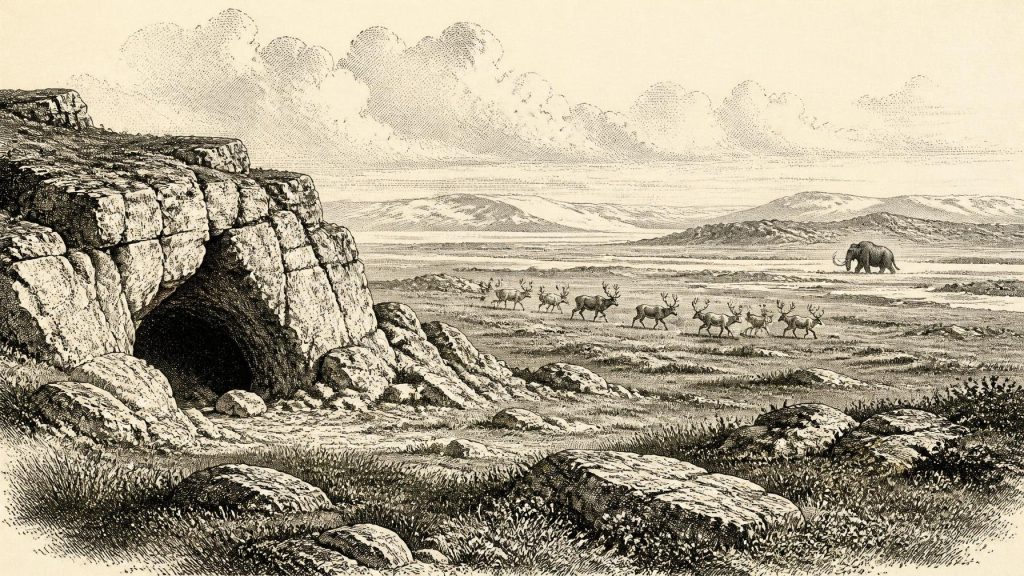
Castlepook Cave near Doneraile, County Cork, preserves a Pleistocene archive from Marine Isotope Stage 3, around 34,000 years ago, before the Last Glacial Maximum. Ireland then experienced cold, unstable conditions, yet retained open tundra, grassland and sheltered habitats supporting mammoth, reindeer, giant deer, bear, wolf, Arctic fox, lemmings and hyaena. Cave processes, predators and poorly recorded early excavations limit interpretation. A dated reindeer bone may bear stone-tool cut marks, suggesting an exceptionally early human encounter, but cannot demonstrate settlement. No communities, structures or cultural traditions are evidenced. The assemblage instead reveals a pre-glacial landscape and unresolved possibility of human presence.
Dateline
The label “31,917 BCE” is useful for filing this article, but it must not be mistaken for a date that people or animals in prehistoric Ireland could have recognised. No written calendar, event record or year-by-year chronology survives from this depth of time. In archaeological terms, the point corresponds only broadly to about 33,900 calendar years before present, conventionally counted from 1950, during Marine Isotope Stage 3 (MIS 3) of the last glacial cycle. Even that translation is an approximation: radiocarbon results require calibration and normally yield ranges rather than a single modern calendar year.
What can responsibly be said is that Ireland stood close to a major environmental threshold. Evidence suggests that much of the island was still ice-free until roughly 32,000 years ago, before the final expansion of the Irish Ice Sheet towards its Last Glacial Maximum. Conditions were cold, unstable and regionally varied, but Ireland was not yet simply the featureless ice-covered land often imagined in popular accounts. Its best evidence comes not from settlements, monuments or graves, but from cave deposits, animal bones, glacial sediments and later scientific re-examination of old museum collections.
Dating a Deep Landscape
For this period, precision is necessarily limited. Radiocarbon laboratories measure the remaining radioactive carbon in once-living material, such as bone collagen. The result is expressed in radiocarbon years before present, not in BCE. Atmospheric carbon levels changed over millennia, so those results must be compared with calibration curves assembled from independently dated records, including tree rings, corals, cave deposits and lake sediments. At nearly 34,000 years ago, calibrated ranges can be broad, and revisions to methods or samples can alter previous conclusions.
This matters especially in Ireland because many significant cave collections were excavated between the late nineteenth and early twentieth centuries. Their excavators recovered remarkable bones but did not record layers, locations and associations to standards expected today. A bone may be reliably identified and dated, yet have an uncertain route into a cave: an animal may have died nearby, been dragged in by a predator, been washed or disturbed within sediments, or been moved during excavation. Archaeologists therefore separate the date of an animal’s death from the date, if any, of human activity upon it.
Modern calendar-year certainty is unavailable for 31,917 BCE. The most defensible language is consequently “around 34,000 years ago”, “in the later part of MIS 3”, or “before the Last Glacial Maximum”, rather than an assertion that a particular episode occurred in this exact year. That caution is not a weakness in the history; it is the central fact of an exceptionally sparse archive.
A Pre-Maximum Ice Age
MIS 3 was a glacial age, but it was not climatically uniform. Across the North Atlantic world it included abrupt shifts between relatively milder interstadial phases and colder stadials. Ireland’s position at the western edge of Europe made it sensitive to changes in Atlantic circulation, snowfall, temperature and sea level. The evidence for the last Irish Ice Sheet indicates a complicated, asynchronous growth rather than an island-wide freezing event occurring everywhere at once. Around this article’s broad horizon, glaciers and upland ice were important parts of the landscape, but the full maximum ice cover lay ahead.
Lower global sea levels altered the surrounding geography, exposing areas now beneath the Irish and Celtic Seas. That does not licence a simple picture of a broad, dependable land bridge to Britain or continental Europe. Ice, sea channels, coasts and terrain changed through time, while the physical route available to animals or people remains uncertain for any particular millennium. What is clear is that Ireland was less geographically isolated than it would become after later sea-level rise, and that animals reached it during pre-maximum phases of the Ice Age.
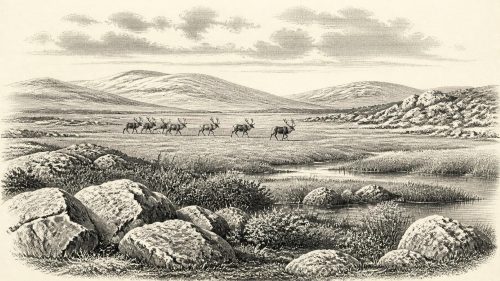
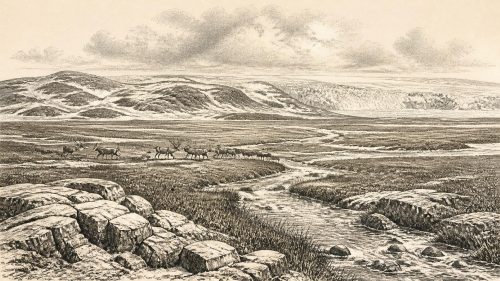
The Irish landscape would have been open and demanding. Extensive forest is unlikely in the coldest settings; instead, grassland, herb-rich tundra, shrub vegetation and patches of more sheltered habitat probably formed a variable mosaic. Such environments could support grazing mammals, but seasonal weather, snow cover, exposed ground and advancing ice would have made resources unpredictable. The familiar modern pattern of enclosed fields, dense woodland and settled villages was unimaginably far in the future.
The Castlepook Evidence
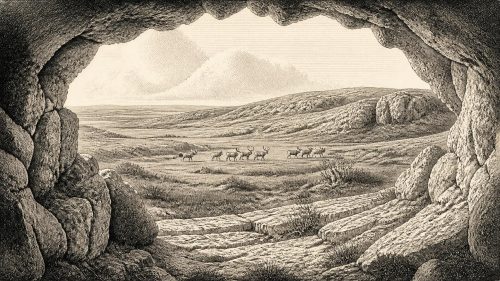
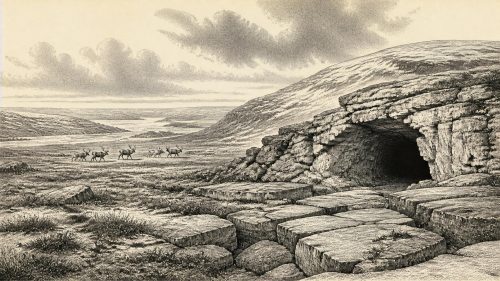
Castlepook Cave, near Doneraile in north County Cork, is the key Irish site for this period. Excavated principally by Richard J. Ussher in the early twentieth century, it produced an unusually rich collection of Pleistocene vertebrate remains. Subsequent dating and reassessment have shown that its deposits contain material of differing ages, including a substantial pre-Last Glacial Maximum fauna. It is not a preserved snapshot of one season or one community; rather, it is a time-depth archive assembled through animal activity, cave processes and early excavation.
The fauna associated with Castlepook and comparable southern Irish cave finds demonstrates that Ireland supported a striking range of Ice Age mammals. Remains include woolly mammoth, reindeer, giant deer, brown bear, wolf, Arctic fox, mountain hare, lemmings and spotted hyaena. The animals should not be imagined as all standing together on one day. Their dated remains span long periods, and each species had its own ecological requirements. Nevertheless, their presence establishes that parts of Ireland were capable of sustaining grazing animals and predators during phases before the ice sheet reached its greatest extent.
Spotted hyaena is particularly revealing. Its bones and other traces indicate carnivore use of caves and warn against treating every bone as the residue of human hunting. Hyaenas could carry carcass parts into underground shelters, gnaw bones and disturb deposits. Brown bears, wolves and other scavengers also complicate interpretation. Cave assemblages preserve food webs, but not a straightforward prehistoric larder.
The large herbivores point to open country with substantial forage. Reindeer are strongly associated with cool, open environments; mammoths required broad feeding ranges; giant deer browsed and grazed within changing mosaics of vegetation. Their occurrence makes a picture of entirely barren Ireland untenable. Yet fossil evidence cannot tell us the density of herds, the exact season represented, or how continuously any species occupied the island. Absence of a fossil is likewise not proof that an animal was absent from all Ireland.
A Reindeer Bone and Human Possibility
The most arresting claim relevant to this horizon concerns a reindeer bone from Castlepook reported as bearing marks consistent with stone-tool butchery and as dating to about 33,000 years ago. If the modification is confirmed as anthropogenic, it would be evidence that a person handled, and perhaps processed, a reindeer carcass in Ireland during the Upper Palaeolithic far earlier than the island’s previously accepted human record. It would be an important addition to Irish prehistory.
It is not, however, evidence for a settled population in 31,917 BCE. The bone derives from an old collection rather than a modern excavation of an undisturbed occupation floor. No securely associated hearth, stone-tool assemblage, dwelling, burial or human skeleton establishes a camp at Castlepook in this period. Nor can one marked bone identify a language, named people, migration route or cultural tradition. The most cautious interpretation is a possible brief human encounter with an animal carcass, not a demonstrated colony.
This distinction is vital. Cut marks are assessed by their shape, position and relation to anatomy, but marks on bone may also be confused with carnivore damage, trampling, sediment abrasion, excavation damage or later handling. The claim deserves continued study alongside fresh fieldwork and direct dating. It should neither be dismissed merely because it is inconvenient nor inflated into a story of permanent “first settlers”.
No Polities, No Proven Communities
There is no evidence from Ireland around this point for political institutions, rulers, diplomacy, warfare, religious monuments, formal learning, markets or long-distance trade. Terms such as kingdom, tribe, chiefdom or nation would impose later social forms on a record that cannot sustain them. Nor is there evidence for houses, farms, cultivated crops, domestic livestock or burial rites. Agriculture would not arrive in Ireland for many tens of thousands of years.
If people did reach the island, they may have travelled in very small, mobile hunting groups whose social life left little durable material trace. That is an inference from wider Upper Palaeolithic archaeology, not a demonstrated fact for Ireland. Continental and British communities of this broad era made sophisticated stone and organic tools, organised hunting, used pigments and sometimes produced striking art. None of that can presently be assigned to Ireland at Castlepook’s pre-maximum horizon. Irish evidence supports the possibility of an encounter, not a reconstruction of its participants’ culture.
An Archive of Survival
The importance of this period lies in the correction it offers to a simplified national origin story. Ireland was not yet an empty stage awaiting the Mesolithic settlers of the early Holocene, although those later communities provide the first clear evidence for sustained human occupation. Before the Last Glacial Maximum, southern cave deposits preserve a world of mammoths, reindeer, predators and perhaps an exceptionally early human visit. Soon afterwards, growing ice would transform or erase many accessible landscapes and make the archaeological record still harder to recover.
For 31,917 BCE, then, the responsible history is environmental and evidential. Ireland was part of the far north-western theatre of an unstable Ice Age: a place where animal populations moved through open cold landscapes, cave mouths accumulated bone, and human presence remains a significant but unresolved possibility. The surviving material does not yield a dated event. It does reveal a living landscape on the eve of much harsher glaciation, and a question that future archaeology may yet answer more securely.
Primary Sources
- Castlepook Cave
- A Reconsideration of the Radiocarbon Dating of the Marine Isotope Stage 3 Fauna from Southern Ireland
- The Irish Quaternary Fauna Project
- The Last Irish Ice Sheet: Extent and Chronology
- Late Pleistocene Chronostratigraphy and Ice Sheet Limits, Southern Ireland
- Trimlines, Blockfields and the Vertical Extent of the Last Ice Sheet in Southern Ireland
- Dimensions and Chronology of the Last Ice Sheet in Western Ireland
- Ireland: Submerged Prehistoric Sites and Landscapes
- First Evidence of a Late Upper Palaeolithic Human Presence in Ireland
- First Evidence of a Late Upper Palaeolithic Human Presence in Ireland
- New Insights on the Fauna of Ireland’s Younger Dryas and Early Holocene from Alice & Gwendoline Cave
- The Colonization of Ireland: A Human Ecology Perspective
- The Mesolithic in Ireland: When Was It?
- The IntCal20 Northern Hemisphere Radiocarbon Age Calibration Curve (0–55 cal kBP)
- IntCal Publications
- Dansgaard–Oeschger Events in Climate Models: Review and Baseline Marine Isotope Stage 3 Protocol
- The Marine δ18O Record Overestimates Continental Ice Volume During Marine Isotope Stage 3
- Could Brown Bears (Ursus arctos) Have Survived in Ireland During the Last Glacial Maximum?
- Archaeological Heritage of County Cork
- Heritage Artefacts of County Cork
- Exploration of Castlepook Cave, Co. Cork
- Pleistocene Vertebrates in the British Isles
- A Critical Review and Re-Investigation of the Pleistocene Deposits Between Cranfield Point and Kilkeel, Northern Ireland