Doneraile Passage31918 BCE
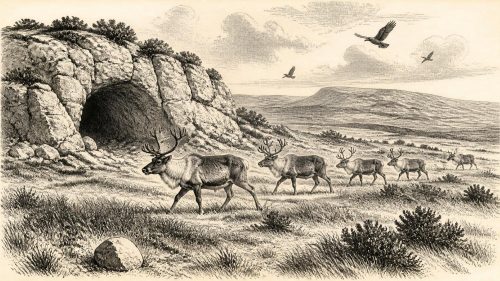
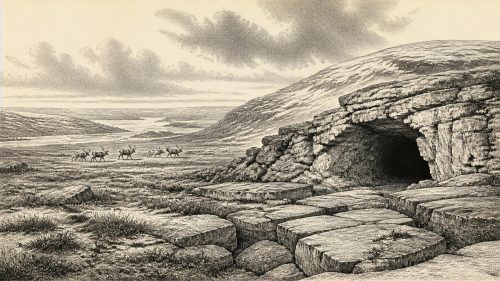
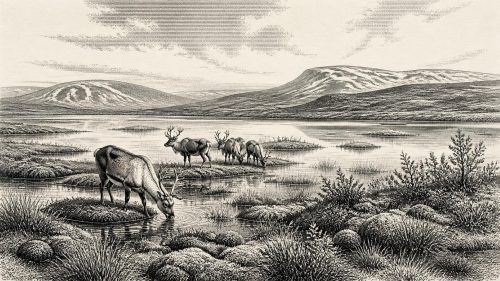
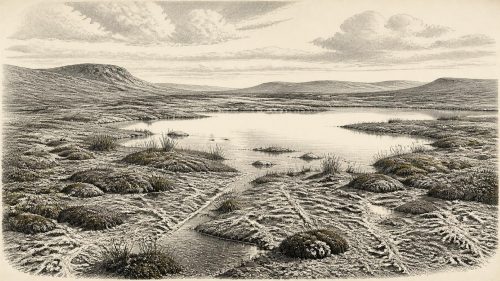
About 31,918 BCE, Ireland lay within the later Last Glacial Period, as climate deteriorated before the Last Glacial Maximum. Castlepook Cave near Doneraile, County Cork, preserves remains of reindeer, mammoth, hyaena and other cold-adapted fauna, demonstrating repeated animal presence rather than one contemporaneous landscape. A reindeer femur bearing probable stone-tool butchery marks, dated to roughly 33,000 years ago, may indicate Ireland’s earliest human visit. However, disturbed cave deposits and limited evidence preclude claims of settlement. Lower sea levels may have facilitated movement, though routes remain uncertain. Expanding ice later transformed this exposed, seasonal frontier. Research may revise this fragile picture.
Dateline
The label 31,918 BCE supplies a useful point on a modern chronological scale, but it cannot identify an Irish event in the way a medieval annalistic year can. No written record, settlement sequence or archaeological layer allows historians to isolate that particular year. In this deep past, dates are expressed as calibrated ranges or broader phases, and the appropriate setting is the later part of Marine Isotope Stage 3 (MIS 3), within the Last Glacial Period. Around 34,000 calendar years ago, Ireland was entering a profound climatic deterioration that would culminate in the Last Glacial Maximum several millennia later. What can responsibly be said is therefore regional and provisional: southern Ireland contained an Ice Age fauna, caves preserved fragments of its history, and one find from County Cork raises the possibility of a very early human visit.
A Date Without a Calendar
Modern BCE notation is far more precise than the evidence permits. Radiocarbon determinations measure the remaining carbon-14 in once-living material, then must be calibrated against changing atmospheric carbon levels; their results are normally reported as probability ranges, not as a single historical date. Moreover, the relation between a date expressed in “years before present” and a BCE year is not a simple conversion. “Present” in radiocarbon convention is 1950, and calibration can widen or shift the apparent age substantially. For this reason, 31,918 BCE should be read as approximately 34,000 years ago, not as the anniversary of a known occurrence. The relevant archaeological and environmental record spans thousands of years.
This was not yet the peak of the last Irish glaciation. Synthesis of geological evidence indicates that Ireland was largely ice-free until about 32,000 years ago, after which the last Irish Ice Sheet expanded markedly. Its greatest extent came later, broadly between c. 27,000 and 23,000 calibrated years before present, although timing varied across the island and its surrounding shelf. At the point represented by this article, then, ice, climate, sea level and habitable ground were changing rather than fixed. It is misleading to picture every part of Ireland as either a uniform white ice cap or a settled tundra plain. Conditions differed between uplands, coast, river valleys and limestone country, and the surviving evidence is uneven.
Castlepook’s Cave Record
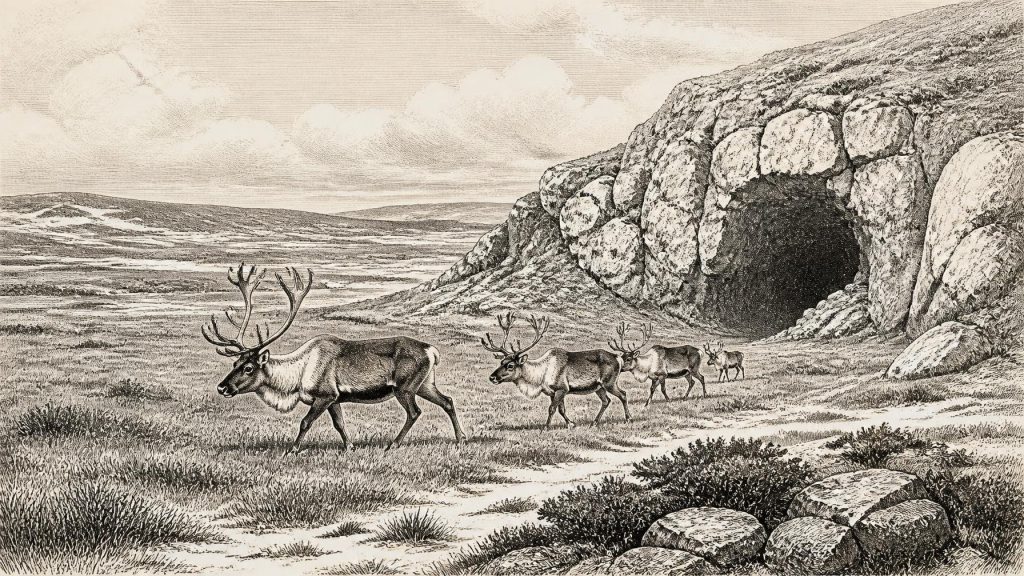
The most important Irish place for discussing this period is Castlepook Cave, also known as Mammoth Cave, near Doneraile in north County Cork. Its passages lie in Carboniferous limestone in the Awbeg valley below the Ballyhoura Hills. Excavations undertaken in the early twentieth century recovered a striking collection of animal remains. Subsequent research, including renewed fieldwork in 2022, has stressed both the exceptional value of the site and a central difficulty: much of the old collection came from deposits disturbed by earlier excavation, cave processes and animal activity. A bone found in the same gallery as another bone need not be of the same date, and cave assemblages cannot automatically be treated as snapshots of a single living landscape.
Even with that caution, Castlepook establishes that Ireland supported a richer Pleistocene fauna than the modern island. Identified remains include reindeer, brown bear, wolf, Arctic fox, mountain hare, lemmings, giant deer, woolly mammoth and spotted hyaena. Re-dating has been especially important. Improved pretreatment of bone samples produced dates substantially older than some results obtained in the 1990s, and research suggests that giant deer and spotted hyaena may have disappeared locally before the Last Glacial Maximum, around 40,000 calibrated years ago. The proper conclusion is not that all these animals met in one herd at 31,918 BCE; rather, Castlepook records repeated animal presences during MIS 3 and later cold phases.
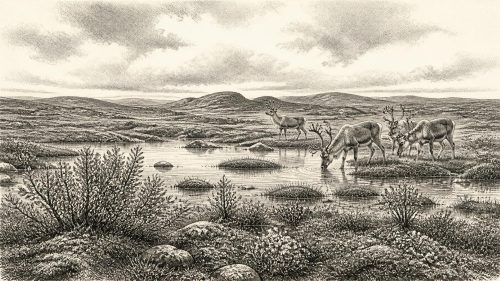
Reindeer are especially relevant to the period. Their presence indicates open, cold-adapted landscapes with sufficient grazing, not the dense woodland familiar from much later Ireland. Yet reindeer bone alone cannot reconstruct vegetation exactly, population numbers or seasonal migrations. Mammoth, hyena and lemming remains likewise show that Ireland formed part of the wider north-west European world of cold-stage animals, while leaving many local questions unanswered. Caves tend to preserve bones deposited by carnivores, animals dying in shelter, water and sediment movement, as well as people. Castlepook was therefore an animal refuge and trap for evidence before it can be confidently called a human site.
The Marked Reindeer Bone
A reindeer femur from Castlepook provides the closest possible connection between this date and human activity. Re-examination of the old collection identified deep marks interpreted as having been made on fresh bone by a sharp stone implement during butchery. Publicly reported dating placed the specimen at roughly 33,000 years ago. If the interpretation and chronological association are sustained by continuing research, it would represent the earliest known evidence of human activity in Ireland by a very large margin: not proof of a settled population, but evidence that people reached the island or its then-accessible margins during the Upper Palaeolithic.
The distinction matters. The bone is not a house floor, hearth, stone-tool assemblage, burial or camp with intact stratigraphy. It does not tell us whether the people involved were there for hours, days or a season; whether they hunted the animal, scavenged it, or merely processed part of a carcass; nor whether they returned. Nor has a named human individual, a language or a social group been recovered from Ireland for this time. The evidence is strongest for a particular action on an animal bone, weaker for the wider setting of that action, and insufficient for a narrative of permanent colonisation. Archaeology progresses by maintaining those levels of confidence rather than collapsing them into a dramatic origin story.
That restraint is reinforced by the contrast with later evidence. At Alice and Gwendoline Cave in County Clare, a brown-bear kneecap bearing cut marks has been directly dated to approximately 12,810–12,590 calibrated years before present. It is secure evidence that people were present in Ireland in the Late Upper Palaeolithic, but it is more than twenty millennia later than the Castlepook reindeer claim. The best-supported substantial settlement record remains still later, in the Mesolithic. Thus the Cork find opens a compelling possibility of earlier visitation; it does not erase the long gaps in the Irish archaeological record.
Landscape, Movement and Survival
At this time, lowering global sea level exposed broad areas of the continental shelf around north-west Europe. That fact makes animal and human movement towards Ireland plausible, but it does not license a simple claim that a permanent dry road joined Ireland and Britain. Relative sea level depended not only on global ocean volume but also on crustal movements and the growth of nearby ice. Models and geological studies have produced different reconstructions of possible connections, while later work rejects an uncomplicated late-glacial Irish land bridge. For around 31,918 BCE, the cautious position is that the geography of the Irish Sea was different and routes may have been more practicable, but the exact route taken by any animal or person represented at Castlepook is unknown.
Climate set the terms of life. The progressive growth of the British–Irish Ice Sheet altered drainage, sea level, vegetation and the availability of feeding grounds. The later ice sheet would cover Ireland and the continental shelf almost completely, but its advance was asynchronous: some regions were engulfed earlier than others, and southern Ireland may have experienced a relatively short interval of full glacial occupation. For mobile herbivores and their predators, such environmental change would have shaped movement and local extinction. For any human party, it would have made Ireland a demanding northern frontier: exposed, seasonal and uncertain, rather than an empty stage waiting for history to begin.
What Cannot Be Reconstructed
There is no evidence from Ireland around this point for political institutions, chiefs, territorial kingdoms, warfare, treaties or diplomacy. Equally, there is no basis for identifying trade networks, currencies, farming, villages, religious monuments, formal burials, art or systems of learning. These absences are not evidence that Ice Age people lacked social relationships, beliefs, skill or language; Upper Palaeolithic communities elsewhere in Europe certainly possessed complex social and cultural lives. They are statements about the Irish record. A single modified bone cannot reveal a hierarchy, a ritual or an economy.
Some modest inferences remain reasonable. The person or people who made the Castlepook marks, if the human interpretation is confirmed, possessed a cutting implement of stone and the practical knowledge to use it on a large animal. Processing meat, hide, sinew or bone would have been valuable in a cold environment. Such work need not have occurred deep inside the cave: the discarded portion may have entered it later through scavenging or natural movement. The cave’s ancient deposits are evidence of a changing ecological zone, while the marked femur may be evidence of a fleeting human encounter within it. The difference between those two propositions should remain visible.
Ireland around 31,918 BCE is therefore not a year of kings, monuments or recorded battles. It is a horizon of evidence preserved in limestone: reindeer moving through cold open country, predators and scavengers using caves, and an old bone from Doneraile carrying marks that may place human hands at the western edge of Ice Age Europe. Future excavation, direct dating and taphonomic study may refine, confirm or revise that picture. For now, its historical importance lies precisely in its fragility: the possibility of an early human visit, set against a landscape about to be transformed by expanding ice.
Source References
Hover over a number to see the source. Select it to open the source.

- [1] The Irish Quaternary Fauna Project
- [2] A reconsideration of the radiocarbon dating of the Marine Isotope Stage 3 fauna from southern Ireland
- [3] First evidence of a Late Upper Palaeolithic human presence in Ireland
- [4] New insights on the fauna of Ireland's Younger Dryas and Early Holocene from Alice & Gwendoline Cave
- [5] Late Pleistocene chronostratigraphy and ice sheet limits, southern Ireland
- [6] Maximum extent and dynamic behaviour of the last British–Irish Ice Sheet west of Ireland
- [7] Radiocarbon constraints on the age of the maximum advance of the British–Irish Ice Sheet in the Celtic Sea
- [8] The last Irish Ice Sheet: extent and chronology
- [9] Pattern and timing of retreat of the last British-Irish Ice Sheet
- [10] Growth and retreat of the last British–Irish Ice Sheet, 31,000 to 15,000 years ago: the BRITICE-CHRONO reconstruction
- [11] Trimlines, blockfields and the vertical extent of the last ice sheet in southern Ireland
- [12] Timing and pace of ice-sheet withdrawal across the marine–terrestrial transition west of Ireland during the last glaciation
- [13] The problem of a late quaternary landbridge between Britain and Ireland
- [14] Deglaciation, Earth crustal behaviour and sea-level changes in the determination of insularity: A perspective from Ireland
- [15] The Island of Ireland: Drowning the Myth of an Irish Land-Bridge?
- [16] Ireland: Submerged Prehistoric Sites and Landscapes
- [17] The colonization of Ireland: A human ecology perspective
- [18] 2022:564 - CASTLEPOOK CAVE, Castlepook South, Cork
- [19] Castlepook Caves
- [20] Heritage Artefacts of County Cork
- [21] Archaeological Heritage of County Cork
- [22] Our Ancient Landscapes: Hunter-Gatherers in Ireland
- [23] Reindeer bone found in Cork cave shows human activity in Ireland 33,000 years ago
- [24] IntCal20 Northern Hemisphere Radiocarbon Age Calibration Curve (0–55 cal kBP)
Primary Sources
- The Irish Quaternary Fauna Project
- A reconsideration of the radiocarbon dating of the Marine Isotope Stage 3 fauna from southern Ireland
- First evidence of a Late Upper Palaeolithic human presence in Ireland
- New insights on the fauna of Ireland's Younger Dryas and Early Holocene from Alice & Gwendoline Cave
- Late Pleistocene chronostratigraphy and ice sheet limits, southern Ireland
- Maximum extent and dynamic behaviour of the last British–Irish Ice Sheet west of Ireland
- Radiocarbon constraints on the age of the maximum advance of the British–Irish Ice Sheet in the Celtic Sea
- The last Irish Ice Sheet: extent and chronology
- Pattern and timing of retreat of the last British-Irish Ice Sheet
- Growth and retreat of the last British–Irish Ice Sheet, 31,000 to 15,000 years ago: the BRITICE-CHRONO reconstruction
- Trimlines, blockfields and the vertical extent of the last ice sheet in southern Ireland
- Timing and pace of ice-sheet withdrawal across the marine–terrestrial transition west of Ireland during the last glaciation
- The problem of a late quaternary landbridge between Britain and Ireland
- Deglaciation, Earth crustal behaviour and sea-level changes in the determination of insularity: A perspective from Ireland
- The Island of Ireland: Drowning the Myth of an Irish Land-Bridge?
- Ireland: Submerged Prehistoric Sites and Landscapes
- The colonization of Ireland: A human ecology perspective
- 2022:564 – CASTLEPOOK CAVE, Castlepook South, Cork
- Castlepook Caves
- Heritage Artefacts of County Cork
- Archaeological Heritage of County Cork
- Our Ancient Landscapes: Hunter-Gatherers in Ireland
- Reindeer bone found in Cork cave shows human activity in Ireland 33,000 years ago
- IntCal20 Northern Hemisphere Radiocarbon Age Calibration Curve (0–55 cal kBP)