Castlepook’s Faunal Threshold30224 BCE
Thirty thousand years BCE is an artificial chronological label, not a recorded Irish event. During Marine Isotope Stage 3, Ireland experienced fluctuating cold conditions before the Last Glacial Maximum, supporting varied, locally productive open habitats amid ice, wetlands and periglacial terrain. Castlepook Cave in County Cork preserves Ireland’s richest pre-maximum vertebrate record, though its mixed, disturbed deposits span millennia and cannot reconstruct a single fauna. Mammoth, reindeer, giant deer, carnivores and smaller cold-adapted animals indicate changing ecosystems; Fermanagh plant remains document wetlands. A possibly tool-marked reindeer bone suggests an early human visit, but settlement remains unproven. Evidence remains highly fragmentary.

Dateline
The label 30,224 BCE is useful only as a modern organising device. It does not identify a recorded Irish year, season, ruler or event. In archaeological terms it lies roughly 32,173 years before the conventional radiocarbon present of 1950, within the Late Pleistocene and broadly within Marine Isotope Stage 3 (MIS 3). No evidence from Ireland can be dated with calendar-year precision at this depth of time. Radiocarbon results must be calibrated, carry statistical ranges, and are often associated with individual animal bones rather than with a single, intact landscape or occupation. The responsible question is therefore not what happened in Ireland in one numbered year, but what the surviving evidence permits us to say about the island during the millennia around it.
Before the Ice Sheet Maximum
Ireland was moving through a volatile phase of the last glacial cycle. MIS 3 was not one uniformly frozen age: Greenland ice-core records and North Atlantic evidence show repeated swings between colder stadials and relatively milder interstadials. Those wider climatic reversals affected Irish ice, vegetation, rivers and animal habitats, although they cannot be translated mechanically into a local weather report for any one place or year. The full Last Glacial Maximum, when the British–Irish Ice Sheet achieved its widest extent, belongs later, conventionally around 26,500–19,000 calibrated years before present. Around the notional date represented here, the island was approaching that severe phase rather than already existing as the wholly ice-covered landscape often imagined by later visitors.
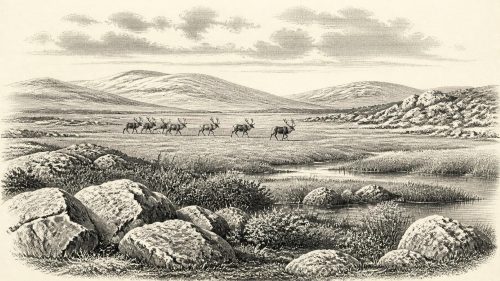
That distinction matters. The evidence indicates that parts of Ireland could support sizeable terrestrial mammals before the maximum, while other areas were affected by advancing ice or harsh periglacial conditions. Ireland was not a modern green island in winter dress. It was a shifting northern environment of exposed ground, short growing seasons, cold wetlands, grass- and herb-rich patches, scrub in more favourable localities and, in some regions, ice margins or terrain shaped by frost. The precise distribution of these habitats is uncertain. Subsequent ice movement eroded and buried many deposits, leaving a heavily selective record concentrated in caves, sediments preserved beneath glacial deposits, and scattered fossil finds.
The Castlepook Record
The principal Irish archive for this earlier part of the last glaciation is Castlepook Cave, also called Mammoth Cave or Doneraile Cave, in the Awbeg Valley of north County Cork. It is a maze-like limestone cave system whose chambers acquired evocative names, including Elephant Hall and Hyenahall, during nineteenth-century exploration. Excavations undertaken chiefly between 1904 and 1918 produced more than 2,000 bones. Geological Survey Ireland identifies Castlepook as the island’s richest known site for vertebrate fauna in the period leading towards the Last Glacial Maximum.
Its importance should not be mistaken for simplicity. Castlepook is a repository, not a sealed snapshot. Mammal remains entered over a very long span; water disturbed parts of the deposits; carnivores may have carried in prey or scavenged portions of carcasses; and early excavators worked before modern recording standards. Individual bones from the cave have yielded dates ranging broadly from about 45,700 to 19,950 radiocarbon years before present. Thus a list of species from Castlepook does not mean that every animal met in one herd, or that each occupied the Cork landscape in 30,224 BCE.
Reassessment has sharpened that warning. New radiocarbon work on southern Irish cave fauna has shown that some older determinations understated the age of particular specimens by thousands of radiocarbon years. It suggests that giant deer and spotted hyaena may have disappeared locally before about 40,000 calibrated years before present, well before the final ice maximum. Mammoth, reindeer, brown bear, wolf, Arctic fox, mountain hare and lemmings all belong to the wider Irish Pleistocene record, but their local timing differs. The strongest conclusion is consequently modest but significant: Ireland supported changing large-mammal communities during the long pre-maximum phase, and Castlepook preserves rare evidence of that ecological history.
Animals and Landscape
The animals themselves illuminate the character, rather than the exact appearance, of the country. Reindeer and lemmings point to cold, open habitats. Mammoth implies productive grazing and browsing country somewhere within the animals’ accessible range, not an unbroken ice desert. Brown bear, wolf and spotted hyaena remind us that large carnivores and scavengers formed part of the food web. Giant deer, popularly but misleadingly known as the “Irish elk”, was not uniquely Irish, though Ireland later became especially famous for its enormous antlers. In this much earlier setting, its remains are evidence for a Pleistocene species with a complex chronology, not for a timeless national emblem.
Plant evidence is scarcer and often more difficult to date securely, but it supports a picture of treeless or nearly treeless cold-country mosaics in some locations. Organic silts preserved between glacial deposits at Derryvree near Maguiresbridge in County Fermanagh have yielded mosses, sedges, dwarf willow, mountain avens, bogbean and aquatic plants. These remains indicate freshwater and wet-ground habitats during an ice-free interval, rather than permanent polar barrenness. They cannot be assigned confidently to the artificial year 30,224 BCE, nor should they be treated as a national vegetation map. Yet alongside the animal record, they demonstrate that local pools, fens and seasonally productive margins existed during parts of the glacial cycle.
Regional difference was fundamental. Caves in the limestone country of Cork and Clare preserve bones because fissures and chambers trapped them. A buried wetland in Fermanagh preserves seeds and mosses because sediment sealed them beneath later till. Much of the rest of the island has lost comparable evidence through glacial erosion, river action and later soil formation. Absence of fossils in a county is therefore not proof that animals never passed through it. Equally, a fossil occurrence is not proof of a dense, enduring population. The map of Ice Age Ireland is a map of survival as much as a map of former life.
The Unsettled Human Question
The most consequential possible human evidence close to this broad period is also the most contested in implication. A reindeer femur from Castlepook has been reported as carrying a deep incision consistent with modification by a stone tool, and its bone has been publicised as approximately 33,000 radiocarbon years old. If the mark proves to be an anthropogenic cut made when the bone was fresh, it would show that a person handled a reindeer in Ireland far earlier than the long-accepted record of human presence.
That conditional language is essential. A date on the bone dates the animal’s death, not automatically the making of a surface mark. Nor does one modified bone establish a camp, a population, a route of migration, or continuous residence. Castlepook has not yet produced a securely associated lithic assemblage, hearth, dwelling, burial, human bone or stratified occupation surface of this age. Recent survey and excavation have sought undisturbed deposits capable of testing the old collections with modern methods. Their value lies partly in recognising how much could still be learned, and how much the original excavations left unresolved.
For that reason, it would be irresponsible to populate Ireland in 30,224 BCE with named hunter groups, seasonal territories or a fixed culture such as the Aurignacian or Gravettian. Such traditions are documented elsewhere in north-western Europe, but none is securely demonstrated in Ireland at this time. A brief visit by mobile people exploiting a favourable environmental window is possible if the modified-bone interpretation stands; a proven settlement is not. The better-established evidence for humans in Ireland comes much later, including a butchered brown-bear patella from Alice and Gwendoline Cave, County Clare, dated to about 12,810–12,590 calibrated years before present.
No Kingdoms, No Diplomacy
There were no Irish political institutions, kingships, borders, diplomacy or recorded conflicts that can be recovered for this date. Nor is there evidence for farming, metallurgy, pottery, permanent villages, monuments, formal religion or trade networks within Ireland. If people did reach the island in the earlier Upper Palaeolithic, they would have depended upon knowledge carried in their bodies and social relationships: the reading of animal tracks, weather, stone, shelter, water and safe routes. But that is a comparative inference from hunter-gatherer lifeways, not a documented Irish social system.
The same restraint applies to economy and exchange. Lower sea levels changed the geography of the Irish Sea basin, but water, ice and coastlines were themselves changing, and no proven route or trading connection can be assigned to this moment. Animal movement demonstrates that terrestrial colonisation was possible during parts of the glacial cycle; it does not tell us precisely how people, if present, arrived. Caves are often places of repeated animal use and natural accumulation, not necessarily human homes.
What This Date Can Mean
The historical significance of 30,224 BCE is therefore ecological and evidential rather than political. Ireland was part of a wider north-west European Ice Age world, its environments repeatedly altered by climate and ice. In sheltered pockets and open cold-country landscapes, mammals ranging from reindeer to mammoth could find habitat. In cave chambers near Doneraile, their bones accumulated through many different processes and across many thousands of years. Beneath later glacial deposits in Fermanagh, plant remains recorded wetlands that ice would subsequently overrun or seal.
Modern research turns these fragmentary survivals into a more cautious history. Radiocarbon calibration, zooarchaeology, taphonomy, sedimentology, palaeobotany and renewed cave excavation can narrow questions, but none supplies the certainty of an annal. Around this point in deep time, Ireland cannot be described year by year. It can, however, be understood as a changing Pleistocene landscape: environmentally diverse in places, rich enough at intervals to sustain formidable fauna, and possibly visited by people whose presence remains an important scientific question rather than an established chapter of settlement history.
Primary Sources
- A reconsideration of the radiocarbon dating of the Marine Isotope Stage 3 fauna from southern Ireland
- Castlepook Cave
- The Irish Quaternary Fauna Project
- Archaeology Research Excavation Grant 2022
- Archaeology Research Excavation Grant Report
- First evidence of a Late Upper Palaeolithic human presence in Ireland
- New insights on the fauna of Ireland's Younger Dryas and Early Holocene from Alice & Gwendoline Cave
- Deglaciation chronology of the Donegal Ice Centre, north-west Ireland
- Radiocarbon constraints on the age of the maximum advance of the British-Irish Ice Sheet in the Celtic Sea
- Dimensions and chronology of the last ice sheet in Western Ireland
- Last Glacial Maximum cirque glaciation in Ireland and implications for reconstructions of the Irish Ice Sheet
- Cosmogenic 10Be chronology of the last deglaciation of western Ireland
- Figure 6.— The subdivision of the Quaternary Period in Ireland
- Outreach and Education Resources
- The IntCal20 Northern Hemisphere radiocarbon age calibration curve (0-55 cal kBP)
- The IntCal20 Northern Hemisphere Radiocarbon Age Calibration Curve (0–55 cal kBP)
- Occurrence of mammalia relicts at site Castlepook Cave
- Castlepook Cave, Castlepook South, Cork
- Areas of Scientific Interest in County Cork
- Prehistoric Details
- Investigating seasonal mobility in Irish giant deer (Megaloceros giganteus Blumenbach) using strontium isotope analysis
- Glacial geomorphology in the Wicklow Mountains, Ireland
- The geomorphology of Ireland’s continental shelf