Celtic Shelf Horizons31869 BCE
Around 31,869 BCE, Ireland was a cold Late Pleistocene landscape, not a precisely datable historical moment. Before the Last Glacial Maximum, parts of the island remained ice-free, supporting open tundra wetlands, sedges, grasses, mosses and shallow freshwater habitats. Derryvree and Greenagho deposits in Fermanagh demonstrate these conditions, while cave evidence records climatic fluctuations and diverse fauna including mammoth, reindeer, giant deer, predators and smaller cold-adapted animals. Castlepook Cave suggests wider ecological links with north-west Europe, but its disturbed deposits limit precision. Human visits remain possible, yet no secure contemporary settlement exists. Expanding ice later reshaped and obscured much earlier evidence.
Dateline
“31,869 BCE” is a modern chronological label, not a date that can be identified in Ireland’s prehistoric record. No inscription, settlement layer or event can be assigned to that particular year. In calendar terms it falls roughly 33,800 years before AD 1950, conventionally expressed as about 33.8 thousand calibrated years BP. At such depth of time, radiocarbon results carry substantial ranges and must be calibrated rather than treated as exact calendar dates. The responsible subject, therefore, is not what happened in a single Irish year, but what the surviving geological, botanical and animal evidence can reveal about the island during the later part of Marine Isotope Stage 3, within the last glacial cycle.
A Cold-Phase Ireland
Ireland at this point lay in the Pleistocene, long before farming, monuments, metalworking, written language or the political communities familiar from later history. Archaeologists and Quaternary scientists commonly use Midlandian for the last cold stage in Ireland, broadly corresponding to the Devensian of Britain and parts of Marine Isotope Stages 4–2. Around 33.8 thousand calibrated years BP, the climate was cold, but the final and most extensive phase of the last Irish Ice Sheet had not yet overwhelmed all parts of the island.
This distinction matters. Older popular accounts sometimes pictured Ireland simply as a country buried continuously beneath ice throughout the Ice Age. The evidence instead indicates fluctuating conditions: advances of ice, periods when ice margins withdrew or remained localised, and severe periglacial landscapes beyond them. The best available reconstructions suggest that north-central Ireland was ice-free until at least about 34,000 years ago, while major expansion of the last Irish Ice Sheet occurred later and its maximum extent belongs principally to the period around 27,000–23,000 years ago. That broad sequence places 31,869 BCE near an important threshold, when cold environments and growing ice masses were reshaping the country but before the Last Glacial Maximum.
That is a regional reconstruction, not a map precise enough to locate an ice front on a particular day or even in a particular century. Ice sheets are dynamic; their margins respond to snowfall, summer melting, sea level, topography and changes in North Atlantic climate. Ireland’s record is also patchy because later glaciers eroded, mixed and buried many earlier deposits. What survives is often protected beneath till, preserved in caves, or retained as small organic lenses in old lake and wetland sediments.
Derryvree’s Buried Evidence
The most illuminating evidence for conditions broadly overlapping this date comes from Derryvree near Maguiresbridge, County Fermanagh. There, excavations exposed freshwater silts and fine sands trapped between two thick tills within a drumlin. The organic deposit produced a radiocarbon determination of 30,500 years BP, with a quoted laboratory uncertainty; published calibrations place its age broadly between about 36,900 and 31,700 calibrated years BP. The modern label 31,869 BCE falls within that broad interval, but it would be wrong to say that the deposit records that precise year.
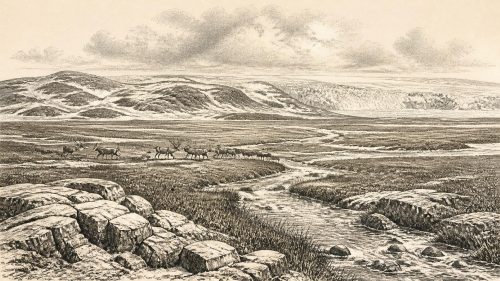
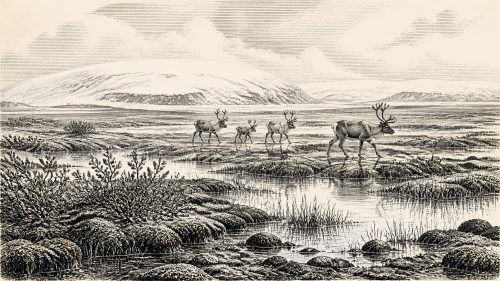
The Derryvree flora and fauna nevertheless offer an unusually direct local window. Pollen, plant macrofossils, mosses and insect remains point to open tundra or muskeg: wet, uneven ground with shallow pools, sedges, grasses, herbs and moss-rich surfaces, rather than a closed forest. Juniper occurred locally or regionally, while the sparse tree pollen needs cautious treatment because pollen can travel far and can be reworked from older sediment. The stronger conclusion is that extensive woodland was absent around the site. This was a treeless, exposed landscape shaped by frost, seasonal thaw and short growing seasons.
Nearby Greenagho, also in County Fermanagh, yielded organic material beneath till dated to an earlier but overlapping Middle Midlandian episode, calibrated broadly to about 37,200–35,700 years BP. Together, these sites establish that parts of northern Ireland could support freshwater habitats and low, open vegetation during intervals before the later ice-sheet advance. They do not prove that Derryvree and Greenagho had identical weather, vegetation or animal populations at every moment. Their value lies in demonstrating the kind of cold-phase landscape that existed within the relevant millennia.
Grass, Sedge and Shallow Water
Everyday life in this environment, if people were present, would have been constrained by exposure, mobility and seasonality. Yet the evidence does not establish a human community in Ireland at 31,869 BCE. There are no securely dated houses, hearths, stone-tool scatters, burials or occupation surfaces from this phase. It follows that there can be no responsible account of Irish households, clothing, language, kin groups or food-sharing customs for this numbered year. These are absences in the record, not proof that no person ever entered the island during the wider period.
The landscape itself had its own rhythms. Snow cover, frozen ground and spring melt would have controlled where water gathered and where plants could grow. Sedge- and grass-dominated areas would have offered forage in the warmer part of the year; mossy wetlands and pools would have created locally varied habitats amid generally sparse vegetation. Insects recovered from comparable deposits supply an independent check on plant evidence, because species have particular environmental requirements. They reinforce the picture of cold, open ground rather than a forested Ireland.
Crag Cave in County Kerry provides a different sort of climate archive. Uranium-thorium dating of broken and reworked speleothems shows episodes of calcite formation during Marine Isotope Stage 3. Because cave calcite requires liquid water moving through the rock, its formation indicates intervals sufficiently mild for mean annual temperatures to rise above freezing in this shallow cave system. Such evidence does not turn Ireland into a temperate refuge, nor does it date an outdoor landscape at a particular location. It does, however, show that the late glacial world was punctuated by millennial-scale climatic shifts rather than being uniformly frozen.
Animals and the Cave Record
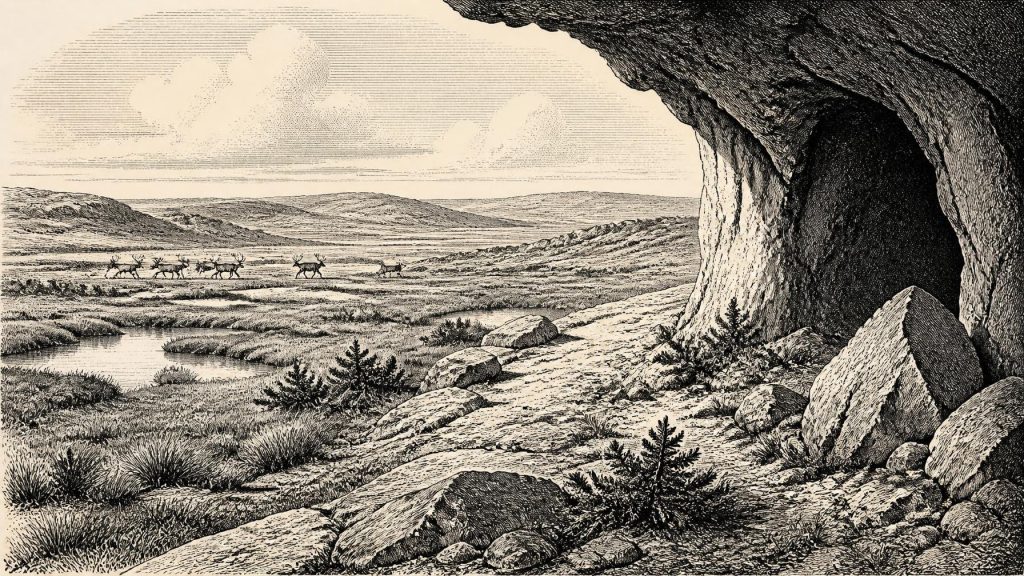
The richest Irish animal archive for this broad period is Castlepook Cave near Doneraile in north County Cork. Its deposits have produced remains attributed to woolly mammoth, reindeer, giant deer, brown bear, wolf, Arctic fox, mountain hare, lemmings and spotted hyaena. A cave is not a census of the surrounding countryside: carnivores may drag prey inside, floods can move bones, and nineteenth- and early twentieth-century excavations did not always record layers to modern standards. Some material at Castlepook is demonstrably later than the Ice-Age fauna, while water disturbance and complex deposits complicate associations between bones.
Those limitations are central to interpretation. Direct radiocarbon dating and later reassessment place elements of the Castlepook assemblage in Marine Isotope Stage 3, but individual species and bones need not all be exactly contemporary. The site supports the robust conclusion that a varied cold-stage mammal community occurred in Ireland during the wider pre-Last Glacial Maximum period. It cannot show that every listed animal shared the same hillside in 31,869 BCE.
Still, the combination is revealing. Reindeer, hares and lemmings suit cold, open habitats; mammoth and giant deer indicate the potential for large herbivores where forage and access permitted; wolves and hyaenas imply large predators and scavengers. Their presence is evidence of ecological connections into the wider north-west European world. It does not settle the exact routes by which animals reached Ireland. Lower sea levels exposed areas now under the sea, while ice, water channels and changing coastlines made connections between Ireland, Britain and continental Europe complex. Scholars continue to debate the timing and practicality of land or ice connections; a simple, permanent ‘Irish land bridge’ is not an adequate explanation.
People: Possibility, Not a Recorded Society
The question of humans requires especially careful language. A reindeer bone from Castlepook has been publicised as bearing a possible cut mark and has been linked to human activity around 33,000 years ago. If confirmed as a genuine stone-tool mark made soon after the animal’s death, it would be important evidence that people reached Ireland during the broader interval. But one modified bone, from a disturbed cave context, is not equivalent to a securely excavated camp. It supplies neither a population estimate nor evidence for permanent settlement, political organisation or a continuous occupation of the island.
For the present, the earliest firmly dated evidence of human presence in Ireland belongs much later, in the terminal Pleistocene at Alice and Gwendoline Cave in County Clare. That contrast is instructive: evidence can establish that humans were present at a cave at one later date without resolving whether they visited Ireland tens of millennia earlier. Around 31,869 BCE, a cautious history must retain the possibility of short-lived human incursions while refusing to invent Palaeolithic tribes, leaders, rituals or conflicts.
No Polities, No Diplomacy
There is no evidence for political affairs, warfare, diplomacy, institutions or named territories in Ireland at this time. Such categories depend on people and social structures that leave recognisable traces, and none can be reconstructed here. Nor can religion and learning be described in specifically Irish terms: no images, graves, ceremonial sites, spoken traditions or written sources survive from this period. The absence of evidence is particularly stark because later glaciation removed or buried much of the old land surface.
Likewise, there was no economy in the historical sense of fields, livestock, markets, coinage or long-distance trade networks evidenced in Ireland. The only ‘exchange’ securely visible is ecological: animals and plants dispersing through shifting northern Atlantic environments, with caves and sediments preserving fragments of their passage. If people occasionally crossed into Ireland, they may have carried knowledge and materials, but that is an inference without direct Irish artefacts for this date.
An Island Before Its History
The importance of 31,869 BCE lies less in a singular occurrence than in the conditions it represents. Ireland was a severe but not lifeless part of the wider Late Pleistocene world: at least some areas were open, cold and ice-free; freshwater pools and tundra vegetation existed in the north; large mammals ranged through parts of the island during the wider period; and ice-sheet expansion was gathering force. The physical foundations of later Ireland—its drumlins, scoured rock, altered drainage and glacial sediments—were being made or prepared by processes that would intensify after this time.
Modern calendar precision should not disguise that scale of uncertainty. The evidence supports calibrated ranges, environmental patterns and carefully bounded possibilities, not an event diary. For Ireland around 31,869 BCE, the most honest historical picture is a landscape of tundra wetlands, roaming fauna and changing ice, poised before the much more extensive glaciation that would erase so much of what came before.
Primary Sources
- A Middle Midlandian Freshwater Series at Derryvree, Maguiresbridge, County Fermanagh, Northern Ireland
- Middle Midlandian Interstadial Deposits at Greenagho, Near Belcoo, County Fermanagh, Northern Ireland
- Early Midlandian–Middle Midlandian, Pleistocene, Northern Ireland
- Trimlines, Blockfields and the Vertical Extent of the Last Ice Sheet in Southern Ireland
- Late Pleistocene Chronostratigraphy and Ice Sheet Limits, Southern Ireland
- Dimensions and Chronology of the Last Ice Sheet in Western Ireland
- Vertical Dimensions and Age of the Wicklow Mountains Ice Dome, Eastern Ireland, and Implications for the Extent of the Last Irish Ice Sheet
- Stratigraphic and Palaeo-Geomorphological Evidence for the Glacial-Deglacial History of the Last British-Irish Ice Sheet in the North-Western Irish Sea
- Oscillating Retreat of the Last British-Irish Ice Sheet on the Continental Shelf Offshore Galway Bay, Western Ireland
- Timing and Pace of Ice-Sheet Withdrawal Across the Marine–Terrestrial Transition West of Ireland During the Last Glaciation
- Episodic Speleothem Deposition Tracks the Terrestrial Impact of Millennial-Scale Last Glacial Climate Variability in SW Ireland
- A Reconsideration of the Radiocarbon Dating of the Marine Isotope Stage 3 Fauna from Southern Ireland
- Castlepook Cave, County Geological Site Report
- The Exploration of Castlepook Cave, County Cork
- The Irish Quaternary Fauna Project
- Occurrence of Mammalia Relicts at Site Castlepook Cave
- Pleistocene Vertebrates in the British Isles
- New Insights on the Fauna of Ireland’s Younger Dryas and Early Holocene from Alice & Gwendoline Cave
- First Evidence of a Late Upper Palaeolithic Human Presence in Ireland
- The IntCal20 Northern Hemisphere Radiocarbon Age Calibration Curve (0–55 cal kBP)
- Landscapes and Environments of the Last Glacial-Interglacial Transition: A Time of Amazingly Rapid Change in Ireland
- Palaeoecology: Irish Quaternary Association Field Guide
- The Problem of a Late Quaternary Landbridge Between Britain and Ireland
- Origin of British and Irish Mammals: Disparate Post-Glacial Colonisation and Species Introductions