Elephant Hall’s Mammoth Bone31905 BCE
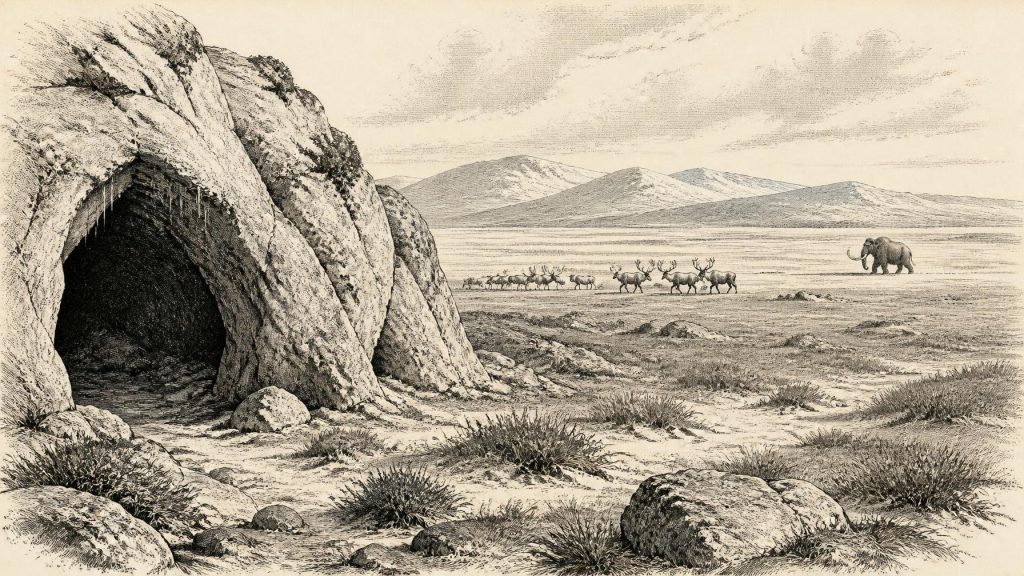
Around 31,905 BCE, Ireland was a variable Late Pleistocene landscape, not a place with recoverable annual history. Derryvree, County Fermanagh, preserves freshwater deposits indicating treeless, periglacial tundra during MIS 3, although dates remain broad and local. Castlepook Cave in County Cork yielded mammoth, reindeer, giant deer, bear, wolf, Arctic fox, hyaena and lemming remains, demonstrating links with north-west European cold-stage fauna. Redating complicates earlier conclusions. A cut-marked reindeer bone may indicate brief Upper Palaeolithic butchery, but no secure occupation evidence exists. These fragments suggest occasional human visitation, not continuous settlement, before later glaciation and post-glacial colonisation in the archaeological record.
Dateline
The label 31,905 BCE offers a misleading degree of precision. No Irish written record, annually layered settlement sequence, named community or datable historical event can be assigned to this particular year. In archaeological terms it falls broadly around 33,850 years before present, conventionally measured from 1950, during the Late Pleistocene and Marine Isotope Stage 3 (MIS 3). That is useful orientation, not an anniversary. Radiocarbon determinations must be calibrated against changing atmospheric carbon levels, and the results are expressed as probability ranges rather than exact calendar years. The responsible question is therefore not what happened in Ireland in one year, but what its surviving geological and faunal evidence can say about the island around this part of the Ice Age.
A Far-Northwestern Landscape
Ireland lay at the north-western edge of the European landmass and climatic system. Sea levels were substantially lower than now because large quantities of water were locked in global ice sheets. The present Irish Sea and Celtic Sea were altered landscapes, with exposed shelf in places and changing routes between Ireland, Britain and continental Europe. Yet lowered sea level did not automatically mean an easy or permanent dry crossing. The configuration of coasts, rivers, estuaries, sea ice and local ice margins changed through time, while Ireland’s relation to Britain was shaped by a complicated, mobile glacial environment.
Nor was the island uniformly buried beneath ice at this moment. The full Last Glacial Maximum, when the British–Irish Ice Sheet reached its greatest late-glacial extent, came later, broadly after about 26,500 years ago. Evidence from caves and buried terrestrial deposits shows that, during portions of MIS 3, some Irish landscapes could support vegetation and large mammals. Exactly which districts were ice-free at any short-lived interval remains debated. Ice sheets advanced and retreated; periglacial conditions could dominate beyond their margins; and later glaciation stripped away or redeposited much of the evidence that might once have existed.
Derryvree’s Buried Tundra
The clearest environmental evidence relevant to this date comes not from a settlement but from a buried deposit at Derryvree near Maguiresbridge, County Fermanagh. Roadworks exposed freshwater silts and fine sands enclosed between two separate tills within a drumlin. Organic material from the deposit returned a conventional radiocarbon determination of 30,500 years BP, with an uncertainty of +1,170 and −1,030 years. Later calibration places the age broadly within about 31,700–36,900 calibrated years BP. The modern year 31,905 BCE, approximately 33,850 years before present, falls within that broad chronological neighbourhood, but cannot be pinpointed inside it.
The plants and small animals preserved in the Derryvree sediments indicate open tundra and a periglacial regime: ground subject to intense frost, short growing seasons and little or no woodland. Grasses, sedges, juniper and herbaceous plants were important components of this landscape, alongside mosses. This was not the green, wooded Ireland familiar today, nor an utterly lifeless polar desert. It was a sparse, wind-exposed terrain in which wet hollows and shallow freshwater environments could preserve organic remains. Such evidence provides a local environmental record, not a complete map of the island; nevertheless, it demonstrates that at least part of Ulster had a treeless cold-stage ecosystem during a period close to this one.
Other Fermanagh sites add depth and caution. Organic beds at Greenagho, near Belcoo, and at Hollymount and Aghnadarragh have yielded pollen, insects and sediments associated with changing Middle Midlandian conditions. Their chronologies and correlations are not all equally secure. Taken together, they suggest that Irish climate during MIS 3 did not follow one uninterrupted descent into maximum cold. It fluctuated sharply, and local environments responded differently to changing moisture, temperature and ice extent. Calcite formations in Crag Cave, County Kerry, offer independent evidence of this instability: episodes of speleothem growth indicate intervals when water could percolate through the limestone, while growth stopped during harsher Greenland stadials.
The Cave Fauna of North Cork
For southern Ireland, Castlepook Cave near Doneraile, County Cork, is the crucial site. Known historically as Mammoth Cave, its chambers include the evocatively named Elephant Hall. Excavations in the late nineteenth and early twentieth centuries, followed by later work, recovered a remarkable assemblage of Ice Age animal remains. They include woolly mammoth, reindeer, giant deer, brown bear, wolf, Arctic fox, spotted hyaena and lemmings. Not every specimen came from a sealed modern excavation, and the cave’s deposits were accumulated, disturbed and investigated over a long period. Consequently, the assemblage must not be treated as a photograph of a single moment or an intact animal community living together on one day.
Nevertheless, the fauna establishes something important. Ireland was not biologically isolated from the wider north-west European cold-stage world. Reindeer and mammoth imply substantial grazing country; lemmings and Arctic fox point to cold, open habitats; wolves, bears and hyaenas occupied higher levels of the food web. The presence of spotted hyaena is particularly striking. Caves were not necessarily places where these animals died naturally: carnivores could transport bones into dens, and water, collapse and later digging could move them again. Elephant Hall’s mammoth bone is therefore evidence for an Ice Age animal, not proof that mammoths inhabited that particular chamber.
Recent redating has made the chronology more complicated but more reliable. Improved pretreatment of bone collagen has shown that several older Irish cave radiocarbon results were too young, in some cases by thousands of radiocarbon years. Reassessment of material from Castlepook, Foley and Shandon caves places portions of the southern Irish fauna firmly within MIS 3 and suggests that giant deer and spotted hyaena may have disappeared locally before the Last Glacial Maximum. The lesson is methodological as well as chronological: a famous specimen may remain valuable while its date, depositional history and interpretation require revision.
A Possible Human Trace
Castlepook also matters because a reindeer femur from its old collections has been reported as bearing a mark consistent with cutting by a sharp stone tool. It has been presented as possible evidence that Upper Palaeolithic hunters processed a reindeer in Ireland roughly 33,000 years ago. If that interpretation is sustained, it would extend the island’s known human story enormously beyond the post-glacial hunter-gatherer settlement usually represented by Mount Sandel, which began many millennia later.
The qualification is essential. A modified animal bone is not a campsite. No securely associated hearth, lithic assemblage, human skeleton, dwelling floor, art panel or stratified occupation surface has yet demonstrated a settled human presence in Ireland around 31,905 BCE. Natural damage, carnivore activity, sediment movement and the limitations of antiquarian excavation all require scrutiny when assessing marks on bone. Current fieldwork at Castlepook seeks undisturbed deposits and the kinds of associated evidence that could test the claim. At present, the strongest formulation is that the bone may record a brief episode of human butchery or carcass processing, rather than a permanent population.
Life Without a Recorded Society
If people did reach Ireland during this phase of MIS 3, they would have been highly mobile hunter-gatherers operating within a severe and variable environment. Their practical concerns would have included locating game, fuel and shelter, reading seasonal conditions, and maintaining contact with other groups beyond the island. Reindeer would have supplied meat, fat, hides, sinew, antler and bone; carcasses of other large animals could also have been valuable. These are reasonable inferences from Upper Palaeolithic lifeways elsewhere in north-west Europe, not directly documented facts about a named Irish group.
There is no evidence here for farms, herds of domestic animals, fields, pottery, metalworking, villages, chiefs, kingdoms or formal institutions. Equally, there is no evidence from which to reconstruct political affairs, diplomacy, organised warfare, law, religion, language or ritual in Ireland at this date. A cave bone cannot reveal whether a hunting party travelled alone, cooperated with neighbouring groups, crossed from Britain, or returned home after a short visit. It cannot tell us whether people and hyaenas used the cave in the same generation, let alone encountered one another.
Trade must also be approached negatively. The Island’s position made movement across the surrounding landscape and waters consequential, but there are no Irish objects from this period that demonstrate an exchange network. Stone tools, if future excavations recover them in secure context, might reveal raw-material sources and technological links. Until then, the possibility of travel is stronger than evidence for commerce. Knowledge, culture and learning were almost certainly carried in bodies, skills, stories and social relationships rather than writing, but none of these leaves an identifiable record at Castlepook or Derryvree.
What This Year Can Mean
Around the modern label 31,905 BCE, Ireland should be understood as a changing cold-stage landscape rather than a country with a recoverable annual history. In Fermanagh, freshwater silts preserve evidence of treeless tundra between episodes of glaciation. In north Cork, cave deposits retain the remains of animals adapted to a cold, open world and a tantalising possible sign of human action. The evidence is important precisely because it is so limited: it shows that Ireland had ecological connections to Pleistocene Europe and may have received rare human visitors long before the better-attested post-glacial settlement.
It does not warrant a story of continuous occupation or an invented Ice Age community. The next advances will depend on carefully excavated contexts, modern dating, microscopic analysis of bone surfaces, environmental DNA where preservation permits, and comparison with Britain and continental Europe. For now, Elephant Hall’s mammoth bone and Derryvree’s buried tundra offer the most responsible portrait: not a known event in a known year, but fragments from a deep past in which ice, grassland, animals and perhaps passing hunters shaped Ireland’s earliest recoverable horizon.
Primary Sources
- A Reconsideration of the Radiocarbon Dating of the Marine Isotope Stage 3 Fauna from Southern Ireland
- The Irish Quaternary Fauna Project
- Middle Midlandian Freshwater Series at Derryvree, Maguiresbridge, County Fermanagh, Northern Ireland
- Middle Midlandian Interstadial Deposits at Greenagho, Near Belcoo, County Fermanagh, Northern Ireland
- Episodic Speleothem Deposition Tracks the Terrestrial Impact of Millennial-Scale Last Glacial Climate Variability in SW Ireland
- The IntCal20 Northern Hemisphere Radiocarbon Age Calibration Curve (0–55 cal kBP)
- The IntCal20 Northern Hemisphere Radiocarbon Age Calibration Curve (0–55 cal kBP)
- Maximum Extent and Dynamic Behaviour of the Last British–Irish Ice Sheet West of Ireland
- Pattern and Timing of Retreat of the Last British-Irish Ice Sheet
- Stratigraphic and Palaeo-Geomorphological Evidence for the Glacial-Deglacial History of the Last British-Irish Ice Sheet in the North-Western Irish Sea
- New Data for the Last Glacial Maximum in Great Britain and Ireland
- Figure 6: The Subdivision of the Quaternary Period in Ireland
- Archaeology Research Excavation Grant 2022: Final Report
- 2022:564 — Castlepook Cave, Castlepook South, Cork
- Heritage Artefacts of County Cork
- New Insights on the Fauna of Ireland’s Younger Dryas and Early Holocene from Alice & Gwendoline Cave
- Phylogeographic, Ancient DNA, Fossil and Morphometric Analyses Reveal Ancient and Modern Introductions of a Large Mammal: The Complex Case of Red Deer (Cervus elaphus) in Ireland
- Pleistocene Vertebrates in the British Isles
- Proceedings of the Royal Irish Academy: Castlepook Cave Report
- Mammoth Cave