Muskeg Beneath Fermanagh31906 BCE
Around 31,906 BCE, Ireland has no annual historical record; the date represents a broad Late Pleistocene, Marine Isotope Stage 3 horizon. Derryvree, County Fermanagh, preserves organic silts between tills, showing locally ice-free, treeless tundra-like wetlands supporting plants, insects and freshwater pools. Castlepook Cave, County Cork, contains accumulated remains of mammoth, reindeer, giant deer, hyaena and other cold-adapted mammals, although their dates and associations vary. A possibly cut-marked reindeer bone may indicate an early human visit, not settlement. No political, cultural or economic history is demonstrable. As the British-Irish Ice Sheet expanded, glaciers later erased much evidence, leaving rare ecological archives.

Dateline
31,906 BCE is a modern calendar label, not a year for which Ireland possesses an event-by-event history. There were no written records, named peoples, governments or dated monuments on the island. Nor can archaeological science identify something that happened in one particular calendar year so deep in time. Converted simply to the conventional archaeological reference point of AD 1950, the label lies about 33,855 years before present; it should be treated as a broad horizon around 34,000 calibrated years BP, not as a precise anniversary. At this age, calibrated ranges commonly span centuries or longer, and deposits may record episodes separated in time.
That horizon falls within the Late Pleistocene, during Marine Isotope Stage 3, in the long climatic descent towards the Last Glacial Maximum. In Irish terminology it belongs to the Midlandian glacial cycle. Ireland was not the settled, wooded island familiar from later prehistory. Its landscapes were repeatedly reshaped by cold, ice, wind, meltwater and changing sea levels. Yet the evidence does not justify a simple picture of an island uniformly sealed beneath ice in 31,906 BCE. The extent and timing of the growing British–Irish Ice Sheet differed by region, and the best local records instead reveal a harsh but locally ice-free environment in parts of Ireland during the wider interval.
Time Measured in Deposits
The most useful evidence near this date comes from Derryvree, close to Maguiresbridge in County Fermanagh. There, freshwater organic silts survived between two layers of glacial till. This is an exceptional piece of geological good fortune: later ice both erased much evidence elsewhere and sealed this small archive below its debris. A radiocarbon determination of 30,500 ± 1,200 radiocarbon years BP from the Derryvree series calibrates broadly to about 36,900–31,700 cal BP. That range encompasses the chronological neighbourhood of 31,906 BCE, though it cannot prove that every fossil in the deposit lived in that nominal year.
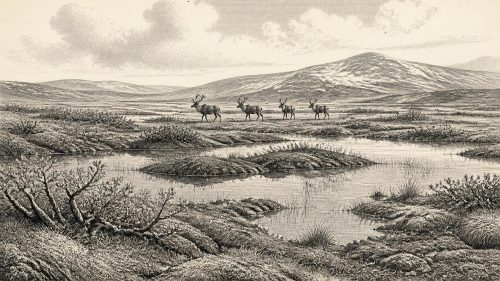
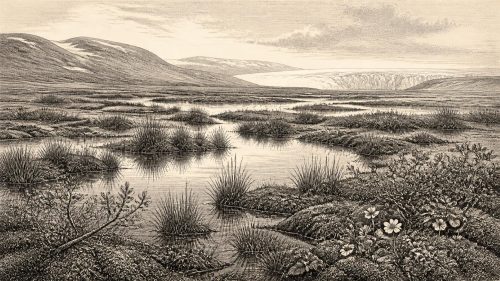
The Derryvree plants, pollen, mosses and insects indicate treeless, open ground with wet hollows and pools rich in plant material: a cold muskeg or tundra-like mosaic rather than forest. Grasses, sedges, juniper and herbs occurred alongside plants now associated with Arctic-alpine or wetland settings, including mountain avens, dwarf willow and bogbean. Insect evidence supports the picture of freshwater pools bordered by mossy vegetation. The cautious conclusion is strong enough to be vivid: at least in this part of Fermanagh, plants and small animals occupied a severe, periglacial landscape despite bitter winters.
It would be wrong, however, to project Derryvree unchanged across every Irish county. Palaeoenvironmental records are local, while the ice sheet and climate were dynamic. A pool-side community in Fermanagh does not tell us the exact character of exposed ground in Cork, the west coast or the Irish Sea basin. Its importance is that it decisively complicates the old assumption that late Ice Age Ireland was an ecological blank. Around the broad interval represented by this article, there were places where freshwater, vegetation and terrestrial life persisted.
Castlepook’s Animal World
In southern Ireland, the limestone caves at Castlepook near Doneraile, County Cork, preserve the most celebrated evidence for this earlier Ice Age fauna. Antiquarian excavators removed a very large collection of bones from the cave system in the late nineteenth and early twentieth centuries. Subsequent study has identified a remarkable range of mammals, including woolly mammoth, reindeer, giant deer, brown bear, wolf, Arctic fox, mountain hare, lemmings and spotted hyaena. Not every species need have been present together, and not every specimen belongs to the same climatic episode; a cave collection is an accumulated record, not a snapshot.
Even so, the assemblage demonstrates that Ireland could support a varied cold-stage animal community before the fullest glaciation. Mammoth and reindeer suggest open habitats capable of sustaining grazing herds; lemmings, hares and Arctic fox speak to cold conditions and low vegetation; bears and wolves remind us that a food web includes predators and opportunists as well as prey. Spotted hyaena is particularly significant. Its bones, tooth marks and droppings show that Castlepook was at times used as a den or scavenging place. Hyaenas could carry carcass parts into caves and gnaw them intensively. Therefore, animal bones found there do not automatically record animals dying in place, much less people hunting them.
Radiocarbon programmes have altered the chronology of the southern cave faunas. Early determinations from Castlepook already suggested a Middle Midlandian antiquity for mammoth and hyaena. Improved pretreatment and accelerator dating have since shown that several older Irish cave dates were too young, placing important Castlepook animals more securely within Marine Isotope Stage 3. Some results indicate that species such as giant deer and spotted hyaena disappeared locally before the Last Glacial Maximum, around 40,000 calibrated years ago. The consequence is not a neatly dated animal parade for 31,906 BCE, but a better-founded recognition that the Irish fauna had a deeper and more complex history than once thought.
A Possible Human Trace
Castlepook also matters because a reindeer femur from the old collection has been reported as bearing a mark consistent with cutting by a sharp stone tool. Its date has been publicised as about 33,000 BCE, making it broadly relevant to the period under discussion. If microscopic and contextual scrutiny ultimately confirms that the mark was made by people while processing a fresh carcass, it would be evidence that Upper Palaeolithic visitors reached Ireland vastly earlier than the formerly accepted late-glacial evidence.
The conditional language is essential. The bone came from an old excavation, rather than a modern, closely recorded archaeological layer. No securely associated hearth, stone-tool assemblage, dwelling floor, human burial or repeatedly used butchery site of comparable age has yet been recovered at Castlepook. Nor does one modified bone demonstrate a resident population. It may indicate a short visit by a small party, or it may require reinterpretation as research continues. The responsible historical position is that the femur is an important and promising possible sign of human activity, while sustained settlement in Ireland at this date remains unproven.
This uncertainty is heightened by geography. Lower sea levels and altered ice margins changed the outline of the Irish region, but modern coasts are a poor guide to the terrain, shorelines and crossings of the time. Nor can a dry land connection be assumed merely because large mammals reached Ireland. The routes by which animals and any people travelled, whether across temporary ice, narrow waters or changing coastal landscapes, remain unresolved. Later glaciation also destroyed or buried many potential sites, making absence of evidence a less decisive argument than it might otherwise be.
No Kingdoms, No Trade Network
There is no evidence for political affairs in Ireland around 31,906 BCE: no chiefs, tribes, boundaries, diplomacy, warfare or institutions can responsibly be named. The same is true of religion, language, art and formal learning. Caves may later acquire cultural meanings, but Castlepook’s evidence at this depth is principally palaeontological and geological. It cannot demonstrate ritual activity. Likewise, there is no Irish evidence for farming, herding, houses, pottery, metalworking, exchange networks or trade at this time. To supply any of these from better-known Upper Palaeolithic Europe would turn analogy into invented Irish history.
If people did visit, the reindeer bone permits only the narrowest economic inference: animal carcasses may have been a source of meat, hide, sinew, marrow or bone. Such uses are plausible for hunter-gatherers elsewhere, but they have not been excavated as a complete activity area in Ireland. Everyday life is more securely illuminated through the non-human record: animals navigating open country, predators using shelter, and plants surviving in wet ground through a demanding climate.
Approaching a Landscape Transformation
The larger development was environmental. The British–Irish Ice Sheet was building towards a much more extensive phase, although its advance was not simultaneous in every sector. Research based on landforms, offshore sediment cores and extensive dating programmes places the ice sheet’s maximum volume later, around 23,000 years ago, while margins advanced and retreated at different times between roughly 30,000 and 22,000 years ago. Near 31,906 BCE, Ireland stood in a transition: parts of its landscape still offered habitat and freshwater, but the forces that would scour, bury and reorder the island were gathering strength.
That future ice explains the peculiar shape of the evidence. Derryvree’s buried silts and Castlepook’s protected cave deposits are survivors of a record otherwise stripped by glaciers and erosion. They do not furnish a conventional annual chronicle. They offer something more fragmentary but still profound: proof that Late Pleistocene Ireland was a changing ecological frontier, inhabited certainly by cold-adapted animals and perhaps briefly visited by people, on the eve of a glacial transformation that would remove much of the evidence of both.
Primary Sources
- Middle Midlandian Freshwater Series at Derryvree, Maguiresbridge, County Fermanagh, Northern Ireland
- Irish Pleistocene Biostratigraphy
- A Reconsideration of the Radiocarbon Dating of the Marine Isotope Stage 3 Fauna from Southern Ireland
- The Irish Quaternary Fauna Project
- Growth and Retreat of the Last British–Irish Ice Sheet, 31 000 to 15 000 Years Ago: the BRITICE-CHRONO Reconstruction
- Trimlines, Blockfields and the Vertical Extent of the Last Ice Sheet in Southern Ireland
- Pattern and Timing of Retreat of the Last British-Irish Ice Sheet
- The Colonization of Ireland: A Human Ecology Perspective
- The IntCal20 Northern Hemisphere Radiocarbon Age Calibration Curve (0–55 cal kBP)
- First Evidence of a Late Upper Palaeolithic Human Presence in Ireland
- New Insights on the Fauna of Ireland's Younger Dryas and Early Holocene from Alice & Gwendoline Cave
- Ireland's Palaeolithic Archaeology – Fleeting Footprints in a Frozen Land
- 32564: Castlepook Cave, Ballyhea, Cork
- Heritage Artefacts of County Cork
- Ice Age Ireland
- Guide to the National Museum of Ireland – Natural History
- The Quaternary of Fermanagh and South Tyrone
- Project Findings Provide Essential Insight into the Last British–Irish Ice Sheet
- Hydrographic Survey Data Uncovers Preserved Glacial Landscape
- Geology of the Rockall Basin and Adjacent Areas