
Elephant Hall’s Hyena World30774 BCE
30,774 BCE is a modern label within later Marine Isotope Stage 3, not a date recoverable in Irish history. Derryvree, County Fermanagh, preserves evidence of an ice-free interval: cold, treeless freshwater wetlands with tundra vegetation, later buried by glacial deposits. Castlepook Cave, County Cork, contains Pleistocene remains of mammoths, reindeer, giant deer, bears, wolves, lemmings and hyaenas, indicating changing cold-steppe ecosystems. Cave materials accumulated over long periods and cannot represent one moment. A possibly tool-marked reindeer femur may indicate transient Upper Palaeolithic activity, but remains unconfirmed. Lower seas enabled uncertain dispersal routes; no secure evidence supports settlement, institutions or exchange.
Dateline
30,774 BCE is a modern chronological label, not a recoverable year in Irish history. No calendar, inscription, settlement sequence or historical event lets us identify what happened on the island in that particular year. In the archaeological convention in which “present” is AD 1950, it falls at roughly 32,700 years before present. That places it within Marine Isotope Stage 3 (MIS 3), a climatically unstable part of the Late Pleistocene, before the fullest expansion of the last British–Irish Ice Sheet. The evidence is measured in broad radiocarbon and calibrated ranges, not annual dates. Ireland at this depth of time is therefore illuminated by sediments, fossil plants, animal bones, cave deposits and glacial landforms rather than by people whose names, communities or decisions can be known.
An Ice-Age Interval, Not an Annual Chronicle
The nominal date lies close to the younger part of the range associated with the important Derryvree organic deposits in County Fermanagh. These sediments, exposed in a road cutting through a drumlin near Maguiresbridge, lay between two tills: deposits left directly by glacier ice. Between those glacial episodes, fine sands, silts and organic material accumulated in and beside fresh water. A conventional radiocarbon determination from the deposit, Birm-166, was 30,500 ± 1,200 radiocarbon years BP. When calibrated using modern curves, it gives a much broader calendar range, commonly expressed as roughly 36,900–31,700 cal BP. The range encompasses the modern label 30,774 BCE, but cannot prove that the Derryvree wetland existed in that exact year.
This distinction matters. Radiocarbon dating does not retrieve a date from a prehistoric calendar. It estimates the age of once-living material, with statistical uncertainty; calibration converts that result into probabilities on a calendar timescale because atmospheric carbon-14 has varied. A specimen dated to this remote period may have a range of centuries or millennia. Nor does one sample date every animal, pool or patch of vegetation in its deposit. The responsible account is thus one of an Irish landscape around the later MIS 3 world, not a claim to have reconstructed a day, season or event in 30,774 BCE.
Wet Ground Beneath Later Ice
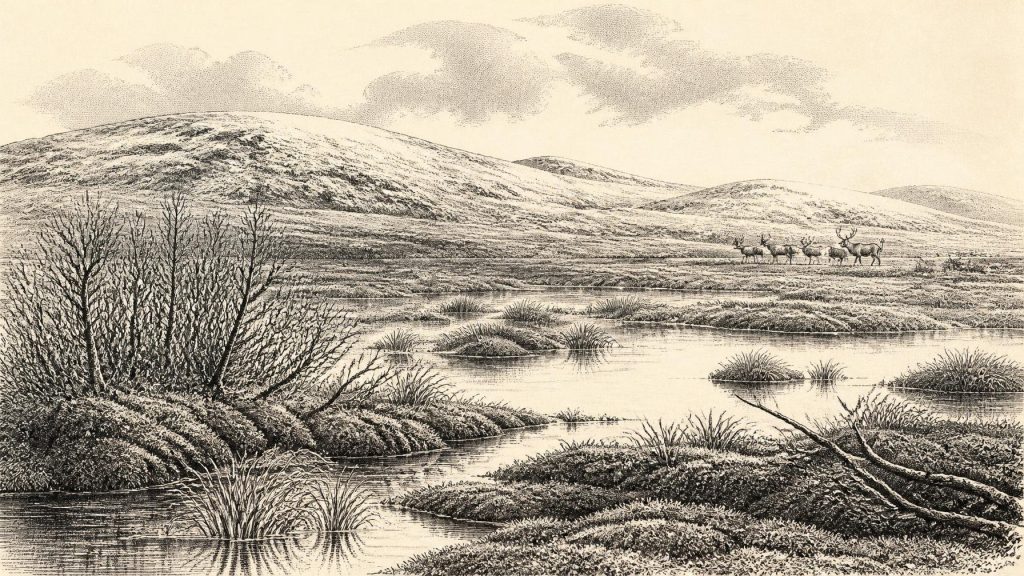
Derryvree provides the clearest local environmental window relevant to this point in time. Its plant macrofossils, pollen and insect remains indicate a cold, open and largely treeless setting. Mosses, sedges, grasses and hardy tundra plants grew around shallow water and wet ground. Fossil bogbean, a plant associated with fresh water and marshy margins, is especially useful evidence that this was not an entirely frozen wilderness. The landscape probably included pools, waterlogged hollows and patches of vegetation sustained by meltwater or local drainage, amid ground repeatedly affected by frost and thaw.
That evidence should not be expanded into a detailed island-wide map. Derryvree was a particular basin, with sheltered and wet conditions capable of preserving organic remains. It demonstrates that part of Fermanagh was ice-free during one interval between glacial advances; it does not show that every Irish region had the same climate, vegetation or accessibility. Even so, it corrects a simple but misleading picture of Ireland as continuously buried beneath ice throughout the last cold stage. MIS 3 was variable. Ice margins, temperature, precipitation and the extent of permafrost changed over long timescales, leaving temporary ecological opportunities in some places and eliminating them in others.
Later glaciation was fundamental to what can now be known. Ice eroded older deposits, redistributed sediment and covered surviving environmental archives beneath till. It also reshaped drainage and coastlines. Consequently, the scarcity of evidence for people or animals is not necessarily proof of total absence. It is, however, a strong reason not to turn silence into a story of settled tribes, villages or migrations. Much of the original Late Pleistocene landscape has simply not survived in a form that archaeology can read.
Castlepook’s Bone Archive
For large animals, the principal Irish archive is Castlepook Cave near Doneraile in north County Cork, also known as Mammoth Cave. Early twentieth-century excavation uncovered a remarkable concentration of Pleistocene bone from chambers including Elephant Hall and Hyaena Hall. The collection has made Castlepook the most important Irish site for mammal remains from the last cold stage. Its fauna includes woolly mammoth, reindeer, giant deer, brown bear, wolf, Arctic fox, mountain hare, collared and Norwegian lemmings, and spotted hyaena.
The assemblage supports a broad conclusion: at different times in the Late Pleistocene, southern Ireland could sustain or be reached by an animal community characteristic of cold, open north-west European environments. Reindeer and lemmings are particularly suggestive of tundra or steppe-tundra conditions, while mammoth, giant deer, wolves and hyaenas point to an ecosystem with substantial grazing animals, predators and scavengers. A hyaena skull and bones with carnivore damage also remind us that caves were not passive storehouses. Carnivores may have carried prey remains into them; water, sediment movement and later disturbance could mix material from different episodes.
For that reason, Castlepook is not a single frozen scene from 30,774 BCE. The cave deposits accumulated across a long period and were excavated before modern standards of stratigraphic recording. Some bones have been directly dated, while others are assigned by association, species identification or comparison. Recent redating has shown that some earlier radiocarbon results from southern Irish caves underestimated the age of specimens. The cave nevertheless offers firm evidence for a changing Pleistocene fauna and a salutary warning against assuming that all finds in one chamber were contemporaneous.
The Reindeer Femur Question
A reindeer femur from Castlepook has prompted an important, but unresolved, question about people. Zooarchaeologist Ruth Carden has interpreted a deep mark on the bone as having been made by a sharp stone tool while fresh tissue was being removed. The specimen has been publicly presented as approximately 33,000 years old, broadly close to the era considered here. If that interpretation and chronology are confirmed through full scholarly publication and further investigation, it would be striking evidence that one or more Upper Palaeolithic visitors processed a reindeer in Ireland.
Its limits are equally important. The bone is not from a securely sealed camp floor excavated with modern methods. No directly associated stone-tool assemblage, hearth, dwelling, burial, human skeleton, repeated butchery area or stratified occupation surface of equivalent age has been published from Ireland. A marked animal bone cannot reveal whether people killed the reindeer, found an already dead animal, processed it elsewhere before it entered the cave, remained for a few hours or returned repeatedly. It cannot establish a resident population, a language, ancestry, social organisation or a route of arrival.
The National Museum of Ireland consequently continues to state that clear evidence of human presence during the Irish Palaeolithic has not yet emerged. That cautious institutional position is compatible with recognising the femur as a potentially transformative object. It is a hypothesis supported by a specific piece of material evidence, rather than a licence to write a settled human history several tens of millennia before the island’s securely documented Mesolithic communities.
Connections Across a Changing Seascape
Ireland was part of a wider north-west European environmental system, not an isolated modern island. Global sea levels were lower during the wider last-glacial period, exposing areas of the present continental shelf. Yet lower sea level did not automatically create a simple, dry land bridge from Ireland to Britain or mainland Europe. Ice, rivers, lakes, marine channels, coastlines and local relief changed repeatedly. The routes used by mammoths, hyaenas, reindeer or any possible human visitors remain uncertain, and may not have been the same in every climatic phase.
The animal record proves movement occurred at some point: Ireland’s cold-stage fauna shares affinities with Britain and continental Europe. It does not establish an organised trade network, diplomatic contact or regular human traffic. There is no evidence for exchange goods, imported toolstone, boats, territorial boundaries or alliances around this date. At most, the landscape and lowered seas may have made episodic dispersal possible during favourable intervals. This is an inference from geography, ice-sheet history and faunal distribution, not direct testimony of a journey.
What Cannot Be Recovered
There is no responsible evidence for political affairs, warfare, diplomacy, agriculture, permanent settlement, religious practice, art, formal learning or economic exchange in Ireland in 30,774 BCE. Nor can an absence of evidence demonstrate that transient visitors had no beliefs, skills or social relationships. It means only that Ireland has not yielded archaeological traces capable of identifying them. If the Castlepook cut mark is eventually substantiated, it would suggest practical knowledge of stone tools and animal carcass processing; comparable Upper Palaeolithic groups elsewhere in Europe possessed complex social and cultural lives. But comparison cannot substitute for Irish evidence.
The most defensible picture is therefore both vivid and restrained. Around the broad timespan represented by 30,774 BCE, parts of Ireland experienced severe but variable Ice Age conditions. In Fermanagh, a freshwater tundra wetland flourished during an ice-free interval before later burial beneath glacial sediment. In Cork, caves preserved the remains of mammoths, reindeer, giant deer and predators from a wider cold-stage ecosystem. A single reindeer bone may preserve a fleeting human action. Whether it does or not, Ireland’s deep past at this date is not an empty prelude: it is a fragmentary record of climate, animals, water and ice, from which a human history can only cautiously begin.
Primary Sources
- A Reconsideration of the Radiocarbon Dating of the Marine Isotope Stage 3 Fauna from Southern Ireland
- New Insights on the Fauna of Ireland's Younger Dryas and Early Holocene from Alice & Gwendoline Cave
- Castlepook Cave, County Geological Site Report
- Spotted Hyena Skull
- Prehistoric Details: Mell Flint Flake
- Heritage Artefacts of County Cork 2021
- 2022:564 – Castlepook Cave, Castlepook South, Cork
- Irish Pleistocene Biostratigraphy
- The Irish Quaternary Fauna Project
- The Middle Midlandian Palaeoenvironment of South Fermanagh
- Figure 6: The Subdivision of the Quaternary Period in Ireland
- Soils of Co. Waterford
- The IntCal20 Northern Hemisphere Radiocarbon Age Calibration Curve (0–55 kcal BP)
- Growth and Retreat of the Last British–Irish Ice Sheet, 31,000 to 15,000 Years Ago: the BRITICE-CHRONO Reconstruction
- Reconstructing the Last Irish Ice Sheet 2: A Geomorphologically-Driven Model of Ice Sheet Growth, Retreat and Dynamics
- The Island of Ireland: Drowning the Myth of an Irish Land-Bridge?
- Pleistocene Vertebrates in the British Isles
- Occurrence of Mammalia Relicts at Site Castlepook Cave
- Mammoth Cave
- Reindeer Bone Found in Cork Cave Shows Human Activity in Ireland 33,000 Years Ago
- UCD School of Archaeology Research Day 2022
- Proceedings of the Postglacial Colonisation Conference