Elephant Hall’s Mammoth Country30896 BCE
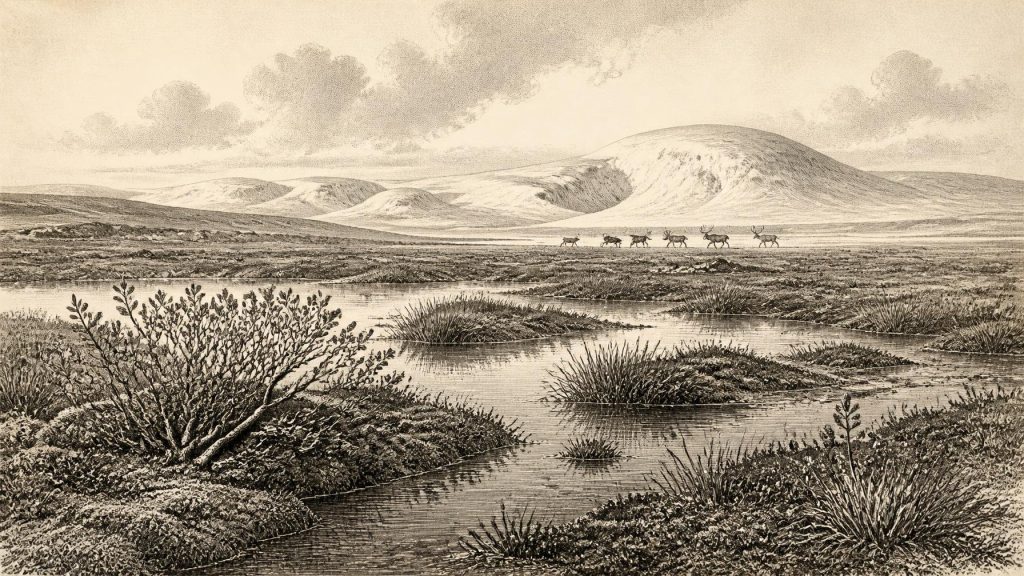
Around 30,896 BCE, Ireland’s evidence records environmental change rather than events. At Derryvree, County Fermanagh, freshwater sediments beneath glacial till preserve tundra-like wetland vegetation, showing that cold, ice-free intervals supported plant life before renewed glaciation. Castlepook Cave, County Cork, contains diverse MIS 3 fauna, including mammoth, reindeer, giant deer, hyaena, wolves and Arctic foxes, though species need not have coexisted. These remains demonstrate intermittent connections with Britain and Europe under shifting climates and sea levels. A possibly tool-marked reindeer bone suggests brief human presence, but cannot prove settlement. Ireland was a dynamic, sparsely evidenced Ice-Age landscape during this remote period.
Dateline
30,896 BCE is not a date at which Ireland can be described year by year. It is a modern calendar label, roughly 32,845 years before AD 1950, applied to a phase of the Late Pleistocene rather than to a recorded human year. No Irish community left writing, a calendar, a named ruler or an event that can be assigned to this point. The responsible approach is to place it within a wider span of climatic and ecological change: Marine Isotope Stage 3 (MIS 3), long before the Last Glacial Maximum.
Even calibrated radiocarbon dating cannot make this a precise anniversary. The principal northern Irish deposit relevant to this period, at Derryvree near Maguiresbridge in County Fermanagh, produced a conventional radiocarbon determination of 30,500 +1,170/−1,030 years BP. When converted through modern calibration, it falls broadly within about 36,900–31,700 calibrated years BP, or approximately 34,950–29,750 BCE. The requested year lies within that wide interval. It cannot, however, be tied to a particular season, animal, pool or human action. The evidence illuminates an age, not a day.
A Wetland Between the Ice
Derryvree provides the closest and most revealing environmental archive. Road works in 1969 cut through a drumlin, a streamlined hill shaped and built by glacier ice. Beneath an upper layer of till, the unsorted debris left by a glacier, investigators found fine sand, silt and organic freshwater sediment. These rested on an older till. The sequence records a clear order of events: ice had earlier occupied the locality; an interval without overriding local ice allowed water and organic matter to accumulate; then a later advance buried the evidence beneath new glacial debris.
This was not the green, wooded Ireland familiar from later millennia. Fossil pollen, plant macrofossils, mosses and insects from Derryvree indicate a cold, periglacial setting with open tundra-like vegetation. Sedges, mosses and herbaceous plants could grow around shallow water and saturated ground. Finds including bogbean, water-milfoil, dwarf willow, mountain-avens and lesser clubmoss show that the landscape was neither a uniform snowfield nor an empty wasteland. It contained freshwater habitats and patches of vegetation, though dry ground was probably sparsely covered and exposed to severe cold.
That reconstruction must remain local. Derryvree does not demonstrate that all parts of Ireland had exactly the same climate or plant cover in 30,896 BCE. It does demonstrate that a northern inland basin supported freshwater life during a cold interval before renewed glaciation. Its preservation beneath till is itself part of the story: later ice destroyed or concealed much of the evidence needed to make a fuller map of Ireland at this depth in time.
Animals of Castlepook
At the other end of the island, Castlepook Cave near Doneraile in north County Cork offers a different archive. The limestone system, also called Mammoth Cave, has yielded Ireland’s richest known collection of Late Pleistocene vertebrate remains. Its old excavations and complicated deposits demand caution: bones accumulated through more than one process and at more than one time, while early twentieth-century digging did not provide the stratigraphic controls expected today. A cave assemblage is therefore not a photograph of one living herd or one season.
Nonetheless, radiocarbon dating and subsequent reassessment establish that important elements of the Castlepook fauna belong to MIS 3, broadly relevant to this date. Remains include woolly mammoth, reindeer, giant deer, brown bear, wolf, Arctic fox, mountain hare, Norwegian and collared lemmings, and spotted hyaena. A mammoth rib from Elephant Hall and reindeer material from the cave have produced dates in the broad pre-Last Glacial Maximum range. The evidence proves that these animals reached Ireland during the later Ice Age; it does not prove that every species listed lived together in 30,896 BCE.
The combination nevertheless conveys a landscape of open country, grazing opportunities and strong seasonality. Reindeer and mammoth required extensive feeding grounds; lemmings and Arctic fox point towards cold conditions; wolves, bears and hyaenas occupied the same larger ecological world as herbivores. Spotted hyaena is especially significant. Chewed bones and the character of the cave deposits indicate carnivore activity, reminding us that Castlepook was not simply a human hunting shelter awaiting discovery. It was, at least at times, part of an animal landscape in which predators carried carcass parts into underground chambers.
Connections Across a Changing North-West
Ireland was not environmentally isolated in the way its modern coastline may suggest. The presence of large terrestrial mammals establishes that repeated connections, direct or indirect, existed between Ireland, Britain and the wider European landmass during portions of the Pleistocene. Lower sea levels changed coastlines, while ice margins and rivers repeatedly altered possible routes. Yet it would be misleading to draw a single permanent land bridge on a map for this exact date. The available evidence does not identify one route, its duration, or whether a journey was made over exposed land, ice, shallow water, or a shifting combination of these.
Climate was also unstable. MIS 3 contained abrupt warmer and colder oscillations, and the British–Irish Ice Sheet had not yet reached its later maximum extent. The greatest expansion of that ice sheet came much later, broadly around 27,000–21,000 years ago, with maximum extent in the Irish Sea sector around 25,000–23,000 years BP. Around the interval represented by Derryvree and Castlepook, conditions could therefore change sharply across relatively short geological timescales. An open wetland or animal corridor was not necessarily a lasting feature. Growing ice would ultimately remodel the terrain, alter drainage and erase much of the surface record.
The Human Question
The most striking possible human evidence is a reindeer femur from Castlepook. A deep mark on the bone has been interpreted as damage made to fresh bone by a sharp stone tool during carcass processing. The bone has been publicised as approximately 33,000 years old, making it broadly pertinent to the period around 30,896 BCE. If the modification is confirmed as anthropogenic and contemporary with the death of the animal, it would indicate that people handled a reindeer carcass in Ireland far earlier than once thought.
That is an important possibility, but not a licence to imagine a settled Palaeolithic Ireland. The specimen comes from an older cave collection rather than a recently excavated, sealed occupation floor. No securely associated tool kit, hearth, dwelling, burial, human skeleton, repeated camp surface or food-processing area of comparable antiquity has yet been recovered in Ireland. A radiocarbon result dates the animal’s death, not automatically the making of a mark on its bone. Debate over taphonomy—whether a surface alteration was made by a tool, carnivore, sediment movement or another agency—is therefore essential rather than pedantic.
If people were present, the most cautious interpretation is of a brief visit by a small, highly mobile group familiar with stone cutting implements and large-animal carcasses. It does not establish permanent settlement, population size, ancestry, language or a continuous occupation surviving into later Irish prehistory. Modern humans elsewhere in Europe had sophisticated traditions of hunting, tool-making and symbolic culture, but no comparable Irish artefact assemblage of this age has been securely demonstrated. Continental evidence may provide context; it cannot fill Irish gaps with certainty.
Society Beyond Recovery
Consequently, there are no recoverable political affairs, diplomacy, warfare, laws, rulers or territories for Ireland at this point. There is likewise no evidence for formal religion, shrines, graves, artistic traditions, education, trade systems or exchange networks within Ireland. The absence is not evidence that people lacked beliefs, social ties or knowledge; it means that the surviving Irish record cannot responsibly describe them. Neither the Derryvree wetland nor Castlepook’s bone deposits preserves a recognisable settlement community.
“Economy” can only be discussed in ecological, not institutional, terms. Plants turned short growing seasons into biomass; grazing animals converted that vegetation into meat, hides and bone; predators and scavengers competed for carcasses. Should the marked reindeer femur prove humanly modified, it would be the slenderest evidence for the acquisition or processing of animal resources. It would not reveal whether the animal was hunted, found dead, scavenged from carnivores, or processed by visitors who stayed only briefly.
A Landscape, Not a Chronicle
The most important history of Ireland around 30,896 BCE is therefore environmental. Derryvree records cold freshwater ground and tundra vegetation between episodes of glaciation. Castlepook records an unexpectedly varied fauna in southern Ireland, including mammoth, reindeer and hyaena, and preserves a tentative clue to human action. Together they show that Ice-Age Ireland was not uniformly ice-covered, wholly barren or permanently cut off. It was a changing north-western landscape whose habitable places, animal populations and routes expanded and contracted with climate.
Its surviving record demands humility. The scientific evidence is real: sediments, plants, insects, bones, dates and glacial landforms. The larger picture—open habitats, mobile animals, intermittent connections and perhaps fleeting people—is an interpretation built from those traces. For this remote point in time, that distinction is the foundation of responsible Irish history.
Primary Sources
- A Middle Midlandian Freshwater Series at Derryvree, Maguiresbridge, County Fermanagh, Northern Ireland
- The Irish Quaternary Fauna Project
- A Reconsideration of the Radiocarbon Dating of the Marine Isotope Stage 3 Fauna from Southern Ireland
- Castlepook Cave: County Geological Site Report
- Spotted Hyena Skull
- The Exploration of Castlepook Cave, County Cork
- The Exploration of Castlepook Cave, Co. Cork. With 3 Plates.
- Palaeoecology: IQUA Field Guide 16
- Early Midlandian–Middle Midlandian, Pleistocene, Northern Ireland
- The IntCal20 Northern Hemisphere Radiocarbon Age Calibration Curve (0–55 cal kBP)
- IntCal: International Radiocarbon Calibration
- Stratigraphic and Palaeo-Geomorphological Evidence for the Glacial-Deglacial History of the Last British-Irish Ice Sheet in the North-Western Irish Sea
- Dimensions and Chronology of the Last Ice Sheet in Western Ireland
- Trimlines, Blockfields and the Vertical Extent of the Last Ice Sheet in Southern Ireland
- Freshwater Organic Deposits and Stratified Sediments Between Early and Late Midlandian (Devensian) Till Sheets, at Aghnadarragh, County Antrim, Northern Ireland
- Dating Constraints on the Last British-Irish Ice Sheet: A Map and Database
- New Insights on the Fauna of Ireland's Younger Dryas and Early Holocene from Alice and Gwendoline Cave
- Castlepook Cave, Castlepook South, Cork: 2022 Excavation Report
- Heritage Artefacts of County Cork
- Mammoth Cave, County Cork
- Introduction to the Glacial Sand and Gravel Landscapes of Northern Ireland