Elephant Hall’s Pleistocene Ledger31886 BCE
31,886 BCE is an imprecise modern label for a fluctuating MIS 3 Ice Age interval around 34,000 calibrated years ago, not a recorded Irish date. Ireland lacked known settlement, states and documentary history, but supported changing cold-adapted fauna. Castlepook Cave, County Cork, particularly Elephant Hall, preserves bones accumulated over millennia, including mammoth, reindeer, giant deer, bears, hyaenas and smaller mammals. Pollen and insect records indicate open, harsh, patchy landscapes. A reportedly cut-marked reindeer femur may signal Upper Palaeolithic butchery, yet remains unconfirmed and cannot demonstrate settlement. Later ice-sheet expansion destroyed or buried evidence, leaving ecological history clearer than human history.
Dateline
“31,886 BCE” is a modern calendar label, not a date that can be matched to a recorded Irish event. No inhabitants of Ireland used such a calendar, and archaeology cannot isolate a political decision, hunt or seasonal journey to this particular year. The date corresponds broadly to about 33,835 years before AD 1950, but Late Pleistocene chronologies are expressed through radiocarbon determinations and calibrated ranges, not annual precision. The responsible frame is therefore a wider interval around 34,000 calibrated years ago, within Marine Isotope Stage 3 (MIS 3), the long and climatically unstable middle part of the last Ice Age.
For Ireland, this was an age before documentary history, before known farming, monuments, towns, kingdoms or enduring named communities. It is also earlier than any securely established settlement record. Yet it was not an empty chapter in environmental terms. Fossil bones, cave sediments, pollen, beetles, glacial landforms and offshore evidence show that parts of Ireland supported a changing Ice Age fauna before the Last Glacial Maximum. The richest single archive is Castlepook Cave near Doneraile, County Cork, especially a chamber called Elephant Hall. Its accumulated animal remains offer an unusually deep, if imperfect, ledger of Ireland’s Pleistocene life.
A Date Within a Range
Radiocarbon years are not identical to calendar years. Atmospheric carbon levels have varied through time, so radiocarbon measurements require calibration against independently dated records. At around 34,000 years ago the resulting calibrated spans can be broad; an apparently exact BCE year should never conceal that uncertainty. Nor should every specimen dated to roughly this era be treated as contemporary with every other. A cave collection may contain bones deposited centuries or millennia apart, while an animal’s death date says nothing certain about when a cave was entered by people.
31,886 BCE falls near the later part of MIS 3, conventionally dated from roughly 57,000 to 29,000 years ago. Across the North Atlantic world, this was not a single uniform climate. Warmer Greenland interstadials alternated with colder stadials, and ice sheets, sea level, vegetation and animal ranges responded unevenly. The British–Irish Ice Sheet was growing towards its later maximum, but the reconstruction of its advance shows considerable regional variation. It would be misleading to picture all Ireland as buried beneath one unchanging mass of ice at this point. Equally, it would be misleading to imagine a mild, wooded island. The evidence favours a cold, exposed and shifting environment, with ice-free ground in some places and expanding ice elsewhere.
Castlepook and the Animal Archive
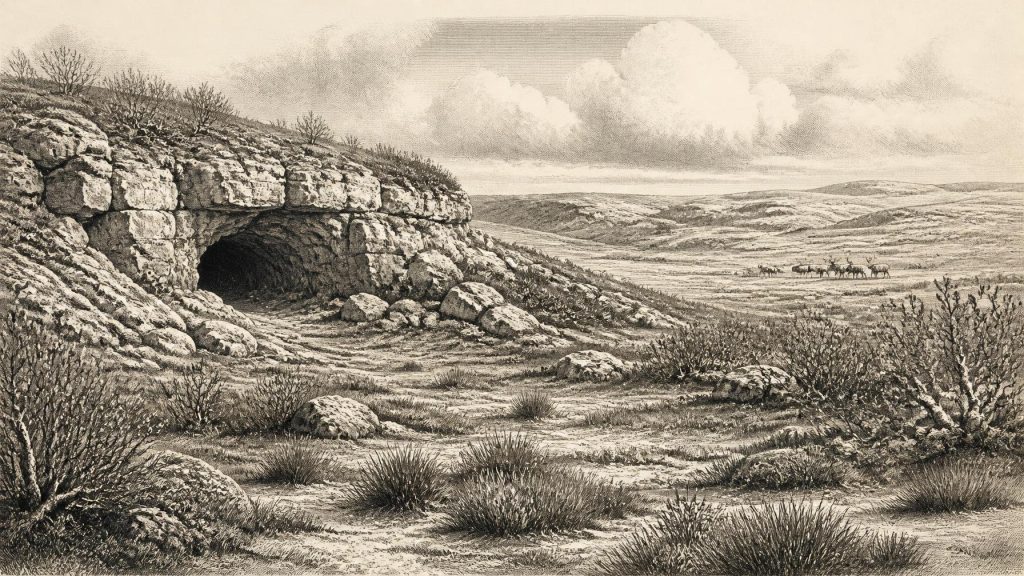
Castlepook Cave is central because it preserves a remarkable concentration of Pleistocene vertebrate remains. Antiquarian investigations in the early twentieth century recovered thousands of bones from passages and chambers with memorable names including Hyaena Hall, the Gallery of Aged Carnivores and Elephant Hall. Modern radiocarbon work has demonstrated that individual bones represent a long sequence rather than one event. Geological Survey Ireland summarises dates from the site ranging from about 45,700 to 19,950 radiocarbon years BP. That long duration is both its strength and its principal warning: Castlepook records changing faunas over many millennia, not a single frozen moment.
Some of the dates are directly relevant to the broad period surrounding this article’s nominal year. Earlier research obtained Middle Midlandian, or broadly MIS 3, ages for mammoth, reindeer, brown bear and giant deer remains from the cave. The faunal list also includes spotted hyaena, wolf, red fox, Arctic fox, mountain hare, Norwegian lemming and collared lemming. These finds establish that Ireland, or at least accessible parts of its southern landscape, could sustain large herbivores, small cold-adapted mammals and formidable carnivores before the most severe late-glacial ice expansion.
That does not mean all these species met in Elephant Hall on the same day, season or even millennium. Nor can a cave assemblage straightforwardly measure the abundance of animals beyond its entrance. Carnivores may drag prey into a den; flowing water may move bones; scavenging, trampling and excavation can alter surfaces and positions. Castlepook’s old excavations also left incomplete contextual records, and some deposits were disturbed. The site is compelling precisely because it contains so much evidence, but its complexity rules out simple stories.
An Open, Cold Landscape
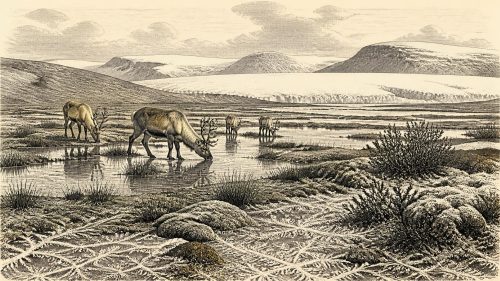
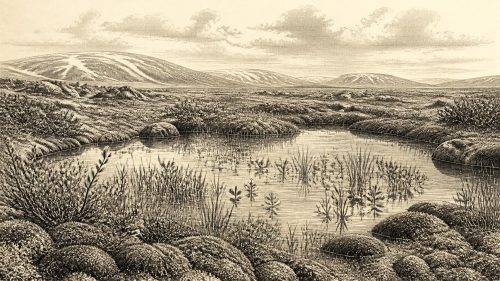
Environmental sequences from northern Ireland help to fill out the landscape beyond Cork’s caves, although they cannot provide a weather report for 31,886 BCE. Organic deposits beneath later glacial sediments in Fermanagh, including at Derryvree, Hollymount, Aghnadarragh and Greenagho, preserve pollen and insect evidence for cold phases during the Midlandian. Their signals point towards largely treeless or very sparsely wooded country: grasses and sedges, dwarf birch and willow, heaths, crowberry, herbs and other plants suited to open ground. Insect evidence includes species whose modern distributions are far to the north.
This was not a landscape of the familiar Irish green, enclosed fields or oak woodland. It was a mosaic shaped by short growing seasons, wind, frost action, exposed soils, wetlands and local topography. Where vegetation was sufficient, it could feed grazing and browsing animals; where it was sparse, large mammals would have ranged widely between more favourable patches. Mammoth, reindeer and giant deer should not be imagined as proof of a single uniform “mammoth steppe” across the island. Their bones show presence at particular times. The wider palaeoecological evidence suggests a patchwork of herb-rich tundra, marshy ground, scrub and bare mineral surfaces.
Water and ice determined regional change. Lower global sea levels altered the form of the surrounding shelves, but whether a continuously dry, easily traversed land route linked Ireland to Britain at every relevant point remains uncertain and depends on the timing, ice geometry and local relative sea level being reconstructed. Mammals evidently reached Ireland during parts of the Pleistocene. That fact alone does not demonstrate an open migration corridor at 31,886 BCE, and it certainly cannot establish a particular human route. The sea, ice margins and exposed coastal plains were changing features rather than fixed borders.
The Human Question
The most consequential but least settled evidence concerns a reindeer femur from the Castlepook collection. Public reporting in 2021 described the bone as roughly 33,000 years old and bearing deep marks interpreted as compatible with butchery by a sharp stone tool. If the date, the identification of the marks and their association are confirmed through full contextual study, it would indicate that people handled a reindeer in Ireland during the Upper Palaeolithic—many millennia before the island’s well-attested Mesolithic settlement.
That possibility deserves attention, not embellishment. A modified bone is not a campsite. There is no securely dated hearth, dwelling, human burial, lithic assemblage or stratified occupation surface in Ireland that permits historians to describe a resident community in 31,886 BCE. Nor is there evidence for continuous occupation from this period into the later Stone Age. The National Museum of Ireland accordingly continues to state that clear evidence of Palaeolithic human presence has not yet emerged. Its caution reflects a genuine archaeological problem: marks made by stone tools must be distinguished from carnivore damage, sediment abrasion, trampling, excavation damage and later handling, while old collections rarely retain ideal provenance.
Thus the Castlepook femur is best understood as an important research question, not as a licence to invent Ireland’s first village, tribal territory or named hunting party. At most, the proposed interpretation would support a brief human visit or episode of carcass processing. A visitor might have crossed a changing maritime or icy landscape from Britain or farther afield, but neither origin nor route is known. The technologies, language, kinship and beliefs of any such people cannot be recovered from this single disputed indication.
Society Without States
Because human presence is unproven or at best fleeting, there were no demonstrable political affairs, diplomacy, warfare, taxation or institutions in Ireland at this date. It would be anachronistic to project later Celtic peoples, Irish kingdoms, Christianity or even the familiar social world of Mesolithic hunter-gatherers backwards into MIS 3. There are no Irish artefacts from this horizon that reveal domestic routines, clothing, artistic traditions, ceremonial practice, exchange networks or learning.
If people did reach the island, their likely priorities can only be inferred from the wider Upper Palaeolithic world: movement through seasonal landscapes, shelter, fuel, food, tool maintenance and close knowledge of animal behaviour. Such inference is not direct evidence for Ireland. A cave could have been used by animals rather than people; indeed, spotted hyaena may have been an important agent in accumulating the Castlepook bones. The safest conclusion is that the island’s observable history at this depth is primarily ecological, not political.
Approaching a Break in the Record
The importance of this period lies partly in what came next. Over the following millennia, the British–Irish Ice Sheet expanded and reshaped much of the island. Glacial erosion, deposition and later sea-level change removed, buried or disturbed many possible traces of earlier life. That destructive history helps explain why the Irish Palaeolithic record is so sparse and why protected cave deposits carry exceptional weight. Absence of evidence is not proof that no person ever arrived; it is, however, a firm reason not to claim a settled population where none has been demonstrated.
Around the modern label 31,886 BCE, then, Ireland was an Ice Age landscape in transition. Caves near Doneraile preserve evidence of reindeer, mammoth, deer, bears, hyaenas and cold-adapted smaller mammals across a long span of time. Northern pollen and insect records show open, harsh environments rather than later woodland. A single reported cut-marked reindeer bone raises the possibility of a very early human encounter with this world, but does not yet reveal a society. Elephant Hall’s true historical value is its restraint: it gives Ireland a deep Pleistocene past while reminding us how much of that past remains unresolved.
Primary Sources
- Prehistoric Details
- Castlepook Cave, County Cork: County Geological Site Report
- The Exploration of Castlepook Cave, County Cork
- Holdings: The Exploration of Castlepook Cave, Co. Cork. With 3 Plates
- Occurrence of Mammalia Relicts at Site Castlepook Cave
- The Irish Quaternary Fauna Project
- The Irish Quaternary Fauna Project
- Pleistocene Vertebrates in the British Isles
- Irish Pleistocene Biostratigraphy
- Palaeoecology
- Introduction to the Late Quaternary and Holocene of Northern Ireland
- Growth and Retreat of the Last British–Irish Ice Sheet, 31 000 to 15 000 Years Ago: The BRITICE-CHRONO Reconstruction
- Growth and Retreat of the Last British–Irish Ice Sheet, 31 000 to 15 000 Years Ago: The BRITICE-CHRONO Reconstruction
- BRITICE-CHRONO Maps and GIS Data of the Last British-Irish Ice Sheet 31 to 15 ka
- The Timing and Magnitude of the British–Irish Ice Sheet Between Marine Isotope Stages 5d and 2
- Maximum Extent and Dynamic Behaviour of the Last British–Irish Ice Sheet West of Ireland
- Character of Advance and Retreat of the Southwest Sector of the British-Irish Ice Sheet During the Last Glaciation
- The IntCal20 Northern Hemisphere Radiocarbon Age Calibration Curve (0–55 cal kBP)
- The IntCal20 Approach to Radiocarbon Calibration Curve Construction: A New Methodology Using Bayesian Splines and Errors-in-Variables
- First Evidence of a Late Upper Palaeolithic Human Presence in Ireland
- New Insights on the Fauna of Ireland's Younger Dryas and Early Holocene From Alice & Gwendoline Cave