Fermanagh’s Interstadial Mosses31887 BCE
Although 31,887 BCE cannot be treated as a recoverable Irish calendar year, it broadly falls within MIS 3, before the Last Glacial Maximum. Fragmentary evidence from Derryvree and Greenagho, County Fermanagh, records cold, open, wet tundra-like environments, with mosses, pools, sparse vegetation and later glacial burial. Castlepook Cave’s mixed fauna demonstrates varied cold-adapted animals, including reindeer, mammoth, giant deer and carnivores, but not a single contemporaneous community. A cut-marked reindeer bone may indicate brief human activity, yet remains uncertain. No settlements, culture, language or political organisation are known. Ireland’s surviving record chiefly reveals changing Ice Age ecology and advancing ice.
Dateline
The label 31,887 BCE gives a useful position on a modern timeline, but it must not be mistaken for a year that can be recovered from Irish evidence. No written calendar existed in Ireland, and neither archaeology nor environmental science can isolate a political event, a settlement episode or an individual life to this particular year. In radiocarbon practice, “before present” is counted from 1950; 31,887 BCE lies broadly around 33,800 calendar years before present. At that depth of time, calibrated ranges of centuries or millennia—not a single calendar year—are the responsible measure.
What can be said is that this notional date falls within the Late Pleistocene, during Marine Isotope Stage 3 (MIS 3), a long and climatically unsettled phase of the last Ice Age. Ireland was not yet at the Last Glacial Maximum, conventionally placed later, roughly 26,000–20,000 years ago. Its landscapes were nevertheless already shaped by severe cold, fluctuating ice margins, sparse vegetation and changing sea levels. The most illuminating Irish evidence comes not from a town, graveyard or tool workshop, but from buried sediments, pollen, mosses, insects and animal bones.
A Landscape Known Through Fragments
For this period, Ireland’s archive is exceptionally uneven. Later prehistory is rich in houses, monuments and artefacts; the evidence for the earlier Upper Palaeolithic is sparse, frequently disturbed and difficult to date. Caves preserve bones but can also be used by carnivores, reworked by water, disturbed by digging or mixed by later processes. Sediments beneath glacial deposits preserve environmental snapshots, but only at rare sites exposed by quarrying, road works or research excavation. The resulting history is necessarily regional and provisional.
Derryvree, near Maguiresbridge in County Fermanagh, is especially important because organic silts and fine sands were found sealed between layers of glacial till inside a drumlin. A conventional radiocarbon determination of about 30,500 radiocarbon years before present was obtained from the deposit. That is not the same thing as 30,500 calendar years ago: calibration shifts such results substantially, and its uncertainty must be retained. Yet the sequence securely demonstrates a pre-Last Glacial Maximum interval in which freshwater and wet-ground deposits formed in southern Fermanagh before later ice laid down the overlying till.
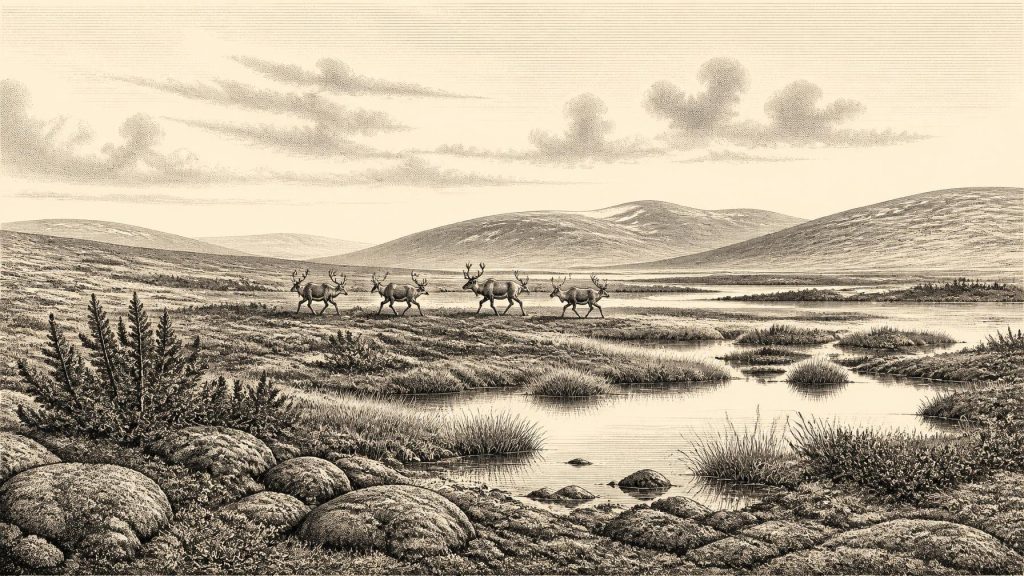
The Derryvree material provides no evidence of people, but it gives an unusually tangible setting for Ireland around this broad horizon. Plant remains, pollen and beetles point towards an open, treeless tundra or muskeg environment. Grasses, sedges, herbs, juniper and a notable moss flora are more appropriate comparisons than forest. Open pools held water and plant debris; surrounding ground was wet in places, while exposed mineral soils elsewhere would have supported scattered low vegetation. The evidence indicates cold conditions and harsh winters. It does not justify a claim that every corner of Ireland looked identical, since altitude, drainage, latitude, season and proximity to ice all mattered.
Ice Was Advancing, Not Yet Supreme
The notional year belongs to the long approach towards the maximum spread of the British–Irish Ice Sheet. Modern reconstructions show that this was not a simple, simultaneous freezing of the island. Ice expanded and reorganised across different catchments and offshore basins over thousands of years. Some areas had ice; others retained ice-free ground or water; still others were repeatedly overridden, eroding or burying earlier surfaces. Later glaciation destroyed much of the evidence that might once have recorded plants, animals or visiting people.
That destructive power explains why surviving deposits such as Derryvree have such importance. The drumlins, striated rock, moraines and meltwater forms visible in Ireland today are part of the physical legacy of the Quaternary ice ages, but most cannot be assigned to 31,887 BCE itself. They reveal processes unfolding across long spans, not a dated scene. Similarly, evidence from Greenagho, also in Fermanagh, indicates organic deposits beneath till and supports the conclusion that ice-free or less heavily glaciated conditions occurred in northern Ireland before the later expansion of ice. Such sites warn against imagining an island uniformly buried under ice at every moment of the Late Pleistocene.
Lower global sea levels altered the map, although not in a way that permits easy statements about a permanent land bridge to Britain. The Irish Sea basin, the Celtic Sea shelf and surrounding coastal plains had markedly different outlines from today. Connections and barriers changed with sea level, ice and local topography. Animals could reach Ireland during favourable intervals, but the exact routes, duration and openness of those corridors remain matters for reconstruction rather than direct observation. For any people who might have travelled here, crossing water or moving through changing coastal landscapes may have been an important constraint.
Castlepook and the Animal Record
The best-known southern Irish archive is Castlepook Cave, near Doneraile in north County Cork. Antiquarian excavations there produced a remarkable collection of Pleistocene animal remains, subsequently reassessed through the Irish Quaternary Fauna Project and later dating work. The assemblage includes animals associated with cold and open environments, among them reindeer, woolly mammoth, giant deer, brown bear, wolf, Arctic fox, mountain hare, collared lemming and Norwegian lemming; spotted hyaena is also a striking component. The collection does not show that all these animals lived beside one another in a single season. Cave deposits and old collections may combine material accumulated over long periods.
Even so, radiocarbon reassessment supports the broad conclusion that Ireland carried a more varied terrestrial fauna during MIS 3 than was once accepted. Some Castlepook dates, together with dated remains from caves in Cork and Waterford, fall in calibrated ranges that overlap or approach the millennium represented by 31,887 BCE. They establish the presence of particular species in Ireland across episodes before the Last Glacial Maximum; they do not produce a census of the island in one exact year. The well-known name “Irish elk” can also mislead. Megaloceros giganteus was giant deer, a Eurasian species, rather than an animal unique to Ireland.
The cave is valuable precisely because it complicates simple pictures of a barren frozen land. Reindeer and lemmings suggest cold open country, while mammoth, giant deer and carnivores imply food webs extending beyond the cave entrance. Yet the cave itself was not necessarily a human camp. Hyaenas and other carnivores could carry carcass parts into caves; scavenging, trampling, water movement and early excavation methods all affect what survives. Animal bones prove the wider presence of fauna more securely than they reveal the behaviour of any one species at the site.
The Human Question
There is no securely excavated dwelling, hearth, tool assemblage, burial or art from Ireland that can be assigned to around 31,887 BCE. Accordingly, there is no responsible basis for describing an Irish tribe, language, leader, territory, religion or political order. There were no states, diplomatic relations or recorded wars in the later historical sense. Claims about “Celtic” Ireland are especially inappropriate: Celtic languages and identities belong to vastly later contexts and cannot be projected back into MIS 3.
One find makes the question more interesting, while also demanding restraint. A reindeer femur from Castlepook has been reported as bearing deep marks interpreted as cuts or chops made during butchery with a stone tool. Its reported age, around 33,000 years ago, would place possible human activity in Ireland much earlier than the previously accepted Late Upper Palaeolithic evidence from Alice and Gwendoline Cave in County Clare, where a butchered brown-bear bone dates to approximately 12,810–12,590 calibrated years before present. At Castlepook, however, the old collection’s incomplete excavation context and the need for further work mean that the marked reindeer bone is best treated as evidence suggestive of a brief human visit, not proof of a settled population or a developed Irish Upper Palaeolithic culture.
If the marks are confirmed as anthropogenic, the most modest inference is that one or more people acquired or processed a reindeer carcass in, or near, the cave’s landscape. That would imply knowledge of stone-working and meat processing familiar across Upper Palaeolithic Europe. It would not tell us whether the animal was hunted, found dead, taken from another predator or processed by a party that remained only briefly. Nor does a single modified bone demonstrate regular seasonal migration, a permanent camp, kinship structures or a particular technology.
Daily Life Beyond the Evidence
For Ireland itself, society and economy at this horizon are mostly unknown. There is no evidence for farming, herding, pottery, metalworking, buildings, long-distance trade goods or formal burial. Agriculture was still many millennia in the future. Any human visitors, if present, would have relied upon mobile hunter-gatherer practices: knowledge of animals, weather, fuel, shelter and routes would have been essential. This is a comparative inference from Upper Palaeolithic lifeways elsewhere in north-west Europe, not a documented description of an Irish community.
The same limit applies to culture and belief. Upper Palaeolithic peoples elsewhere made sophisticated tools, ornaments and images, but no such objects are known from Ireland at this date. Caves can invite modern assumptions about ritual, yet Castlepook’s direct evidence is faunal and geological. There is no Irish cave art, shrine or grave that can responsibly be connected with 31,887 BCE. Learning existed in the practical sense that any successful people possessed accumulated knowledge, but its language, transmission and symbolic forms are beyond recovery here.
Thus the most important development around this point is environmental rather than political: Ireland was a changing Ice Age peninsula or island-edge landscape, intermittently capable of supporting a cold-adapted fauna before later ice expansion transformed it again. Derryvree’s mosses and pools, and Castlepook’s bones, preserve separate pieces of that world. They reveal real ecological complexity and a tantalising possibility of human contact, while also marking the boundary between evidence and imagination.
Primary Sources
- A Reconsideration of the Radiocarbon Dating of the Marine Isotope Stage 3 Fauna from Southern Ireland
- The Irish Quaternary Fauna Project
- Growth and Retreat of the Last British–Irish Ice Sheet, 31,000 to 15,000 Years Ago: the BRITICE-CHRONO Reconstruction
- Trimlines, Blockfields and the Vertical Extent of the Last Ice Sheet in Southern Ireland
- Radiocarbon Constraints on the Age of the Maximum Advance of the British-Irish Ice Sheet in the Celtic Sea
- Dimensions and Chronology of the Last Ice Sheet in Western Ireland
- Palaeoecology
- Irish Pleistocene Biostratigraphy
- Quaternary Deposits and Glacial Stratigraphy in Ireland
- Figure 6.— The Subdivision of the Quaternary Period in Ireland
- The IntCal20 Northern Hemisphere Radiocarbon Age Calibration Curve (0–55 cal kBP)
- Radiocarbon Dating
- First Evidence of a Late Upper Palaeolithic Human Presence in Ireland
- First Evidence of a Late Upper Palaeolithic Human Presence in Ireland
- New Insights on the Fauna of Ireland's Younger Dryas and Early Holocene from Alice & Gwendoline Cave
- Archaeology Research Excavation Grant 2022
- 2022:564 – Castlepook Cave, Castlepook South, Cork
- The Archaeology of Caves in Ireland
- Archaeological Heritage of County Cork
- Heritage Artefacts of County Cork
- Castlepook Caves
- Guide to the National Museum of Ireland – Natural History
- Ireland Through Geological Time
- Quaternary – Geological Survey Ireland