Castlepook’s Wandering Herds31888 BCE
31,888 BCE is a modern label, not a securely datable Irish event. During Marine Isotope Stage 3, Ireland was a cold, open, climatically unstable landscape before maximum British–Irish Ice Sheet expansion. Derryvree sediments in Fermanagh indicate treeless marshes, with sedges, grasses and low shrubs. Castlepook Cave and other southern caves preserve mixed, imperfectly dated remains of mammoth, reindeer, giant deer, bears, wolves, hyaenas, foxes, hares and lemmings, demonstrating varied cold-stage fauna over time. No secure evidence establishes human settlement, politics or culture, although a possibly cut-marked reindeer bone merits investigation. Later glaciation reshaped Ireland and erased or buried earlier evidence.
Dateline
31,888 BCE is not a year to which an Irish event can responsibly be assigned. No written record, annual chronology or securely dated settlement sequence survives from this depth of time. It is a modern calendar label. In archaeological terms it corresponds only approximately to 33,800 calendar years before present (where “present” conventionally means 1950), within the Late Pleistocene and Marine Isotope Stage 3 (MIS 3), a long and climatically unstable part of the last glacial period. Radiocarbon results from this era require calibration and usually yield ranges rather than a pinpoint date. The responsible question, therefore, is not what happened in Ireland in this numbered year, but what the island’s fragmentary environmental and faunal evidence can illuminate about its condition around the early thirty-fourth millennium years ago.
A Cold Land Before the Ice Peak
Ireland was approaching, but had not yet reached, the fullest expansion of the last British–Irish Ice Sheet. The Last Glacial Maximum is generally placed later, broadly after c. 26,500 calendar years ago, although ice-sheet growth was neither simple nor simultaneous in every region. Reconstructions show that the British–Irish Ice Sheet expanded in phases, with different sectors reaching their greatest extent at different times. Around the chronological neighbourhood of 31,888 BCE, Ireland stood within a changing glacial world: substantial ice existed in the wider north-west European region, but parts of Ireland had at earlier points in MIS 3 remained free of overriding ice long enough for lakes, wetlands, plants and animals to leave traces.
This distinction matters. The familiar Irish landscape of deep soils, woods, fields and bogs did not exist. Later glaciation stripped or buried many older deposits, while acidic soils destroyed much organic material. What remains is biased towards caves, sediments protected beneath glacial deposits, and scattered bones recovered in nineteenth- and early twentieth-century excavations. Much of the evidence therefore tells historians not of a continuous inhabited country but of episodes: animals entering an accessible landscape, caves receiving bones, waterlogged hollows preserving pollen, and advancing ice repeatedly erasing earlier surfaces.
MIS 3 was not uniformly frozen. Across north-west Europe it contained abrupt climatic shifts, including relatively milder interstadial episodes and harsh stadials. At roughly this date, continental records identify the beginning of the Denekamp Interstadial complex, conventionally placed around c. 32,000–28,000 calendar years ago, but Ireland’s local record is too incomplete to translate that broad European label into a particular season, temperature or vegetation map for 31,888 BCE. It is safer to say that Irish conditions were cold, open and highly variable, and that any local improvement would have been precarious.
The Derryvree Window
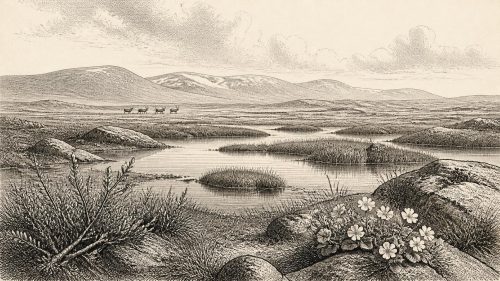
One of the most important Irish clues comes from Derryvree near Maguiresbridge in County Fermanagh. There, organic-rich freshwater silts were found between glacial tills. Their very existence demonstrates that, before the later ice advance which covered them, a freshwater environment developed in this part of Ulster. Pollen and plant remains have been interpreted as evidence for treeless, wet ground: a muskeg or sedge-rich marshy landscape rather than woodland. Such deposits offer an unusually direct glimpse of an Irish interlude when plants could grow, standing water could accumulate sediment, and the land was not beneath an ice sheet.
The precise age and correlation of the Derryvree sequence have long been debated. Legacy dates are difficult to assess, and the deposits cannot be made to describe one exact calendar year. Yet the evidence remains valuable at the scale appropriate to it. It indicates a cold, open environment in inland northern Ireland during a pre-Last Glacial Maximum interval. Mosses, sedges, grasses and low shrubs are more plausible components of such country than forest. Exposed mineral ground, shallow pools, seasonally frozen soil and strong winds would have shaped the terrain. For people accustomed to modern Ireland’s moist green vegetation, this is a reminder that the island’s environmental history has included landscapes closer in character to Arctic and sub-Arctic tundra.
These environmental archives also demonstrate why terms such as “Irish wilderness” must be used carefully. The landscape was not empty in an ecological sense. It contained plants, insects, birds and mammals adapted to cold and shifting conditions, even if the record preserves only a portion of them. Nor was it static. Water levels, sediment supply, vegetation and animal movement could change rapidly as climate fluctuated and ice margins altered beyond the immediate horizon.
Castlepook and the Animal World
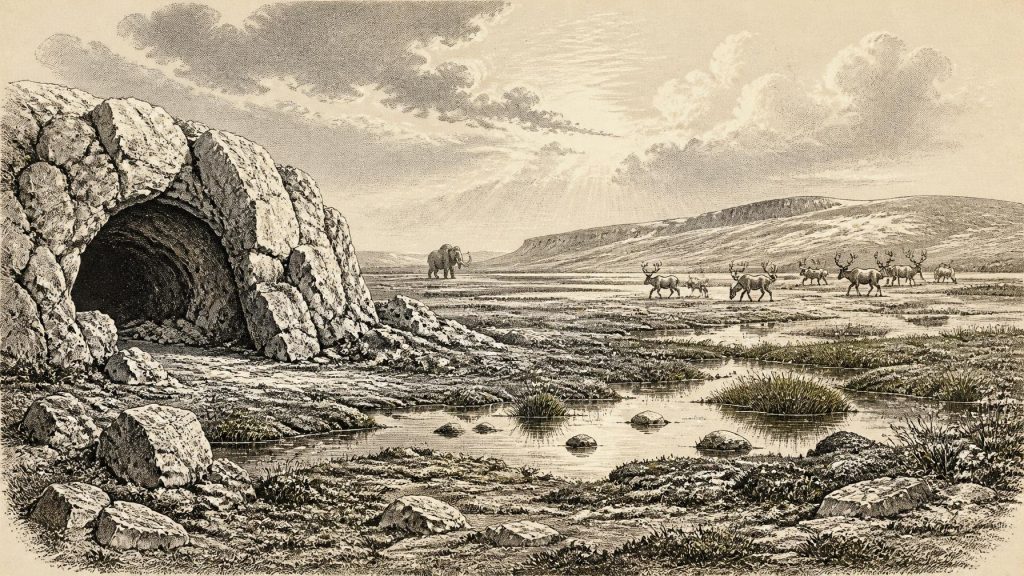
The richest evidence for Ireland’s pre-maximum Ice Age fauna comes from Castlepook Cave, also called Mammoth or Doneraile Cave, near Doneraile in north County Cork. The cave system produced a remarkable assemblage during antiquarian excavations: remains attributed to mammoth, reindeer, giant deer, brown bear, wolf, fox, Arctic fox, mountain hare, spotted hyaena and both Norwegian and Arctic lemmings. Other southern Irish caves, including Shandon Cave in County Waterford and Foley Cave in County Cork, add to the picture. Together they establish that Ireland supported, at different points during MIS 3, a much richer cold-stage mammal community than the island possesses today.
That list should not be mistaken for a single herd or a single moment. Castlepook was excavated before modern standards of recording, and later study has shown that bones from different periods were mixed or lacked secure stratigraphic context. Fresh radiocarbon measurements have revised several specimens substantially older than earlier dates suggested. The result is a stronger case for a long pre-Last Glacial Maximum history of animal presence, but a weaker basis for reconstructing one perfectly contemporaneous ecosystem. A mammoth bone, a reindeer metatarsal and a hyaena remain may each illuminate Ice Age Ireland while belonging to different centuries or millennia.
Even with that caution, the fauna conveys a vivid ecological reality. Reindeer and mammoth point to broad, open country capable of supporting large grazers and browsers. Giant deer required substantial forage but were not necessarily animals of closed forest; their presence should not be used to infer a wooded Ireland. Lemmings and Arctic foxes indicate cold conditions, while hyaenas and wolves were predators and scavengers within a food web that could draw carcasses into caves. Cave accumulations may reflect carnivore activity, natural deaths, water movement or later disturbance as much as deliberate human deposition. A cave full of bones is not automatically a hunting camp.
No Politics, and No Proven Community
There is no evidence for political affairs, diplomacy, named groups, territorial boundaries or organised conflict in Ireland at this date. Nor is there evidence for houses, hearths, graves, tools, art, clothing, ritual places, exchange networks or a settled human community. It would be misleading to manufacture an Irish “tribe” from the presence of reindeer and mammoth. The everyday lives, beliefs, languages and social arrangements of any people who might have reached the island around this time are unknown because their material traces have not been securely identified.
The question of human presence is nevertheless important. Upper Palaeolithic people were living elsewhere in north-west Europe during parts of MIS 3, with sophisticated stone technologies, hunting practices, social networks and symbolic cultures. Low sea levels exposed large areas of what is now sea floor around Britain and Ireland, altering coastlines and possible travel routes. But exposed land does not by itself prove a dry, usable route into Ireland at every date, still less a crossing by people. The form and timing of connections between Ireland, Britain and the continent remain matters of palaeogeographical reconstruction, not a licence to assume migration.
Castlepook has generated particular interest because a reindeer bone from its historic collection has been reported as bearing possible cut marks and has received a late Pleistocene radiocarbon determination. If those marks were conclusively shown to have been made by people, and securely associated with the bone’s age, they would have major implications for the antiquity of human contact with Ireland. At present, however, no securely excavated 32nd-millennium BCE hearth, stone-tool assemblage, occupation floor, human bone or unmistakably butchered animal assemblage establishes people in Ireland. The distinction is fundamental: a possible humanly modified specimen is evidence worth testing, not proof of a resident population.
Approaching Erasure
The most consequential long-term development was environmental rather than political. Ice-sheet growth would eventually transform the island. At its later maximum, the British–Irish Ice Sheet covered Ireland and extended onto surrounding shelves, eroding bedrock, remoulding valleys and depositing till. The drumlins, moraines, lake basins and scoured surfaces familiar in modern Ireland owe much to this glacial legacy. That same process destroyed or concealed many surfaces on which an earlier human presence might once have been recorded.
Thus Ireland around 31,888 BCE is best understood as a changing northern landscape at the edge of the known human world, inhabited demonstrably by cold-stage animals and poised before more extensive glaciation. Its history is preserved in cave bones and buried wetland sediments, not in annals. The evidence supports wandering herds, predators, marshy treeless ground and climatic uncertainty. It does not support kings, battles, farms, temples or a calendar-date event. Respecting that boundary between evidence and interpretation is what makes this remote Irish past historically meaningful rather than merely imagined.
Primary Sources
- The IntCal20 Northern Hemisphere Radiocarbon Age Calibration Curve (0–55 cal kBP)
- Growth and retreat of the last British–Irish Ice Sheet, 31,000 to 15,000 years ago: the BRITICE-CHRONO reconstruction
- Growth and retreat of the last British–Irish Ice Sheet, 31,000 to 15,000 years ago: the BRITICE-CHRONO reconstruction
- The timing and magnitude of the British–Irish Ice Sheet between Marine Isotope Stages 5d and 2: implications for glacio-isostatic adjustment, high relative sea levels and ‘giant erratic’ emplacement
- A reconsideration of the radiocarbon dating of the Marine Isotope Stage 3 fauna from southern Ireland
- The Irish Quaternary Fauna Project
- Cenozoic: Tertiary and Quaternary (until 11,700 years before 2000)
- A Middle Midlandian Freshwater Series at Derryvree, Maguiresbridge, County Fermanagh, Northern Ireland
- Figure 6—The subdivision of the Quaternary Period in Ireland
- The problem of a late Quaternary landbridge between Britain and Ireland
- Deglaciation, Earth crustal behaviour and sea-level changes in the determination of insularity: A perspective from Ireland
- Pleistocene vertebrates in the British Isles
- Irish Cave Exploration
- Notice of the occurrence of mammoth and other animal remains: discovered under limestone in a bone cave at Shandon, near Dungarvan, in the county of Waterford
- Mammoth Cave
- First evidence of a Late Upper Palaeolithic human presence in Ireland
- New insights on the fauna of Ireland’s Younger Dryas and Early Holocene from Alice & Gwendoline Cave
- Castlepook Cave, Castlepook South, Co. Cork
- Archaeological Heritage of County Cork
- BRITICE-CHRONO: Introduction
- New data for the Last Glacial Maximum in Great Britain and Ireland
- Reconstructing the last Irish Ice Sheet 2: a geomorphologically-driven model of ice sheet growth, retreat and dynamics