Cork’s Earliest Butchery Claim30312 BCE
Thirty thousand years BCE is an imprecise modern conversion, not a recorded Irish date. During Marine Isotope Stage 3, Ireland contained shifting ice margins, tundra-like environments and intermittently diverse mammals, documented especially at Castlepook Cave, County Cork. Its mixed deposits include reindeer, mammoth, giant deer, hyaena and Arctic species. A reindeer femur, tentatively dated near this period, bears a possible stone-tool butchery mark. If confirmed, it would indicate a brief human visit, not permanent settlement or organised society. Lost contexts, contamination and broad radiocarbon ranges limit certainty. Castlepook nevertheless challenges assumptions that humans reached Ireland only after the Ice Age.
Dateline
The label 30,312 BCE cannot describe a recorded Irish year. No community in Ireland left a calendar, a name, a settlement plan or a historical narrative that can be tied to that point with annual precision. It is a modern conversion, approximately 32,260 years before the conventional radiocarbon reference year of AD 1950. At this depth of time, even the best dating evidence is expressed as probability ranges rather than as a single calendar year. The most responsible subject is therefore Ireland in the later part of Marine Isotope Stage 3: a cold, unstable phase of the Late Pleistocene, before the fullest expansion of the Last Glacial Maximum ice sheet.
Dating a Deep Past
Radiocarbon ages are not calendar ages. A bone’s measured radiocarbon result must be calibrated against changing atmospheric carbon levels, and the resulting calendar range may extend over centuries or longer. The archaeological deposits relevant to Ireland at this time are also few, often disturbed, and sometimes excavated more than a century ago. Their dates identify broad episodes in which animals, ice margins or water-lain sediments existed; they do not create a diary of life in a particular year.
This distinction matters especially for the celebrated evidence from Castlepook Cave, also called Mammoth Cave, near Doneraile in north County Cork. A reindeer femur from the old cave collection has been presented as roughly 33,000 years old and as bearing a deep mark consistent with cutting by a sharp stone edge. The target date of 30,312 BCE sits broadly near that deep-time horizon, but it cannot be equated automatically with the death of that reindeer, the making of the mark, or the arrival of any person. The claim is important precisely because it is unusual, not because it is settled beyond doubt.
Castlepook’s Animal Archive
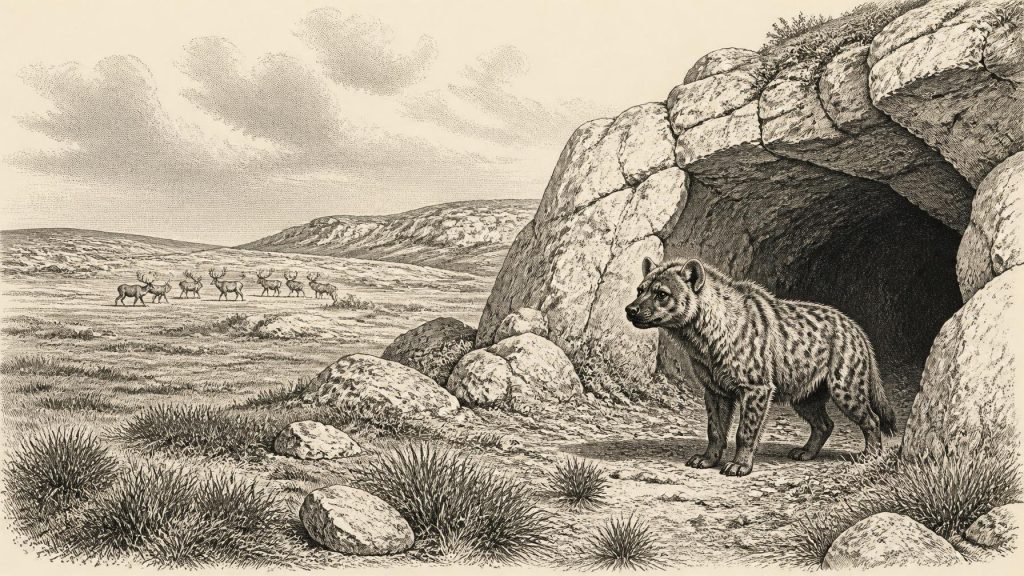
Castlepook is Ireland’s principal archive for a pre-Last Glacial Maximum mammal community. Its limestone passages yielded a striking assortment of Ice Age remains during excavations between 1904 and 1908: reindeer, woolly mammoth, giant deer, brown bear, wolf, hare, Arctic fox, lemmings and spotted hyaena. This was not a single herd, a single season or an intact domestic landscape. Cave deposits accumulate through many processes: carnivores carry in prey, animals die in or near entrances, water moves bones, sediments slump, and excavators mix or remove layers. Much of the original collection and its field context have been lost.
Nevertheless, the fauna establishes an essential point. Ireland supported, at intervals, a much richer large-mammal assemblage than its later historic fauna. Reindeer indicate cold open country and seasonal mobility; lemmings and Arctic fox point to severe conditions; mammoth and giant deer show that large herbivores could use parts of the island. Spotted hyaena, a formidable scavenger and hunter, is particularly revealing. Its presence means that carcasses and prey animals were sufficient to support a large carnivore, at least episodically. The National Museum of Ireland places the migration of hyaenas and other mammals from Britain to Ireland broadly between 45,000 and 30,000 years ago.
That is evidence for animal movement, not for a timeless ‘mammoth Ireland’. Individual species need not have overlapped everywhere or continuously. Modern re-dating has also shown that some radiocarbon determinations made in the 1990s were too young because older methods could not remove all contaminants from bone collagen. A 2020 reassessment of southern Irish cave fauna returned Castlepook dates between roughly 5,000 and 12,000 radiocarbon years older than their earlier results. The lesson is not that every old bone belongs to one moment, but that Ireland’s Middle Pleniglacial history must be rebuilt specimen by specimen.
Ice, Water and Open Ground
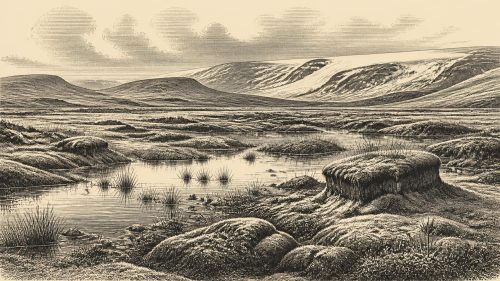
At around 30,312 BCE, Ireland was not simply a white island sealed beneath unchanging ice. The British–Irish Ice Sheet had already grown during earlier cold phases, and evidence from western Ireland indicates substantial glacial loading and changing ice margins well before the global Last Glacial Maximum. Yet the extent, thickness and timing of ice around the island remained dynamic. Recent syntheses stress that advance and retreat occurred during Marine Isotope Stage 3, while the more comprehensively mapped maximum and retreat sequence belongs largely to the period after about 31,000 years ago.
It is therefore unsafe to draw a single coast-to-coast ice boundary for this notional year. Southern limestone caves could preserve animal evidence while other regions were occupied by ice, periglacial ground or glacial meltwater systems. The later Last Glacial Maximum, conventionally placed at about 26,500–19,000 years before present, would transform conditions further. At 30,312 BCE, Ireland was approaching that major phase of environmental contraction rather than living in its final, uniform state.
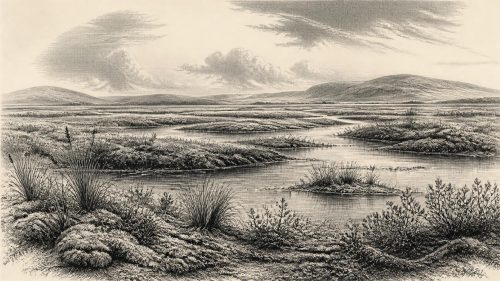
Older investigations at Derryvree near Maguiresbridge, County Fermanagh, are relevant but must be used cautiously. Organic sediments buried between tills recorded mosses, sedges, dwarf willow, mountain avens, bogbean and aquatic plants, suggesting cold freshwater margins and treeless tundra-like mosaics during an earlier ice-free or less glaciated interval. One historic radiocarbon determination, BIRM-166, was reported as 30,500 ± 1,100 radiocarbon years before present. Its broad uncertainty, old methodology and complicated position between glacial deposits mean it cannot illuminate 30,312 BCE as a precise date. It does, however, overturn any simplistic assumption that every part of Ice Age Ireland was permanently ice-covered.
Life Without a Village
For people, the evidence is far thinner than for animals. If the mark on the Castlepook reindeer femur is confirmed as a fresh-bone butchery cut, it would show that one or more Upper Palaeolithic people handled a reindeer carcass in Ireland during this broad period. It would be a powerful indication of a visit, hunt, scavenging episode or short camp nearby. It would not demonstrate a permanent population, a village, a named people, or uninterrupted occupation. There is no securely associated hearth, stone-tool assemblage, dwelling surface, burial, ornament, artwork or human skeleton from Castlepook of this age.
The biological identity of any visitors is likewise unknown. By this period, Homo sapiens were widespread in western Europe, but the Irish bone does not preserve human DNA and has no associated diagnostic artefacts. Nor can the probable route be reconstructed with confidence. Lower sea levels altered the Irish Sea basin dramatically, while changing ice, rivers, coastlines and exposed shelf terrain affected possible crossings. The animal record shows that Ireland was not biologically isolated; it does not prove a particular land bridge or a specific human journey.
Everyday life can consequently be discussed only as a carefully labelled interpretation. People able to reach this landscape would have needed portable clothing, fire-making knowledge, cutting tools and close attention to animal movements, weather and shelter. Reindeer would have offered meat, marrow, hide, sinew and bone, but there is no Irish assemblage from this date demonstrating how those resources were divided, stored or shared. A small mobile group, perhaps visiting seasonally, is more compatible with the surviving evidence than any settled society, but even that remains an inference.
No Kingdoms, No Trade Network
There is no evidence for political institutions, warfare, diplomacy, leaders, territories or formal trade in Ireland at this date. It would be misleading to fill that silence with imagined clans or rival hunting bands. The same restraint applies to religion and learning. Caves can be evocative places, but Castlepook has yielded no dated ritual deposit, symbolic art, burial or structured offering belonging to this period. No language, oral tradition or belief can be recovered from a cut-marked bone and a mixed faunal collection.
Culture is present only in the most minimal possible sense: if the reindeer mark is anthropogenic, it reflects skilled use of a sharp implement and knowledge of animal anatomy. Economy, if people were present, was overwhelmingly one of immediate subsistence in a harsh environment rather than farming, herding, metalworking or market exchange. The central historical development is not a political event but the possibility that Ireland was visited by people far earlier than the long-accepted post-glacial settlement record allowed.
A Landscape of Possibility
For 30,312 BCE, Ireland is best understood as a changing northern refuge and corridor, where open cold landscapes, cave shelters, shifting ice margins and mobile animal populations occasionally coincided. Castlepook preserves the clearest material challenge to the older view that humans first reached Ireland only near the end of the Ice Age. Yet its evidence remains a question under active investigation. Future work—secure excavation, modern collagen treatment, sedimentary DNA, microscopic study of bone surfaces and tightly controlled dating—may confirm, refine or overturn the earliest-butcher claim. For now, the honest history of this year is one of sparse traces, formidable animals and carefully bounded possibility.
Primary Sources
- A reconsideration of the radiocarbon dating of the Marine Isotope Stage 3 fauna from southern Ireland
- The Irish quaternary fauna project
- Spotted Hyena Skull
- New insights on the fauna of Ireland's Younger Dryas and Early Holocene from Alice & Gwendoline Cave
- The Archaeological Heritage of County Cork
- Heritage Artefacts of County Cork
- Ireland's Palaeolithic Archaeology – Fleeting Footprints in a Frozen Land
- The timing and magnitude of the British–Irish Ice Sheet between Marine Isotope Stages 5d and 2: implications for glacio-isostatic adjustment, high relative sea levels and ‘giant erratic’ emplacement
- Growth and retreat of the last British–Irish Ice Sheet, 31,000 to 15,000 years ago: the BRITICE-CHRONO reconstruction
- Radiocarbon constraints on the history of the western Irish ice sheet prior to the Last Glacial Maximum
- Pattern and timing of retreat of the last British-Irish Ice Sheet
- New data for the Last Glacial Maximum in Great Britain and Ireland
- Radiocarbon constraints on the age of the maximum advance of the British–Irish Ice Sheet in the Celtic Sea
- Trimlines, blockfields and the vertical extent of the last ice sheet in southern Ireland
- Oscillating retreat of the last British-Irish Ice Sheet on the continental shelf offshore Galway Bay, western Ireland
- The deglaciation of the western sector of the Irish Ice Sheet from the inner continental shelf to its terrestrial margin
- Deglaciation chronology of the Donegal Ice Centre, north-west Ireland
- The IntCal20 Northern Hemisphere radiocarbon age calibration curve (0–55 cal kBP)
- Marine20—The Marine Radiocarbon Age Calibration Curve (0–55,000 cal BP)
- A Middle Midlandian freshwater series at Derryvree, Maguirebridge, County Fermanagh, Northern Ireland