Hyaena Land, Castlepook31920 BCE
Castlepook Cave near Doneraile, County Cork, preserves a disturbed, important Late Pleistocene animal archive rather than evidence for a dated event in 31,920 BCE. Fossils, individually dated across approximately 45,700–19,950 years ago, include mammoth, giant deer, reindeer, bear, spotted hyaena, wolf, Arctic fox and lemmings. Gnawed bones indicate repeated hyaena use, not a local fauna. Revised dating suggests giant deer and hyaenas may have vanished locally before 40,000 years ago. A reindeer femur possibly bearing butchery marks suggests an early Upper Palaeolithic human visit, but proves neither settlement nor community. These changing landscapes supported habitats before ice-sheet advance erased evidence.

Dateline
The label 31,920 BCE must not be treated as the date of a recorded Irish event. No calendar, written testimony, named community or securely dated settlement allows history to be narrated at year-by-year precision this far back. Expressed simply against the conventional radiocarbon baseline of 1950, it falls about 33,870 years before present; yet that arithmetic conversion is not itself a calibrated archaeological date. The responsible setting is the Late Pleistocene, broadly Marine Isotope Stage 3 (MIS 3), when climates repeatedly altered and Ireland’s evidence survives only in scattered caves, sediments and fossils. The most illuminating Irish place is Castlepook Cave near Doneraile, County Cork: not a prehistoric town or shrine, but a limestone cave whose animal remains preserve a rare glimpse of a landscape that later ice and erosion largely removed.
A Date Range, Not A Dated Year
Radiocarbon ages and calendar ages are not interchangeable. A measured radiocarbon result has to be calibrated against curves that account for past fluctuations in atmospheric carbon-14, and the uncertainties become especially important in the deep past. IntCal20 provides a Northern Hemisphere calibration framework back to 55,000 calendar years before present, but it does not turn a cave find into evidence for a particular modern-style year. Accordingly, 31,920 BCE is best used here as a point within a broad chronological neighbourhood, around 34,000 calendar years ago, rather than as a moment at which anyone can be shown to have acted in Ireland.
That distinction matters because Castlepook’s remains do not form one sealed deposit made in one season or even one millennium. The cave was excavated principally between 1904 and 1918, and its deposits were disturbed by water, animals and excavation. More than 2,000 recovered bones are now recorded in the Geological Survey Ireland account, while older reports describe a much larger antiquarian collection. Direct dates from individual specimens span a very long stretch of the Ice Age, approximately 45,700 to 19,950 years before present. Each bone can therefore illuminate the existence of a species at some point, but no complete animal list should automatically be projected on to 31,920 BCE.
The Cave’s Animal Archive
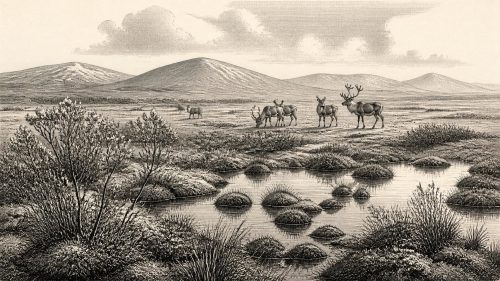
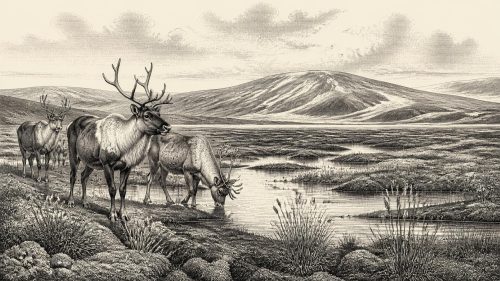
Even with that warning, Castlepook is exceptionally important. Its Pleistocene fauna includes woolly mammoth, giant deer, reindeer, brown bear and spotted hyaena; later Ice Age material also includes wolf, Arctic fox and both collared and Norwegian lemmings. These are direct fossil identifications, not imaginative reconstructions. They show that, during different portions of the pre-Last Glacial Maximum period, Ireland could support a cold-stage mammal community of striking variety. Mammoth and reindeer evoke open, productive grazing ground; lemmings and Arctic fox point to severe conditions; hyaenas reveal the presence of a large predator and scavenger capable of bringing bones into sheltered places.
The hyaena is central to interpreting the cave. Many bones have been gnawed, and Castlepook has long been understood as a place to which spotted hyaenas carried carcass parts or scavenged remains. That explains why a cave assemblage is not a simple census of animals living immediately outside its entrance. A hyaena den records predation, scavenging, bone transport and repeated use of shelter. It may preserve prey that people never encountered, as well as animals that died far from the cave. In historical terms, the best image is not of a stable “Irish fauna” assembled in one place, but of episodic animal traffic through a changing region.
Re-dating has made the picture more complex and more valuable. Improved pretreatment of bone samples produced Castlepook results between roughly 5,000 and 12,000 radiocarbon years older than earlier determinations for the same site. The 2020 reassessment concluded that giant deer and spotted hyaena may have disappeared locally before about 40,000 calibrated years ago. This is an interpretation based on the revised dates, not proof that every individual species was absent from Ireland in the notional year 31,920 BCE. It does, however, make caution essential: the presence of hyaena remains at Castlepook cannot by itself demonstrate living hyaenas in County Cork at that exact calendar point.
People: A Possible Trace, Not A Population
The most consequential, and most limited, evidence concerns a reindeer femur from the Castlepook collection. Researchers have identified marks on it as consistent with stone-tool butchery, and public reporting of the research places the bone at about 33,000 years ago. If that interpretation and association are sustained, the bone indicates that humans processed an animal in Ireland during the Upper Palaeolithic, pushing evidence of human activity far earlier than the previously accepted Late Upper Palaeolithic evidence from Alice and Gwendoline Cave in County Clare. It would be a major discovery precisely because the Irish record is so sparse.
Yet a butchered bone is not evidence for permanent settlement. There is no securely associated house, hearth, lithic workshop, cemetery, art panel, tool assemblage or human DNA from Castlepook that can define a resident community at this time. Nor does the bone identify a language, ethnicity, kin group or named archaeological culture. Its original excavation context was shaped by early twentieth-century methods, and the cave’s sediment history is complicated. The most that can responsibly be said is that one or more people may have reached Ireland and handled reindeer during this broad phase of the Ice Age. Whether they made a short hunting visit, used the cave itself, or belonged to a recurring seasonal movement across the wider north-west European landscape remains unknown.
Landscape Before The Ice Maximum
At around 34,000 calendar years ago, Ireland stood before the Last Glacial Maximum rather than within its fullest extent. Later research places the maximum British–Irish Ice Sheet in Irish and adjacent seas broadly around 25,000–23,000 years before present, while wider reconstructions examine ice-sheet growth and retreat from 31,000 to 15,000 years ago. Southern Ireland was not simply an unchanging white expanse throughout the entire Late Pleistocene. Evidence from south-coast raised beaches and marine sands demonstrates MIS 4–3 conditions before later glaciation; subsequent ice advance altered and, in many places, erased older landscapes.
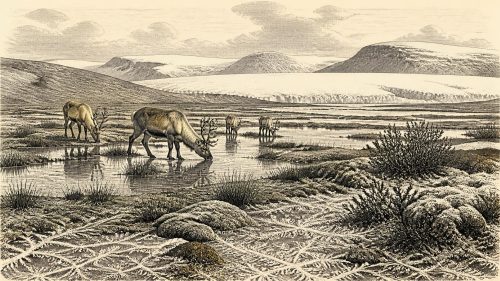
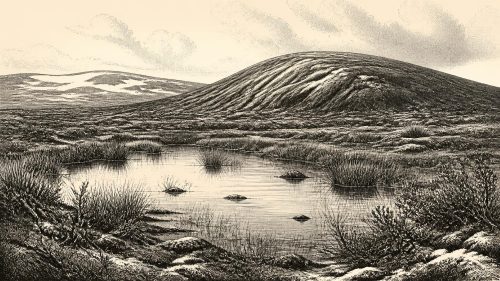
The environment suggested by the faunal record was cold and generally open, but it should not be reduced to a featureless tundra. Reindeer, mammoth and giant deer require food; their presence implies patches of vegetation capable of sustaining large herbivores, probably within a shifting mosaic of grassland, herb-rich steppe-tundra, wet ground and more sheltered terrain. Weather, growing seasons and plant cover would have varied across centuries and millennia, particularly through the abrupt climatic oscillations characteristic of MIS 3. The low sea levels of the glacial world also made coastlines very different from those of modern Ireland. They may have reduced or rearranged sea barriers, but the precise availability of a continuous route from Britain or continental Europe at any one date cannot be assumed from the evidence now available.
No Polities, No Trade Network
There is no evidence from Ireland around this point for political authority, diplomacy, warfare between organised polities, farming, metalworking, trade routes, formal religion or literacy. Such headings belong to later prehistoric and historic societies; forcing them on to Castlepook would replace evidence with fiction. If people did reach the island, their practical economy would have depended on mobility, knowledge of animal behaviour, suitable stone tools, clothing and shelter adequate for an unstable cold climate. Those are reasonable inferences from Upper Palaeolithic life elsewhere, but they cannot be described as directly observed Irish institutions.
Equally, it would be wrong to claim either peaceful coexistence or conflict between people and carnivores. Hyaenas, wolves and bears made large carcasses and caves contested resources in an ecological sense. But Castlepook provides no incident, battle, ritual or personal story. The cave’s cultural significance lies instead in its refusal to yield easy narratives. It demonstrates how much Irish prehistory has been lost, mixed or buried, while preserving enough material to show that the island was not outside the biological world of Ice Age north-west Europe.
What Can Be Said Responsibly
The strongest conclusion for the period represented by 31,920 BCE is environmental, not political. Parts of Ireland had, at various times in MIS 3, a cold-stage fauna including large grazers and formidable predators. Castlepook Cave in north Cork is the principal Irish archive for this evidence. A reindeer bone potentially bearing butchery marks raises the possibility of a very early human visit, but does not establish a continuous population or a year-specific occupation. The approaching growth of the British–Irish Ice Sheet would later transform the island’s terrain and drastically narrow the archaeological record. New excavations and modern re-dating programmes are therefore crucial: intact deposits, rather than old collections alone, offer the best prospect of learning whether fleeting human footprints can be separated from the deeper tracks of reindeer, mammoth and hyaena.
Primary Sources
- Castlepook Cave, County Geological Site Report
- A Reconsideration of the Radiocarbon Dating of the Marine Isotope Stage 3 Fauna from Southern Ireland
- The Irish Quaternary Fauna Project
- Pleistocene Vertebrates in the British Isles
- The Archaeological Heritage of County Cork
- CASTLEPOOK CAVE, Castlepook South, Cork: Excavation Report 2022
- First Evidence of a Late Upper Palaeolithic Human Presence in Ireland
- New Insights on the Fauna of Ireland's Younger Dryas and Early Holocene from Alice & Gwendoline Cave
- Ireland's Palaeolithic Archaeology – Fleeting Footprints in a Frozen Land
- Late Pleistocene Chronostratigraphy and Ice Sheet Limits, Southern Ireland
- Stratigraphic and Palaeo-Geomorphological Evidence for the Glacial-Deglacial History of the Last British-Irish Ice Sheet in the North-Western Irish Sea
- Growth and Retreat of the Last British–Irish Ice Sheet, 31,000 to 15,000 Years Ago: the BRITICE-CHRONO Reconstruction
- Dimensions and Chronology of the Last Ice Sheet in Western Ireland
- Last Glacial Maximum Cirque Glaciation in Ireland and Implications for Reconstructions of the Irish Ice Sheet
- The Timing and Magnitude of the British–Irish Ice Sheet Between Marine Isotope Stages 5d and 2
- The IntCal20 Northern Hemisphere Radiocarbon Age Calibration Curve (0–55 cal kBP)
- IntCal Publications
- Prehistoric Ireland
- Guide to the National Museum of Ireland
- Irish Quaternary Association Field Guides