The Cut-Marked Reindeer31919 BCE
31,919 BCE is a modern label for a Late Pleistocene period, not a recoverable Irish historical year. Before the Last Glacial Maximum, deposits in Fermanagh indicate that some Irish landscapes were intermittently ice-free, although conditions varied regionally. Castlepook Cave in County Cork preserves a chronologically mixed fauna including reindeer, mammoth, giant deer, hyaena and other cold-stage animals, demonstrating habitable environments. A cut-marked reindeer femur may indicate human butchery around 33,000 BCE, but disturbed deposits, alternative explanations and absent artefacts prevent confirmation. Later glaciation created a vast gap; securely dated human activity appears only over twenty millennia later in County Clare.

Dateline
The label 31,919 BCE is a modern calendar convention, not a year for which Ireland has a recoverable historical record. No contemporary people named it, wrote about it or dated events by it. In archaeological terms it falls roughly 33,868 years before the conventional radiocarbon “present” of 1950, but that arithmetic conversion must not be confused with a calibrated scientific date. Radiocarbon and other dating methods produce ranges, often broad ones, and their results are related to particular samples rather than to an island-wide annual snapshot. The responsible description is therefore Ireland during the Late Pleistocene, within Marine Isotope Stage 3 and before the Last Glacial Maximum.
There was no Ireland in the political or cultural sense familiar from later history: no kingdoms, towns, farms, written language, churches, monuments or known burial grounds. Nor is there evidence from this horizon for diplomacy, trade networks, formal warfare or a settled population. What can be investigated is more fundamental, yet remarkable: whether the land that is now Ireland could support large mammals, whether parts of it remained free of a full ice sheet, and whether people may briefly have reached it.
A Date Beyond Annual History
The numbered year sits within a long and unstable climatic interval. The Last Glacial Maximum, when the British–Irish Ice Sheet became especially extensive, lay later, broadly between about 26,500 and 19,000 years ago. Around the earlier horizon represented by 31,919 BCE, the eventual expansion of that ice sheet was not yet complete. Geological evidence from north-central Ireland is particularly important. Organic sediments beneath later glacial deposits at Derryvree and Greenagho in County Fermanagh indicate ice-free conditions during parts of the preceding interval. One calibrated range from Derryvree spans approximately 36,900–31,700 cal BP; another from Greenagho spans about 37,200–35,700 cal BP.
Those ranges overlap a great deal of time, and neither proves that every Irish region was open ground at once. They nevertheless overturn an older, simple picture of an Ireland continuously smothered by ice before the glacial maximum. The best interpretation is regional and provisional: at least some lowland landscapes, lakes and coastal waters existed before later ice advanced, while uplands and northern or western sectors could have had very different local conditions. Subsequent glacier movement eroded, buried and rearranged evidence, making this one of the most difficult periods in Irish archaeology to reconstruct.
Castlepook’s Fossil Archive
The strongest direct window on Ireland’s living world is Castlepook Cave, also called Mammoth Cave, near Doneraile in north County Cork. Excavations in the late nineteenth and early twentieth centuries recovered a very large collection of animal remains there. Later study and radiocarbon dating by the Irish Quaternary Fauna Project showed that Irish cave collections preserve evidence for mammals over a long Late Pleistocene span, rather than a single intact occupation layer. Castlepook is consequently an archive of repeated animal use, death, scavenging and sediment movement, not a frozen scene from one day or one year.
Its fauna includes reindeer, woolly mammoth, giant deer, brown bear, wolf, Arctic fox, hare, collared lemming and spotted hyaena. The hyaena is especially striking: Castlepook has produced Ireland’s only known remains of this Ice Age predator. Chewed bones suggest that hyaenas used parts of the cave system as a den or feeding place. That is evidence of carnivore behaviour, however, not proof that all the animals listed lived together at precisely the same time. Individual specimens have dates separated by millennia; species lists must not be turned into a single, overcrowded tableau.
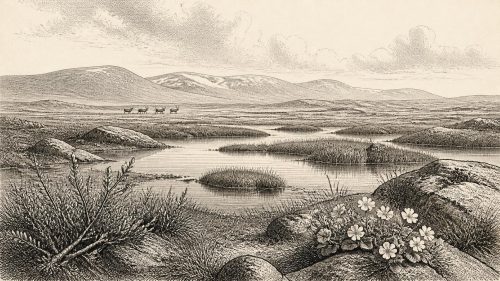
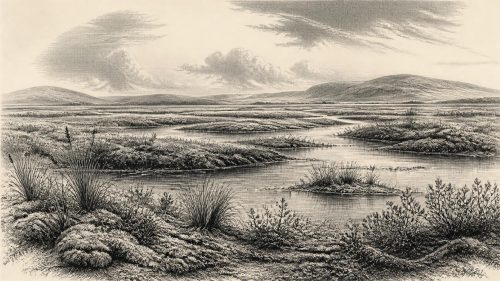
Still, the broad implication is clear. Before the full glacial maximum, portions of Ireland could sustain a cold-stage fauna of large grazers, browsers, scavengers and predators. Reindeer point to open, cold environments, while mammoth and giant deer testify to substantial food resources somewhere in the wider landscape. The appropriate image is not modern green pasture or continuous woodland, but a variable, exposed and seasonally demanding mosaic shaped by cold, wind, sparse vegetation, rock, water and changing ice margins. The exact proportions of grassland, herb-rich tundra, scrub and bare ground cannot be read directly from the cave bone collection alone.
The Reindeer Bone and People
Castlepook also supplies the most consequential, and most carefully qualified, possible human evidence for this early date. A reindeer femur from older excavations has been reported as bearing a cut mark consistent with the use of a sharp stone tool, and public heritage accounts place the animal at around 33,000 BCE. If that diagnosis and association withstand continuing specialist scrutiny, it would show that humans processed a reindeer in Ireland far earlier than the formerly accepted Late Upper Palaeolithic evidence from County Clare.
The distinction between evidence and interpretation matters. The physical evidence is a dated animal bone with a mark identified as compatible with butchery. The larger interpretation—that a small party of Homo sapiens travelled to Ireland, hunted or scavenged reindeer, butchered one carcass and then departed—is plausible, but it is not demonstrated by a camp, hearth, stone-tool assemblage, dwelling, human skeleton or repeated sequence of securely dated activity. Marks on ancient bone must be distinguished from carnivore damage, trampling, sediment abrasion, excavation damage and later handling. Moreover, much of Castlepook’s historic collection came from disturbed deposits, where the original relationships between objects were poorly recorded by modern standards.
Recent licensed investigation at Castlepook is important precisely because it addresses that weakness. The 2022 excavation sought surviving Pleistocene deposits and identified potentially useful sediments in several cave areas, but found no cultural artefacts. That negative result neither disproves the cut-mark interpretation nor establishes occupation. It underlines how little can honestly be claimed. Fresh stratigraphic excavation, micromorphology, direct dating and further faunal analysis offer the prospect of testing the older finds rather than merely repeating them.
Life at the Edge of Evidence
If people were present near this horizon, their visit was almost certainly small-scale and mobile. A group capable of reaching such a landscape would have needed detailed knowledge of animals, weather, shelter and stone-working, but Ireland currently provides no evidence from which to reconstruct kinship, leadership, language, clothing, ritual or social identity. It is unsafe to give them a tribal name, assign them an ethnicity, or treat them as ancestors of historically known Irish populations. The later disappearance of evidence during the harshest glacial conditions also means that a brief early visit should not be mistaken for continuous settlement.
Everyday life, if there was any human presence, would have centred on immediate survival: finding food, making and maintaining cutting implements, protecting bodies from cold and wet, and judging movement through a changing coastal and upland world. These are general inferences from Upper Palaeolithic lifeways elsewhere in north-west Europe, not observations made at Castlepook. There is no Irish evidence at 31,919 BCE for farming, domesticated animals, pottery, metalworking, long-distance exchange of finished goods or permanent houses. Any connection with Britain or continental Europe is similarly unproven. Lower sea levels altered the geography of the Irish Sea region, but neither a route nor the means of crossing can be specified from the available Irish evidence.
Religion and culture are even less visible. No cave art, portable art, ceremonial deposit, grave or musical instrument can securely be assigned to Ireland at this date. A cut-marked bone would be significant as evidence of subsistence technology, not of symbolic practice. The silence of the record is not proof that visiting people lacked stories, beliefs, skills or social rules; it means that such things have not survived in identifiable Irish form.
What Changed, and What Did Not
The central development around this date was environmental possibility. Ireland was not yet simply the ice-covered blank that older summaries sometimes implied. Faunal remains and buried deposits show that parts of the island or its then broader surrounding landscape supported life during a fluctuating pre-maximum glacial phase. Castlepook’s animals place Ireland within wider European ecological worlds, where reindeer, mammoth, hyaena and human hunters or scavengers could, at different times, move across changing northern landscapes.
But this was no foundation year for a continuous Irish society. The evidence remains sparse, cave-bound and chronologically stretched. The clearest securely dated proof of later human activity is the butchered brown-bear patella from Alice and Gwendoline Cave in County Clare, dated to approximately 12,810–12,590 cal BP—more than twenty millennia after the period considered here. Between the possible Castlepook episode and those later traces lie severe climatic deterioration, major ice-sheet growth and an immense archaeological gap.
For 31,919 BCE, then, the responsible history of Ireland is one of a cold but intermittently habitable land, large animals, advancing climatic risk and a tantalising possible human signature. Castlepook’s reindeer bone may eventually alter the beginning of Ireland’s human story. At present, it is best treated not as evidence for a populated Ice Age Ireland, but as a challenging clue that makes the absence of stronger evidence all the more important.
Primary Sources
- The Irish Quaternary Fauna Project
- New Insights on the Fauna of Ireland's Younger Dryas and Early Holocene from Alice & Gwendoline Cave
- First Evidence of a Late Upper Palaeolithic Human Presence in Ireland
- Archaeology Research Excavation Grant Report: Castlepook Cave
- 2022:564 – Castlepook Cave, Castlepook South, Cork
- Heritage Artefacts of County Cork
- Archaeological Heritage of County Cork
- Guide to the National Museum of Ireland – Natural History
- Ice Age Ireland
- Trimlines, Blockfields and the Vertical Extent of the Last Ice Sheet in Southern Ireland
- Late Pleistocene Chronostratigraphy and Ice Sheet Limits, Southern Ireland
- Radiocarbon Constraints on the Age of the Maximum Advance of the British-Irish Ice Sheet in the Celtic Sea
- Last Glacial Maximum Cirque Glaciation in Ireland and Implications for Reconstructions of the Irish Ice Sheet
- Early Deglaciation of the British-Irish Ice Sheet on the Atlantic Shelf Northwest of Ireland Driven by Glacioisostatic Depression and High Relative Sea Level
- Growth and Retreat of the Last British–Irish Ice Sheet, 31,000 to 15,000 Years Ago: the BRITICE-CHRONO Reconstruction
- New Data for the Last Glacial Maximum in Great Britain and Ireland
- The Problem of a Late Quaternary Landbridge Between Britain and Ireland
- Ireland: Submerged Prehistoric Sites and Landscapes
- Castlepook Caves
- Irish Caves Database: Mammoth Cave
- Pleistocene Vertebrates in the British Isles
- Ireland's Palaeolithic Archaeology – Fleeting Footprints in a Frozen Land