Castlepook’s Deep Winter31819 BCE
Around 31,819 BCE, Ireland was a climatically unstable Late Pleistocene landscape, not a place with recorded human history. Lower seas, shifting ice margins and episodic connections shaped animal movement, although routes remain uncertain. Derryvree deposits in Fermanagh preserve evidence of cold, open tundra vegetation, freshwater habitats and an ice-free interval later buried by glaciers. Castlepook Cave in Cork contains remains of reindeer, mammoth, giant deer, hyaena and other cold-stage animals, demonstrating varied fauna before the Last Glacial Maximum. A marked reindeer femur may indicate human butchery, but cannot prove settlement. Later glaciation destroyed much evidence, leaving uncertainty central to interpretation.
Dateline
The label 31,819 BCE is a useful modern reference point, but it cannot identify an event in Ireland in a single ancient calendar year. Nobody then recorded years, rulers or seasons in a recoverable Irish chronology. In archaeological terms, the date falls approximately 33,800 calibrated years before present (cal BP, where “present” is AD 1950), within the Late Pleistocene and Marine Isotope Stage 3 (MIS 3). That conversion is necessarily approximate. Radiocarbon ages must be calibrated against changing atmospheric carbon levels, and results at this depth of time are properly reported as probability ranges, not as annual anniversaries.
For Ireland, the evidence is exceptionally fragmentary. Later glaciers eroded, redeposited or buried much of the older landscape, while cave material was often recovered during early excavations whose recording standards were unlike those of today. The responsible question is therefore not what happened in 31,819 BCE, but what deposits, fossils and dates can illuminate Ireland around this broad horizon. They reveal a cold, changeable north-western land supporting Ice Age animals, with a possible but still unproven human presence.
A Variable Ice-Age Landscape
This was not yet the Last Glacial Maximum, the later phase in which the British–Irish Ice Sheet expanded to cover Ireland and much of the surrounding continental shelf. Yet neither was the island simply free of ice. Research increasingly indicates that the British–Irish Ice Sheet had a long and dynamic history, with growth, retreat and renewed advances before its maximum extent. The precise position of ice margins around 33.8 thousand cal BP remains uncertain, and may have differed sharply from one region to another. It is unsafe to imagine a single uniform map for the entire island.
The sea was lower than today because substantial volumes of water were locked in northern ice sheets. Ireland’s coastlines and surrounding shallow seas therefore looked very different. Exposed shelf and altered channels may at times have reduced the distance separating Ireland from Britain and continental Europe, but they do not demonstrate a simple, dry land bridge available to people or animals at this particular moment. Ice, tidal waters, rivers, sea level and changing terrain all mattered. Connectivity was episodic rather than permanent, and the routes by which animals reached Ireland remain a subject of investigation rather than settled fact.
MIS 3 itself was climatically unstable. Across the North Atlantic world, millennial-scale shifts produced comparatively milder interstadial phases and harsher stadial conditions. Conditions in Ireland would have changed over periods longer than any human lifetime, but sometimes rapidly in geological terms. A date expressed as 31,819 BCE must consequently stand for a wide environmental setting, not one fixed temperature, shoreline or vegetation map.
Derryvree’s Freshwater Record
One of the most valuable Irish windows onto this world lies at Derryvree near Maguiresbridge, County Fermanagh. There, freshwater silts and sands were found sandwiched between two glacial tills in a drumlin landscape. The sediments contained organic remains and yielded a radiocarbon determination of 30,500 radiocarbon years BP. With modern calibration, the result spans a broad calendar range that includes the approximate horizon represented by 31,819 BCE. It records an interval when the site was not under overriding glacier ice; it does not date an individual year, nor prove uninterrupted conditions across Ireland.
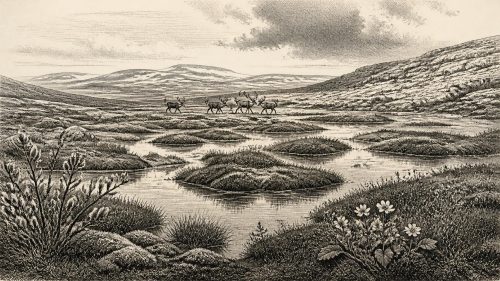
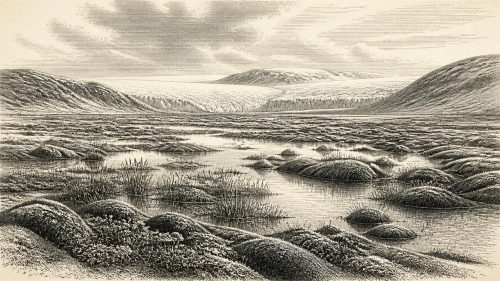
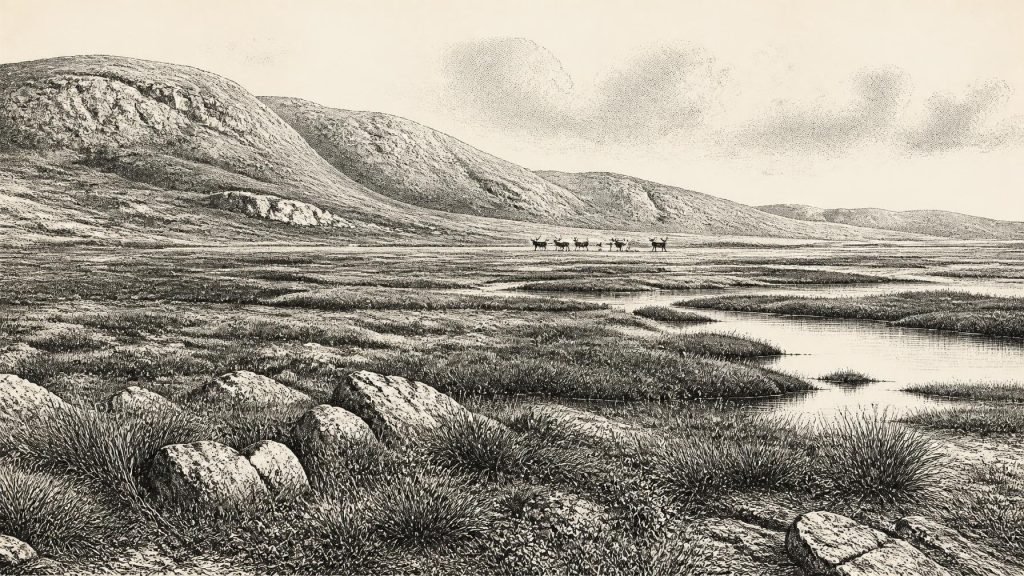
The Derryvree evidence indicates a cold, open environment with wet ground and freshwater habitats. Pollen, plant macrofossils and other environmental traces point away from closed forest and towards tundra-like vegetation: grasses, sedges, herbs, mosses and low shrubs, arranged according to local soils and drainage. Finds including mountain avens, Dryas octopetala, are consistent with a landscape able to support cold-adapted plant communities. Pools, marshy margins and shallow streams could provide concentrated summer resources, while frost, sparse tree cover and a short growing season imposed severe limits.
This was not a lifeless snowfield. Open ground can be highly productive in brief summers, especially where herbs and sedges flourish. But it was a demanding habitat. Wind exposure, seasonal freezing and unpredictable weather would have shaped every animal movement. The later advance of ice, which sealed the Derryvree deposits beneath till, also explains why such records are rare: much evidence from the same age has not survived, or has not yet been recognised.
The Caves of North Cork
Castlepook Cave, also known as Mammoth Cave, near Doneraile in County Cork, supplies the most striking faunal evidence for pre-maximum Ireland. Excavations undertaken principally between 1904 and 1913 recovered a large collection of animal remains, although only a small fraction of the material said to have been found survives in museum collections. The cave deposits are scientifically important but difficult: caves can be dens, traps, shelters, drainage routes and sediment repositories, and bones may be moved by water, carnivores or later disturbance. A bone in a cave is not automatically evidence of a human campsite.
Modern reassessment and radiocarbon dating have shown that part of the Castlepook fauna belongs to MIS 3. Reindeer, giant deer, brown bear, Arctic fox, wolf, lemming, woolly mammoth and spotted hyaena are represented in the wider assemblage or associated collections. Not all were necessarily present together, and not every specimen can be assigned closely to 33.8 thousand cal BP. Nevertheless, this range makes clear that southern Ireland could support a varied cold-stage fauna during periods before the Last Glacial Maximum.
Spotted hyaena deserves particular notice. It was not the African animal’s modern range projected backwards, but a large Pleistocene carnivore living in a different European ecological world. Its Castlepook remains, including material held by the National Museum of Ireland, show that predators as well as herbivores crossed into Ireland during favourable phases. Hyaenas may have accumulated or modified bones in caves. Their presence is an important warning against treating every broken or marked specimen as evidence of people.
A Reindeer Bone and Its Limits
A reindeer femur from Castlepook has been presented as bearing a deep mark consistent with cutting by a stone tool, while the bone itself has been reported as about 33,000 years old. If the mark was made during fresh butchery, it would be potentially important evidence that Upper Palaeolithic people reached Ireland far earlier than the island’s long-established late-glacial human record. In the broad chronological sense, it is relevant to the world around 31,819 BCE.
That possibility must be stated with care. The specimen derives from an old collection, not a recently excavated and securely stratified occupation floor. Its radiocarbon measurement dates the animal’s death, rather than independently dating the mark, the killing place or the duration of a visit. No associated hearth, stone-tool assemblage, dwelling surface, burial, artwork or human bone of comparable antiquity has established a 32nd-millennium BCE community in Ireland. The identification of a mark as a tool cut is also a specialist interpretation that requires comparison with carnivore damage, sediment abrasion and other natural processes.
The strongest conclusion is modest but significant: a short human incursion into Ireland during MIS 3 is possible, and the Castlepook femur may preserve evidence of reindeer processing. It does not demonstrate permanent settlement, a population continuity, or an Irish branch of a named Upper Palaeolithic culture. Recent fieldwork at Castlepook has sought surviving undisturbed deposits precisely because new excavation, secure context and further dating are required to test the earlier collection’s promise.
Society Beyond the Evidence
No political history can responsibly be written for Ireland at this date. There are no kingdoms, chiefs, tribal names, diplomatic exchanges, battles, laws or boundaries in the evidence. Nor can archaeologists identify an Irish language, ethnicity or religion. If hunter-gatherers visited, they would have belonged to small, mobile groups whose decisions were governed by weather, animal movement, knowledge of routes and the immediate demands of food, fuel and shelter. Those are reasonable inferences from Upper Palaeolithic lifeways elsewhere in Europe, not direct observations of a group at Castlepook.
The same distinction applies to economy and culture. Reindeer would have offered meat, fat, hides, sinew, antler and bone to hunters who acquired one, but a single potentially modified bone cannot reveal a local hunting season, division of labour or exchange network. Caves might have offered temporary shelter, but Castlepook’s evidence does not prove that people lived in it. European communities of this broad era made sophisticated stone tools, ornaments and art; none can presently be assigned to Ireland around this horizon.
What can be said is that Ireland was part of a wider ecological frontier. Animal populations arrived, survived for periods and disappeared as climate, ice and sea changed. Any humans who entered would have encountered a land of open vegetation, wet hollows, limestone caves and dangerous large mammals, not a settled island with farms or monuments. Their traces, if they existed, were vulnerable to being erased by later glaciation.
Evidence, Not an Anniversary
Around the approximate time represented by 31,819 BCE, Ireland’s history is principally environmental history. Derryvree preserves freshwater and tundra evidence beneath later ice. Castlepook preserves the bones of animals that lived on or reached the island during a fluctuating cold stage. Together they challenge the old image of an entirely empty, featureless Ireland before the final great glaciation, while also demonstrating how little is securely known.
The most important development was therefore not a recorded political act or a named human achievement, but the existence of habitable, if severe, ecological windows before the ice sheet’s maximum advance. Ireland was intermittently connected to wider north-west European animal worlds and perhaps briefly visited by people. The reindeer femur offers a provocative clue, not a finished origin story. For this remote period, uncertainty is not a defect to be concealed; it is the central historical fact.
Primary Sources
- A reconsideration of the radiocarbon dating of the Marine Isotope Stage 3 fauna from southern Ireland
- The Irish Quaternary Fauna Project
- The Exploration of Castlepook Cave, County Cork
- A Middle Midlandian Freshwater Series at Derryvree, Maguiresbridge, County Fermanagh, Northern Ireland
- The timing and magnitude of the British–Irish Ice Sheet between Marine Isotope Stages 5d and 2: implications for glacio-isostatic adjustment, high relative sea levels and ‘giant erratic’ emplacement
- Late Pleistocene chronostratigraphy and ice sheet limits, southern Ireland
- Radiocarbon constraints on the age of the maximum advance of the British–Irish Ice Sheet in the Celtic Sea
- Maximum extent and dynamic behaviour of the last British–Irish Ice Sheet west of Ireland
- Timing and pace of ice-sheet withdrawal across the marine–terrestrial transition west of Ireland during the last glaciation
- The deglaciation of the western sector of the Irish Ice Sheet from the inner continental shelf to its terrestrial margin
- The IntCal20 Northern Hemisphere radiocarbon age calibration curve (0–55 cal kBP)
- The IntCal20 approach to radiocarbon calibration curve construction: a new methodology using Bayesian splines and errors-in-variables
- Dansgaard–Oeschger events in climate models: review and baseline Marine Isotope Stage 3 (MIS3) protocol
- Spotted Hyena Skull
- 2022:564 – CASTLEPOOK CAVE, Castlepook South, Cork
- Archaeology Research Excavation Grant 2022
- Could brown bears (Ursus arctos) have survived in Ireland during the Last Glacial Maximum?
- New insights on the fauna of Ireland's Younger Dryas and Early Holocene from Alice & Gwendoline Cave
- A Pleistocene deposit preserved in deep karst at Coolough, County Galway, western Ireland
- Occurrence of mammalia relicts at site Castlepook Cave
- The behavioural ecology of reindeer (Rangifer tarandus) during the last glaciation
- The Archaeological Heritage of County Cork
- Dryas octopetala L.
- Ireland's Palaeolithic Archaeology – Fleeting Footprints in a Frozen Land