

Castlepook’s Hyena-Reindeer World31131 BCE
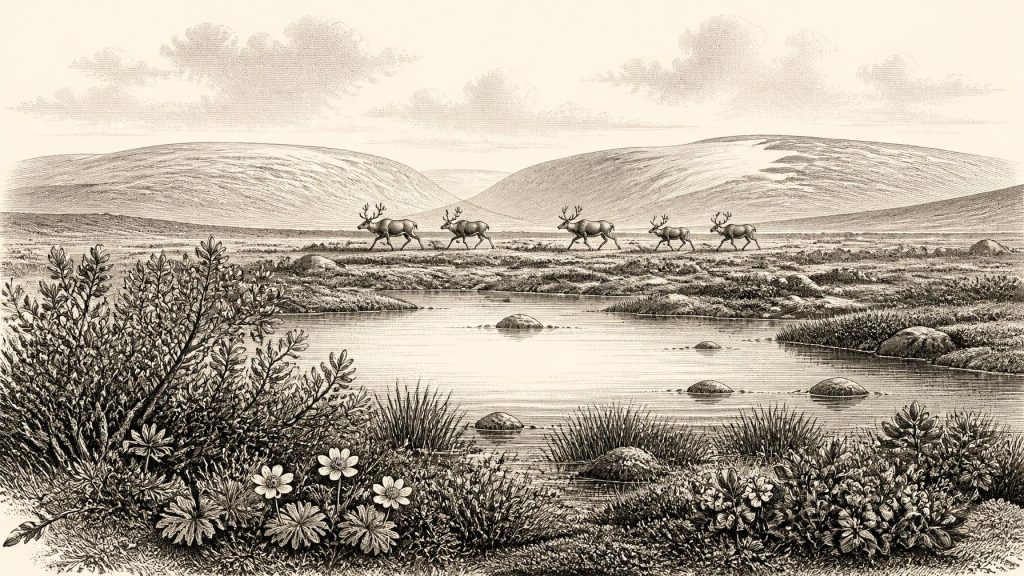
At roughly 31,131 BCE, Ireland formed part of a changing pre-Last Glacial Maximum environment, not a recorded historical year. Derryvree in County Fermanagh preserves freshwater sediments dated broadly to 36,900–31,700 cal BP, indicating cold tundra-steppe wetland with Arctic-alpine plants and open water between glacial advances. Castlepook Cave in Cork yielded a long, complex assemblage spanning about 45,700–19,950 BP, including mammoth, reindeer, giant deer, brown bear and spotted hyaena. These remains demonstrate ecological connectivity with north-west Europe, but not simultaneous species or events. A possibly cut-marked reindeer bone suggests an early human visit, yet lacks supporting tools or secure settlement evidence.
Dateline
The label 31,131 BCE is useful only as a modern point of reference. No community in Ireland recorded years, events or named individuals at this depth of time, and archaeology cannot identify what happened in one calendar year. In calendar terms the date is roughly 33,080 years before AD 1950, but the evidence is dated in broad radiocarbon and calibrated ranges, often with substantial uncertainty. The responsible subject, therefore, is not a supposed Irish “year” but Ireland during a changing Middle Midlandian, pre-Last Glacial Maximum landscape.
The most informative evidence comes from deposits that accumulated over centuries or millennia rather than from a moment: freshwater muds buried beneath later glacial sediments in County Fermanagh, and animal bones gathered in caves in north County Cork. Together they show that parts of Ireland supported cold-climate vegetation and a surprisingly varied large-mammal fauna before later ice-sheet growth destroyed, buried or reworked much of the earlier record. They do not reveal a settled nation, a political community or a continuous human population.
Dating a Calendarless Landscape
Radiocarbon ages are not calendar dates. They measure the remaining radioactive carbon in once-living material and must be calibrated against changing atmospheric carbon levels. At more than 30,000 years ago, calibration produces broad probability ranges rather than a precise anniversary. This matters especially at Derryvree, near Maguiresbridge, County Fermanagh. Organic, moss-rich freshwater mud there produced a conventional radiocarbon determination of about 30,500 years BP, with an uncertainty of more than a millennium. Calibrated discussions place the deposit broadly around 36,900–31,700 cal BP. The modern date 31,131 BCE falls within that wide window, but cannot be assigned to a particular season, pool, plant or animal preserved in it.
Derryvree’s geological position is equally important. Its freshwater silts and sands lay between glacial tills: sediments left directly by ice. The sequence records an earlier glacial episode, then a period when the locality supported open-water and wetland life, followed by renewed ice advance. It is thus evidence for an ice-free or at least locally deglaciated interval in Fermanagh, not proof that all of Ireland was simultaneously free of ice, nor a map of the coast on one day. Regional conditions varied sharply across the island and changed repeatedly during the last glacial cycle.
A Fermanagh Tundra Wetland
The Derryvree fossils provide the clearest local picture. Plant remains include bogbean, mountain-avens, water-milfoil, dwarf willow and mosses. This combination supports an interpretation of a cold, open tundra or tundra-steppe mosaic, with shallow freshwater, damp sedge-rich ground and low woody vegetation rather than forest. Mountain-avens and dwarf willow are familiar Arctic-alpine plants; bogbean and water-milfoil show that freshwater habitats persisted within the cold landscape. Such evidence is more secure than any imaginative panorama: it establishes plants and wet conditions close to the former basin, while the broader reconstruction of surrounding vegetation remains an interpretation.
For animals, the environment implied difficult seasonal conditions but not lifelessness. Small mammals and beetle evidence from comparable Irish deposits, alongside the plant record, suggest ground that could be frozen for long periods, with a short growing season and exposed mineral soils. Streams, pools and marshy margins would have offered drinking water and vegetation during milder months. Wind, frost action and sparse plant cover probably made erosion severe. This was not the familiar green Ireland of later millennia. Yet it was a landscape with ecological niches, not simply a blank sheet of ice.
The Cave Record at Castlepook
Castlepook Cave near Doneraile, County Cork, is the principal Irish archive for the larger animals of this broader pre-maximum period. Excavations beginning in the early twentieth century recovered more than two thousand bones from its passages and chambers, including remains attributed to woolly mammoth, giant deer, reindeer, brown bear and spotted hyaena, with later cold-stage occurrences of Arctic fox, wolf and lemmings. Direct radiocarbon dates on individual bones show that the cave assemblage spans a long interval, approximately 45,700 to 19,950 years BP. It must therefore not be treated as a single herd, a single predator den or a snapshot of 31,131 BCE.
That qualification is central. Caves concentrate evidence through carnivore activity, animal deaths, water movement, roof fall, excavation disturbance and later redeposition. A hyaena may have carried part of a carcass into one chamber; a bear may have used another place at a different time; water could have moved bones long after death. Nevertheless, the Castlepook collection demonstrates that Ireland was reached by mammals now absent from the island, and that its southern limestone country formed part of a wider north-west European Ice Age ecological world.
The presence of spotted hyaena is particularly revealing. Hyaenas are both predators and scavengers capable of transporting, chewing and breaking bones, and their activity helps explain why caves are rich but complicated archives. Mammoth and reindeer remains indicate access to large herbivore populations, while giant deer and brown bear point to further diversity in suitable habitats. None of this proves that all these species met in one valley in the same year. It does, however, overturn any assumption that pre-maximum Ireland was uniformly barren or ecologically isolated.
People: A Serious but Unsettled Question
Human history at this date is much less certain than environmental history. A reindeer bone from Castlepook has been reported as bearing a deep linear mark interpreted as a fresh-bone cut or chop made by a sharp stone implement. Its suggested age, around 33,000 radiocarbon years BP, has raised the possibility that Upper Palaeolithic people processed an animal in Ireland far earlier than the previously accepted evidence for human activity. If further work confirms that interpretation, it would be a major indication of a short human visit during the broader pre-Last Glacial Maximum period.
But the distinction between possibility and demonstration must be retained. The dated animal bone does not, by itself, date the surface mark, identify its maker or establish a camp at Castlepook. No securely associated stone-tool assemblage, hearth, dwelling floor, human burial or repeated butchery area of comparable antiquity has been recovered there. Carnivore damage, sediment abrasion, breakage and the disturbed history of old cave collections all require careful exclusion. The securely dated butchered brown-bear patella from Alice and Gwendoline Cave, County Clare, is much later, in the terminal Pleistocene around 12,810–12,590 cal BP. It remains the firmer published benchmark for Upper Palaeolithic human presence in Ireland.
Movement Without States or Borders
At this time there is no evidence for Irish political affairs, warfare, diplomacy, leaders, territories or institutions. There is likewise no evidence for farming, villages, trade networks, formal religion, monuments, writing, art or schools. These absences are not merely gaps in a historical chronicle: the kinds of evidence needed to support such claims have not been found. If people did reach Ireland, the most cautious inference is of small, mobile hunter-gatherer parties operating within the much wider Upper Palaeolithic world of western Eurasia, not of a permanent and identifiable Irish society.
How animals, and potentially people, reached Ireland is also unresolved. Lower global sea levels altered the Irish Sea basin, but lower sea level did not automatically create a straightforward, durable land bridge. Ice margins, channels, rivers and coastlines changed repeatedly. Faunal movement may have occurred through temporary northern connections, across exposed coastal lowlands, by short water crossings, or by combinations of these routes. The cave fauna establishes connectivity of some kind; it does not settle the exact route, season or frequency of crossings.
The Approach of Greater Ice
In the long view, the significance of this period lies partly in what followed. The British–Irish Ice Sheet expanded towards its Last Glacial Maximum after this broad interval, eventually covering or profoundly reshaping much of Ireland. Later glacier action scoured older land surfaces and left thick till, while changing rivers and coasts removed further evidence. That destructive history helps explain why Ireland’s deep Palaeolithic record is so fragmentary compared with regions farther south and east.
For 31,131 BCE, then, the most defensible narrative is environmental. Fermanagh preserves a cold freshwater tundra wetland within a wide calibrated range that includes this modernly numbered year. Castlepook preserves a long, complex record of mammoths, reindeer, giant deer, bears and hyaenas in pre-maximum Ireland. Together they reveal an inhabited animal landscape at Europe’s north-western edge, and perhaps—still only perhaps—a fleeting human encounter with it. They cannot responsibly supply kings, tribes, battles or a dated Irish event.
Primary Sources
- Castlepook Cave
- Early Midlandian–Middle Midlandian, Pleistocene, Northern Ireland
- The IntCal20 Northern Hemisphere radiocarbon age calibration curve (0–55 kcal BP)
- First Evidence of a Late Upper Palaeolithic Human Presence in Ireland
- First Evidence of a Late Upper Palaeolithic Human Presence in Ireland
- New Insights on the Fauna of Ireland's Younger Dryas and Early Holocene from Alice & Gwendoline Cave
- New Insights on the Fauna of Ireland's Younger Dryas and Early Holocene from Alice & Gwendoline Cave
- The Irish Quaternary Fauna Project
- Irish Pleistocene Biostratigraphy
- Growth and Retreat of the Last British–Irish Ice Sheet, 31,000 to 15,000 Years Ago: the BRITICE-CHRONO Reconstruction
- Growth and Retreat of the Last British–Irish Ice Sheet, 31,000 to 15,000 Years Ago: the BRITICE-CHRONO Reconstruction
- Timing, Pace and Controls on Ice Sheet Retreat: an Introduction to the BRITICE-CHRONO Transect Reconstructions of the British-Irish Ice Sheet
- Dimensions and Chronology of the Last Ice Sheet in Western Ireland
- Trimlines, Blockfields and the Vertical Extent of the Last Ice Sheet in Southern Ireland
- Maximum Extent and Dynamic Behaviour of the Last British–Irish Ice Sheet West of Ireland
- The Problem of a Late Quaternary Landbridge Between Britain and Ireland
- Menyanthes trifoliata
- Dryas octopetala
- Myriophyllum alterniflorum
- Upper Palaeolithic
- Archaeological Excavations at Killuragh Cave, Co. Limerick: A Persistent Place in the Landscape from the Early Mesolithic to the Late Bronze Age
- The Mesolithic in Ireland: When Was It?
- The Colonization of Ireland: A Human Ecology Perspective
- Irish Quaternary Association