Castlepook’s Ambiguous Chopping Mark31716 BCE
Labelled 31,716 BCE, this period belongs broadly to Marine Isotope Stage 3, not a precisely datable Irish year. Fermanagh deposits at Derryvree and Greenagho indicate cold, ice-free freshwater wetlands during parts of the Late Pleistocene, before advancing ice sheets reshaped Ireland. Castlepook Cave in County Cork yielded Ice-Age fauna, including a reindeer femur with a possible stone-tool butchery mark. Though potentially early evidence of human activity, its old, poorly contextualised collection and lack of associated tools or occupation evidence prevent conclusions about settlement. Lower sea levels did not ensure access; animal and human movements remained uncertain. Later glaciation obscured evidence.
Dateline
The label 31,716 BCE is a modern chronological convenience, not a year that anybody in prehistoric Ireland could have named, recorded or remembered. It corresponds roughly to 33,665 years before AD 1950, the conventional ‘present’ used in radiocarbon reporting. At such depth in time, however, neither archaeology nor earth science can identify an Irish event within a single calendar year. The most responsible approach is to place this point within the later part of the Late Pleistocene, broadly Marine Isotope Stage 3, and to use wide calibrated ranges rather than pretend to annual precision.
For Ireland, the evidence is unusually thin and unusually important. It comes not from settlements, graves, rulers, weapons or written traditions, but from cave bones, buried wetland sediments, pollen, insects, glacial deposits and the difficult task of dating them. Around the time represented by this date, Ireland was a cold, changeable north-western edge of Europe. It was not yet the fully ice-covered landscape of the Last Glacial Maximum, although the expansion of the last Irish Ice Sheet was approaching. Whether people briefly visited it remains an open archaeological question rather than an established chapter of continuous habitation.
A Date Within Broad Ranges
Radiocarbon years and calendar years are not interchangeable. Atmospheric carbon-14 levels altered over time, so laboratory determinations must be calibrated against internationally maintained curves. At around 34,000 calendar years before present, the results are necessarily broad and sometimes irregular ranges. The modern label 31,716 BCE therefore cannot be matched to a cave visit, an animal death or a change of season.
One of the most relevant Irish sequences lies at Derryvree, near Maguiresbridge in County Fermanagh. There, organic silts and sands were found between separate layers of till, sediment laid down by glacier ice. A conventional radiocarbon determination of 30,500 ± 1,200 radiocarbon years BP from the intervening deposits has been calibrated to a broad range of approximately 36,900–31,700 calendar years BP. The range overlaps the time represented by 31,716 BCE, but that overlap does not prove that the Derryvree wetland existed in this precise numbered year. It shows, more cautiously, that north-central Ireland retained ice-free freshwater environments during part of the long interval before later ice overran them.
Nearby Greenagho, also in County Fermanagh, produced organic material beneath till with a radiocarbon age of 32,500 ± 300 BP, calibrated broadly to about 37,200–35,700 calendar years BP. Taken together, the sites illuminate a regional landscape before the island’s last extensive glaciation. They are not annual chronicles, and their old measurements and disturbed geological settings require continuing scrutiny. Yet they decisively complicate any simple picture of Ireland as permanently buried under ice throughout the Ice Age.
Wetlands on Open Ground
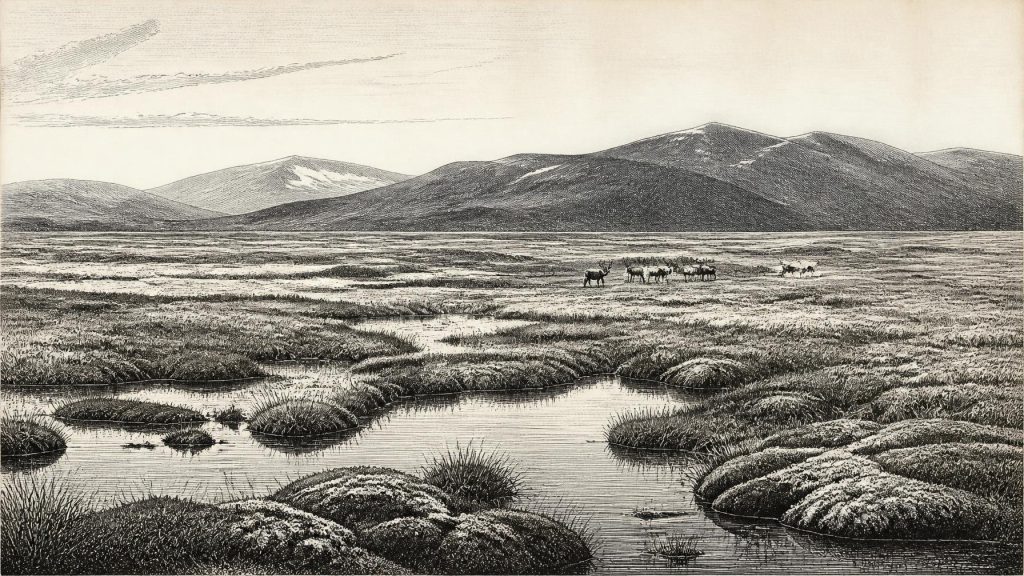
The Derryvree deposits preserve clues to a cold, treeless environment. Mosses, sedges, bogbean and other plant remains, together with insect evidence, point to freshwater pools, marshy ground and tundra-like vegetation. ‘Tundra’ here should not conjure a featureless white wilderness. It describes open country where low-growing plants could survive short summers and severe winters, where water collected in hollows, and where freezing and thawing repeatedly disturbed soil and sediment. Local shelter, aspect, drainage and season would have mattered greatly.
Such deposits offer a more secure picture of environment than of human life. They indicate vegetation and water, but cannot reveal a political territory, a population total or a social group. There were no Irish states, chiefs, boundaries, diplomatic agreements or named communities recoverable from this evidence. Nor is there evidence for farming, permanent villages, pottery, metalworking, long-distance commerce or organised religion in Ireland at this time. Those subjects belong to vastly later prehistoric periods. To fill their absence with imagined Ice-Age tribes would be misleading.
The landscape itself was also geographically unfamiliar. Global sea level was lower than today because immense volumes of water were locked in ice sheets. Nevertheless, lower seas did not automatically provide a simple, dry land bridge from continental Europe to Ireland. The evolving Irish Sea basin, ice margins and local relative sea levels made routes variable and contested. Animals plainly reached Ireland in favourable phases, while any human crossing would have demanded knowledge, opportunity and substantial resilience. Possible access across exposed or narrowed coastal zones is an interpretation based on palaeogeography, not evidence of a particular journey.
The Castlepook Question
The most arresting evidence relevant to human activity comes from Castlepook Cave, also called Mammoth Cave, near Doneraile in north County Cork. Excavations undertaken from the late nineteenth century into the early twentieth recovered a remarkable Ice-Age fauna. The wider assemblage includes remains attributed to woolly mammoth, reindeer, giant deer, brown bear, wolf, Arctic fox, mountain hare, lemmings and spotted hyaena. A cave is not automatically a human site: carnivores carry bones into caves, gnaw them, scatter them and use protected chambers as dens. Water, sediment movement and antiquarian excavation can further mix deposits.
A reindeer femur from the Castlepook collection has become central to debate. It was reported as dating to roughly 33,000 years ago and bears a deep linear mark interpreted by palaeozoologist Ruth Carden as consistent with the use of a sharp stone implement during carcass processing. If that interpretation is confirmed, it would represent exceptionally early evidence that people handled a reindeer in Ireland during the Upper Palaeolithic, long before the better-established post-glacial settlement of the island.
But the qualifications are as important as the possibility. The bone derives from an old collection rather than a modern excavation with a fully documented stratigraphic context. No securely associated stone tool, hearth, dwelling floor, human bone or camp deposit has yet demonstrated an occupation at Castlepook around this time. A cut-like mark must be distinguished from damage caused by carnivore teeth, trampling, excavation or geological processes. The femur may support an episode of butchery; it cannot, on its own, demonstrate a resident population, a settlement or a continuous lineage of inhabitants.
This is why the word ‘ambiguous’ is not a dismissal. It describes a productive scientific condition. The Castlepook bone has directed attention back to museum collections, old cave records and surviving sediments that were once thought exhausted. New excavations have sought undisturbed deposits in the cave system, while improved dating, microscopic study and ancient biomolecular techniques offer ways to test older conclusions. The evidence is potentially transformative precisely because it is being subjected to stronger tests.
Animals, Predators and People
The fauna suggests that parts of Ireland could sustain substantial animal life during suitable late-Pleistocene intervals. Reindeer are particularly evocative because their presence implies open, cold-adapted grazing landscapes. Mammoth and giant deer indicate that large herbivores sometimes entered the wider region, while hyaena, wolf and bear reveal a food web with formidable predators and scavengers. These animals did not necessarily live together at precisely the same moment; cave collections can combine remains accumulated across many centuries or millennia. The assemblage is evidence for a changing faunal world, not a single neatly reconstructed scene.
If people did reach Ireland, their economy would have been based on immediate survival rather than trade in any later sense: mobile hunting and gathering, the use of stone tools, and careful use of meat, fat, hide, sinew, bone and perhaps antler. This is a reasonable inference from Upper Palaeolithic lifeways elsewhere in north-west Europe and from the proposed processing mark at Castlepook. It is not a directly excavated Irish household. No evidence currently permits claims about language, kinship rules, ritual practice, art, leadership or exchange networks on the island in this interval.
Nor should the possible visitors be turned into an uncomplicated origin story. At about 31,716 BCE, anatomically modern humans were widespread in Europe, but no human remains from Ireland securely identify who, if anyone, made the Castlepook mark. Even a genuine butcher’s cut would record an encounter with one animal, perhaps during a short visit, rather than the foundation of ‘the Irish’ as a people. The later ice-sheet advance would in any case have transformed and eroded many landscapes in which a camp might once have stood.
Approaching a Glacial Transformation
Research on the British–Irish Ice Sheet indicates that its build-up followed roughly after 35,000–32,000 years ago, with maximum extent generally placed later, around 27,000–21,000 years ago, though timing varied by sector. Ireland’s ice cover was therefore neither an on-off event nor uniform across the island. At the time indexed by 31,716 BCE, evidence from Fermanagh supports some ice-free ground and freshwater habitats, while the broader climatic trend was towards a harsher, increasingly glaciated world.
That later advance explains the paradox of this period. Ireland may have offered habitable windows for animals and perhaps very occasional people, yet the geological force that followed destroyed, buried or displaced much of the evidence they left. Caves and sealed sediments are precious because they escaped that erasure imperfectly. They provide fragments rather than a full social history.
The Ireland of this date, then, has no politics or diplomacy that can responsibly be narrated, and no confirmed community whose customs can be described. It has cold wetlands at Derryvree, faunal evidence in Cork caves, shifting coastlines, and the prospect of expanding ice. Above all, it has the Castlepook reindeer femur: not proof of a settled Palaeolithic Ireland, but a serious and still-testing clue that human activity may have reached the island during one of the last openings before the great ice-sheet transformation.
Primary Sources
- Growth and retreat of the last British-Irish Ice Sheet, 31 000 to 15 000 years ago: the BRITICE-CHRONO reconstruction
- Trimlines, blockfields and the vertical extent of the last ice sheet in southern Ireland
- Extent and timing of the Last Glacial Maximum (LGM) in Britain and Ireland: a review
- The Last Irish Ice Sheet: Extent and Chronology
- Quaternary deposits and glacial stratigraphy in Ireland
- Freshwater organic deposits and stratified sediments between Early and Late Midlandian (Devensian) till sheets, at Aghnadarragh, County Antrim, Northern Ireland
- Late Pleistocene chronostratigraphy and ice sheet limits, southern Ireland
- Maximum extent and dynamic behaviour of the last British–Irish Ice Sheet west of Ireland
- Sedimentology and chronology of the advance and retreat of the last British-Irish ice sheet on the continental shelf west of Ireland
- New age constraints for the maximum extent of the last British-Irish Ice Sheet (NW sector)
- New insights on the fauna of Ireland's Younger Dryas and Early Holocene from Alice & Gwendoline Cave
- The Irish Quaternary Fauna Project
- Pleistocene vertebrates in the British Isles
- Irish Pleistocene biostratigraphy
- Prehistoric Details
- Heritage Artefacts of County Cork
- Castlepook Cave Excavation, Co. Cork, 2022
- Mammoth Cave, County Cork
- The IntCal20 Northern Hemisphere Radiocarbon Age Calibration Curve (0–55 cal kBP)
- The problem of a late quaternary landbridge between Britain and Ireland
- Deglaciation, Earth crustal behaviour and sea-level changes in the determination of insularity: A perspective from Ireland
- Figure 6.— The subdivision of the Quaternary Period in Ireland