
Cork’s Pleistocene Crossroads31715 BCE
Around 31,715 BCE, Ireland lay in the unstable Late Pleistocene before the Last Glacial Maximum, when climate, ice extent and coastlines changed. Evidence comes from animal bones, wetland sediments, pollen and glacial deposits, not historical records. Castlepook Cave in County Cork contained cold-adapted fauna; a reindeer femur bearing a possible stone-tool cut mark may indicate human carcass processing about 33,000 years ago. However, disturbed cave deposits and absent associated tools preclude claims of settlement. Derryvree and other inter-till sites reveal open tundra wetlands and regional environmental variation. Ireland may have hosted intermittent visitors, but sustained Upper Palaeolithic occupation remains unproven.
Dateline
31,715 BCE is a modern retrospective label, not a date that can be matched to a recorded Irish event. At this depth of time, modern calendar-year precision is unavailable. The useful chronological language is instead Late Pleistocene, broadly Marine Isotope Stage 3 (MIS 3), and calibrated ranges measured in millennia. This nominal year falls about 33,664 years before the conventional radiocarbon reference point of AD 1950. It lies within a cold, unstable part of the last Ice Age, before the Last Glacial Maximum, when ice sheets later expanded across much of Ireland. What can be known of Ireland at roughly this point comes from cave bones, buried freshwater sediments, pollen, mosses, insect remains and glacial landforms—not chronicles, settlements or named peoples.
A Date Range, Not a Diary Entry
Radiocarbon years are not the same as calendar years. The amount of radioactive carbon in the atmosphere has varied through time, so dates must be calibrated against an internationally maintained curve. Even with modern calibration, a specimen more than 30,000 years old commonly produces a broad calendar range rather than a precise annual result. Nor does a date on animal bone automatically date every later mark, movement or burial process affecting it. For 31,715 BCE, then, it is responsible to describe conditions around the mid-34th millennium before present, rather than to claim that a particular event happened in this one numbered year.
This caution matters especially in Ireland, where later glaciation damaged or removed many older land surfaces. The archaeological record is consequently thin and uneven. A cave deposit may preserve bone brought in by carnivores, water or collapse; a road cutting may reveal a pocket of organic sediment sealed between tills. Such evidence is exceptionally valuable, but it is not equivalent to a carefully excavated camp floor. The history of this period is therefore one of environments and possibilities, with the limits of the evidence forming part of the story.
Castlepook and the Reindeer Bone
The most consequential evidence close to this date comes from Castlepook Cave, near Doneraile in north County Cork. Excavations undertaken principally in the early twentieth century recovered a large and varied collection of Pleistocene animal remains from its limestone galleries. Later researchers, working with museum collections and improved radiocarbon methods, have shown that Castlepook preserves material from more than one phase of the last glacial cycle. The assemblage includes reindeer, woolly mammoth, giant deer, brown bear, wolf, Arctic fox, lemming and spotted hyaena. It records an Irish fauna far richer, colder-adapted and more changeable than the island’s recent fauna.
A reindeer femur from the cave has particular importance. It has been presented as dating to roughly 33,000 years ago and bears a deep mark interpreted by zooarchaeologist Ruth Carden as damage made with a sharp stone edge while the bone was fresh: possible evidence of carcass processing by people. If that interpretation is confirmed, it would push evidence for human activity in Ireland far earlier than the long-established post-glacial record. It would not, however, establish a permanent settlement, a continuous population, a named culture or a particular hunting party in 31,715 BCE.
The distinction is fundamental. The bone derives from an old cave collection, not a newly excavated, intact occupation layer with associated tools, hearths and living surfaces. Castlepook’s deposits were affected by carnivores, sediment movement, cave processes and early excavation practices that did not meet modern recording standards. The radiocarbon measurement dates the animal’s death, while identifying a cut mark requires a separate taphonomic judgement. No securely associated lithic assemblage, dwelling, human burial or fire-place of comparable age has yet been published from the site. The femur is therefore a potentially transformative trace of a human action, not proof of an established Ice-Age community.
A Carnivore Cave in Open Country
The cave itself was probably often a carnivore place rather than a human home. Early investigators named chambers Elephant Hall, Hyaena Hall and Wolf Hall because of the animals represented there. Reindeer did not need to enter a narrow cave voluntarily for their bones to arrive within it: predators and scavengers could drag portions of carcasses underground, consume them, leave gnawed remains and mix bones from separate episodes. Spotted hyaenas, now absent from Europe, were powerful bone collectors. Their presence warns against treating the Castlepook assemblage as a simple list of animals living simultaneously outside the entrance.
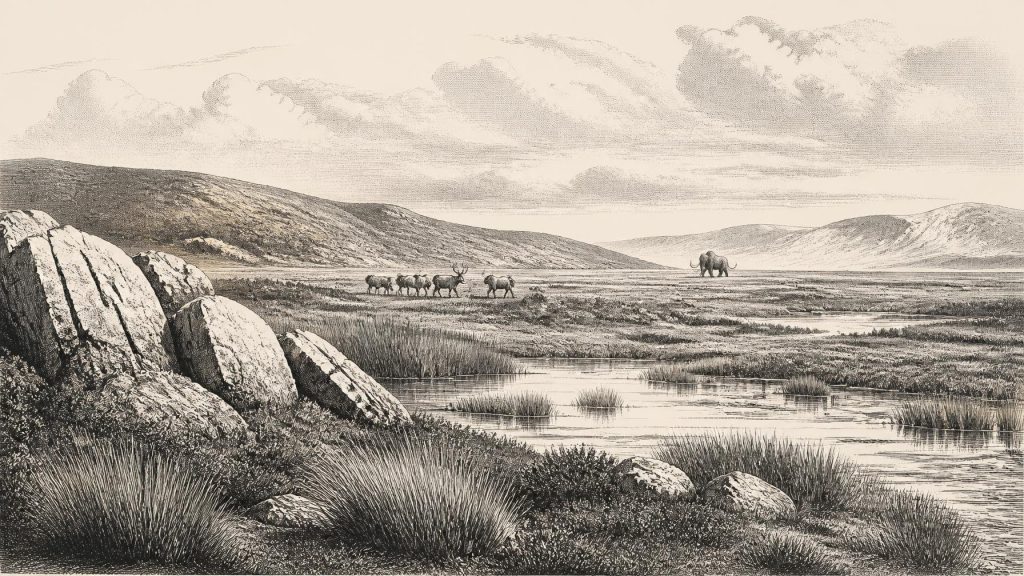
Even so, the fauna offers a powerful environmental picture. Reindeer and lemming point to cold, open habitats. Mammoth, giant deer and other grazers required extensive feeding grounds, while bears, wolves and hyaenas occupied different positions in the food web. The best reconstruction is neither an unbroken snowfield nor a modern green Ireland. It is a shifting mosaic of herb-rich tundra or steppe-tundra, grasses and sedges, patches of bare or frost-disturbed ground, damp hollows, pools, mossy ground and low woody plants where conditions allowed. Seasonal contrasts would have been severe, and the availability of forage, carrion and shelter would have varied sharply across the year.
Fermanagh’s Buried Wetlands
North Cork is not the only guide. At Derryvree near Maguiresbridge in County Fermanagh, road works exposed freshwater silts and fine sands sealed between two thick tills within a drumlin. Organic material from this sequence produced a conventional radiocarbon determination of 30,500 years before present, with a substantial uncertainty; calibration places it broadly across a span that includes the time represented by this article. Its pollen, plant macrofossils, mosses and insect remains indicate an open tundra landscape and a periglacial climate. The sediments preserve a wetland world with pools and plant-rich ground, rather than a landscape buried continuously under ice.
Nearby Greenagho and the important Pleistocene sequence at Aghnadarragh, County Antrim, add to the picture of regional variation. Their inter-till deposits show that cold-stage Ireland did not have one fixed climate or one unchanging ice margin. Some organic horizons preserve evidence for treeless open ground; others suggest intervals in which shrubs or trees could survive locally under less severe conditions. Pollen can be reworked from older deposits, and individual sequences require careful interpretation, but collectively they demonstrate fluctuation. Around this broad period, parts of Ireland were ice-free enough to sustain freshwater habitats, vegetation and large mammals, while the growth and movement of ice remained a major threat to their persistence.
Before the Ice Maximum
The British–Irish Ice Sheet was not yet at its last and fullest expansion. Modern reconstructions show that its advance and retreat were complex, asynchronous and regionally variable. Some areas may have supported ice while others remained exposed, and the timing of maximum coverage differs by sector. The later Last Glacial Maximum is generally placed around 26,000–19,000 years before present, though the timing of local advances must not be reduced to a single date. At approximately 33,700 years before present, Ireland stood in the lead-up to that more extensive glaciation: a place of rapidly changing climate and landscapes rather than a uniformly frozen island.
Lower global sea levels altered coastlines and exposed parts of the continental shelf. That would have narrowed some sea crossings and changed routes available to animals and, potentially, people. Yet it should not be assumed that Ireland was simply joined to Britain by a permanent dry corridor. Sea level, local topography, ice position and changing drainage made connections complex. Animal remains demonstrate that species reached Ireland at different times; they do not reveal one universal route, nor do they prove a human migration path. Any people represented by the marked reindeer bone may have arrived during a short favourable window, not necessarily as part of a lasting occupation.
People at the Edge of Evidence
If humans did butcher the Castlepook reindeer, they were mobile hunter-gatherers whose social world cannot be recovered in detail from one modified bone. Reindeer could provide meat, fat, hide, sinew, bone and antler; a stone edge could serve in dismembering a carcass or separating useful tissues. Such practical knowledge implies skill and cooperation, but population size, language, kinship, clothing, routes and length of stay remain unknown. There is no basis for identifying an Irish Aurignacian or Gravettian community, though Ireland lay on the far north-western fringe of European Upper Palaeolithic worlds.
Nothing supports claims about political institutions, leaders, territories, warfare, alliances or diplomacy. Nor is there evidence for trade in the later sense of regular exchange between known communities. The relevant economic activity, if people were present, was direct subsistence: obtaining animal and plant resources, finding stone suitable for sharp edges, moving through safe terrain and carrying valuable materials. These are reasonable inferences from the environment and the possible butchery trace, not documented facts about a local society.
No Recoverable Religion or Tradition
There are no Irish monuments, graves, figurative artworks, ornaments or written traditions securely attributable to this period. It would be an anachronism to project Celtic religion, Gaelic identities, medieval place-names or later sacred landscapes back more than thirty millennia. Caves can hold ritual meaning in many societies, but Castlepook provides no evidence that it was a shrine. Its demonstrated importance is as a difficult natural archive containing the remains of animals and perhaps the faintest material sign of people.
The lasting significance of this moment is therefore not a known event but a research question. Castlepook’s marked reindeer femur, Derryvree’s freshwater sediments and the wider record of glacial change show that Ireland was neither historically empty nor archaeologically simple during the later Ice Age. They also insist on restraint. Around 31,715 BCE, Ireland had cold open habitats, wetlands, large herbivores and carnivores; it may also have received brief human visitors. Whether those visitors formed part of a repeated, wider pattern of Upper Palaeolithic movement remains unresolved, awaiting securely stratified discoveries, further dating and transparent publication.
Primary Sources
- A reconsideration of the radiocarbon dating of the Marine Isotope Stage 3 fauna from southern Ireland
- The Irish Quaternary Fauna Project
- A Middle Midlandian Freshwater Series at Derryvree, Maguiresbridge, County Fermanagh, Northern Ireland
- Middle Midlandian Interstadial Deposits at Greenagho, Near Belcoo, County Fermanagh, Northern Ireland
- Freshwater organic deposits and stratified sediments between Early and Late Midlandian (Devensian) till sheets, at Aghnadarragh, County Antrim, Northern Ireland
- Growth and retreat of the last British–Irish Ice Sheet, 31,000 to 15,000 years ago: the BRITICE-CHRONO reconstruction
- Exploring the record of the last British-Irish Ice Sheet in the Celtic Sea
- New data for the Last Glacial Maximum in Great Britain and Ireland
- Dimensions and chronology of the last ice sheet in Western Ireland
- Vertical dimensions and age of the Wicklow Mountains ice dome, Eastern Ireland, and implications for the extent of the last Irish Ice Sheet
- IntCal20 Northern Hemisphere Radiocarbon Age Calibration Curve (0–55 cal kBP)
- Palaeoecology: Irish Quaternary Association Field Guide
- Aghnadarragh ASSI
- Aghnadarragh
- Heritage Artefacts of County Cork
- Archaeology Research Excavation Grant 2022: Final Report
- Castlepook Cave, Co. Cork, 2022
- The Exploration of Castlepook Cave, Co. Cork
- Proceedings of the Royal Irish Academy: The Exploration of Castlepook Cave, Co. Cork
- Spotted Hyena Skull
- New insights on the fauna of Ireland's Younger Dryas and Early Holocene from Alice & Gwendoline Cave