Derryvree’s Mossy Basin31717 BCE
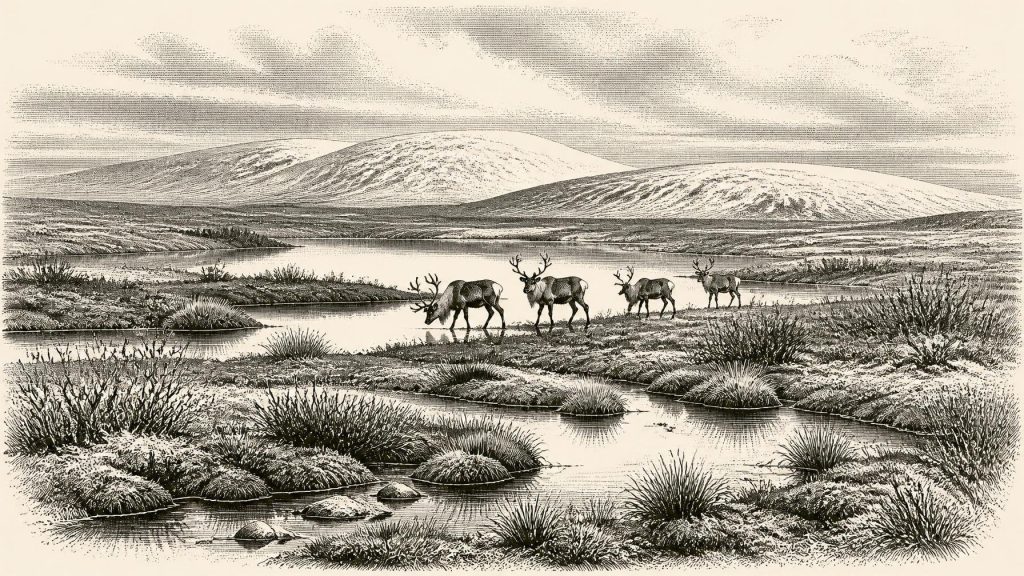
Labelled 31,717 BCE only by modern calibration, this period in Ireland belongs to the fluctuating cold of Marine Isotope Stage 3, not a recoverable single year. Derryvree, County Fermanagh, preserves freshwater organic beds between tills, showing an ice-free wetland of mosses, sedges and open tundra-like vegetation between glacial advances. Crag Cave mineral deposits indicate intermittent milder conditions. Castlepook Cave’s MIS 3 fauna included mammoth, reindeer, giant deer, predators and cold-adapted mammals, although deposits were mixed. A cut-marked reindeer femur may indicate human butchery, but no settlement evidence exists. Subsequent ice-sheet expansion buried or erased much evidence before eventual later deglaciation.
Dateline
31,717 BCE is a modern calendar label, not a date that can be recovered from Irish prehistory with year-by-year precision. It falls roughly 33,667 years before 1950, in the later part of Marine Isotope Stage 3, a volatile phase of the last Ice Age. Radiocarbon measurements from this depth of time must be calibrated into broad calendar ranges, and the calibration curve itself carries uncertainty. The most responsible account, therefore, is not a supposed event in one Irish year but an evidence-led reconstruction of the landscapes, animals and possible human activity that belong to the surrounding millennia.
For Ireland, the crucial evidence comes from deposits beneath later glacial sediments, from cave bones in the south, and from cave mineral growth in the south-west. It establishes a changing, cold country before the full expansion of the last British–Irish Ice Sheet. It does not provide named peoples, a settlement plan, a political boundary or a historical narrative in the ordinary sense. Even the date most closely relevant here, from organic layers at Derryvree in County Fermanagh, is a range rather than a pinpoint: an old radiocarbon determination of 30,500 ± 1,200 radiocarbon years BP was formerly calibrated to about 36,900–31,700 calendar years BP. This nominal year sits within that wide interval, not at a securely observed moment within it.
A Wetland Between Ice Advances
Derryvree offers one of the clearest Irish windows onto this earlier Ice Age world. In a road cutting through a drumlin, investigators recorded organic-rich freshwater silts and fine sands between two layers of till: stony sediment left by glacier ice. The sequence matters more than any single sample. An earlier ice advance had laid down the lower till; later, ice-free conditions allowed a wetland deposit to form; a subsequent advance covered it beneath the upper till. The buried organic beds are consequently evidence for a real interval of exposed ground and fresh water in north-central Ireland before the great ice-sheet growth of the Last Glacial Maximum.
The environment represented was not Ireland’s later green, wooded landscape. Plant remains include freshwater mosses and sedges, while the insect fauna has cold, northern affinities. In the older terminology of Irish Quaternary research it was described as a treeless muskeg: waterlogged, mossy ground, with sedgy margins, shallow pools and slow channels. “Tundra” is a useful broad shorthand, provided it is not imagined as a uniform white desert. Such ground could be biologically productive during a short growing season, yet exposed to severe winters, frost action and a strongly seasonal climate. Pollen and insect evidence from related Fermanagh and Antrim sequences supports a generally open landscape of grasses, sedges, dwarf birch or willow, heath and herbs rather than closed forest.
There is an important limit to that picture. These remains accumulated at particular wet sites, not across every hill and valley. Pollen may travel long distances or be redeposited; a plant preserved at a pool edge cannot be converted into a complete map of the island. Nevertheless, the convergence of botanical, insect and sedimentary evidence makes the central conclusion robust: during portions of this broad period, parts of Ireland had cold but unglaciated habitats, with vegetation sufficient to support animal life. The landscape was dynamic, and different regions could have experienced different conditions at the same time.
Ice Was Advancing, Not Yet Supreme
This was a prelude to a much harsher transformation. The Irish Ice Sheet did not simply appear everywhere at once. Recent reconstructions use onshore landforms, offshore sediments and numerical dating to show a long build-up from broadly ice-free conditions in parts of Ireland around 34,000 years ago towards a far more extensive ice sheet after about 24,000 years ago. The maximum phase came later still, conventionally within the Last Glacial Maximum, broadly around 26,500–19,000 years ago. Thus 31,717 BCE belongs to an era of approaching, uneven glaciation rather than securely to the peak ice cover.
That distinction has human importance as well as geological importance. Ice margins, frozen ground, meltwater rivers and exposed lowlands could rearrange routes and habitats repeatedly. Farther south-west, uranium-series dates from broken speleothems in Crag Cave, County Kerry, show that calcite grew episodically during Marine Isotope Stage 3. Since cave calcite needs water moving through the rock and conditions conducive to liquid water, this is independent evidence that comparatively milder episodes interrupted the long cold stage. It does not mean a stable warm Ireland; rather, it confirms abrupt climatic oscillation at a scale far beyond a single calendar year.
Castlepook’s Animal World
In north Cork, Castlepook Cave near Doneraile preserves a different kind of archive. Early twentieth-century excavations recovered a large, complex collection of animal bones from several cave passages. Subsequent research has identified an Ice Age assemblage including mammoth, reindeer, giant deer, brown bear, wolf, fox, mountain hare, Arctic and Norway lemmings, and spotted hyaena. Individual bones need not all be contemporary, and cave deposits can mix material through carnivore activity, water movement, collapse and earlier excavation methods. Yet modern redating confirms that significant parts of the assemblage belong to Marine Isotope Stage 3, well before the Last Glacial Maximum.
This fauna gives substance to the Fermanagh wetland record. Reindeer and giant deer point to open country with grazing and browsing opportunities; lemmings and mountain hare accord with cold conditions; mammoth belongs to the wider northern European mammoth-steppe world. Predators and scavengers show that carcasses had more than one possible destination. A cave bone is not automatically a record of an animal dying where it was found. Hyenas, wolves and other carnivores could carry remains underground, while caves might also trap animals or receive sediment and bones from outside. Castlepook therefore documents an ecological community and a set of taphonomic processes, not a tidy scene of animals living permanently in the chambers.
The animal list should also be handled with restraint. It demonstrates that particular species reached Ireland at intervals during this part of the Pleistocene; it cannot establish their abundance across the entire island in 31,717 BCE. Nor do faunal remains reveal a fixed coastline. Sea level was substantially lower than today during glacial conditions and the outlines of the Irish Sea region differed greatly, but routes between Ireland, Britain and continental Europe changed with sea level, ice and local topography. Physical access for animals was evidently possible at some times; the exact pathways and timing remain subjects of reconstruction rather than settled fact.
The Human Question
The most arresting possibility is a reindeer femur from Castlepook bearing a deep mark interpreted by zooarchaeologist Ruth Carden as damage made by a sharp stone tool during butchery. County Cork’s heritage record presents the bone as dating to about 31,000 BC, and public reporting has described it as evidence of human activity roughly 33,000 years ago. If that interpretation is sustained, it would push the evidence for people in Ireland far beyond the long-accepted post-glacial record. It would fit a world in which mobile Upper Palaeolithic hunters could have followed large herbivores through north-west Europe.
But the wording matters. The bone is compelling evidence for a dated reindeer and a potentially humanly modified surface; it is not, by itself, proof of a permanent settlement, a population size, language, ancestry or named archaeological culture. Castlepook was excavated long before present-day standards of stratigraphic recovery, and its bone deposits accumulated through multiple natural processes over long periods. No securely associated stone-tool assemblage, hearth, dwelling floor or cemetery of this age has yet been identified in Ireland. Recent excavations have located further Pleistocene bone-bearing deposits and have shown why careful re-examination of the cave remains valuable, but they have not converted the one marked femur into a complete occupation record.
No Kingdoms, No Known Trade
Accordingly, there are no political affairs, diplomacy, warfare, rulers or institutions that can responsibly be assigned to Ireland at this date. There is no evidence for farming, villages, metalworking, monuments, writing, formal religion or exchange networks. It would be equally misleading to fill the silence with a generic “tribal” society. If people did visit, the evidence is compatible only with small-scale, highly mobile hunter-gatherer activity focused on animal resources. Meat, hides, bone, antler, sinew and fat would have been valuable materials in such a lifeway elsewhere in Upper Palaeolithic Europe, but their use in Ireland at this date remains an inference, not something directly demonstrated by the Castlepook bone.
Religion, art and learning likewise leave no identifiable Irish trace from this period. The capacity for complex social life and symbolic culture among contemporary people elsewhere in Europe should not be mistaken for evidence that a particular artistic or ritual tradition existed on this island. The strongest cultural lesson is methodological: Ireland’s earliest past is reconstructed through patient comparison of sediments, pollen, insects, bones, cave minerals and dating techniques, each with its own uncertainty. The absence of a conventional historical record is itself a defining fact of the period.
A Future Ice-Bound Island
What followed was not gradual progress towards later prehistoric Ireland. The growth of the British–Irish Ice Sheet erased, buried or displaced much of the evidence that might once have existed, while changing climates repeatedly altered habitats and connections. A later, full-glacial Ireland was far less hospitable over extensive areas. Only after deglaciation would new plant and animal communities spread, and only much later would the securely documented Mesolithic settlement record begin. The fragmentary archives at Derryvree, Crag Cave and Castlepook are precious precisely because they preserve glimpses from before that destructive ice advance.
For the notional year 31,717 BCE, then, the defensible picture is of an unsettled Ice Age Ireland: at least some ground free of the later ice sheet; cold freshwater wetlands in the north; open, seasonal habitats supporting large herbivores and carnivores in the south; and a provocative but still limited indication that humans may have briefly processed a reindeer. It is not a year of kings or battles. It is a deep-time threshold, where environmental evidence is strong, animal evidence is substantial, and the human story remains tantalisingly incomplete.
Primary Sources
- Early Midlandian–Middle Midlandian, Pleistocene, Northern Ireland
- Figure 6.— The subdivision of the Quaternary Period in Ireland
- Trimlines, blockfields and the vertical extent of the last ice sheet in southern Ireland
- Exploring controls of the early and stepped deglaciation on the western margin of the British Irish Ice Sheet
- Deglaciation chronology of the Donegal Ice Centre, north-west Ireland
- Growth and retreat of the last British–Irish Ice Sheet, 31,000 to 15,000 years ago: the BRITICE-CHRONO reconstruction
- Late Pleistocene chronostratigraphy and ice sheet limits, southern Ireland
- A reconsideration of the radiocarbon dating of the Marine Isotope Stage 3 fauna from southern Ireland
- The Irish Quaternary Fauna Project
- Occurrence of mammalia relicts at site Castlepook Cave
- Pleistocene vertebrates in the British Isles
- 2022:564 – Castlepook Cave, Castlepook South, Cork
- Heritage Artefacts of County Cork
- Archaeology Research Excavation Grant 2022
- Episodic speleothem deposition tracks the terrestrial impact of millennial-scale last glacial climate variability in SW Ireland
- The IntCal20 Northern Hemisphere Radiocarbon Age Calibration Curve (0–55 cal kBP)
- Marine20—The Marine Radiocarbon Age Calibration Curve (0–55,000 cal BP)
- The problem of a late Quaternary landbridge between Britain and Ireland
- Relative sea-level changes and crustal movements in Britain and Ireland since the Last Glacial Maximum
- New insights on the fauna of Ireland’s Younger Dryas and Early Holocene from Alice & Gwendoline Cave
- Dansgaard–Oeschger events in climate models: review and baseline Marine Isotope Stage 3 protocol