Cork Femur Debate31787 BCE
31,787 BCE is a modern proleptic label within late Marine Isotope Stage 3, not a recoverable Irish historical year. Ireland was a cold, variable pre-Last Glacial Maximum landscape, with changing ice, sea levels, open vegetation and mammals including reindeer, deer, bears and hyaenas. Cave deposits and revised radiocarbon dates indicate intermittent animal occupation, but cannot establish permanent human settlement. A marked reindeer femur from Castlepook Cave, County Cork, may show stone-tool processing and possible early human presence. However, its insecure context lacks associated tools, hearths or remains. Until evidence emerges, it remains a record of ice-age environments and cave fauna.
Dateline
31,787 BCE is not a year that can be recovered from Ireland’s archaeological record in the way a medieval annalistic year can. It is a modern, proleptic calendar label, approximately 33,736 years before the AD 1950 reference point used for “before present” dating. No excavated Irish layer, bone or artefact can presently be assigned responsibly to that single calendar year. The appropriate setting is instead late Marine Isotope Stage 3 (MIS 3), a fluctuating part of the last Ice Age, broadly before the Last Glacial Maximum. Evidence comes in ranges measured in thousands of years, not in annual instalments; its meaning is necessarily provisional.
A Date Without an Annal
For Ireland around this point, there are no names, communities, settlements, graves, tools in secure context, hearths or written traditions. There can therefore be no responsible account of rulers, diplomacy, warfare, law or political boundaries. Nor is there evidence for a permanent population. This is not a failure to look hard enough for a lost Irish kingdom: it reflects the immense antiquity of the period, subsequent glacial erosion, changing sea levels and the very small amount of surviving Palaeolithic evidence on the island.
The most useful distinction is between evidence and interpretation. Evidence includes cave bones, their radiocarbon measurements, sediments beneath glacial deposits, pollen and insect remains, and the landforms left by ice. Interpretation connects these traces into a changing landscape of animals, vegetation and possible human movement. That connection is valuable, but it cannot produce a diary entry for 31,787 BCE. Radiocarbon results also require calibration against changing atmospheric carbon, and calibrated ranges, rather than a single unqualified age, are the responsible way to express deep time.
Before the Maximum Ice
At roughly 33.7 thousand calendar years before present, Ireland lay in the later part of MIS 3, before the coldest and most extensive phase of the last glaciation. The Last Glacial Maximum is generally placed much later, around 26,000–19,000 calendar years ago. Ireland was not yet simply the wholly ice-covered island familiar from popular images of the Ice Age. Research on the British–Irish Ice Sheet instead shows a complex, rapidly changing system: major growth was under way in the wider archipelago from about 32,000–31,000 years ago, while its timing, limits and thickness differed between regions.
That regional complexity matters. Southern Irish cave faunas demonstrate that mammals had occupied parts of the island during MIS 3, while modern reassessment of old radiocarbon samples has made some of those animals considerably older than earlier chronologies suggested. At Castlepook Cave near Doneraile in north County Cork, and at Foley and Shandon caves in the south, re-dating has altered the chronology of several faunal remains. The published conclusion is not that all Ireland was hospitable at all times, but that particular mammals were present during earlier, variable phases of the glacial cycle.
The shoreline was also profoundly unlike that of modern Ireland. Lower global sea level exposed broad shelves around north-west Europe, while glaciers, rivers and ice-dammed waters repeatedly altered routes and barriers. It would be rash to imagine today’s Irish Sea as a fixed obstacle, or alternatively to assume a simple, continuous dry land bridge to Britain and continental Europe. The exact geography available to animals or people depended on the relationship between sea level, local crustal movement and the advancing ice. What can safely be said is that Ireland’s position on Europe’s Atlantic margin was different, more connected in some respects and more ice-affected in others, than it is today.
Open Country and Cave Fauna
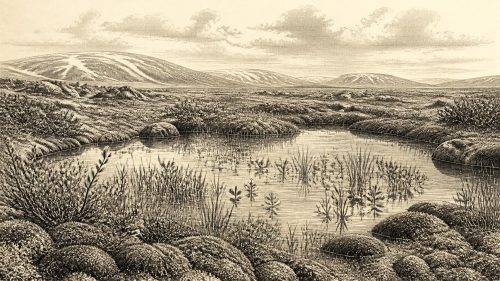
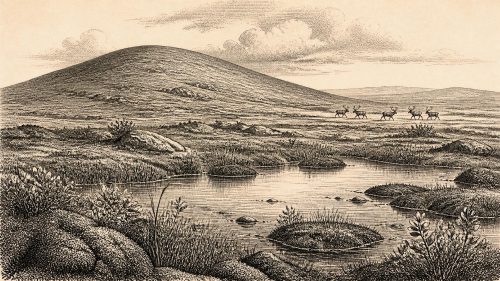
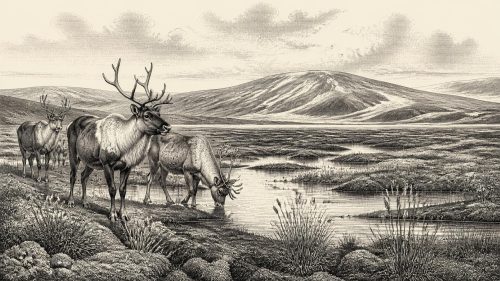
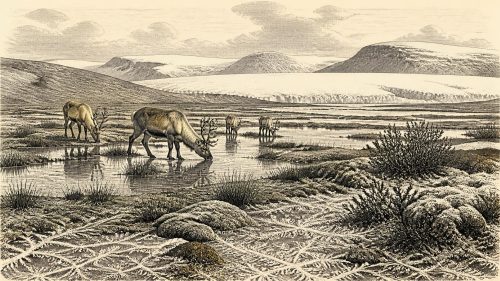
The evidence points to a cold, largely open and environmentally diverse Ireland rather than a modern green, wooded island. Plant-bearing deposits preserved beneath later glacial sediments in Fermanagh are particularly important, though their exact correlation with individual climate oscillations remains difficult. Organic silts at Derryvree have been interpreted as a treeless muskeg environment, while other Irish interstadial deposits preserve evidence for wet ground, sedges, mosses and sparse vegetation. These records show that even within a generally cold age, habitats could vary sharply with local drainage and climate.
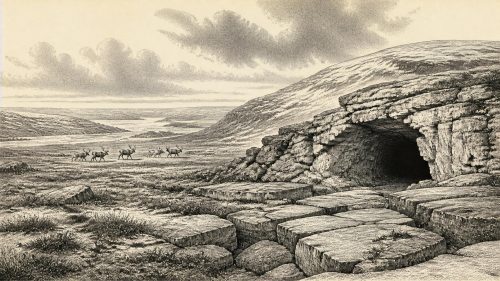
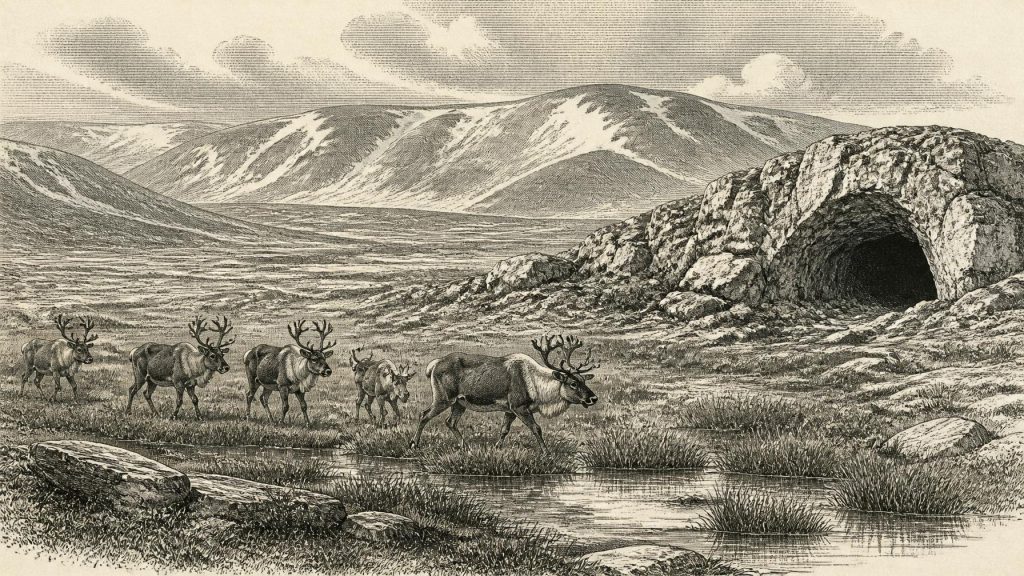
For the wider MIS 3 interval, cave assemblages give the clearest picture of animal life. The Irish Quaternary Fauna Project identified a substantial Pleistocene mammal record, and subsequent work at southern caves has emphasised reindeer, red deer, giant deer, brown bear and spotted hyaena among the fauna represented. Such lists must not be read as a single herd grazing together on one day. Cave collections often combine remains accumulated over long periods, and carnivores can carry bones into caves. Nonetheless, they establish that parts of Ireland supported substantial animal communities before maximum glaciation.
Predators are especially revealing. A spotted-hyaena skull from Mammoth Cave, Castlepook, is held by the National Museum of Ireland. Hyaenas could use caves as dens and bone-accumulating places, complicating every claim that a bone was carried there by people. Brown-bear genetic and fossil research likewise demonstrates how Irish cave material can illuminate broader questions of animal survival, dispersal and extinction, even where it cannot yield a straightforward human story. Caves are archives, but they are not automatically campsites.
The North Cork Femur
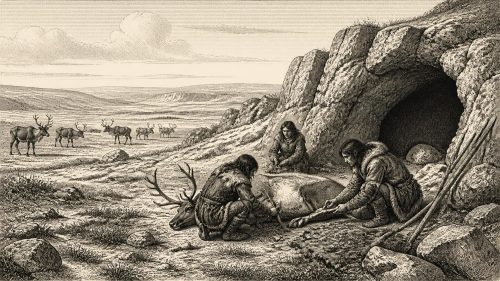
The object most closely associated with this broad era is a reindeer femur from Castlepook Cave. The County Cork heritage catalogue assigns it to about 31,000 BCE and records a deep linear mark interpreted by zooarchaeologist Ruth Carden as having been made with a sharp stone tool while fresh bone was being processed. If that interpretation is sustained, it is potentially the earliest known indication of human activity in Ireland, far earlier than the securely dated Late Upper Palaeolithic evidence from Alice and Gwendoline Cave in County Clare, where a butchered brown-bear patella dates to about 12,810–12,590 calibrated years BP.
But the Castlepook femur is a reason for careful investigation, not a licence for certainty. The bone derives from older cave excavations rather than a newly excavated, sealed occupation surface. No associated lithic tool, hearth, dwelling floor or human bone has yet been published from the same securely dated context. A cut-like mark may be highly suggestive, but its identification, the relation of the mark to the bone’s age and the route by which the bone reached the cave all require scrutiny. The current Castlepook research programme has explicitly sought surviving deposits, fresh environmental samples, charcoal, lithics and further modified bones precisely because those finds would test the hypothesis properly.
The cautious conclusion for 31,787 BCE is therefore deliberately limited. A reindeer bone from north Cork, broadly near this period, makes a short-lived human visit or episode of carcass processing possible. It does not demonstrate that people lived continuously in Ireland, that they hunted the animal where it died, or that the cave was their home. It cannot tell us whether one person or a group was involved, what language they spoke, or whether they belonged to any archaeological culture recognised elsewhere in Upper Palaeolithic Europe.
Lives We Cannot Yet Describe
If people did reach Ireland during a favourable interval of MIS 3, they would have depended on mobile knowledge of terrain, weather, animals and routes. That is an inference from the demands of northern European hunter-gatherer life, not a directly observed Irish social system. The reindeer femur could be consistent with obtaining meat, marrow, sinew, hide or other useful material, but none of these products is preserved as proof. A cave bone does not disclose family structure, seasonal round, clothing, shelters, ritual or learning.
Accordingly, “economy” at this date can only mean the possible use of wild resources, not farming, herding, markets or trade. There is no evidence for crops, domestic animals, pottery, metalworking, monuments, boats or exchange networks in Ireland around 31,787 BCE. There is equally no direct evidence for religion or art. Later prehistoric Ireland is rich in monumental, funerary and artistic evidence, but projecting those worlds backwards by more than thirty millennia would erase the real scale of change.
Conflict and diplomacy are beyond recovery as well. Large carnivores, harsh weather and shifting ice made survival difficult, but natural danger is not evidence of warfare. Nor should the absence of evidence be turned into a romantic picture of isolated “first Irish” people. The island’s earliest well-substantiated human traces remain much later than this date, and the Mesolithic provides the first substantial archaeological record of sustained lifeways in Ireland. The possible MIS 3 signal is important precisely because it is so slight and because later ice may have removed much of what once existed.
An Island of Evidence Fragments
The lasting importance of this period lies in method as much as discovery. Museum collections, originally excavated cave sediments, improved bone pretreatment, accelerator radiocarbon dating, ancient DNA, pollen analysis and new fieldwork have together changed the questions historians can ask. Re-dating has shown why old numerical ages cannot simply be repeated; better methods can revise the timing of animals and, potentially, people.
Around 31,787 BCE, then, Ireland was not a nation, polity or settled society waiting to enter written history. It was a changing Ice-Age landscape, occupied at least intermittently by cold-adapted mammals and subject to the growing power of the British–Irish Ice Sheet. The North Cork reindeer femur offers a tantalising possibility that humans briefly touched that landscape. Until securely stratified tools, hearths or further unequivocal modified bones are found, the honest history of this date remains one of tundra, caves, animal remains and a question still open.
Primary Sources
- A reconsideration of the radiocarbon dating of the Marine Isotope Stage 3 fauna from southern Ireland
- The Irish Quaternary Fauna Project
- Phylogeographic, ancient DNA, fossil and morphometric analyses reveal ancient and modern introductions of a large mammal: the complex case of red deer (Cervus elaphus) in Ireland
- First evidence of a Late Upper Palaeolithic human presence in Ireland
- New insights on the fauna of Ireland's Younger Dryas and Early Holocene from Alice & Gwendoline Cave
- The colonization of Ireland: A human ecology perspective
- Growth and retreat of the last British–Irish Ice Sheet, 31,000 to 15,000 years ago: the BRITICE-CHRONO reconstruction
- Timing, pace and controls on ice sheet retreat: an introduction to the BRITICE-CHRONO transect reconstructions of the British-Irish Ice Sheet
- Trimlines, blockfields and the vertical extent of the last ice sheet in southern Ireland
- Archaeology Research Excavation Grant 2022
- Heritage Artefacts of County Cork
- Archaeological Heritage of County Cork
- Spotted Hyena Skull
- Could brown bears (Ursus arctos) have survived in Ireland during the Last Glacial Maximum?
- Figure 6.— The subdivision of the Quaternary Period in Ireland
- ESCR Site Summary
- The Mesolithic in Ireland: when was it?
- Anthropogenic changes to the Holocene nitrogen cycle in Ireland
- Ireland's Palaeolithic Archaeology – Fleeting Footprints in a Frozen Land
- What was on the menu in prehistoric Ireland?
- Landscapes and environments of the last glacial-interglacial transition: a time of amazingly rapid change in Ireland