
Cork’s Reindeer Femur31750 BCE
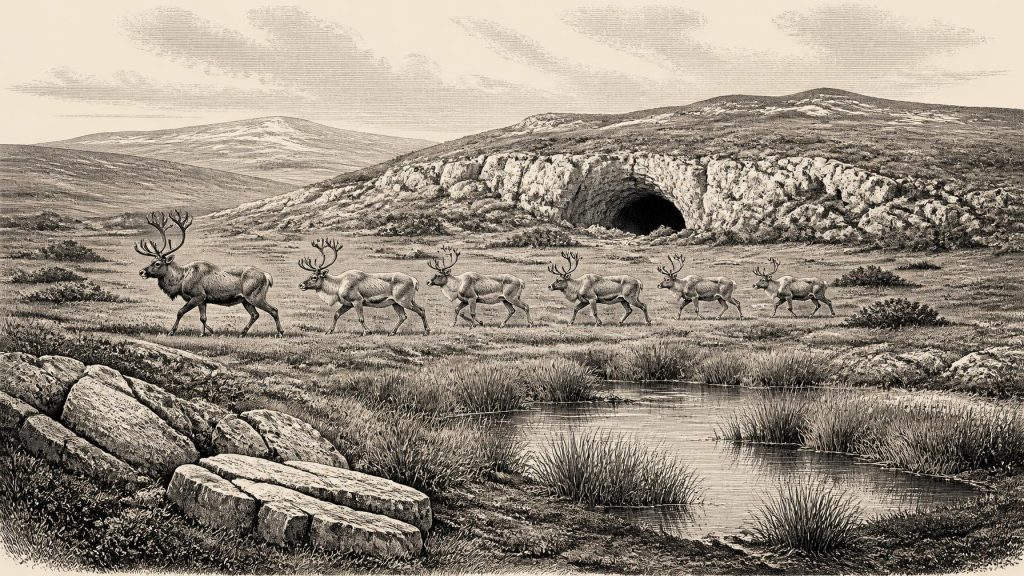
31,750 BCE is a modern label for a broad, climatically unstable MIS 3 interval, not a recoverable Irish historical year. Derryvree, County Fermanagh, preserves freshwater sediments dated broadly to 36,900–31,700 cal BP, indicating cold, treeless tundra wetlands during an ice-free phase between glacial advances. Lower sea levels reshaped coasts and may have enabled animal movements, although specific routes remain unknown. Castlepook Cave, County Cork, yielded diverse cold-stage fauna, including reindeer, mammoth and hyaena. A reindeer femur bearing a possible stone-tool cut may indicate early human presence, but associated artefacts and secure occupation evidence are absent, preventing conclusions about permanent settlement.
Dateline
“31,750 BCE” is a modern chronological label, not a year that can be recovered from Ireland’s prehistoric record. No Irish community used this calendar; no written source, named individual, political event or datable settlement belongs to it. In conventional archaeological terms, the label falls roughly 33,700 years before 1950, within Marine Isotope Stage 3 (MIS 3), a long and climatically volatile part of the Late Pleistocene. At this depth of time, responsible history must use broad calibrated ranges, rather than pretend that evidence distinguishes one winter, generation or calendar year from another.
The evidence is fragmentary but important. It comes chiefly from buried freshwater deposits in County Fermanagh, fossil animal remains from limestone caves in County Cork, and reconstructions of the growing British–Irish Ice Sheet. Together, these sources show that Ireland was neither the familiar green island of later history nor a simple, permanently frozen wilderness. Parts of the island had ice-free ground during this broad interval; cold-adapted plants and animals occupied changing habitats; and the eventual expansion of ice would erase, bury or disturb much of the earlier record. What cannot yet be demonstrated is a settled human population in Ireland at this time.
Reading a Date Beyond History
Radiocarbon dates are not calendar dates. A measurement on organic material gives an estimate in radiocarbon years before present, with “present” conventionally fixed at 1950. It must then be calibrated against records of past atmospheric carbon-14 variation. At around 34,000 calendar years ago, calibrated estimates are necessarily broad, and the results depend on the material, its preservation and the quality of its archaeological or geological context. The modern IntCal20 curve reaches this period, but it does not turn a single bone or silt layer into an annual chronicle.
A useful Irish benchmark is Derryvree, near Maguiresbridge in County Fermanagh. Road works in 1969 exposed organic freshwater silts and fine sands sealed between two tills inside a drumlin. The lower till records an earlier glacial episode; the organic beds record an intervening period in which water, vegetation and animals occupied the site; the upper till represents a later advance of ice. The organic deposit produced a legacy radiocarbon determination of 30,500 ± 1,170/1,030 radiocarbon years BP. Published discussion places its broad calibrated span at approximately 36,900–31,700 cal BP. The notional date 31,750 BCE lies within that wide interval, but it does not date a discrete layer, event or day at Derryvree.
Derryvree’s Cold Wetland
Derryvree is unusually valuable because later glaciers have removed so many older Irish deposits. Its biological traces indicate a freshwater setting in a cold, largely treeless and periglacial landscape. Pollen was dominated by herbaceous plants, although poorly preserved. Plant macrofossils included a remarkable moss flora, while insect remains added evidence for wet, open ground. The combined interpretation is of tundra or muskeg-like terrain: shallow pools, mossy and sedgy margins, damp mineral soils, sparse dry-ground vegetation and landscapes repeatedly affected by frost.
This should not be imagined as a uniform blanket of snow or bare stone. Summer growth could make wetlands and herb-rich patches productive, while low shrubs, grasses and sedges offered forage where drainage and shelter permitted. Yet the growing season was short, winters severe and tree cover negligible. Any comparison with modern Ireland must therefore be resisted. There were no oak and hazel woods, no pasture fields, no enclosed farms and no peat bog landscapes shaped by millennia of Holocene vegetation. The Derryvree sediments illuminate a particular Fermanagh locality, not the entire island; nevertheless, they decisively complicate any claim that all Ireland was continuously under ice at this point.
Ice, Land and Changing Coasts
Ireland’s physical geography was in transition. The Last Glacial Maximum, when the British–Irish Ice Sheet reached its greatest overall scale, came later, broadly during the period from about 27,000 to 21,000 years ago in different sectors. Ice-sheet growth and maximum extent were asynchronous rather than one island-wide event. Reconstructions based on seafloor mapping, sediments, landforms and numerical dating show advancing and retreating margins responding to regional topography, marine conditions and climate. Around the broad horizon represented by 31,750 BCE, the future large-scale expansion of the ice sheet was approaching, but local evidence still preserves ice-free intervals.
Sea level was much lower than today because vast volumes of water were stored in continental ice sheets. The Irish coastline therefore lay far beyond many modern shores, and the Irish Sea and Atlantic shelf landscapes differed profoundly from their present form. That created ecological links between Ireland, Britain and the exposed shelf at some times, but it does not licence a simple claim of a particular land bridge on this particular year. Routes changed with sea level, ice margins, rivers and terrain. The safest conclusion is that animals could reach Ireland during favourable phases and that the island formed part of a wider north-west European Ice Age zone, not that every migration route is known.
Castlepook’s Faunal Record
The clearest southern Irish evidence comes from Castlepook Cave, also known as Mammoth Cave, near Doneraile in north County Cork. Excavations undertaken principally in the early twentieth century recovered a major collection of Pleistocene animal remains. Subsequent reassessment and improved radiocarbon pretreatment have shown that some specimens are substantially older than earlier results suggested. Castlepook contains evidence for a striking cold-stage fauna, including reindeer, woolly mammoth, giant deer, brown bear, wolf, Arctic fox, mountain hare, lemmings and spotted hyaena.
The list does not mean that all these species stood together outside the cave in one season, nor that every bone retained its original position. Cave deposits can be reworked by animals, water, collapse, earlier digging and later disturbance. The collection nevertheless proves that Ireland supported, at intervals during MIS 3, animal communities unlike any living on the island today. Spotted hyaena is especially revealing: Castlepook is Ireland’s principal last-cold-stage site for this predator. Carnivores could carry prey and bones into caves, gnaw them, disturb them and create accumulations that resemble human food debris to an untrained eye. Careful taphonomy is therefore as important as a radiocarbon result.
The Marked Reindeer Bone
A reindeer femur from Castlepook has made this period especially consequential. It has been reported as carrying a deep incision interpreted by researcher Ruth Carden as consistent with cutting by a sharp stone tool, and the animal bone has been presented as dating to about 33,000 years ago. If that interpretation is confirmed, it would be potentially transformative evidence: a person may have processed a reindeer in Ireland far earlier than the formerly accepted beginning of human activity on the island.
But “potentially” matters. The femur is not accompanied by a securely associated stone-tool assemblage, hearth, shelter floor, human remains or undisturbed occupation surface of comparable age. Nor can a single marked bone establish whether people hunted the animal, scavenged it, visited briefly, travelled seasonally or lived locally. Recent archaeological work at Castlepook has found surviving cave sediments and further faunal material, but its 2022 investigation identified no cultural artefacts. That negative result does not disprove a short-lived Palaeolithic visit; it does show why the case cannot responsibly be inflated into a colony, camp or named ‘first settlers’.
Society Beyond Recovery
Political affairs, diplomacy and warfare are not recoverable for Ireland at this date. There is no evidence for kingdoms, tribes, territorial boundaries, leaders, treaties or organised conflict. Likewise, no artefact, burial, artwork or structure permits claims about language, religion, ritual, kinship or formal learning. The lack is not evidence that people lacked culture elsewhere in north-west Europe; Upper Palaeolithic societies certainly possessed sophisticated skills and social lives. It is evidence that Ireland has not yet yielded securely dated material through which such matters can be described here.
Economy and everyday life can be addressed only conditionally. If people reached Castlepook or another Irish locality, reindeer would have offered meat, marrow, hides, sinew and bone, while a mobile hunting party would have needed intimate knowledge of weather, animal movement, fuel and safe routes. These are plausible inferences from the ecology of reindeer hunting, not facts demonstrated for Ireland. There is no direct evidence for Irish exchange networks, boats, trade goods, dwellings or repeated seasonal rounds around 31,750 BCE. The more certain economy was ecological: plants converting a short summer into fodder; herbivores moving through open country; predators and scavengers competing for carcasses; and caves acting as shelters, dens and traps for bone.
An Archive of Possibilities
Ireland around 31,750 BCE is therefore best understood as a contested environmental horizon rather than a year of recorded human events. Derryvree provides a calibrated, local window onto cold freshwater tundra before a later ice advance. Castlepook preserves evidence of Ice Age mammals and a debated reindeer bone that may one day establish an early human visit. Future excavation, direct dating, microscopic study of marks and better stratigraphic control may alter the balance of evidence. For now, the responsible conclusion is both modest and remarkable: Ireland was a changing, living Pleistocene landscape, and the question of whether people briefly entered it remains open rather than answered.
Primary Sources
- A reconsideration of the radiocarbon dating of the Marine Isotope Stage 3 fauna from southern Ireland
- The Irish Quaternary Fauna Project
- New insights on the fauna of Ireland's Younger Dryas and Early Holocene from Alice & Gwendoline Cave
- First evidence of a Late Upper Palaeolithic human presence in Ireland
- The colonization of Ireland: A human ecology perspective
- Spotted Hyena Skull
- 2022:564 – Castlepook Cave, Castlepook South, Cork
- Growth and retreat of the last British–Irish Ice Sheet, 31,000 to 15,000 years ago: the BRITICE-CHRONO reconstruction
- Pattern and timing of retreat of the last British-Irish Ice Sheet
- Maximum extent and dynamic behaviour of the last British–Irish Ice Sheet west of Ireland
- Exploring controls of the early and stepped deglaciation on the western margin of the British Irish Ice Sheet
- Trimlines, blockfields and the vertical extent of the last ice sheet in southern Ireland
- Middle Midlandian Interstadial Deposits at Greenagho, Near Belcoo, County Fermanagh, Northern Ireland
- Irish Quaternary Association Field Guide No. 16: Fermanagh
- Mammoth and musk ox ESR-dated to the Early Midlandian at Aghnadarragh, County Antrim, Northern Ireland, and the age of the Fermanagh Stadial
- The IntCal20 Northern Hemisphere Radiocarbon Age Calibration Curve (0–55 cal kBP)
- IntCal Publications
- Occurrence of mammalia relicts at site Castlepook Cave
- The Archaeological Heritage of County Cork
- Aghnadarragh