A Reindeer Beyond Doneraile30603 BCE
Thirty thousand six hundred and three BCE is not archaeologically identifiable as a single Irish year, but falls within a fluctuating Late Pleistocene interval. Derryvree, County Fermanagh, preserves freshwater silts beneath later ice, indicating open tundra-steppe vegetation, wetlands and seasonal cold conditions. Castlepook Cave, County Cork, contains Marine Isotope Stage 3 remains of mammoth, reindeer, giant deer, predators and other fauna, demonstrating ecological links with Ice Age Europe. A marked reindeer femur may represent early human butchery, though no associated tools or settlement exist. Ireland was neither settled nor uniformly frozen: varied habitats later suffered extensive glacial transformation, leaving evidence.

Dateline
“30,603 BCE” is a modern chronological label, not a year that can be identified in Ireland’s archaeological record. No document, settlement layer or annually resolved environmental sequence allows historians to say what happened on the island in that particular year. The responsible approach is to place it within a broader interval of the Late Pleistocene: roughly 32,550 calendar years before 1950, during Marine Isotope Stage 3, a highly unstable part of the last Ice Age. The nearest important Irish evidence comes from deposits and animal remains dated across wide calibrated ranges, rather than to a single season or generation.
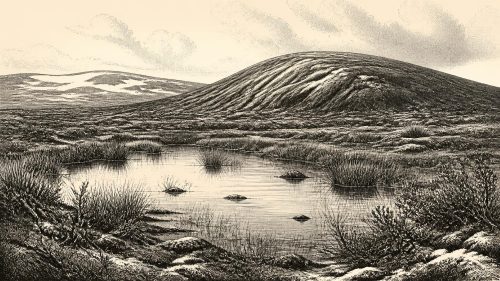
That evidence nevertheless alters the usual picture of an empty, wholly frozen Ireland before the better-known post-glacial settlement. Around this notional date, parts of the island could sustain cold-adapted plants and a surprisingly varied animal population. Ireland was not yet at the climatic extreme called the Last Glacial Maximum, when the British-Irish Ice Sheet later expanded dramatically. But neither was it a familiar green island. The available record points instead to a changing, exposed and locally ice-free landscape, in which wet hollows, sparse tundra vegetation, caves and animal routes preserved fleeting traces of life.
A Date Range, Not a Moment
The strongest environmental comparison is Derryvree, near Maguiresbridge in County Fermanagh. Road works in 1969 cut through a drumlin and exposed freshwater silts and fine sands trapped between two separate layers of glacial till. The deposit produced a conventional radiocarbon age of 30,500 years before present, with a large uncertainty. When calibrated using modern radiocarbon curves, this represents a broad span rather than a precise point, commonly placed at approximately 36,900–31,700 calibrated years before present. The modern label 30,603 BCE falls within that wide interval, but it cannot be pinned to a particular level in the Derryvree sediments.
This distinction matters. Radiocarbon dating measures the death of once-living material, not a named historical event; calibration is especially complex at such depth in time, when atmospheric carbon levels fluctuated sharply. The Derryvree deposit is therefore evidence that a freshwater basin and its surrounding vegetation existed during part of a cold Middle Midlandian interval. It is not a diary of all Ireland, a national weather record, or proof that people were present in Fermanagh. Its value lies in its physical detail: the basin preserves a landscape later overridden and sealed beneath ice.
Fresh Water Beneath Future Ice
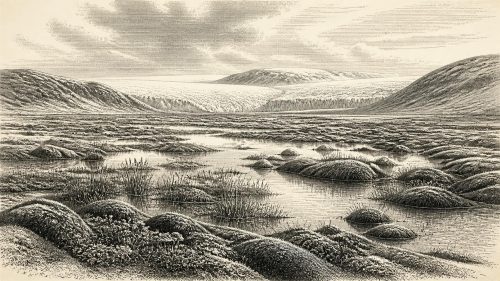
Plant pollen, seeds, mosses, insects and other small remains at Derryvree describe open country rather than woodland. Grasses, sedges and herbaceous plants predominated. Cold-tolerant plants included mountain-avens, dwarf willow and lesser clubmoss; juniper seems to have occurred in limited or sheltered settings. Bogbean and water-milfoil are particularly revealing because they show that shallow freshwater and wet margins persisted. The scene was not an unbroken desert of snow, stone and ice. At least in this Fermanagh hollow, there were pools or slow-moving water, damp sedge-ground and patches of low vegetation capable of supporting insects and other small creatures.
The wider interpretation is tundra or tundra-steppe, perhaps with muskeg-like wetland in poorly drained places. Such terms are useful comparisons, not exact replicas of any modern Arctic environment. Ireland’s position on the Atlantic fringe, variable relief and changing proximity to ice would have created local differences in snow cover, drainage and exposure. Summers may have briefly opened wet ground and encouraged plant growth; winter frost, wind and seasonal thaw would have restricted trees and repeatedly disturbed bare soils. The evidence supports strong seasonality and sparse vegetation. It does not support precise annual temperatures, a mapped coastline, or a uniform climate from Cork to Donegal.
These conditions were part of a wider northern-hemisphere pattern of abrupt climatic shifts. Greenland ice-core records show that the last glacial period oscillated repeatedly between relatively milder interstadials and colder stadials. Correlating an individual Irish deposit exactly with one Greenland event remains difficult. What can safely be said is that Derryvree belongs to a period before the main late-glacial ice advance, when local ice-free ground, freshwater and tundra vegetation could survive in northern Ireland.
Castlepook’s Animal World
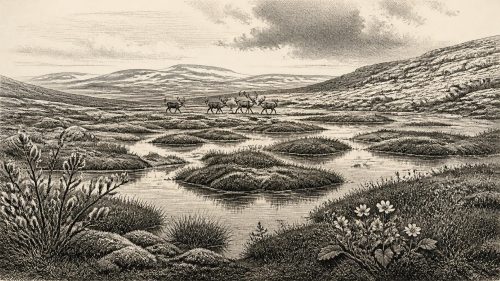
County Cork provides a different sort of evidence. Castlepook Cave, near Doneraile, is Ireland’s richest known site for vertebrate remains from the long interval before the Last Glacial Maximum. Early twentieth-century excavation of its chambers, once widely called Mammoth Cave, recovered an assemblage including woolly mammoth, giant deer, reindeer, brown bear, wolf, Arctic fox, mountain hare, lemmings and spotted hyaena. Revised accelerator radiocarbon dating has shown that some of these animals belonged to Marine Isotope Stage 3, broadly comparable in antiquity to the Derryvree environmental record.
The cave remains should not be read as a single frozen tableau. Bones accumulated over long periods and through several processes. Hyaenas and other carnivores could carry carcass parts into dens; animals might die in or close to fissures; water could move material; and early excavation methods did not preserve the detailed contexts expected today. Consequently, the fauna demonstrates that these species reached Ireland at various times, but it cannot prove that mammoths, hyaenas, reindeer and every other recorded species stood together outside the cave in 30,603 BCE.
Even so, the assemblage is decisive evidence for ecological connectivity. Large herbivores such as reindeer, mammoth and giant deer needed substantial feeding ranges, while wolves and spotted hyaenas point to predator and scavenger populations exploiting those animals. The landscape around Castlepook was probably open, cold and varied enough to offer grazing, shelter and corridors of movement. Caves were places where this animal history accumulated, not necessarily places in which people lived.
The Reindeer Bone and Human Possibility
Castlepook is also central to the cautious case for very early human activity in Ireland. A reindeer femur from the cave has been directly dated to about 33,000 years ago and bears a deep surface mark interpreted by zooarchaeologist Ruth Carden as damage from a sharp stone implement, probably made while processing the animal. County Cork heritage publications identify the find as potentially the earliest known evidence of human handling in Ireland. If that interpretation is accepted, Upper Palaeolithic hunters reached the island many millennia before the Mesolithic communities that left substantial archaeological traces after the ice had retreated.
The word “potentially” is essential. No securely associated stone tool, hearth, dwelling floor, human bone or stratified camp has yet been recovered at Castlepook for this period. The marked femur may indicate that people killed or butchered a reindeer elsewhere and that carnivores later brought, or dragged, the discarded bone into the cave. It cannot establish a permanent settlement at Doneraile, the size of a visiting party, their language, ancestry or route of arrival. Nor can it prove that people were in Ireland continuously throughout the Derryvree interval.
Yet the find makes short visits plausible enough to take seriously. Ireland was then part of a broader north-west European Ice Age world in which mobile hunter-gatherers followed seasonal opportunities and animal movements. Lower sea levels changed the shape of surrounding coasts, but the precise geography of crossings and possible connections is not resolved for this particular date. Any visitors would have been highly mobile, using perishable clothing, hides, wood and organic equipment that rarely survive. Their stone tools, if they used them here, have not yet been found.
Society Without a Settlement Record
There is no evidence for political institutions, territorial states, diplomacy, named leaders or organised warfare in Ireland at this date. Such categories depend on records that simply do not exist. The same restraint applies to everyday society. The Castlepook femur permits the possibility of a brief hunting or carcass-processing episode; it does not reveal households, gender roles, kinship systems, campsites or population numbers. A permanent community cannot responsibly be inferred from one possible butchery mark.
Economy and trade are similarly beyond the evidence. Reindeer could have supplied meat, marrow, hide, sinew, bone and antler to hunters, but no Irish assemblage of this age demonstrates which of those resources were taken, stored or exchanged. There is no basis for imagining farming, herding, fields, boats, markets or regular long-distance trade. The economy visible in the record is ecological rather than social: plants grew in wet tundra; herbivores moved through open country; carnivores and scavengers used caves and carcasses.
Religion, art and learning are also silent. Ireland has no securely dated cave art, portable art, burial or ritual monument from this horizon. This absence does not mean any people who may have visited lacked beliefs, stories or sophisticated knowledge. Upper Palaeolithic communities elsewhere in Europe possessed rich cultural traditions. It means only that none can presently be demonstrated for Ireland around this deep prehistoric point. The archaeological record preserves conditions of possibility, not an Irish mythology or ceremonial life.
An Island in Transition
The most important development around 30,603 BCE was environmental instability. Derryvree shows that an Irish freshwater habitat, surrounded by open cold-climate vegetation, existed before later ice buried it. Castlepook shows that southern Ireland could support a diverse Ice Age fauna, and perhaps received occasional human visitors. In the millennia after this broad interval, worsening conditions and the growth of the British-Irish Ice Sheet transformed the island again. Much of the fragile evidence from exposed landscapes was likely eroded, buried or destroyed by ice.
For that reason, Ireland at 30,603 BCE should not be described as a settled country, a blank wilderness, or a single frozen landscape. It was a geographically varied edge of Ice Age Europe, known through a Fermanagh wetland sealed beneath glacial deposits and a Cork cave full of animal history. The surviving evidence is slight, but it is enough to show water, plants, grazing animals, predators and perhaps a human hand at work on a reindeer bone. Beyond that, responsible history must acknowledge the silence.
Primary Sources
- A Middle Midlandian Freshwater Series at Derryvree, Maguiresbridge, County Fermanagh, Northern Ireland
- A Reconsideration of the Radiocarbon Dating of the Marine Isotope Stage 3 Fauna from Southern Ireland
- Castlepook Cave
- The Archaeological Heritage of County Cork
- Heritage Artefacts of County Cork
- Excavations 2022: Castlepook Cave, County Cork
- Ireland’s Palaeolithic Archaeology – Fleeting Footprints in a Frozen Land
- The Colonization of Ireland: A Human Ecology Perspective
- New Insights on the Fauna of Ireland’s Younger Dryas
- Palaeoecology: Irish Quaternary Association Field Guide
- The Subdivision of the Quaternary Period in Ireland
- The Irish Quaternary Fauna Project
- The IntCal20 Northern Hemisphere Radiocarbon Age Calibration Curve (0–55 cal kBP)
- Radiocarbon Dating
- A Stratigraphic Framework for Abrupt Climatic Changes During the Last Glacial Period Based on Three Synchronized Greenland Ice-Core Records
- Radiocarbon Constraints on the Age of the Maximum Advance of the British-Irish Ice Sheet in the Celtic Sea
- Pattern and Timing of Retreat of the Last British-Irish Ice Sheet
- Stratigraphic and Palaeo-Geomorphological Evidence for the Glacial-Deglacial History of the Last British-Irish Ice Sheet in the North-Western Irish Sea
- New Data for the Last Glacial Maximum in Great Britain and Ireland
- The Mesolithic in Ireland: When Was It?
- Irish Quaternary Association Publications
- Irish Quaternary Association Outreach Links, Events and Exhibitions