
Castlepook’s Limestone Gateway31749 BCE
Rather than a recorded historical year, 31,749 BCE represents an uncertain Late Pleistocene interval around 34,000 calibrated years before present, during Marine Isotope Stage 3. Lower sea levels connected Ireland ecologically to north-west Europe, while volatile cold climates, changing vegetation and advancing ice shaped open landscapes. Cave fauna at Castlepook, County Cork, including reindeer, mammoth, musk ox, horse and predators, indicates varied mammoth-steppe habitats, although deposits combine different ages. A cut-marked reindeer femur may evidence a brief human visit around 33,000 years ago, but no settlement, tools or human remains confirm occupation. Glaciation erased evidence, leaving a fragile, revisable archive.
Dateline
“31,749 BCE” is a modern way of placing a very remote point in time, not a date that people in Ireland could have recognised or recorded. Calendar-year precision is not available here. The responsible historical setting is instead a broad interval around c. 34,000 calibrated years before present (where “present” conventionally means 1950), during Marine Isotope Stage 3 of the Late Pleistocene. Even that conversion carries uncertainty: radiocarbon measurements have error ranges, calibration curves are uneven at great age, and deposits may have been disturbed long after they formed. Ireland at this point was not a country with named peoples, rulers or borders. It was a changing north-western European landscape whose fragmentary record survives in caves, buried sediments, animal bones, pollen, insects and the landforms later ice sheets left behind.
At Europe’s Atlantic Edge
Ireland’s geography was profoundly different from that of the modern island. Global sea levels were far lower during the last glacial cycle, exposing broad continental shelves around Britain and Ireland. The Irish Sea and Celtic Sea basin did not form the familiar marine barriers of today in the same way; connections across low-lying terrain could open or narrow as sea level, river systems and ice margins changed. This did not mean an easy or permanent land bridge, nor does it prove a particular route taken by animals or people. It does mean that Ireland belonged to a wider western European ecological zone, rather than being the isolated island of later prehistory and history.
Its position on that margin made it exceptionally sensitive to North Atlantic climate. Marine Isotope Stage 3, broadly c. 57,000–29,000 years ago, was cold overall but not climatically uniform. Greenland ice-core records document abrupt shifts between relatively milder interstadials and harsher stadials. The Irish evidence cannot yet assign every local deposit to one of these short phases with confidence. Around the date represented by this article, therefore, the safest picture is not of an eternally frozen country, but of a cold, open and unstable environment repeatedly altered by frost, shifting vegetation, changing watercourses and advances or retreats of ice.
A Landscape Before the Maximum
This was before the fullest late-glacial expansion usually called the Last Glacial Maximum. The British–Irish Ice Sheet was growing and its extent varied markedly by region and through time. Recent reconstructions begin at 31,000 years before present precisely because earlier limits are poorly constrained; they indicate accumulating ice in northern Ireland and other upland centres, while acknowledging wide zones of uncertainty. Other work, including evidence from raised beaches in southern Ireland and offshore sediment records, suggests substantial ice-sheet loading and earlier glaciation during Marine Isotope Stages 4 and 3. It would be misleading to draw a single sharp ice edge across Ireland for c. 34,000 years ago.
What can be said is that later ice was to transform, erode and cover much of the evidence from this period. Drumlins, tills, eskers and scoured rock are the visible legacy of repeated glaciation, but they are poor guides to the exact conditions of one moment before the Last Glacial Maximum. In places, organic sediments survived beneath till. The Derryvree and Maguiresbridge sequences in County Fermanagh, and deposits at Aghnadarragh in County Antrim, show why these rare windows matter: plant macrofossils, pollen and beetle remains can reveal freshwater pools, sedge-rich ground, mosses and tundra or cool-temperate communities that no later surface landscape could preserve intact.
Open Ground and Mobile Herds
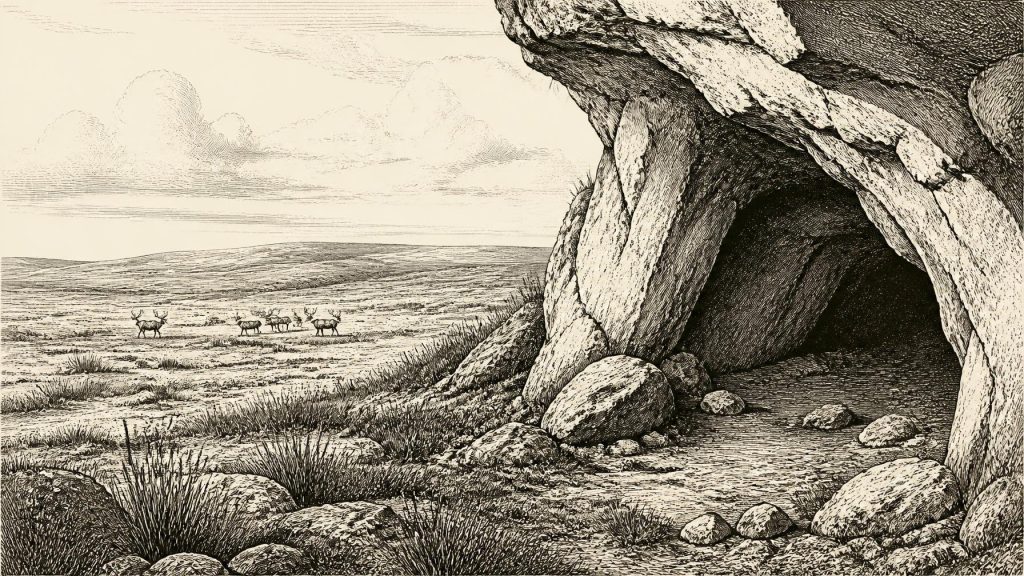
The strongest direct indication of Irish conditions in the broad period comes from vertebrate remains, especially cave collections in the south. Castlepook Cave near Doneraile in north County Cork has yielded Ireland’s richest well-known assemblage of pre-Last Glacial Maximum mammals. Its fauna includes reindeer, woolly mammoth, musk ox, horse, wolf, arctic fox, brown bear, giant deer and spotted hyaena. This list is powerful evidence that Ireland at different points in the Late Pleistocene could sustain, or at least receive, animals now strongly associated with cold open country and the mammoth-steppe world.
But the list must not be turned into a single postcard scene. Cave deposits are palimpsests: bones may have accumulated over thousands of years; scavengers, water, falling sediment and excavators can mix material; and not every species necessarily lived together. Modern re-dating has changed the chronology dramatically. Research led by Ruth Carden, Thomas Higham and Peter Woodman found that some Castlepook samples were between about 5,000 and 12,000 radiocarbon years older than earlier determinations had suggested. It follows that individual specimens, not the entire catalogue, must be used to discuss any particular time range.
Nevertheless, the fauna supports a cautious environmental reconstruction. Reindeer and musk ox point towards sparse, productive grazing landscapes rather than dense forest. Mammoth, horse and giant deer also imply extensive open habitats, though their precise local ranges and dates differ. Such ground may have combined grasses, herbs, sedges, dwarf shrubs, patches of bare mineral soil and wet hollows. Seasonal contrasts would have been demanding. Winter cold, wind and limited cover would restrict forage; spring and summer growth could draw herbivores along routes determined by water, terrain and the distribution of vegetation. Predators and scavengers, including wolves and hyaenas, followed opportunities within that mobile food web.
The Reindeer Femur Question
Castlepook also matters because a reindeer femur recovered from the cave has been reported with marks interpreted as having been made by a stone tool during butchery. Its dating, publicised as roughly 33,000 years ago, has been presented as evidence for an exceptionally early human presence in Ireland. If that interpretation is upheld, it shifts the island’s human story far back beyond the securely documented post-glacial settlement of the early Holocene. It would suggest that people reached the Irish landmass during a more connected Ice Age phase, probably as highly mobile hunter-gatherers exploiting a landscape shared with large herbivores.
The limits of the claim are as important as its excitement. No human skeleton of this age has been found in Ireland, no contemporary dwelling floor is known, and there is no securely associated tool-kit, hearth, camp or repeated occupation sequence at Castlepook. The original cave excavations were undertaken in the early twentieth century, before present-day standards of stratigraphic recording, residue recovery and geoarchaeological sampling. A modified bone is evidence about an encounter with an animal, not proof of a permanent settlement, population size, language, kin group or route of arrival. The possibility of a brief visit is not the same as evidence that Ireland was continuously inhabited.
People Without a Polity
Accordingly, there are no political affairs to narrate for Ireland at this date: no chiefs, kingdoms, assemblies, diplomatic ties, laws or territorial frontiers can responsibly be identified. Nor can conflict be inferred simply from the presence of people, predators or large game. Hunting itself may have involved cooperation, planning and the controlled use of stone-edged tools, but this remains an inference from Upper Palaeolithic lifeways elsewhere in Europe, not a demonstrated social institution at Castlepook.
Should the cut-mark interpretation represent human activity, everyday life was likely organised at a small scale. A successful reindeer kill could provide meat, marrow, fat, hide, sinew and bone, resources valuable in a cold environment. Such processing need not have happened inside the cave; the cave may instead have received a discarded or transported portion of carcass. Fire, clothing, temporary shelters, wooden implements and skin containers are all plausible components of contemporary human adaptation elsewhere, but none has been recovered in Ireland from this horizon. They should be understood as comparative possibilities, not as discovered Irish possessions.
Culture Beyond Recovery
There is no evidence from c. 34,000 years ago for religion, formal burial, visual art, music, story, language or learning in Ireland. That silence cannot be filled by importing the famous painted caves, carved figurines or elaborate burials of continental Europe. Those achievements demonstrate the cultural capacities of Upper Palaeolithic Homo sapiens, but they do not establish an Irish counterpart. Likewise, there is no recoverable evidence of trade in the usual sense. Movement of people, animals and raw materials across the wider exposed shelf is likely to have been possible at times, yet no identifiable exchange network or imported Irish object belongs securely to this date.
The most meaningful regional change was environmental. Ireland lay within a dynamic frontier between habitable open ground and expanding ice. The continued movement of animals across the broader landscape shows that ecological connections existed; the later near-total transformation of the island by the Last Glacial Maximum shows how precarious those connections were. Any small human presence would have faced that same instability. A route usable in one generation could be blocked by ice, water, boggy ground or a changed coastline in another.
What This Date Can Mean
For a point styled 31,749 BCE, the best history is therefore one of evidence and scale. The date belongs to the Late Pleistocene, not to a historical year with events. Cave bones from north Cork, freshwater sediments beneath northern tills, offshore records and ice-sheet reconstructions together establish an Ireland connected to Ice Age ecological processes across north-west Europe. They indicate cold open habitats, varied large-mammal communities and a landscape increasingly vulnerable to glaciation. A marked reindeer femur offers a serious, consequential but still limited indication that humans may have visited.
That restraint is not a failure of the record. It is what makes the record valuable. Every improved bone pretreatment, calibrated radiocarbon determination, sediment study and re-examination of old collections can revise the chronology. Ireland’s deep past around this time is not a blank page awaiting invention; it is a difficult archive, in which the survival, context and dating of a single bone can change the boundaries of the possible.
Primary Sources
- A reconsideration of the radiocarbon dating of the Marine Isotope Stage 3 fauna from southern Ireland
- The Irish Quaternary Fauna Project
- Growth and retreat of the last British–Irish Ice Sheet, 31,000 to 15,000 years ago: the BRITICE-CHRONO reconstruction
- The timing and magnitude of the British–Irish Ice Sheet between Marine Isotope Stages 5d and 2
- Pattern and timing of retreat of the last British-Irish Ice Sheet
- Late Pleistocene chrono-stratigraphy and ice sheet limits, southern Ireland
- Maximum extent and dynamic behaviour of the last British–Irish Ice Sheet west of Ireland
- Timing and pace of ice-sheet withdrawal across the marine–terrestrial transition west of Ireland during the last glaciation
- Radiocarbon constraints on the age of the maximum advance of the British-Irish Ice Sheet in the Celtic Sea
- New data for the Last Glacial Maximum in Great Britain and Ireland
- Dimensions and chronology of the last ice sheet in Western Ireland
- Mammoth and musk ox ESR dated to the Early Midlandian at Aghnadarragh County Antrim, Northern Ireland and the age of the Fermanagh Stadial
- Freshwater organic deposits and stratified sediments between early and late Midlandian till sheets at Aghnadarragh, County Antrim, Northern Ireland
- The subdivision of the Quaternary Period in Ireland
- New insights on the fauna of Ireland’s Younger Dryas and Early Holocene from Alice & Gwendoline Cave
- The exploration of Castlepook Cave, County Cork
- Exploration of the caves of County Clare
- IntCal20 Northern Hemisphere Radiocarbon Age Calibration Curve (0–55 cal kBP)
- European middle and Upper Palaeolithic radiocarbon dates are often older than they look
- AMS radiocarbon dating of Middle and Upper Palaeolithic bone in the British Isles: improved reliability using ultrafiltration
- A 60,000 year Greenland stratigraphic ice core chronology
- Early last glacial intra-interstadial climate variability recorded in a North Atlantic speleothem
- Ireland through geological time
- Quaternary Geomorphology 1:50,000 Ireland (ROI) ITM