Fermanagh’s Buried Bogbean31739 BCE
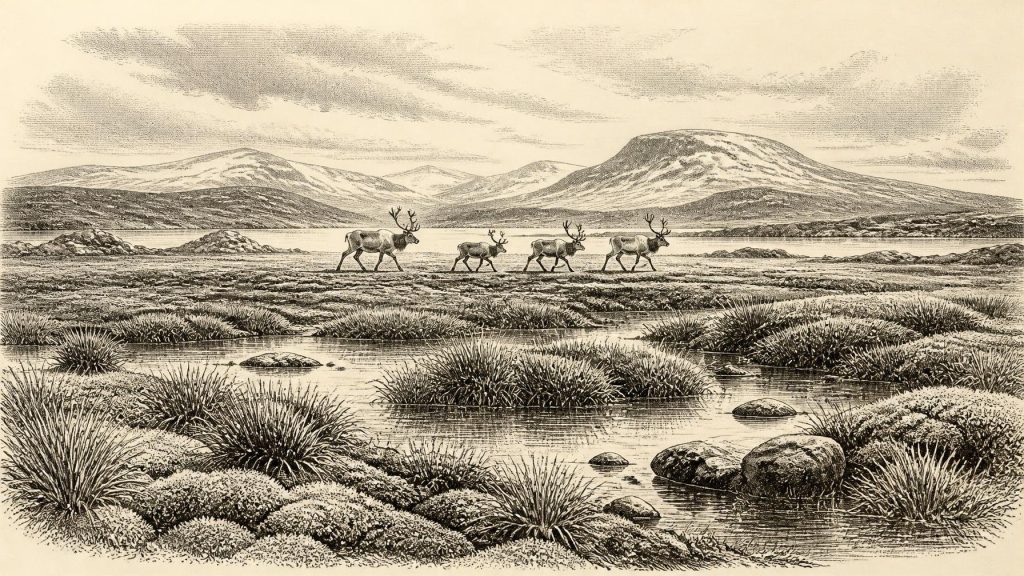
Around 31,739 BCE, Ireland lay within the climatically unstable Late Pleistocene MIS 3, before the Last Glacial Maximum. Derryvree, County Fermanagh, preserves freshwater sediments between glacial tills, indicating cold, open wetland landscapes with sedges, mosses, bogbean and Arctic-alpine plants during an interglacial interval. Southern caves, notably Castlepook and Shandon, contain remains of mammoth, reindeer, giant deer, predators and other Ice-Age fauna, although their deposits span millennia. A cut-marked Castlepook reindeer femur may indicate brief human handling of carcasses, but no securely associated tools, hearths or settlements exist. Ireland’s evidence therefore documents dynamic environments and animals, while human occupation remains unproven.
Dateline
The label 31,739 BCE is a modern chronological convenience, not a year that can be recovered from the Irish archaeological record. Nobody in Ireland then used a calendar of this kind, and no excavation can isolate events to a particular season, let alone a numbered year. In the conventional ‘before present’ system, whose present is AD 1950, it lies roughly 33,700 calendar years ago. The responsible setting is therefore a broad interval of the Late Pleistocene, within Marine Isotope Stage 3 (MIS 3), rather than a diary-like account of one year.
For Ireland, this is a period of exceptional uncertainty and importance. It preceded the Last Glacial Maximum, when the British–Irish Ice Sheet later expanded across much of the island and adjacent seas. Ireland was not simply a white, lifeless block of ice throughout the preceding millennia. Geological, botanical and animal evidence instead indicates shifting conditions: cold open ground, freshwater hollows, wetland vegetation, caves used by animals, and advancing or retreating ice margins. Yet evidence for people is radically thinner. There are no securely excavated homes, hearths, graves, stone-tool scatters or art assemblages in Ireland that can be assigned to this time.
A Landscape Measured in Millennia
At such depth in time, dating needs careful language. Radiocarbon ages are not calendar ages: atmospheric carbon levels changed, so laboratory determinations must be calibrated against an internationally maintained curve. IntCal20 reaches back 55,000 calendar years, but it does not provide annual precision for an isolated Irish bone or sediment layer. Calibrated results may span centuries or millennia, and they can be revised as methods, samples and calibration datasets improve.
The relevant climate phase, MIS 3, lasted for tens of thousands of years and was marked across north-west Europe by abrupt climatic swings. Conditions around Ireland were generally colder than today, but not uniformly identical from Cork to Fermanagh or from one millennium to the next. The later maximum of the last ice sheet belongs mainly to a younger period, broadly after 27,000 years ago. Modern reconstructions accordingly caution against projecting that later ice cover unchanged back to 31,739 BCE. There were ice-free sectors and biologically active landscapes before the final great expansion, even as glaciers and periglacial processes increasingly shaped the island.
Sea level was much lower than at present because so much water was held in global ice sheets. The geography of the Irish Sea basin and the Atlantic shelf was consequently different, with more land exposed around coasts. That fact matters for animal movements, but it should not be inflated into a simple claim of a dry, walkable route from continental Europe to Ireland. Changing sea, ice and land configurations created barriers as well as corridors, while the evidence does not securely document how any people might have crossed them.
Derryvree’s Freshwater Archive
The clearest northern Irish guide to the wider environment comes from Derryvree, near Maguiresbridge in County Fermanagh. Roadworks in 1969 exposed organic silts and fine sands enclosed between two substantial sheets of glacial till in a drumlin. The sequence records a vital geological fact: an earlier phase of ice, followed by an interval in which freshwater sediments accumulated, followed by renewed glaciation. It is evidence against any picture of continuous island-wide ice cover through the whole Late Pleistocene.
A conventional radiocarbon measurement on the Derryvree organic deposit was 30,500 ± 1,100 radiocarbon years BP. Published calibrations have placed it approximately in the mid-30,000s calendar years BP, although the breadth of that estimate, and the evolution of calibration methods, are themselves reasons for restraint. The deposit cannot identify weather on the requested numbered year, and it may pre-date it by millennia. It does, however, illuminate the kind of cold-stage environment available in Ireland during the broader MIS 3 world to which this date belongs.
Plant macrofossils, pollen and insects point towards open, treeless or nearly treeless ground around freshwater. Sedges, mosses and bogbean were part of this wetland setting; the presence of mountain avens, an Arctic-alpine plant, reinforces the cold-climate character. Such evidence is direct proof of plants and depositional conditions at one locality, not a complete map of the island. Nevertheless, it suggests a mosaic of pools, saturated ground and open terrain rather than a forested countryside. Winters were severe, growing seasons short, and exposed ground subject to frost action. Water, vegetation and sediment continued to gather between episodes of glaciation.
Cork Caves and Ice-Age Animals
Southern Irish caves provide the principal evidence for animals living in or reaching Ireland during this broad period. Castlepook Cave, also called Mammoth Cave, near Doneraile in north County Cork, is especially important. Its collections include remains attributed to woolly mammoth, giant deer, reindeer, brown bear, wolf, Arctic fox, both collared and Norwegian lemming, and spotted hyaena. Nearby Shandon Cave, County Waterford, has yielded mammoth, reindeer, horse, bear and wolf. Together, these animals demonstrate that parts of Ireland supported a striking Late Pleistocene fauna, quite unlike the island’s later historic ecosystems.
These lists need to be read as cave evidence, not as a census. Caves are selective archives. Animals may have died in them, fallen into them, been dragged in by predators, or been moved by water after death. At Castlepook, gnawed bones and the presence of spotted hyaena indicate that carnivores helped form the assemblage. The deposits were excavated largely in the early twentieth century, before modern stratigraphic standards, and later water disturbance obscured relationships between some bones. Different specimens can therefore represent different moments spread across many thousands of years.
Improved accelerator radiocarbon dating has transformed the chronology. The Irish Quaternary Fauna Project showed that a range of mammals entered Ireland between at least about 45,000 and 20,000 years ago. A 2020 reassessment found that several earlier Castlepook determinations had been too young, placing significant elements of the southern Irish fauna firmly in MIS 3 and suggesting that giant deer and spotted hyaena may have disappeared locally before the Last Glacial Maximum. Geological Survey Ireland summarises Castlepook’s dated material as extending over a long span, approximately 45,700 to 19,950 years BP. It follows that the cave is a long-lived faunal archive, not a single moment frozen in time.
The Reindeer Femur and Human Presence
One object has made 31,739 BCE especially consequential: a reindeer femur from Castlepook. Zooarchaeologist Ruth Carden identified a deep linear mark on it as consistent with cutting or chopping fresh bone using a sharp stone implement. County Cork heritage material presents the bone as dating to around 30,000 BCE, and the find has been widely described as possible evidence of human activity in Ireland roughly 33,000 years ago. If the interpretation is sustained, it would push Ireland’s earliest known human trace far back beyond the well-established post-glacial record.
Its potential is real, but its limits are equally important. The date measures the death of the reindeer, not necessarily the precise time, place or purpose of any human action. A mark judged to be made by a tool is an expert zooarchaeological interpretation, distinct from the radiocarbon result. Nor was the bone recovered from a modern excavation of an intact occupation floor. No associated stone tool, hearth, dwelling, burial, food-processing area or human bone has yet been published from Ireland at a comparable age.
The marked femur can therefore support a narrow proposition: it may show that one or more people handled a reindeer carcass in Ireland during the Upper Palaeolithic. It cannot demonstrate a permanent settlement, continuous population, named group, language or migration route. The National Museum of Ireland still properly states that clear evidence for human presence during the Palaeolithic has not emerged. That institutional caution and the Castlepook interpretation are not incompatible: the latter is a significant, promising claim whose wider implications require securely stratified corroboration.
Society Beyond the Evidence
For this reason, conventional historical categories largely fall silent. There is no evidence from Ireland for political authority, diplomacy, warfare, social rank, organised religion, formal learning, trade networks or built settlements at this date. It would be misleading to populate the island with tribes, chiefs or rituals borrowed from better-documented Upper Palaeolithic communities elsewhere in Europe. Continental hunter-gatherers did use stone tools, hunted large animals and created remarkable art in some regions, but analogy is not evidence that the same practices occurred in Ireland.
If people did make brief visits, their economy may have involved the opportunistic acquisition or processing of animal resources, perhaps meat, hide, marrow or sinew from reindeer. That is only an inference from the marked-bone interpretation, not a demonstrated Irish subsistence system. There is no basis for claiming regular reindeer hunts, seasonal camps or exchange. The most securely documented ‘economy’ is ecological: herbivores grazing cold open landscapes, predators and scavengers exploiting carcasses, and freshwater plants thriving where sediment and water collected.
What can responsibly be said is that Ireland was neither historically empty in the ecological sense nor securely inhabited in the human sense. Derryvree preserves a northern wetland episode between glaciations. Castlepook and Shandon preserve fragments of a southern fauna adapted to an unstable Ice-Age world. The reindeer femur holds out the possibility that humans briefly entered that world. Future excavation of undisturbed cave deposits, improved dating and microscopic study of bone surfaces may alter the balance of evidence. For now, the history of Ireland around 31,739 BCE is a history of wetlands, animals, caves and ice — and of the discipline required not to claim more than they can prove.
Primary Sources
- A Reconsideration of the Radiocarbon Dating of the Marine Isotope Stage 3 Fauna from Southern Ireland
- The Irish Quaternary Fauna Project
- Castlepook Cave, County Cork: County Geological Site Report
- A Middle Midlandian Freshwater Series at Derryvree, Maguiresbridge, County Fermanagh, Northern Ireland
- Figure 6: The Subdivision of the Quaternary Period in Ireland
- Growth and Retreat of the Last British–Irish Ice Sheet, 31,000 to 15,000 Years Ago: the BRITICE-CHRONO Reconstruction
- Growth and Retreat of the Last British–Irish Ice Sheet, 31,000 to 15,000 Years Ago: the BRITICE-CHRONO Reconstruction
- Maximum Extent and Dynamic Behaviour of the Last British–Irish Ice Sheet West of Ireland
- Pattern and Timing of Retreat of the Last British-Irish Ice Sheet
- Dimensions and Chronology of the Last Ice Sheet in Western Ireland
- Exploring the Last Glaciation in the Celtic Sea Region
- The IntCal20 Northern Hemisphere Radiocarbon Age Calibration Curve (0–55 cal kBP)
- IntCal Publications
- IntCal History
- Prehistoric Details
- Stone Age
- Heritage Artefacts of County Cork
- Spotted Hyena Skull
- Archaeology Research Excavation Grant 2022: Final Report
- Castlepook Cave, Cork, 2022 Excavation Report
- Irish Cave Exploration
- Occurrence of Mammalia Relicts at Site Castlepook Cave