
Shandon’s Reindeer Passage31758 BCE
31,758 BCE is a modern chronological label within climatically unstable Marine Isotope Stage 3, not a precisely datable Irish event. Low sea levels and shifting ice shaped a changing north-west European landscape, while routes into Ireland remain uncertain. Shandon Cave fauna, including reindeer, mammoth, horse, bears and wolves, indicates cold, open habitats and diverse food webs, though cave deposits are not ecological censuses. Castlepook’s marked reindeer bone may evidence human butchery around 33,000 years ago, but cannot prove settlement. Derryvree sediments document treeless freshwater wetlands between glaciations. Later ice transformed or destroyed landscapes, leaving evidence of connections and human presence.
Dateline
“31,758 BCE” is a modern calendar label, not a date at which an event can be placed in prehistoric Ireland. No written record, settlement sequence or annual chronicle permits that degree of precision. In archaeological terms, the point falls about 33,700 calendar years before AD 1950, within Marine Isotope Stage 3 (MIS 3), a long and climatically unstable phase of the Late Pleistocene. The most responsible account is therefore regional and probabilistic: it considers evidence dated to broad calibrated ranges around this point, while keeping firm distinctions between what survives in the record and what archaeologists infer from it.
Ireland was then part of a north-west European world repeatedly reshaped by cold, ice, changing sea levels and mobile animal populations. It was not yet the familiar island of later history. Coastlines lay far beyond many modern shores because large quantities of the world’s water were held in continental ice sheets. Yet low sea level did not automatically create a simple, permanent land bridge from Ireland to Britain or continental Europe. The configuration of sea, ice and habitable land changed over millennia. Animals demonstrably reached Ireland during this period; the precise routes, and the degree of continuity between populations, remain subjects of investigation.
A Date Range, Not a Year
At this depth of time, radiocarbon determinations must be calibrated against changing atmospheric carbon-14 levels. A laboratory age expressed in radiocarbon years before present is therefore not identical to a calendar age, and the calibrated result is normally a range rather than a single point. The distinction matters especially around 34,000 years ago, where calibration uncertainty can be substantial. The year heading should consequently be understood as a convenient place in a modern timeline, not as evidence that a particular hunt, migration or climatic episode happened in one named year.
The Irish evidence nearest this broad interval comes mainly from cave bone assemblages in the south and south-east, and from buried sedimentary sequences elsewhere. These sources have different strengths. Bones can identify animals that reached a locality, but many were excavated long ago and often lack the secure, fine-grained stratigraphy expected of modern fieldwork. Sediments, pollen, plant remains and insects may reveal local environments, but they too represent episodes and accumulations rather than snapshots of a single season. Later glacial erosion also removed or buried vast areas of the contemporary landscape.
Reindeer at Shandon
Shandon Cave in County Waterford provides one of the clearest faunal windows onto Ireland’s pre-Last Glacial Maximum world. The cave has yielded remains attributed to reindeer, mammoth, horse, red deer, brown bear and wolf. Earlier radiocarbon programmes placed a Shandon reindeer radius at 30,840 ± 550 radiocarbon years before present, alongside other specimens of comparable antiquity. Such dates, once calibrated, overlap broadly with the climatic world relevant to 31,758 BCE, though they must not be converted into an assertion that this particular animal lived in that exact calendar year.
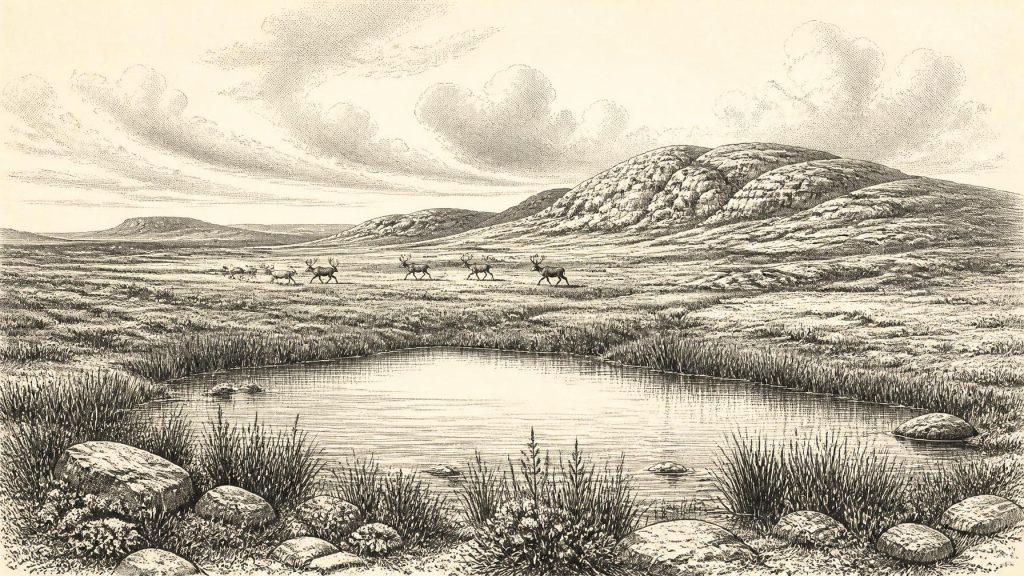
The important conclusion is modest but powerful: Ireland supported, or at least received, a varied large-mammal fauna during parts of MIS 3. Reindeer suggest open, cold-country habitats; horse and mammoth reinforce the picture of extensive grassland or herb-rich tundra rather than a closed forest. Brown bears and wolves show that the food web included sizeable omnivores and predators. This was no empty frozen wasteland. It was a difficult, seasonal landscape in which grazing animals, carnivores and scavengers could move across broad territories.
At the same time, cave collections should not be read as an ecological census. Caves were traps, dens, shelters and repositories where carnivores accumulated prey and where water, sediment movement and later disturbance could mix material. A mammoth rib or reindeer limb proves neither a resident herd at the cave mouth nor a stable local population. The fauna instead establishes a range of species present in Ireland over extended spans of time. Its greatest value lies in demonstrating environmental possibility: animals characteristic of cold open country could reach and survive in parts of the island before the full glacial maximum.
Castlepook and the Human Question
Castlepook Cave near Doneraile, County Cork, is central to discussion of possible people in Ireland at this time. Its exceptionally important assemblage includes reindeer, giant deer, mammoth, brown bear and spotted hyaena. Modern redating has also shown that some earlier radiocarbon results from southern Irish cave bones were too young, underlining how readily conclusions alter when improved pretreatment and calibration are applied. The cave is consequently evidence both for a rich pre-glacial fauna and for the need for caution.
One reindeer femur from Castlepook has been reported as bearing a mark consistent with stone-tool butchery and as dating to roughly 33,000 years ago. If that identification is sustained, it would be Ireland’s earliest known indication of human activity: not a settlement, nation or continuous occupation, but the processing of one animal carcass by a small party of Upper Palaeolithic people. It would show that humans could reach Ireland during MIS 3. It would not tell us their language, kinship, beliefs, numbers, homeland, length of stay or whether they left descendants.
The limitations are decisive. No securely associated hearth, house floor, tool-kit, human bone or repeated occupation horizon is presently available for 31,758 BCE. The marked bone was recovered from a cave assemblage shaped by antiquarian excavation and complex depositional history. Natural abrasion, carnivore activity and excavation damage must always be excluded when recognising a cut mark. The careful formulation is therefore that Castlepook offers suggestive, potentially transformative evidence for a human visit around this wider period, rather than proof of a settled Irish population.
Wetlands Beneath Later Ice
Far from the Cork and Waterford caves, Derryvree near Maguiresbridge in County Fermanagh preserves another kind of archive. Roadworks exposed freshwater silts and fine sands sealed between two thick tills within a drumlin. The stratigraphic position is fundamental: the organic-rich deposits record an interval between episodes of glaciation, then were overridden or enclosed by later ice-related sediment. Their plant and insect evidence has been interpreted as a treeless, cold freshwater and wetland environment, often described as muskeg or tundra wetland.
Derryvree does not furnish a neat map of all Ireland, nor can its radiocarbon evidence be pinned precisely to 31,758 BCE. It does, however, show that northern Ireland could contain standing or slow-moving fresh water, sedges, mosses and open ground during a Middle Midlandian interval broadly relevant to MIS 3. Such places would have supported insects, aquatic plants, small animals and grazing at their margins. They also remind us that Ice Age Ireland contained environmental mosaics: exposed mineral ground, wetlands, river valleys, caves and, in some districts, nearby glaciers or ice sheets.
No Polities, No Recorded Conflict
There is no evidence for political affairs, diplomacy, institutions, chiefs, organised warfare or territorial states in Ireland at this point. Nor is there evidence from which religion, artistic traditions, formal learning or social rank can responsibly be reconstructed. Later Irish monuments, myths, languages and populations are separated from this period by tens of thousands of years and must not be projected backwards.
If people did visit, their everyday economy would most plausibly have been a mobile hunter-gatherer one, dependent on knowledge of animal behaviour, weather, stone and fuel. That is an inference from the wider Upper Palaeolithic of north-west Europe, not a directly excavated Irish household. The Castlepook bone, if anthropogenic, suggests carcass processing; it does not establish regular reindeer hunting, trade in hides or antler, or a camp beside the cave. Likewise, the presence of animal species in Ireland implies ecological connections with Britain and Eurasia, but it does not demonstrate diplomatic or exchange networks among human groups.
Approaching a Colder World
In the longer sequence, this was a precarious prelude to the Last Glacial Maximum, conventionally placed at roughly 26,000–19,000 years ago. Reconstructions differ over precisely when individual Irish sectors became ice-covered, how extensive earlier ice was and how rapidly margins moved. There is nevertheless broad agreement that later glacial conditions profoundly altered the island, eroding earlier surfaces, depositing tills and making long-term human occupation improbable or impossible across much of Ireland.
For that reason, 31,758 BCE is best remembered not as the beginning of an Irish society, but as a rare surviving window onto an older ecological Ireland. Reindeer moved through open country; large mammals occupied landscapes now buried, drowned or transformed; wetlands existed between glacial episodes; and one marked bone may record a fleeting human intervention. The evidence is fragmentary, but its restraint is its significance. It places Ireland within the Late Pleistocene world without pretending that the later history of the island had yet begun.
Primary Sources
- The Irish Quaternary Fauna Project
- A Reconsideration of the Radiocarbon Dating of the Marine Isotope Stage 3 Fauna from Southern Ireland
- A Middle Midlandian Freshwater Series at Derryvree, Maguiresbridge, County Fermanagh, Northern Ireland
- Quaternary Deposits and Glacial Stratigraphy in Ireland
- Late Pleistocene Chronostratigraphy and Ice Sheet Limits, Southern Ireland
- Radiocarbon Constraints on the Age of the Maximum Advance of the British-Irish Ice Sheet in the Celtic Sea
- New Data for the Last Glacial Maximum in Great Britain and Ireland
- Subglacial Bedform Geomorphology of the Irish Ice Sheet Reveals Major Configuration Changes During Growth and Decay
- Reconstructing the Last Irish Ice Sheet 1: Changing Flow Geometries and Ice Flow Dynamics Deciphered from the Glacial Landform Record
- Reconstructing the Last Irish Ice Sheet 2: A Geomorphologically-Driven Model of Ice Sheet Growth, Retreat and Dynamics
- Advances in Irish Quaternary Studies
- Irish Quaternary Vertebrates
- The Human Colonisation of Ireland in Northwest European Context
- The Colonization of Ireland: A Human Ecology Perspective
- First Evidence of a Late Upper Palaeolithic Human Presence in Ireland
- The IntCal20 Northern Hemisphere Radiocarbon Age Calibration Curve (0–55 cal kBP)
- Composition and Consequences of the IntCal20 Radiocarbon Calibration Curve
- Sedimentary Ancient DNA Reveals Late Pleistocene Faunal Connectivity Between Ireland and Eurasia
- Prehistoric Details
- The Mesolithic in Ireland: When Was It?
- Late Pleistocene Chronostratigraphy and Ice Sheet Limits, Southern Ireland
- Stratigraphic and Palaeo-Geomorphological Evidence for the Glacial-Deglacial History of the Last British-Irish Ice Sheet in the North-Western Irish Sea