The Awbeg Reindeer Cut31327 BCE
The modern label 31,327 BCE cannot identify a discrete Irish event, but denotes a fluctuating cold phase of Late Pleistocene MIS 3. Castlepook Cave near Doneraile, County Cork, yielded a reindeer femur bearing a stone-tool cut, potentially Ireland’s earliest claimed human evidence. Its age, provenance and interpretation remain uncertain, as early excavations and changing radiocarbon methods limit precision. Ireland comprised open, seasonal tundra-like habitats amid shifting ice and lower seas, supporting reindeer, mammoth, hyaena and fauna. Derryvree deposits indicate treeless environments between glacial advances. No settlement is proven: any visitors were mobile foragers, while cave processes may have redistributed bones.
Dateline
31,327 BCE is not a date that can be recovered as a single Irish year. It is a modern calendar label, roughly 33,276 years before the conventional radiocarbon reference year of 1950, imposed on a period without written records, named rulers or annual chronologies. Neither radiocarbon dating nor glacial stratigraphy can identify what happened on the island in that particular year. The responsible approach is to place it within a wider Late Pleistocene setting: the later part of Marine Isotope Stage 3 (MIS 3), before the Last Glacial Maximum, when climate, ice margins, sea level and animal ranges changed repeatedly over centuries and millennia.
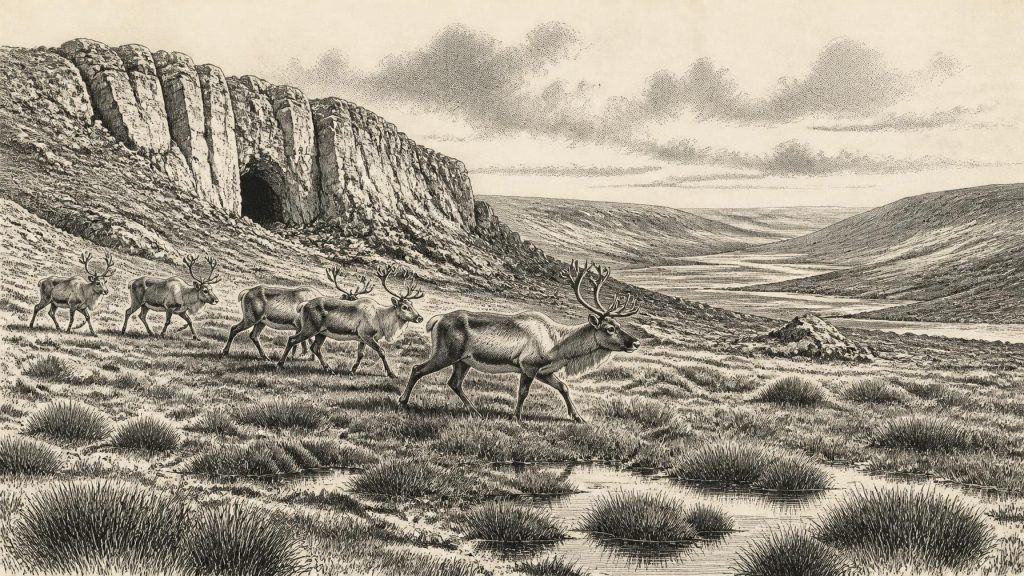
The nearest evidence of exceptional relevance comes from Castlepook Cave, also called Mammoth Cave, near Doneraile in north County Cork, above the Awbeg valley. A reindeer femur in the National Museum of Ireland’s natural-history collection has been assigned broadly to about 31,000 BCE in County Cork heritage material. Zooarchaeologist Ruth Carden has interpreted a deep linear mark on it as damage made by a sharp stone tool during the processing of a fresh carcass. If that interpretation and its association with the animal’s age are sustained, it may represent Ireland’s earliest presently claimed evidence of human activity. It does not, however, establish a settlement, a population or an event in 31,327 BCE.
A Date Made of Ranges
The distinction between a radiocarbon result and a calendar date matters especially at this depth of time. A laboratory measurement gives an age in radiocarbon years before present, with a statistical error; calibration against changing atmospheric carbon produces one or more probability ranges in calendar years. The age of a bone records when the animal ceased exchanging carbon with its environment, not necessarily the moment when a cut was made, when a carcass was moved, or when it entered a cave. The evidence around Castlepook is also drawn largely from collections excavated in the early twentieth century, before modern standards of stratigraphic recording and recovery.
Older Irish cave dates have required reassessment as laboratory methods improved. The Irish Quaternary Fauna Project demonstrated both the richness and the difficulty of the material: cave bones accumulated through many processes and often represented widely separated episodes. More recent work has stressed that pre-ultrafiltration radiocarbon determinations, including some earlier reindeer dates, cannot simply be treated as final. Thus the best chronological language for Ireland around this notional year is deliberately broad: a cold-stage world during MIS 3, perhaps around the transition towards harsher conditions and later ice-sheet growth, rather than a precisely dated human episode.
Open Ground Between Ice Advances
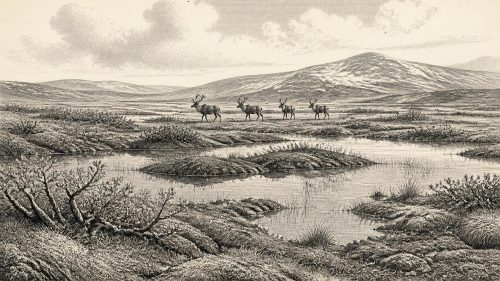
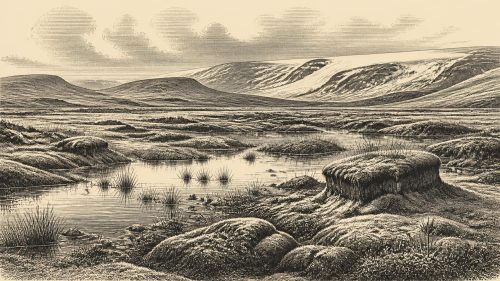
Ireland at this time was not the wooded island familiar from later prehistory. The climatic record indicates a cold, largely open environment, though it was neither uniform nor permanently frozen in the same way everywhere. Ice sheets and glaciers were dynamic. Their limits shifted with changing temperature, snowfall and sea level, while exposed ground could support tundra, herb-rich grassland, wet hollows and sparse shrub vegetation. By the Last Glacial Maximum, conventionally dated in Ireland and its surrounding seas to roughly 26,000–20,000 years ago, a much larger British–Irish Ice Sheet would dominate the region. That maximum lay in the future of 31,327 BCE, but the processes that built it were already remaking north-western Europe.
The Irish record contains a particularly important, if difficult, environmental archive beneath drumlins at Derryvree near Maguiresbridge in County Fermanagh. Organic silts trapped between two tills preserved remains of a treeless, wet tundra or muskeg landscape. Plant fossils and pollen from such deposits are not snapshots of a named year, but they show that water, sedges, mosses and cold-adapted vegetation could persist during intervals between glacial advances. The traditional Irish Quaternary framework has placed the Derryvree Cold Phase broadly in the middle of the last glaciation, around c. 35,000–25,000 years ago. Correlations and absolute ages remain subjects of revision, so Derryvree is best used as regional environmental evidence, not as proof that every part of Ireland looked identical in 31,327 BCE.
Castlepook’s Animal World
Castlepook provides the clearest Irish window onto the animals that could have inhabited or passed through southern Ireland during the cold stages. Its faunal record includes reindeer, woolly mammoth, giant deer, brown bear, wolf, Arctic fox, mountain hare, stoat, collared lemming, Norwegian lemming and spotted hyaena. Individual specimens have different ages, and the entire list must not be compressed into one simultaneous scene. Yet together they demonstrate that, at various points in the Late Pleistocene, Ireland supported or received a fauna suited to open, cold and highly seasonal environments. The cave’s hyaena material is particularly revealing: caves could serve as carnivore dens and bone traps rather than as places chosen by people.
Reindeer are central to the cautious human interpretation. In other parts of Upper Palaeolithic Europe, mobile hunter-gatherers pursued or intercepted herds, using stone points, blades and flakes to hunt and butcher animals. A marked reindeer bone at Castlepook is therefore plausible evidence for carcass processing by people. But plausibility is not confirmation of a camp. No securely associated hearth, knapped-stone assemblage, shelter floor, human burial, food store or repeated concentration of butchered remains of this age has yet been recovered from Ireland. The County Cork account itself notes that the bone may have been carried into the cave by scavengers after butchery elsewhere.
People Without a Proven Settlement
If people did reach the Doneraile area in this broad period, they were almost certainly small, highly mobile Upper Palaeolithic foraging parties rather than a settled community. Their practical knowledge would have included reading animal movement, selecting usable stone, sharing meat and fat, making clothing and shelter suitable for cold weather, and travelling through a landscape whose coastlines differed profoundly from today’s. Lower sea levels exposed much of the continental shelf, reducing sea crossings and creating changing land connections or narrower water barriers between Ireland, Britain and the European mainland. This is an inference from the wider geography of the ice age, not a demonstrated route taken by a particular Irish group.
Nothing in the Irish evidence permits a responsible account of political affairs, diplomacy, chiefs, tribes, warfare or territorial boundaries in 31,327 BCE. Nor can religion, language, kinship rules, art or learning be reconstructed from the marked femur. It would be misleading to import the spectacular cave art, graves, ornaments or named archaeological cultures of continental Europe directly into Cork. Such practices show what some Upper Palaeolithic people elsewhere were capable of; they do not show that they occurred at Castlepook. At most, the reindeer bone raises the prospect of a brief human visit at the far north-western edge of wider European hunter-gatherer worlds.
Economy, Exchange and Survival
There is no evidence for farming, permanent villages, cultivation, livestock, metalworking, markets or organised long-distance trade in Ireland at this time. Any human economy, if the Castlepook interpretation is correct, was based on hunting, scavenging and gathering, with reindeer a potentially valuable source of meat, marrow, hides, sinew, bone and antler. But the femur alone cannot tell whether the animal was hunted, found dead, butchered locally or brought in as part of a carcass. It cannot determine the size of a group, the season of activity or whether people returned.
The cave nevertheless illustrates a wider economy of survival shared by humans and predators. Hyaenas, wolves and other carnivores moved animal remains; water, gravity and sediment then redistributed them. This taphonomy is why archaeological interpretation must remain modest. A cave collection is not a census of a living landscape and not automatically a record of human meals. Recent excavations at Irish cave sites have underlined how antiquarian digging, runoff, fissures and later disturbance can mix material of very different dates.
What This Moment Can Mean
The importance of 31,327 BCE for Irish history lies not in an invented episode but in a question. Castlepook challenges the once simple assumption that people first reached Ireland only after the last great ice retreat. It does not yet replace the better-attested terminal-Pleistocene and early-Holocene record with a securely demonstrated earlier colonisation. The strongest conclusion is therefore both restrained and significant: during a cold, open and ecologically variable phase of the Late Pleistocene, animals certainly ranged through parts of Ireland, and one reindeer bone offers serious but still incomplete evidence that people may have processed an animal there.
That uncertainty is not a failure of the evidence. It is the historical fact. Around this modern calendar label, Ireland was a frontier landscape shaped by climate oscillation, advancing ice and animal mobility. Its human story, if present at all, survives not in names or monuments but in a single contested modification on bone, in cave deposits, and in the painstaking work needed to distinguish a human cut from the many natural processes of an ice-age world.
Primary Sources
- Heritage Artefacts of County Cork
- Archaeological Heritage of County Cork
- The Irish Quaternary Fauna Project
- New Insights on the Fauna of Ireland's Younger Dryas and Early Holocene from Alice & Gwendoline Cave
- Archaeology Research Excavation Grant 2022: Final Report
- Spotted Hyena Skull
- Prehistoric Details
- Occurrence of Mammalia Relicts at Site Castlepook Cave
- Growth and Retreat of the Last British–Irish Ice Sheet, 31,000 to 15,000 Years Ago: the BRITICE-CHRONO Reconstruction
- The Timing and Magnitude of the British–Irish Ice Sheet Between Marine Isotope Stages 5d and 2
- Last Glacial Maximum Cirque Glaciation in Ireland and Implications for Reconstructions of the Irish Ice Sheet
- Trimlines, Blockfields and the Vertical Extent of the Last Ice Sheet in Southern Ireland
- Stratigraphic and Palaeo-Geomorphological Evidence for the Glacial-Deglacial History of the Last British-Irish Ice Sheet in the North-Western Irish Sea
- The Deglaciation of the Western Sector of the Irish Ice Sheet from the Inner Continental Shelf to its Terrestrial Margin
- Exploring Controls of the Early and Stepped Deglaciation on the Western Margin of the British Irish Ice Sheet
- The Quaternary of Ireland: IQUA Guide No. 17
- The Stratigraphic Position and Age of the Gortian
- Archaeological Excavations at Killuragh Cave, Co. Limerick: A Persistent Place in the Landscape from the Early Mesolithic to the Late Bronze Age
- Ireland's Palaeolithic Archaeology – Fleeting Footprints in a Frozen Land
- Reindeer Bone Found in Cork Cave Shows Human Activity in Ireland 33,000 Years Ago
- UCD School of Archaeology Research Day 2022