Derryvree’s Myriophyllum30315 BCE
Around 30,315 BCE, Ireland was a changing Late Pleistocene landscape, not a precisely datable historical moment. Low sea levels altered coastlines, while cold, variable conditions preceded major ice-sheet expansion. At Derryvree in Fermanagh, freshwater sediments between glacial tills preserve plants and insects indicating treeless tundra wetland conditions during an ice-free or ice-marginal interval. Castlepook Cave in Cork produced mammoth, reindeer and predator remains, demonstrating a richer Pleistocene fauna. A possibly cut-marked reindeer bone may indicate human carcass processing, but cannot prove permanent settlement. Evidence supports mobile life in harsh habitats, not named peoples, farming, politics or continuous occupation in Ireland.

Dateline
Modern calendar-year precision is not available for Ireland in 30,315 BCE. The number is a useful modern label, not an ancient date at which a known event, ruler, journey or settlement can be identified. In archaeological terms it falls about 32,265 years before AD 1950, in the Late Pleistocene and Marine Isotope Stage 3: an unstable part of the last Ice Age. The responsible history of Ireland at this depth of time is therefore a reconstruction from cave bones, buried sediments, fossil plants and insects, glacial landforms, and scientific dating. These sources illuminate long intervals and local environments, not a single Irish year.
A Landscape in Flux
Ireland around this notional date was neither the familiar green island nor necessarily an island in the modern geographical sense. Sea level was far lower than today because enormous volumes of water were held in northern ice sheets. The coastline lay well beyond its present position in places, and the Irish Sea basin, western Britain and the continental shelf formed a changing cold-region landscape. Yet lower sea level did not automatically create an uncomplicated land bridge from Ireland to continental Europe. Access routes, ice margins, tidal channels and seasonal conditions altered repeatedly, and any movement of animals or people must be understood within that shifting geography.
The climate was cold, but “Ice Age” must not be treated as a description of one uniform frozen scene. The great Last Glacial Maximum, when ice covered much of Ireland and its surrounding shelves, lay principally later, broadly between 26,000 and 20,000 years ago. Reconstructions of the British–Irish Ice Sheet nevertheless show that glaciers and ice caps were already significant features of the north-west European world by about 31,000 years ago. At 30,315 BCE, Ireland was approaching a period of major ice-sheet growth, while conditions could vary sharply between uplands, ice margins, exposed lowlands, lakeside hollows and sheltered caves.
That regional complexity is crucial. It would be wrong to picture all Ireland as continuously ice-covered on this date; equally, it would be wrong to imagine a broad temperate grassland open for easy travel. The surviving record instead suggests cold, sparse and mobile habitats, repeatedly reshaped by frost, meltwater, wind and advancing or retreating ice. The greatest historical development was environmental: the physical setting in which plants, animals and any occasional human visitors had to survive was becoming increasingly severe and unpredictable.
Derryvree’s Buried Wetland
The most important direct environmental evidence comes from Derryvree near Maguiresbridge in County Fermanagh. Roadworks in 1969 exposed a drumlin section in which freshwater silts and fine sands, containing organic remains, lay between two distinct tills. Till is debris deposited directly by glacier ice. The sequence therefore establishes a relative history: glaciation, followed at that locality by an interval in which water and living things accumulated, followed by renewed ice activity that sealed the deposits beneath another till.
Organic matter from the freshwater bed produced the radiocarbon determination BIRM-166, conventionally reported as 30,500 radiocarbon years BP, with a large uncertainty of +1,170 and −1,030 years. Radiocarbon years are not calendar years. When expressed through later calibration, the date is commonly placed very broadly at about 36,900–31,700 calibrated years BP, approximately 34,950–29,750 BCE. That wide interval encompasses 30,315 BCE, but it cannot identify a particular season, generation or event in that year. Nor did the deposit form in a moment: it accumulated over time.
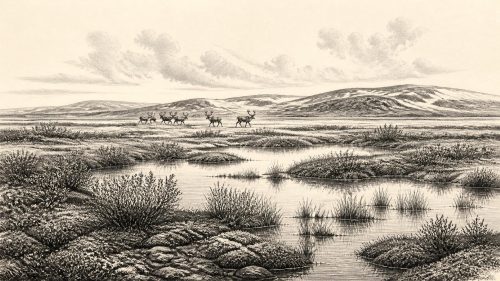
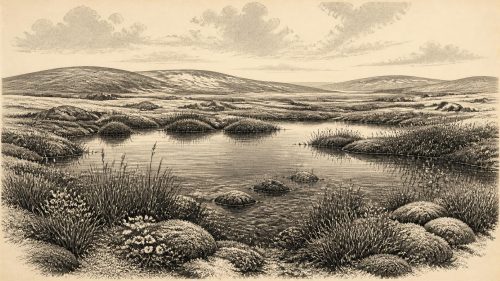
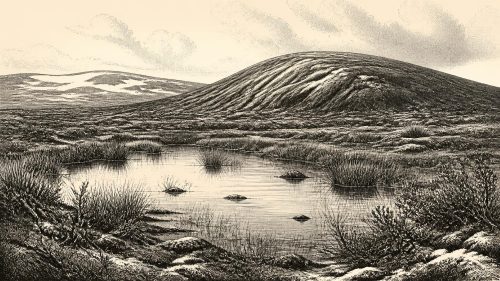
The Derryvree fossils show a cold freshwater and wetland setting. Plant remains, including sedges, mosses, dwarf willow, mountain avens, bogbean and water-milfoil, together with insect evidence, support an interpretation of treeless tundra or muskeg-like ground with pools and wet margins. This is evidence for the presence of particular species and suitable local habitats; the fuller image of a tundra wetland is an interpretation built from the assemblage as a whole. It reveals that, during part of the dated interval, south Fermanagh contained running or standing freshwater and vegetated ground rather than an unbroken cover of glacier ice.
For everyday life, the deposit offers a landscape rather than a human community. There is no excavated dwelling, hearth, tool scatter, grave, trackway or food store at Derryvree. We may infer a short growing season, exposed vegetation and difficult winter conditions, but cannot responsibly assign the place to an ethnic group or describe its inhabitants. The wetland is best understood as an environmental archive: a rare glimpse of life between episodes of glaciation, later hidden beneath the material that ice transported across it.
The Castlepook Question
County Cork provides the most intriguing, but also most limited, possible indication of human activity near this period. Castlepook Cave, near Doneraile and also known as Mammoth Cave, yielded one of Ireland’s richest collections of Pleistocene animal remains during antiquarian excavations in the early twentieth century. Its fauna includes woolly mammoth, giant deer, reindeer, brown bear, wolf and spotted hyaena. Such animals establish that Ireland could support a much richer large-mammal community during colder phases than the modern island does. Cave deposits, however, are accumulations made over long periods, often by carnivores, water movement, collapse and human excavation; they are not automatically snapshots of one living landscape.
A reindeer femur from Castlepook has been presented in County Cork heritage material as dating to about 31,000 BCE and as carrying a deep incision interpreted by zooarchaeologist Ruth Carden as a cut or chop made by a sharp stone tool during carcass processing. If that interpretation is sustained, it is potentially the earliest evidence that people handled an animal in Ireland: perhaps a hunting party or a small group processing reindeer during an Upper Palaeolithic visit. The find is especially relevant because its broad age lies close to the modern label 30,315 BCE.
Its limitations are as important as its promise. The bone came from an old collection rather than a modern, securely excavated occupation layer. A date on the bone establishes when the reindeer lived, not necessarily the exact moment the mark was made. A cut mark can show carcass processing, but cannot reveal whether people killed the animal, scavenged it, took meat, hide, sinew or marrow, or whether carnivores later carried the bone into the cave. No securely associated stone-tool assemblage, hearth, dwelling floor, burial, human skeleton or concentration of butchered remains has demonstrated a permanent settlement at Castlepook at this age.
Accordingly, the evidence permits a cautious statement about economy and movement, but no more. Reindeer were a potentially valuable seasonal resource for mobile hunter-gatherers elsewhere in Upper Palaeolithic Europe, providing food, hide, bone and sinew. If people made the Castlepook mark, they possessed a sharp stone edge and knowledge of animal anatomy. It does not follow that Ireland had a settled hunting population, regular trade, a named archaeological culture or continuous links with later inhabitants. The femur records a possible action, not a society.
Animals, Predators and Open Country
The larger Castlepook animal assemblage helps set that possible human episode in ecological context. Mammoth and reindeer imply open or broken country with substantial grazing, while hyaena, wolf and bear indicate predators and scavengers occupying different niches. Giant deer were also part of Ireland’s Late Pleistocene fauna, though individual animals and deposits need not all be contemporary. The cave may itself have been used as a carnivore refuge or den, an important warning against treating every bone as food refuse from people.
There is no evidence for farming, herding, villages, field systems, pottery, metalworking or managed woodland. The Irish landscape around 30,315 BCE was long before the agricultural and monumental worlds of later prehistory. Its economy, insofar as human evidence can be discussed at all, would have depended on the immediate exploitation of wild animals and plants by highly mobile visitors. Even that remains an inference from European comparison and the single disputed or provisional Irish trace, rather than a demonstrated Irish subsistence system.
What Cannot Be Recovered
Political affairs, diplomacy and organised conflict are beyond the evidence. No named people, chiefdoms, territories or alliances can be recovered from Ireland in this period. Nor is there material evidence for religion, formal learning, art, language or social rank. Silence here is not proof that people lacked beliefs, knowledge or relationships; it means that archaeology has not recovered evidence capable of describing them. The absence of permanent settlement evidence is particularly significant: even if occasional groups entered Ireland, their numbers, duration of stay and routes remain unknown.
The regional story is instead one of threshold and survival. Fermanagh’s buried freshwater sediments document an ice-free or ice-marginal wetland within a broad dated window. Cork’s cave fauna demonstrates that large mammals ranged through, or were transported into, a changing southern landscape. The possible cut-marked reindeer bone raises the prospect that humans were among those moving through Ireland, but does not prove an established population. As ice expanded in subsequent millennia, many such habitats would be overridden, fragmented or buried, while rising seas much later removed or submerged parts of the ancient landscape.
For 30,315 BCE, then, Ireland’s history is not a chronicle of kings or battles. It is a cautiously assembled account of cold water, tundra plants, grazing animals, carnivore caves and encroaching ice. Derryvree and Castlepook are valuable precisely because they preserve fragments from a time normally erased by glaciation. They show an Ireland capable of supporting life in harsh conditions, while reminding us how little can honestly be attached to a single numbered year more than thirty-two millennia ago.
Primary Sources
- A Middle Midlandian Freshwater Series at Derryvree, Maguiresbridge, County Fermanagh, Northern Ireland
- Growth and retreat of the last British–Irish Ice Sheet, 31,000 to 15,000 years ago: the BRITICE-CHRONO reconstruction
- Growth and retreat of the last British–Irish Ice Sheet, 31,000 to 15,000 years ago: the BRITICE-CHRONO reconstruction
- Timing, pace and controls on ice sheet retreat: an introduction to the BRITICE-CHRONO transect reconstructions of the British–Irish Ice Sheet
- Timing, pace and controls on ice sheet retreat: An introduction to the BRITICE-CHRONO transect reconstructions of the British–Irish Ice Sheet
- Last Glacial Maximum cirque glaciation in Ireland and implications for reconstructions of the Irish Ice Sheet
- The Irish Quaternary Fauna Project
- Irish Pleistocene Biostratigraphy
- Palaeoecology
- Quaternary
- Castlepook Cave: County Geological Site Report
- Heritage Artefacts of County Cork
- Castlepook Cave, Co. Cork, 2022
- First evidence of a Late Upper Palaeolithic human presence in Ireland
- First Evidence of a Late Upper Palaeolithic Human Presence in Ireland
- The Archaeology of Caves in Ireland
- New Insights on the Fauna of Ireland’s Younger Dryas and Early Holocene from Alice & Gwendoline Cave
- New Insights on the Fauna of Ireland’s Younger Dryas and Early Holocene from Alice & Gwendoline Cave
- Ireland Under the Ice
- The Colonization of Ireland: A Human Ecology Perspective