The Awbeg Cutmark Debate31648 BCE
31,648 BCE is a modern label for a fluctuating MIS 3 Ice Age environment, not a recoverable Irish historical year. Derryvree, County Fermanagh, preserves freshwater sediments between glacial tills, indicating locally ice-free, treeless wetlands and open periglacial vegetation during a broadly dated interval. Castlepook Cave, County Cork, contains a complex, repeatedly accumulated fauna including mammoth, reindeer, giant deer, bear and hyaena, but cannot represent a single contemporaneous community. A marked reindeer femur may indicate brief human butchery, yet remains inconclusive. No settlement, culture or economy is demonstrable. Changing ice, wetlands, animal movements and fragmentary evidence define this period in Ireland.

Dateline
31,648 BCE is a modern chronological label, not a year that can be recovered from Ireland’s archaeological record. No calendar, written account or identifiable individual brings this point in time into focus. At roughly 33,600 calendar years before the radiocarbon convention’s “present” of AD 1950, it belongs to the later part of the Pleistocene and to Marine Isotope Stage 3 (MIS 3), a climatically unsettled phase before the Last Glacial Maximum. The responsible subject is therefore not a year’s events, but the archaeological period that overlaps it: a cold, variable Ireland in which ice, water, vegetation and animal movement determined what life could be possible.
A Date Within Broad Ranges
At this depth of time, precision must be handled with care. Radiocarbon years are not calendar years, because atmospheric carbon-14 concentrations have varied; laboratory determinations need calibration against independently dated records. Even after calibration, results commonly produce probability ranges rather than a single date. The relevant evidence at Derryvree, near Maguiresbridge in County Fermanagh, comes from organic freshwater silts and fine sands preserved between two layers of glacial till. Its radiocarbon determination, around 30,500 radiocarbon years BP with a substantial uncertainty, has been calibrated broadly to about 36,900–31,700 calendar years BP. That range overlaps the horizon represented by 31,648 BCE, but it neither records that year nor proves that conditions were identical throughout Ireland.
This distinction matters. Derryvree provides a sequence: an earlier glaciation, an interval in which freshwater sediments accumulated on ice-free or locally ice-free ground, and a later glaciation that sealed the deposit beneath till. It is powerful evidence against a simple image of an island continuously smothered by ice. It is not a weather report for the entire island, still less a diary of a particular season. The later British–Irish Ice Sheet was dynamic, with growth and retreat varying between regions; recent reconstructions and modelling stress both the scale of the eventual ice sheet and the limits of any single reconstruction. Around this broad period, northern and southern Ireland need not have shared precisely the same conditions.
Derryvree’s Cold Wetland
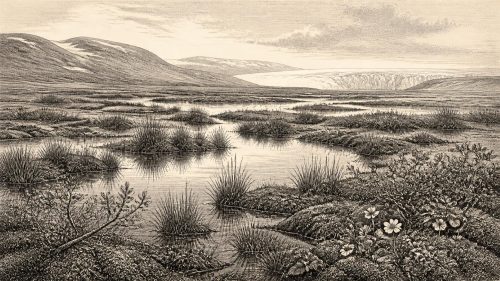
The biological remains at Derryvree give the clearest Irish picture of the wider landscape. Pollen, plant macrofossils, mosses and insect evidence indicate open, largely treeless vegetation in a cold, periglacial environment. This was not the wooded Ireland familiar from later millennia. Wet, mossy and sedgy ground, shallow pools and herb-rich patches could occur in low-lying basins, while frost action affected soils and drainage. Dwarf shrubs and hardy flowering plants were better suited than trees to short growing seasons and severe winters. “Tundra” and “muskeg” are useful descriptions for aspects of the evidence, provided they are not mistaken for a uniform blanket spread across every hill, valley and coast.
Such a landscape was demanding but not lifeless. Summer productivity around wetlands and open grass-herb communities could support insects, birds and grazing animals; winter imposed a far more exacting regime. MIS 3 climate was marked by abrupt shifts visible in Greenland ice cores and North Atlantic marine records. Ireland stood on the Atlantic edge of that wider climatic system. The fossil deposits show local ecological opportunity, but they also imply instability: plant communities, snow cover, frozen ground, watercourses and animal ranges could change substantially across centuries or millennia. It is safer to picture a mosaic of exposed ground, wetlands and ice-influenced terrain than either a green temperate island or an unbroken white wilderness.
Castlepook’s Faunal Archive
The most important southern counterpart is Castlepook Cave, also called Mammoth Cave or Doneraile Cave, near the Awbeg Valley in north County Cork. Its long, narrow limestone galleries preserved more than two thousand animal bones recovered in antiquarian excavations and later investigations. Geological Survey Ireland describes it as Ireland’s richest site for vertebrate fauna from the period leading towards the Last Glacial Maximum. The assemblage includes woolly mammoth, reindeer, giant deer, brown bear and spotted hyaena, with wolf, Arctic fox, hare and lemmings represented among later cold-stage material. These remains establish that a varied Pleistocene fauna reached Ireland during portions of the last Ice Age.
They do not, however, form one perfectly dated animal community. Cave floors are complex repositories. Carnivores can drag in prey; animals die in or near entrances; water moves bone; excavations undertaken more than a century ago did not always retain the stratigraphic information now expected. Modern re-dating has transformed the picture: some Castlepook samples proved between roughly 5,000 and 12,000 radiocarbon years older than earlier results suggested. The cave thus preserves repeated episodes over a long span, rather than a single scene in which mammoths, hyaenas, reindeer and people can all confidently be placed together. The regional faunal record is evidence for changing populations, not a ready-made Ice Age tableau.
The presence of spotted hyaena is particularly revealing. Hyaenas were major scavengers and predators whose use of caves could shape what archaeologists later recover; bones in such contexts are not automatically evidence of hunting by people. Reindeer imply cold open country and seasonal mobility, while mammoth and giant deer underline how different Ireland’s animal world could be from the later historic fauna. Yet individual species had their own chronological histories. Revised dates suggest that giant deer and spotted hyaena may have disappeared locally before the Last Glacial Maximum, perhaps around 40,000 calibrated years BP. The exact mixture around 31,648 BCE remains unknowable, although the broad environmental setting clearly allowed large herbivores and carnivores to enter Ireland at different times.
The Reindeer Femur
A reindeer femur fragment from Castlepook gives this horizon its most provocative human question. The bone has been reported as approximately 33,000 years old and bears a mark interpreted by palaeozoologist Ruth Carden as a cut made by a sharp stone tool while fresh tissue was being removed. If that interpretation survives further microscopic and contextual scrutiny, it would show that a person handled and probably butchered a reindeer in Ireland long before the final retreat of the ice. It would be an extraordinary extension of the island’s Palaeolithic record.
But “if” is essential. The fragment is not a securely excavated camp floor accompanied by stone tools, hearths, shelters, human remains or several independently modified bones. Natural damage, excavation damage and carnivore action can sometimes resemble cultural modification, while the older cave collections have limitations of provenance. Recent fieldwork at Castlepook has located surviving Pleistocene sediments and aims to identify undisturbed deposits, improve dating and seek clearer evidence. For now, the bone supports a carefully worded possibility of brief human activity, not proof of a resident population, a named people, or continuous settlement. It should not be inflated into a claim that Ireland had already been permanently colonised.
People Beyond the Evidence
No political affairs, diplomacy, warfare, leaders or territorial boundaries can responsibly be described for Ireland at this date. Neither can archaeology identify households, language, religion, ritual or systems of learning. There are no Irish graves, monuments, art objects or settlements securely attributable to this horizon. The candidate cutmark cannot tell us the visitor’s identity, age, sex, speech, beliefs or number. It cannot establish whether one person, a small travelling group or an occasional succession of visitors reached the island. Silence on these matters is not an omission from the story; it is the most important fact about the surviving record.
Continental comparison nevertheless provides limited context, clearly separated from Irish evidence. In broadly comparable millennia, Upper Palaeolithic communities in western and central Europe made sophisticated stone and organic tools, processed animals, maintained social links over considerable distances and, in many regions, belonged to cultural traditions conventionally grouped within the Gravettian. That does not licence the label “Gravettian” for Castlepook: no diagnostic Irish tool assemblage exists. At most, if people did reach Cork, survival in a cold, fluctuating north-western landscape would have required practical knowledge of animals, weather, clothing, fire and movement. Those are reasonable inferences from the wider human world, not discoveries made in Ireland itself.
Movement, Not Trade
Economy and trade likewise cannot be reconstructed as institutions. There is no evidence for farming, herding, exchange goods, boats or markets in Ireland around this time. A more defensible subject is movement. Lower global sea levels altered the outlines of the Irish Sea region and expanded coastal plains, but an exposed landscape did not automatically create a simple, continuous land bridge. Local sea level, isostatic change, ice margins, rivers and water channels all mattered. The arrival of terrestrial animals demonstrates ecological connections with Britain and the wider north-west European zone at intervals; it does not determine the route, season or ease of every crossing.
The central development around this notional year was therefore environmental, not political. Derryvree records freshwater and treeless cold-country vegetation before renewed ice advance. Castlepook records a richer, time-layered animal archive from southern Ireland and preserves the unresolved possibility that people briefly entered this world. Subsequent expansion of the ice sheet would erase, bury and rearrange much of the physical evidence, helping to explain why the record is so fragmentary. Ireland at 31,648 BCE can be known as a changing Ice Age landscape of wetlands, open ground, mobile fauna and uncertain human traces—not yet as a settled human society.
Primary Sources
- A Middle Midlandian Freshwater Series at Derryvree, Maguiresbridge, County Fermanagh, Northern Ireland
- A Reconsideration of the Radiocarbon Dating of the Marine Isotope Stage 3 Fauna from Southern Ireland
- The Irish Quaternary Fauna Project
- New Insights on the Fauna of Ireland's Younger Dryas and Early Holocene from Alice & Gwendoline Cave
- Castlepook Cave
- Spotted Hyena Skull
- 2022:564 – Castlepook Cave, Castlepook South, Cork
- The Archaeological Heritage of County Cork
- Maximum Extent and Dynamic Behaviour of the Last British–Irish Ice Sheet West of Ireland
- Growth and Retreat of the Last British–Irish Ice Sheet, 31,000 to 15,000 Years Ago: the BRITICE-CHRONO Reconstruction
- BRITICE Glacial Map, Version 2: a Map and GIS Database of Glacial Landforms of the Last British–Irish Ice Sheet
- Behavioural Tendencies of the Last British–Irish Ice Sheet Revealed by Data–Model Comparison
- The Timing and Magnitude of the British–Irish Ice Sheet Between Marine Isotope Stages 5d and 2
- Exploring Controls of the Early and Stepped Deglaciation on the Western Margin of the British Irish Ice Sheet
- The IntCal20 Northern Hemisphere Radiocarbon Age Calibration Curve (0–55 cal kBP)
- Gulf Stream Variability During Marine Isotope Stage 3
- Equilibrium Simulations of Marine Isotope Stage 3 Climate
- The Nature of MIS 3 Stadial–Interstadial Transitions in Europe: New Insights from Model–Data Comparisons
- Overview of the European Upper Palaeolithic: The Homo sapiens Bone Record
- Early Upper Paleolithic Colonization Across Europe: Time and Mode of the Gravettian Diffusion
- Gravettian
- Occurrence of Mammalia Relicts at Site Castlepook Cave
- Early Midlandian–Middle Midlandian, Pleistocene, Northern Ireland
- Ireland's Palaeolithic Archaeology – Fleeting Footprints in a Frozen Land