
Derryvree’s Plant Bed31596 BCE
Although 31,596 BCE cannot be treated as a precise Irish historical year, Derryvree, County Fermanagh, preserves evidence from a broad Late Pleistocene interval encompassing it. Organic deposits between glacial tills reveal an ice-free freshwater basin with cold, treeless, varied tundra-like wetlands, before later ice advance. Castlepook Cave, County Cork, records a changing MIS 3 fauna including reindeer, mammoth, giant deer, predators and scavengers, though deposits are disturbed and dates vary. A cut-marked reindeer bone may indicate early human activity, but no occupation is proven. Together, these archives depict Ireland as environmentally unstable, periodically habitable, and connected to wider north-western Europe.
Dateline
31,596 BCE is not a year that can be narrated as a dated episode in Irish history. No calendar, writing, named people, settlement sequence or annual archaeological layer permits that kind of precision. The label is useful only as a modern point of reference: in the archaeological convention that counts backwards from AD 1950, it falls roughly 33,500 years before present. That places it in the Late Pleistocene, within Marine Isotope Stage 3, a long and climatically unstable part of the last Ice Age. The responsible evidence comes not from an event of that particular year, but from deposits and animal remains dated across broad calibrated ranges.
The closest important Irish environmental archive is at Derryvree, near Maguiresbridge in County Fermanagh. Here, freshwater silts, sands and organic deposits survived between two layers of till, sediment laid down by glacier ice. Their order matters. They record an earlier glacial episode, then a period when water, plants and sediment accumulated in an ice-free basin, followed by a later advance that buried the evidence. A conventional radiocarbon determination of about 30,500 radiocarbon years BP from the organic material has been calibrated to a broad range commonly expressed as approximately 36,900–31,700 calendar years BP. The notional horizon represented by 31,596 BCE falls within that interval, but the deposit cannot be assigned to a particular year, season or generation.
A Wetland Between Ice Advances
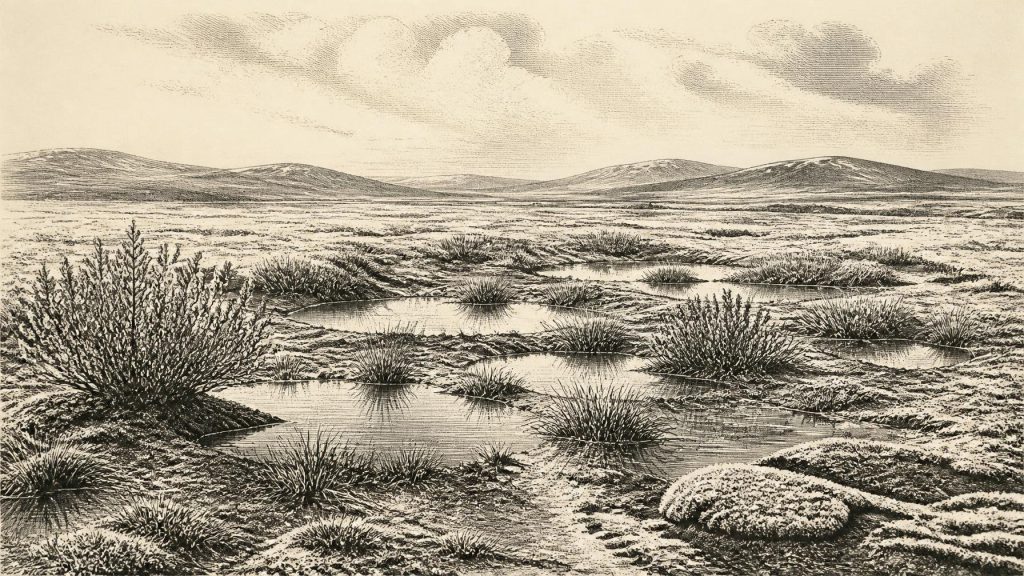
Derryvree is therefore the best guide to the kind of landscape that could have existed in at least part of Ireland around this distant point in time. It was not the familiar wooded and maritime island of later prehistory. Pollen, plant macrofossils, mosses and insects point instead to cold, open, largely treeless ground around freshwater. Sedges, herbs, low shrubs and wetland plants occupied shallow pools and waterlogged hollows. Fossil evidence for bogbean, a plant of marshes and pools, and for dwarf willow helps make the scene more tangible. The ground was affected by severe frost and seasonal freezing, while the short growing season limited woodland development.
“Tundra” is a useful shorthand, provided it does not suggest a featureless frozen waste. Derryvree appears to have contained a varied periglacial mosaic: damp mossy ground, sedge-rich margins, shallow water, exposed mineral soils and patches of low vegetation. In summer, such places could be unexpectedly productive. Plants, insects and grazing animals would have found resources in sheltered or well-watered pockets; in winter, wind, frost, snow cover and frozen ground would have made survival much harder. Conditions also varied across the landmass. A record from one protected Fermanagh basin cannot be treated as a weather report for every valley, coast or upland in Ireland.
This distinction is important because Ireland was not continuously covered by ice throughout the last glacial cycle, but neither was it steadily hospitable. Ice margins expanded and contracted, and climates altered abruptly over periods much longer than a human lifetime. The fullest Late Midlandian, or Last Glacial Maximum, ice-sheet expansion came later, principally after about 27,000 calendar years BP and with major advances around 25,000–23,000 BP in the wider British–Irish Ice Sheet system. Around the broad Derryvree interval, some Irish ground demonstrably supported freshwater environments and vegetation before subsequent ice overran or reshaped it.
Animals in a Changing Country
Irish cave deposits provide another, different kind of evidence. Castlepook Cave, also known as Mammoth Cave, near Doneraile in north County Cork, has produced one of Ireland’s richest collections of Late Pleistocene vertebrate remains. Its fauna includes animals associated with open cold-country landscapes, among them reindeer, woolly mammoth, giant deer, brown bear, wolf, Arctic fox and spotted hyaena. These remains establish that, during portions of Marine Isotope Stage 3, Ireland was biologically connected to a wider north-west European world in which large herbivores and their predators could reach and survive on the western margin of the continent.
That conclusion needs careful qualification. Castlepook was excavated largely in the early twentieth century, and its deposits were affected by carnivore activity, water movement, sediment disturbance and antiquarian collecting practices. Bones from one cave chamber do not necessarily represent a single living animal community. Modern redating has also shown that some earlier radiocarbon determinations from southern Irish caves were substantially too young, demonstrating why direct dating and improved sample preparation matter. Several Castlepook animals appear to belong to earlier parts of MIS 3, with giant deer and spotted hyaena possibly gone from Ireland by around 40,000 calendar years BP. They are evidence for the wider character and changing history of Pleistocene Ireland, not proof that every listed species stood beside the Derryvree wetland in 31,596 BCE.
Reindeer are especially relevant to imagining the ecological possibilities of open ground. Herds could exploit grass-, herb- and lichen-rich country where woodland was absent, while predators and scavengers followed or competed for carcasses. Mammoth and giant deer demonstrate that at favourable times there was sufficient plant productivity, and enough accessible land, to sustain very large herbivores. Yet the surviving record is patchy. Caves preserve bones unusually well, whereas exposed landscapes were repeatedly eroded, flooded, frozen and later scoured by ice. Absence from the present record is not reliable proof that an animal was absent from all of Ireland.
The Human Question
Human history at this date is more uncertain still. A reindeer femur from Castlepook bears a deep linear modification that zooarchaeologist Ruth Carden has interpreted as consistent with cutting or chopping by a sharp stone implement while the bone was fresh. Public reports have described the directly dated bone as about 33,000 years old. If that interpretation is confirmed, it would be potentially momentous: it could indicate human activity in Ireland far earlier than the well-attested post-glacial settlement record.
But a single modified bone is not the same thing as a securely excavated occupation site. No associated hearth, stone-tool assemblage, built shelter, burial, artwork, food store or stratified camp surface has yet established a permanent Upper Palaeolithic population in Ireland at this time. Nor can the Castlepook find be safely tied to the exact modern label 31,596 BCE. It belongs to the broader problem of possible human visits during MIS 3. The careful conclusion is that people may have reached Ireland during suitable windows, perhaps as highly mobile hunter-gatherers moving through the exposed and changing lands of north-west Europe, but sustained residence has not been demonstrated.
Such caution also sets the limits of what can be said about society. There are no named communities, leaders, territories or political institutions. Diplomacy, warfare, law and collective government leave no identifiable trace here. If people were present, their dealings with animals and one another would have been shaped by mobility, weather, food and safety; that is an inference from Upper Palaeolithic lifeways elsewhere, not direct evidence from an Irish campsite. The same applies to trade. Lower global sea levels changed coastlines and may have altered routes across the surrounding shelf, but neither a route nor the movement of goods can be demonstrated for Ireland in this particular millennium.
Culture Beyond Recovery
It would be equally misleading to fill this silence with invented rituals. People of the European Upper Palaeolithic elsewhere certainly possessed knowledge, social ties and symbolic practices, but no Irish artefact or site allows those cultural worlds to be described for 31,596 BCE. There is no evidence for a shrine, burial rite, language, myth or artistic tradition on the landmass that would become Ireland. The absence of such evidence does not show that visiting people had no beliefs or stories. It shows that archaeology has not recovered material grounds for specifying them.
The Derryvree deposit itself offers a different kind of learning: knowledge held in sediments rather than texts. Its plants, pollen, insects and stratigraphy show that life persisted in a cold, unstable borderland between ice advances. Castlepook’s bones show that the island’s later restricted fauna should not be projected backwards without question. Together, these archives replace the old picture of an eternally isolated, uniformly ice-bound Ireland with something more complex: a shifting North Atlantic landscape, periodically open to plants and animals, and perhaps occasionally to people.
For this notional year, then, the central development is environmental rather than political. Ireland was part of a wider Pleistocene world whose shorelines, ice limits and habitats changed on scales beyond any annual chronicle. A freshwater wetland in Fermanagh preserved evidence of treeless cold-country vegetation; caves in Cork retained fragments of a richer, lost mammal fauna; and one contested bone raises the possibility of an early human encounter. These are not the ingredients of a conventional year-by-year history. They are the surviving traces from which a disciplined prehistory can begin.
Primary Sources
- The IntCal20 Northern Hemisphere Radiocarbon Age Calibration Curve (0–55 cal kBP)
- The IntCal20 Approach to Radiocarbon Calibration Curve Construction: A New Methodology Using Bayesian Splines and Errors-in-Variables
- A Reconsideration of the Radiocarbon Dating of the Marine Isotope Stage 3 Fauna from Southern Ireland
- The Irish Quaternary Fauna Project
- Late Pleistocene Chronostratigraphy and Ice Sheet Limits, Southern Ireland
- Maximum Extent and Readvance Dynamics of the Irish Sea Ice Stream and Irish Sea Glacier Since the Last Glacial Maximum
- Advance and Retreat of the Marine-Terminating Irish Sea Ice Stream into the Celtic Sea During the Last Glacial: Timing and Maximum Extent
- Stratigraphic and Palaeo-Geomorphological Evidence for the Glacial-Deglacial History of the Last British-Irish Ice Sheet in the North-Western Irish Sea
- Exposure-Age Constraints on the Extent, Timing and Rate of Retreat of the Last Irish Sea Ice Stream
- Dating Constraints on the Last British-Irish Ice Sheet: A Map and Database
- Castle Pook Cave, County Cork: County Geological Site Report
- Cork County Geological Heritage Audit
- County Geological Heritage Audit Reports
- The Irish Caves Database: Mammoth Cave
- Archaeology Research Excavation Grant 2022: Final Report
- Archaeology Research Excavation Grant 2023: Final Report
- Castlepook Cave, Castlepook South, County Cork: Excavation Bulletin 2022
- The Subdivision of the Quaternary Period in Ireland
- The Quaternary of Northern Ireland
- BSBI: Menyanthes trifoliata
- BSBI: Salix herbacea
- New Insights on the Fauna of Ireland’s Younger Dryas and Early Holocene from Alice & Gwendoline Cave
- The Geological Heritage of Clare
- 18) Castlepook Caves