BIRM-166’s Frozen Marsh31523 BCE
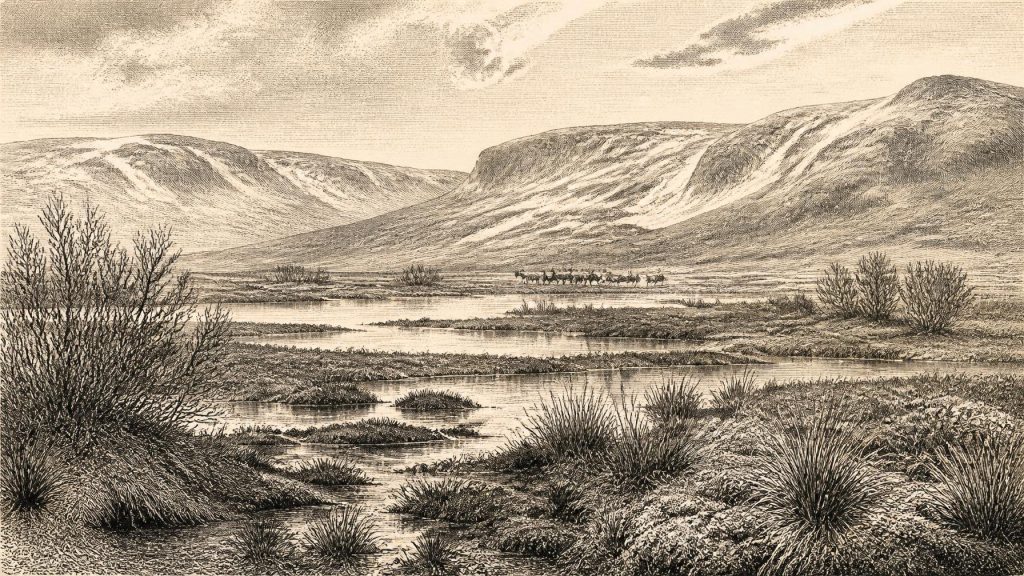
Labelled 31,523 BCE, this poorly dateable interval belongs to Late Pleistocene Ireland, before maximum expansion of the British–Irish Ice Sheet. BIRM-166, from freshwater deposits buried beneath a Fermanagh drumlin, records a treeless periglacial mosaic of marshes, sedges, mosses, aquatic plants and limited dwarf shrubs. It demonstrates locally varied, seasonally productive habitats rather than uniform ice or grassland. Castlepook Cave in Cork preserves MIS 3 fauna including reindeer, mammoth, giant deer, bear and hyaena, though its mixed deposits cannot date coexisting animals. A possibly butchered reindeer bone suggests human visitation, but no secure Palaeolithic settlement evidence exists. Later ice concealed evidence.
Dateline
Modern calendar-year precision is not available for Ireland in 31,523 BCE. The number is a convenient modern label, not a date that prehistoric communities could have recognised or that archaeology can resolve to a single year. Counting back from the conventional radiocarbon ‘present’ of AD 1950 places it roughly 33,473 calendar years ago. The responsible evidence instead consists of calibrated ranges, sediment sequences and animal remains. The closest major Irish environmental archive, a buried freshwater deposit at Derryvree near Maguiresbridge, County Fermanagh, has a radiocarbon determination of 30,500 ± 1,100 radiocarbon years BP, calibrated in later discussion to about 36,900–31,700 calendar years BP. That wide span includes the requested point, but it cannot furnish a snapshot of one particular season, household or event.
A Marsh Beneath the Drumlin
Derryvree is important precisely because it survived. Roadworks in 1969 cut through a drumlin and exposed organic silts and fine sands caught between two thick tills: deposits laid down by water, then sealed beneath later glacial sediment. The preserved material included pollen, plant macrofossils, mosses and invertebrate evidence. It offers an unusual glimpse of a landscape that later ice would largely bury, erode or rearrange. The sample known as BIRM-166 is therefore not an historical document in the ordinary sense, but it is one of the most eloquent witnesses to Ireland’s condition during the later part of Marine Isotope Stage 3, the long cold phase of the Late Pleistocene.
The evidence indicates a treeless, open, periglacial environment. Sedges, mosses and other hardy herbaceous plants grew around freshwater and wet ground; aquatic species, including bogbean, point to pools or slow water. Dwarf shrubs such as willow and juniper may have occupied favoured patches, but there is no basis for imagining the familiar wooded island of later prehistory. Pollen is sparse and often poorly preserved, while long-distance transport can introduce grains from vegetation growing far away. For that reason, the plant macrofossils and mosses are especially valuable: they demonstrate plants living locally, rather than merely pollen blown across an exposed landscape.
‘Tundra’ is a useful broad description, provided it is not mistaken for an empty white wilderness. Derryvree suggests a wet, seasonally productive mosaic: shallow freshwater, sedge-rich margins, mossy ground, bare mineral soil and vegetation adapted to frost, wind and short summers. Permafrost or strongly seasonal frozen ground would have shaped drainage and soil development. Conditions were severe by modern Irish standards, yet parts of the island could support plants, insects and grazing animals. The real lesson is variation. Wetlands, sheltered hollows and river corridors could differ sharply from exposed uplands or ground closer to an advancing ice margin.
Before the Greatest Ice Advance
At this time Ireland was within the wider climate system of the North Atlantic, where abrupt oscillations between colder stadials and relatively milder interstadials repeatedly altered temperature, precipitation, sea ice and glacier behaviour. Ice-core chronologies from Greenland provide the best broad framework for those swings, but they should not be converted mechanically into an Irish weather report. Irish deposits record local responses filtered through landform, drainage and the movement of ice. What can be said is that 31,523 BCE belongs to a period before the best-established maximum growth of the last British–Irish Ice Sheet, rather than to the height of the Last Glacial Maximum itself.
The chronology of that ice-sheet growth has been revised substantially as radiocarbon pretreatment, luminescence dating, cosmogenic exposure dating and modelling have improved. Derryvree’s freshwater beds, together with the similarly buried Greenagho lake deposits in Fermanagh and evidence for open water near Donegal Bay, show that substantial areas were ice-free during portions of the earlier Late Pleistocene. Research synthesising these records argues that north-central Ireland remained ice-free until at least roughly 34,000 calendar years ago, followed by an extended build-up of the Irish Ice Sheet. The requested date falls near that transition in the evidence, not at a securely mapped ice front.
That distinction matters. It would be wrong to draw all Ireland as either an ice sheet or a continuous grassland plain in 31,523 BCE. The geographical pattern changed over millennia and may have changed rapidly in particular regions. Sea level was lower than today because much water was locked in global ice sheets, altering coastlines and the extent of the Irish Sea basin. Yet lower seas do not by themselves prove a simple dry land bridge, a routinely walkable route or an uninterrupted animal corridor. Ice, channels, marshes, coastal waters and seasonal conditions all constrained movement. Ireland’s connections to Britain and north-western Europe must remain a question of changing physical geography, not an assumed highway.
Castlepook’s Animal Evidence
For animal life, the principal Irish archive relevant to this broad period lies far south of Fermanagh. Castlepook Cave near Doneraile, County Cork, produced a remarkable collection during antiquarian excavations in the early twentieth century. Later research and redating have shown that its fauna includes animals associated with Late Pleistocene open country: reindeer, woolly mammoth, giant deer, brown bear and spotted hyaena, alongside smaller cold-adapted species in parts of the assemblage. Improved dating has been decisive. A 2020 reassessment found that several Castlepook bones were thousands of radiocarbon years older than dates obtained using earlier methods, placing significant parts of the fauna in MIS 3.
The cave does not, however, supply a single, neatly contemporary herd for 31,523 BCE. Its deposits accumulated through carnivore activity, natural deaths, water movement, sediment disturbance and excavation practices that predated modern archaeological recording. Different bones may be separated by many centuries or millennia. Woolly mammoth, hyaena and giant deer are therefore evidence that Ireland at different times supported, or was reached by, a richer Pleistocene fauna than later historical experience would suggest. They do not establish that every species stood together in north Cork in the year denoted by this article.
Reindeer are particularly relevant because a femur from Castlepook has been publicly reported as approximately 33,000 years old and as bearing a deep mark interpreted by the palaeozoologist Ruth Carden as damage from a sharp stone implement during butchery. If that interpretation is confirmed, it would be potentially Ireland’s earliest indication that people handled an animal carcass, far earlier than the well-established post-glacial evidence for human presence. But the wording is crucial: a bone date establishes when the animal died within an uncertainty range; identifying a surface modification as a human-made cut is a separate taphonomic judgement; and neither proposition alone demonstrates a settlement.
People: Possibility, Not Population
No securely excavated dwelling, hearth, stone-tool assemblage, burial, art site or human bone can presently be assigned to Ireland around 31,523 BCE. The National Museum of Ireland continues to state that clear evidence demonstrating human presence in Ireland during the Palaeolithic has not yet emerged. That institutional caution reflects the fragmentary character of the evidence, not a denial that short-lived visits are possible. The Castlepook femur is important precisely because it tests a long-standing assumption that the island had no human story before the final retreat of the ice. It should be treated as a claim requiring continued investigation, rather than transformed into a settled origin story.
If people did reach Ireland during this interval, comparison with Upper Palaeolithic groups elsewhere in north-west Europe suggests small, mobile foraging parties rather than villages, chiefdoms or a permanent island population. They could have used stone tools, processed animal carcasses and followed opportunities created by seasonally moving game. That is an inference from better documented regions, not a demonstrated description of Irish society. Nothing presently supports names, languages, ethnic identities, kinship systems, territorial boundaries or an unbroken descent from such visitors to later Irish populations. Nor is there evidence for agriculture, stockkeeping, pottery, metallurgy, monuments, formal diplomacy or organised warfare.
Political affairs and conflict, in the conventional historical sense, are thus beyond recovery. A hyaena-den cave and a reindeer femur cannot reveal alliances or battles. Even an episode of hunting or scavenging would not necessarily be a conflict between people and animals; it may instead record opportunistic processing of a carcass. The most defensible ‘regional politics’ were ecological: shifting ice margins, the availability of crossing routes, competing predators, and the seasonal distribution of food governed whether any group or species could occupy a locality.
Daily Life Without a Settlement Record
Society and everyday life can be described only through environmental limits. In an open, cold landscape, shelter, fuel and reliable food would have been fundamental constraints. Wetlands could provide water and seasonal plant resources, while large herbivores represented concentrated calories, hide, sinew, bone and antler if hunters could obtain them. Carnivores were competitors as well as part of the cave record. But there is no direct Irish evidence that people camped at Derryvree, hunted at Castlepook or used any particular route between them. The sites illuminate habitats and fauna, not a mapped economy.
Religion, culture and learning are still less visible. No ritual object, burial practice, image, musical instrument or structured ceremonial place belongs securely to this Irish interval. It would be inappropriate to transfer cave art, decorative traditions or religious beliefs from France, Iberia or Britain into Ireland merely because humans elsewhere possessed them. The intellectual achievement demonstrable here is modern: palaeobotanists, zoologists, geologists and archaeologists learning to read a landscape from silts, spores, collagen and cut surfaces. Their work also shows why uncertainty is historical information, not an inconvenience to be concealed.
In 31,523 BCE, then, Ireland’s story is not one of named rulers or recorded events. It is the story of an exposed island region within an unstable glacial world: freshwater marshes persisted in Fermanagh; cold-adapted plants and animals made use of habitable patches; cave deposits in Cork retained traces of a vanished fauna; and a single modified reindeer bone raises, but does not settle, the question of human visitation. The later ice-sheet expansion would obliterate or conceal much of this world. BIRM-166 survives beneath a drumlin as a reminder that Ireland’s deepest past is best approached through calibrated ranges, material evidence and disciplined restraint.
Primary Sources
- A Middle Midlandian Freshwater Series at Derryvree, Maguiresbridge, County Fermanagh, Northern Ireland
- The Irish Quaternary Fauna Project
- A Reconsideration of the Radiocarbon Dating of the Marine Isotope Stage 3 Fauna from Southern Ireland
- Trimlines, Blockfields and the Vertical Extent of the Last Ice Sheet in Southern Ireland
- Growth and Retreat of the Last British–Irish Ice Sheet, 31,000 to 15,000 Years Ago: the BRITICE-CHRONO Reconstruction
- BRITICE-CHRONO Maps and GIS Data of the Last British-Irish Ice Sheet 31 to 15 ka
- The Timing and Magnitude of the British–Irish Ice Sheet Between Marine Isotope Stages 5d and 2
- A Stratigraphic Framework for Abrupt Climatic Changes During the Last Glacial Period Based on Three Synchronized Greenland Ice-Core Records
- The IntCal20 Northern Hemisphere Radiocarbon Age Calibration Curve (0–55 cal kBP)
- IntCal Publications
- Palaeoecology
- Figure 6.— The Subdivision of the Quaternary Period in Ireland
- Prehistoric Details: Mell Flint Flake
- The Exhibitions: Prehistoric Ireland
- Archaeological Heritage of County Cork
- Heritage Artefacts of County Cork
- 32564: Castlepook Cave, County Cork
- First Evidence of a Late Upper Palaeolithic Human Presence in Ireland
- New Insights on the Fauna of Ireland’s Younger Dryas and Early Holocene from Alice & Gwendoline Cave
- Ireland: Submerged Prehistoric Sites and Landscapes