Mammoth Cave’s Reindeer Mark31268 BCE
Around 31,268 BCE, Ireland lay in the unstable Marine Isotope Stage 3, before the Last Glacial Maximum. Radiocarbon and sedimentary evidence provide broad ranges, not precise events. Freshwater deposits at Derryvree, County Fermanagh, demonstrate intervals of ice-free, cold wetlands supporting hardy plants, insects and animals between glacial advances. Castlepook Cave, County Cork, preserves a mixed fauna including mammoth, reindeer, giant deer, predators and Arctic species, indicating open, rigorous environments. A marked reindeer femur, dated roughly 33,000 years ago, may record stone-tool butchery and Ireland’s earliest human activity. However, without associated evidence, it cannot prove permanent settlement, society or sustained occupation.
Dateline
The label 31,268 BCE offers a useful point of orientation, but it cannot identify a known day, season, event or community in Ireland. For this depth of time, modern calendar-year precision is unavailable. The date corresponds only approximately to 33,200 years before AD 1950, and the evidence comes from radiocarbon determinations, sediment layers and fossil assemblages whose calibrated ranges commonly span centuries or millennia. The responsible history of Ireland at this point is therefore a history of environments and probabilities, not a chronicle of named people or dated happenings.
Broadly, this was the later part of the Pleistocene, within Marine Isotope Stage 3, a long and climatically unsettled segment of the last glacial cycle. Ireland was not yet in the Last Glacial Maximum, when the British–Irish Ice Sheet later covered much of the island. Yet neither was it a stable, mild landscape. Cold phases and relatively less severe intervals repeatedly altered the reach of ice, the spread of vegetation, the routes open to animals and the likelihood that people could visit.
A Date Measured in Ranges
Radiocarbon ages are not calendar dates straight from the ground. The amount of radioactive carbon surviving in an organic sample must be calibrated against independently dated environmental records, because atmospheric radiocarbon has varied through time. The further back one goes, the wider the probable calendar range may become. Moreover, a dated animal bone tells us when the animal lived and died, not necessarily the precise moment at which its bones were deposited, moved by water, gnawed by a carnivore or, if applicable, cut by a person.
This is especially important in Ireland, where later ice movement, erosion and changing sea levels have destroyed or obscured many old land surfaces. Caves, buried sediments and museum collections are unusually valuable precisely because they can preserve small remnants of a much larger vanished world. They also demand caution. Some Irish cave collections were excavated in the late nineteenth and early twentieth centuries, before modern recording standards. Individual fossils can be securely identified and redated, but their original associations within a cave are sometimes difficult to reconstruct.
Water Between the Tills
The best directly relevant environmental evidence is not in Cork but at Derryvree near Maguiresbridge in County Fermanagh. There, road works exposed organic freshwater silts and sands enclosed between separate sheets of glacial till. The deposit is known as a Middle Midlandian freshwater series: ‘Midlandian’ is the Irish regional name for the last glacial period. Its organic material produced a conventional radiocarbon age of 30,500 ± 1,100 radiocarbon years BP, calibrated in later syntheses to a broad range of about 36,900–31,700 calendar years BP.
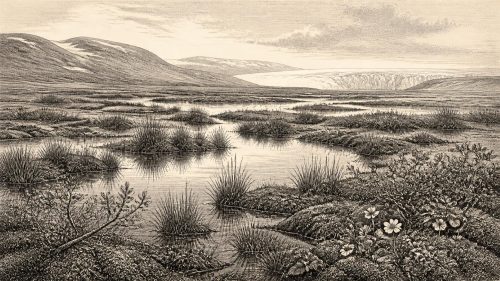
That range includes the approximate chronological position represented by 31,268 BCE. It does not mean that the Derryvree deposit records that individual year. Rather, it demonstrates that, during part of this long interval, north-central Ireland possessed ice-free ground with freshwater habitats between episodes of glaciation. Plant remains, pollen, mosses and invertebrate evidence point to cold, open and wet terrain rather than woodland. Bogbean, an aquatic plant whose distinctive seeds preserve well, is among the notable finds. The wider flora included plants able to endure short growing seasons, exposed ground and severe winter conditions.
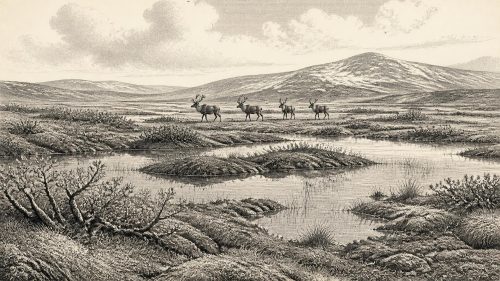
Derryvree therefore corrects the tempting picture of an Ireland continuously smothered by ice throughout the Ice Age. There were pools, marshy margins, mineral-rich silts, flowing or standing water and low vegetation. Such environments could support insects, small mammals and grazing animals, even though they were far removed from the later forested island familiar from historical times. Their survival was precarious: a change in snowfall, summer warmth or ice flow could transform a wetland into a glacially overridden landscape.
An Island in Transition
Regional evidence shows that the growth of the last Irish ice sheet was neither instantaneous nor uniform. Studies of Derryvree and nearby Greenagho indicate ice-free conditions in parts of Fermanagh before roughly 34,000 calendar years ago. Marine shells and sediments around Donegal Bay show that western waters and ice margins also changed repeatedly over a far longer interval. At about this notional date, it is safest to envisage a patchwork of exposed country, local or regional ice and shifting coastal or marine conditions, rather than a single island-wide climate.
Southern Ireland had its own history. Deposits along the south coast formed during Marine Isotope Stages 4–3, before the later maximum expansion of ice. Ice-sheet reconstructions place the major build-up after roughly 35,000–32,000 years ago, with maximum extent substantially later, principally between about 27,000 and 21,000 years ago. Thus 31,268 BCE belongs to a threshold in the long approach towards greater glaciation, not to the height of the Last Glacial Maximum.
It would be unwise to map modern shorelines onto this setting. Lower global sea level altered the form of surrounding seas, while ice and crustal movements affected relative sea level locally. The evidence does not allow a simple claim that people or animals crossed a particular land bridge into Ireland at this time. Any movement between Ireland, Britain and continental north-west Europe depended on changing water barriers, ice, exposed terrain and weather, all of which varied through the glacial cycle.
The Cave Evidence at Castlepook
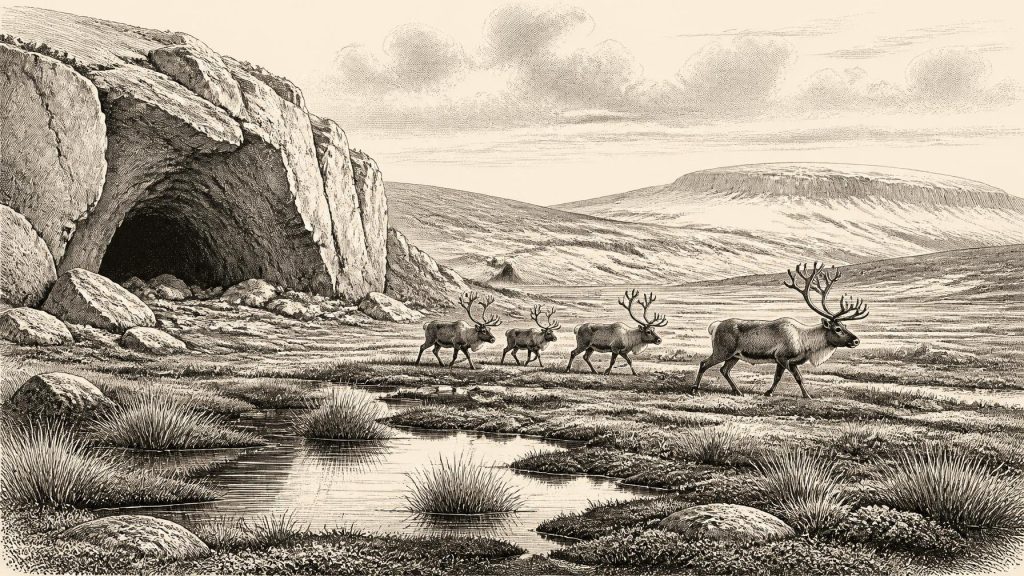
Castlepook Cave, near Doneraile in north County Cork, is the most evocative Irish site for this period. Also called Mammoth Cave, it was excavated chiefly between 1904 and 1913 under the direction of the naturalist Richard J. Ussher and his collaborators. Its collections include remains attributed to a cold-stage fauna: woolly mammoth, reindeer, giant deer, brown bear, wolf, fox, Arctic fox, lemmings and spotted hyaena. The assemblage is not a snapshot. Bones accumulated across different episodes, and later re-dating has shown that older radiocarbon measurements could substantially underestimate the true ages of some specimens.
Modern ultrafiltration and redating of Castlepook material have nevertheless established that important elements of the southern Irish fauna belong to MIS 3. This supports the conclusion that, at favourable times within this cold and variable period, southern Ireland could sustain a diverse animal community. Reindeer imply open country and seasonal grazing opportunities; lemmings and Arctic foxes reinforce the picture of rigorous climates; mammoths and giant deer show that large herbivores could reach, or persist within, Irish landscapes. Spotted hyaena remains also remind us that a cave may have been a carnivore refuge or den, not merely a passive storehouse of animal bones.
A reindeer femur from Castlepook has transformed the discussion. It has been publicly identified as bearing a deep mark interpreted by palaeozoologist Ruth Carden as a stone-tool cut made during the processing of a fresh carcass, and it has been presented as dating to about 33,000 years ago, broadly close to the date considered here. If that interpretation is sustained by continued specialist study, it would be Ireland’s earliest presently claimed evidence of human activity, extending the record far beyond the securely established terminal Palaeolithic traces known from County Clare.
But the limits of this evidence matter as much as its promise. A single marked bone is not a village, a camp, a burial or a population. It does not establish whether one or more visitors killed the reindeer, scavenged it, transported part of it, or encountered an already dead animal. No securely associated hearth, stone-tool assemblage, dwelling surface, human remains or repeated butchery floor of comparable age has yet been recovered at Castlepook. The 2022 excavation located surviving cave deposits but found no cultural artefacts. The femur offers a serious question about human presence, not a completed account of settlement.
Life, Society and What Cannot Be Known
If people did handle a reindeer in Ireland around this time, they were almost certainly highly mobile hunter-gatherers operating in a wider Upper Palaeolithic world. In Britain and continental Europe, such communities used stone tools and animal materials, made clothing and shelters, and maintained connections over considerable distances. Reindeer could yield meat, marrow, hide, sinew, antler and bone. These comparisons help explain why a carcass might have mattered. They cannot demonstrate that an Irish group possessed a particular tool-kit, language, artistic tradition or route of travel.
There is no evidence from Ireland at this date for political institutions, chiefs, territorial states, diplomacy, warfare, formal trade networks, agriculture, permanent settlements, monuments, graves, temples, visual art or writing. It would be misleading to invent them merely because comparable phenomena are known elsewhere or at much later dates. Nor can a bone mark reveal family structure, gender roles, belief or ritual. The proper archaeological conclusion is simpler and more remarkable: a cold but living Irish landscape may have been entered, at least briefly, by people during the Upper Palaeolithic.
For the rest, the strongest evidence concerns ecology. Fermanagh’s freshwater sediments show that plants and wetland life survived between ice advances. Castlepook’s fossils show that large mammals and predators formed part of a changing southern fauna. Ice-sheet research shows that the land was approaching a later phase of greater glaciation. Together, these archives make 31,268 BCE less an empty blank than a carefully bounded frontier: an Ireland of tundra-like wetlands, limestone caves, mobile herds and unstable ice margins, in which the possible human trace remains no larger than a single incision on a reindeer bone.
Primary Sources
- A reconsideration of the radiocarbon dating of the Marine Isotope Stage 3 fauna from southern Ireland
- The Irish Quaternary Fauna Project
- A Middle Midlandian freshwater series at Derryvree, Maguiresbridge, County Fermanagh, Northern Ireland
- Middle Midlandian Interstadial Deposits at Greenagho, Near Belcoo, County Fermanagh, Northern Ireland
- Trimlines, blockfields and the vertical extent of the last ice sheet in southern Ireland
- Radiocarbon constraints on the history of the western Irish ice sheet prior to the Last Glacial Maximum
- Late Pleistocene chronostratigraphy and ice sheet limits, southern Ireland
- Extent and timing of the Last Glacial Maximum (LGM) in Britain and Ireland: a review
- Pattern and timing of retreat of the last British-Irish Ice Sheet
- Growth and retreat of the last British–Irish Ice Sheet, 31,000 to 15,000 years ago: the BRITICE-CHRONO reconstruction
- Maximum extent and dynamic behaviour of the last British–Irish Ice Sheet west of Ireland
- The IntCal20 Northern Hemisphere Radiocarbon Age Calibration Curve (0–55 cal kBP)
- The Exploration of Castlepook Cave, County Cork, Being the Third Report from the Committee Appointed to Explore Irish Caves
- Occurrence of mammalia relicts at site Castlepook Cave
- HERITAGE ARTEFACTS of County Cork
- 2022:564 – CASTLEPOOK CAVE, Castlepook South, Cork
- The Archaeology of Caves in Ireland
- First evidence of a Late Upper Palaeolithic human presence in Ireland
- New insights on the fauna of Ireland's Younger Dryas and Early Holocene from Alice & Gwendoline Cave
- Fast and slow components of interstadial warming in the North Atlantic during the last glacial