

Mammoth Cave’s Cold Menagerie31654 BCE
Around 31,654 BCE, Ireland lay within the fluctuating cold conditions of Marine Isotope Stage 3, not a precisely datable year. Fermanagh sediments preserve evidence of open, wet habitats with cold-adapted plants and freshwater life, showing that some areas remained ice-free before later glaciation. Castlepook Cave in County Cork yielded Ireland’s richest cold-stage fauna, including mammoth, reindeer, giant deer, hyaena and Arctic fox. A cut-marked reindeer bone may indicate human carcass processing around 33,000 years ago, but requires confirmation. No permanent settlement is demonstrated. Subsequent ice-sheet growth reshaped landscapes and erased much earlier evidence, leaving an ecological, rather than societal, record.
Dateline
The label 31,654 BCE cannot identify an event in Ireland to a single modern calendar year. No written chronology existed, and archaeological dating at this depth of time works through probability ranges rather than anniversaries. In modern conversion, the label falls at roughly 33,600 years before present, within the Late Pleistocene and Marine Isotope Stage 3 (MIS 3), an unstable interval of the last Ice Age. The responsible task is therefore not to invent a happening for that year, but to ask what the surviving environmental, faunal and archaeological evidence can say about Ireland during the surrounding millennia.
A Date Within Ranges, Not a Dated Year
Radiocarbon determinations are reported in radiocarbon years and then calibrated against independently established curves to produce calendar-age ranges. Both the scientific measurement and the conversion have uncertainties. A calendar label such as 31,654 BCE is consequently much more precise-looking than the evidence permits. It should be treated as a point within a broad chronological neighbourhood, not as a moment at which conditions across the island can be reconstructed exactly.
Two important buried deposits in County Fermanagh demonstrate both the value and the limits of the evidence. Organic material from lake deposits beneath till at Greenagho produced an age calibrated to about 37,200–35,700 calendar years before present. Organic-rich silts between tills at Derryvree produced a wider calibrated range of about 36,900–31,700 calendar years before present. These are not annual records, and they do not prove that every part of Ireland was simultaneously ice-free or inhabited. They do show that, during intervals encompassing the date in question, north-central Ireland contained environments capable of preserving freshwater sediments, plants and small animal remains before later glacier ice overran and sealed them.
The date also belongs to the long and uneven build-up towards the Last Glacial Maximum, rather than to the maximum itself. The fullest expansion of the last British–Irish Ice Sheet came later, broadly in the period after about 27,000 years ago and with different sectors advancing at different times. Ice-sheet growth was not a simple, island-wide march from mild conditions to an unbroken frozen cover. Climate fluctuated sharply; uplands and northern areas could have supported expanding ice while other districts retained exposed ground, wetlands, rivers, caves and animal habitat. Reconstructions remain actively debated because the later ice sheet eroded or buried much of the earlier evidence.
Open Ground and Freshwater Basins
The Fermanagh deposits offer the closest environmental window. Their fossils include plants suited to cold, open and wet ground: sedges and other herbs, aquatic plants, mosses and dwarf shrubs. Such assemblages are evidence for local habitats, not a complete botanical map of the island. Yet they make a densely forested Ireland implausible. The landscape around suitable basins was likely a patchwork of shallow water, marsh, damp mineral soil and exposed, frost-affected terrain, with vegetation low enough to leave much ground open to wind and seasonal cold.
That does not mean that Ireland was uniformly barren. MIS 3 contained recurrent climatic shifts, and vegetation could respond rapidly where moisture, shelter and soil allowed. The plant evidence is best read as a record of cold-stage ecological mosaics, in which wet hollows and water margins sustained more life than an image of a featureless ice desert suggests. Small-scale variation mattered: a sheltered limestone valley, a spring-fed pool or a river terrace could offer forage and cover very different from nearby slopes.
Sea level was lower than today because vast quantities of water were locked in northern ice sheets. Ireland’s coastline and the surrounding shelf were therefore unlike the familiar modern outline, while the Irish Sea region formed a changing geographical threshold rather than a fixed boundary. The presence of terrestrial mammals in Ireland establishes that populations reached the island during favourable phases, but the precise routes and timing of every crossing cannot be recovered. It is safer to speak of shifting opportunities for dispersal than of a confidently mapped land bridge at this particular date.
Castlepook’s Faunal Evidence
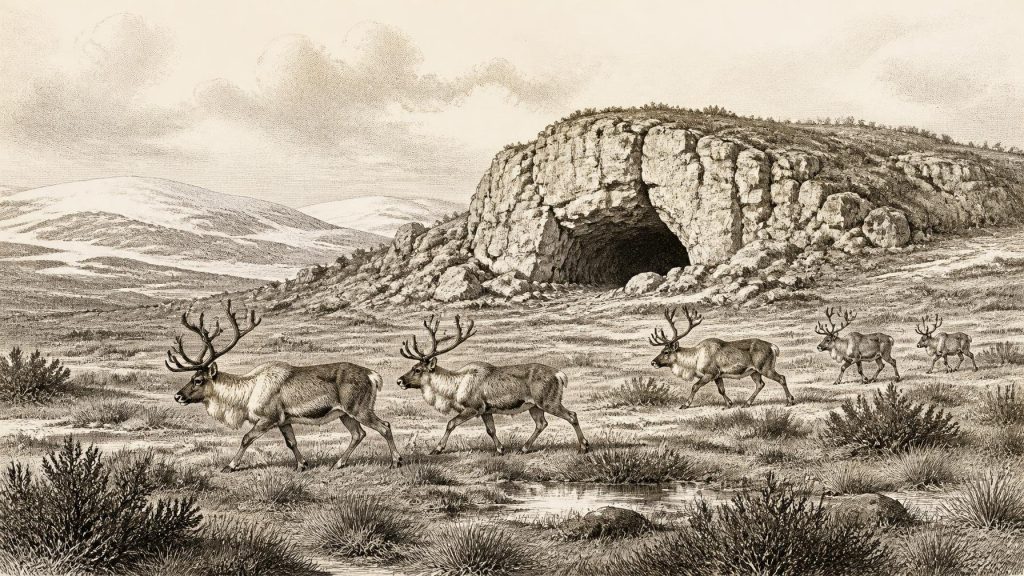
The richest Irish evidence for this broad phase comes from Castlepook Cave, also called Mammoth Cave, near Doneraile in north County Cork. Excavations begun in the early twentieth century recovered an extraordinary Pleistocene bone assemblage. Its recorded animals include woolly mammoth, reindeer, giant deer, brown bear, wolf, Arctic fox, mountain hare, lemmings and spotted hyaena. The National Museum of Ireland identifies Castlepook as the country’s most important site for mammal remains from the last cold stage.
This is not a photograph of one day in 31,654 BCE. Cave deposits accumulated through repeated episodes and were disturbed by carnivores, water, excavation and later interpretation. Direct radiocarbon work has shown that parts of the southern Irish fauna belong to MIS 3, while also revising older assumptions based simply on animal species. A mammoth bone or hyaena skull proves that the animal, or its remains, entered a particular depositional history; it does not automatically prove that all the listed animals grazed or hunted together in one season.
Nevertheless, the assemblage establishes the ecological possibilities of late Pleistocene Ireland. Reindeer point to open forage country. Mammoths and giant deer indicate that large herbivores could use at least some landscapes. Carnivores, especially spotted hyaena, matter because caves may have been dens, scavenging places or traps in the movement of bones. Hyaenas could carry carcass parts into shelter and gnaw them; bears could occupy caves; water could redeposit material. Archaeologists must disentangle these processes before assigning any bone to people.
A Possible Human Trace
One Castlepook reindeer femur has changed the terms of discussion. Zooarchaeologist Dr Ruth Carden identified a deep incision on the bone as consistent with a sharp stone tool used in carcass processing. Public presentation of the find described it as evidence of human activity in Ireland around 33,000 years ago. If that interpretation is sustained by further microscopic study, securely stratified finds and comparable material, it would push the known Irish human story far earlier than the previously accepted terminal-Pleistocene evidence from County Clare.
It must, however, remain a carefully qualified possibility rather than the foundation for an invented settlement. The bone’s date is the date of the animal, within a measured range; the inference that its mark was made by a human is a separate taphonomic judgement. A single modified bone would show an encounter with a carcass, perhaps a brief hunting or scavenging visit. It would not demonstrate a permanent population, a camp, a family group, a tool-making workshop or a continuous Irish Palaeolithic tradition. No associated hearth, stone-tool assemblage, dwelling floor or human remains have yet supplied that larger context.
Any visitors would have belonged broadly to the Upper Palaeolithic hunter-gatherer world of north-west Europe. That comparison allows restrained generalisation: people elsewhere used portable stone tools, practised skilled carcass processing and moved through seasonal landscapes in small, flexible groups. It cannot fill Ireland with particular tents, clothing, languages, kin groups or rituals. Such details are culturally plausible in a continental sense but unsupported in the Irish record for this period.
Life Beyond the Reach of Certainty
There is no evidence from Ireland at this date for political institutions, named leaders, territories, diplomacy, warfare, farming, livestock, formal trade routes, monuments or organised religion. These are not merely gaps in a written record: the material traces needed to infer them are absent. The most defensible economic picture is ecological rather than political. Animals moved through a cold landscape; carnivores and scavengers competed for carcasses; and, if people were present, food, hides, marrow and bone were potentially valuable resources obtained through hunting, scavenging or both.
Likewise, no Irish evidence can identify religious practice, art, teaching or language around this point. Caves should not be assumed to have been sanctuaries simply because cave art is known in parts of Ice Age France and Spain. Castlepook’s importance lies instead in its faunal archive: bones, tooth marks, sediment histories and the possibility of a humanly altered specimen. Learning in the modern sense cannot be documented, although any mobile foragers who reached Ireland would necessarily have depended on transmitted environmental knowledge—of animals, weather, routes and workable stone.
Settlement, if it occurred, was probably intermittent and vulnerable to climatic change. A small visiting party could leave almost nothing that survived later erosion, glaciation and rising sea level. Conversely, absence of evidence is not proof that no one ever arrived. The appropriate conclusion is narrower: permanent occupation has not been demonstrated, whereas a possible human episode at Castlepook deserves further testing.
Approaching a Glacial Future
The greatest development relevant to Ireland around 31,654 BCE was environmental change. In the following millennia the growing Irish sector of the British–Irish Ice Sheet transformed landscapes, scoured older surfaces and reduced the preservation of earlier human traces. By the Last Glacial Maximum, much of Ireland was ice-covered or subject to severe periglacial conditions. The sheltered Fermanagh sediments and the Cork caves are precious partly because they survived this destructive history.
For this notional year, then, Ireland was neither a land of known communities nor simply a blank beneath ice. It was a changing northern environment in which freshwater basins preserved cold-adapted vegetation, large mammals ranged during suitable phases, and a cave near Doneraile accumulated the remains of an Ice Age food web. One marked reindeer bone may eventually add people to that scene. Until corroborating evidence arrives, it should be understood as a provocative clue, not a calendar-year certainty.
Primary Sources
- A reconsideration of the radiocarbon dating of the Marine Isotope Stage 3 fauna from southern Ireland
- The Irish Quaternary Fauna Project
- Trimlines, blockfields and the vertical extent of the last ice sheet in southern Ireland
- Dimensions and chronology of the last ice sheet in Western Ireland
- Maximum extent and dynamic behaviour of the last British–Irish Ice Sheet west of Ireland
- The timing and magnitude of the British–Irish Ice Sheet between Marine Isotope Stages 5d and 2: implications for glacio-isostatic adjustment, high relative sea levels and ‘giant erratic’ emplacement
- Behavioural tendencies of the last British–Irish Ice Sheet revealed by data–model comparison
- New data for the Last Glacial Maximum in Great Britain and Ireland
- Early deglaciation of the British-Irish Ice Sheet on the Atlantic margin
- The deglaciation of the western sector of the Irish Ice Sheet
- New insights on the fauna of Ireland's Younger Dryas and Early Holocene from Alice & Gwendoline Cave
- Spotted Hyena Skull
- Heritage Artefacts of County Cork
- Palaeoecology
- Figure 6.— The subdivision of the Quaternary Period in Ireland
- The Mesolithic in Ireland: when was it?
- High-resolution record of Northern Hemisphere climate extending into the last interglacial period
- A stratigraphic framework for abrupt climatic changes during the Last Glacial period based on three synchronized Greenland ice-core records: Refining and extending the INTIMATE event stratigraphy
- Occurrence of mammalia relicts at site Castlepook Cave
- Ireland's Palaeolithic Archaeology – Fleeting Footprints in a Frozen Land
- Reindeer bone found in Cork cave shows human activity in Ireland 33,000 years ago