Reindeer Handling31053 BCE
31,053 BCE is a modern chronological point within Marine Isotope Stage 3, not a datable Irish historical year. Evidence from Derryvree, County Fermanagh, records a cold, treeless freshwater wetland between glacial advances, with mosses, sedges and northern insects. Castlepook Cave, County Cork, preserves a long-accumulated fauna including mammoth, reindeer, giant deer, predators and lemmings, demonstrating changing habitats supporting cold-adapted life. A marked reindeer femur may indicate early human butchery, but remains unconfirmed because cave deposits and bone histories are complex. No settlements, tools or institutions establish human occupation. Ireland was an ecological frontier of shifting ice, exposed land and uncertainty.
Dateline
The label 31,053 BCE suggests the precision of an annal, but no Irish annal, calendar, named person or dated event exists for this depth of time. It is better understood as a modern point placed within the later Pleistocene, roughly 33,000 calendar years before the archaeological present of AD 1950. Evidence can illuminate broad intervals, not this individual year. The relevant archaeological setting is Marine Isotope Stage 3, part of the last glacial cycle, when Ireland’s climate, ice cover, coastlines and animal communities changed repeatedly over millennia.
For Ireland, the responsible history of this period is therefore one of deposits, bones and landscapes rather than rulers or settlements. Two especially important bodies of evidence frame the picture: the buried freshwater sediments at Derryvree near Maguiresbridge in County Fermanagh, and the rich cave fauna of Castlepook, or Mammoth Cave, near Doneraile in north County Cork. Neither is a diary of 31,053 BCE. Together, however, they show that parts of Ireland could sustain cold-adapted life before the fullest expansion of the last ice sheet, and they raise—without finally answering—a remarkable question about very early human activity.
A Date Without Calendar Precision
Radiocarbon dates are not historical dates in the familiar sense. A laboratory measurement gives an age in radiocarbon years before present, conventionally before AD 1950. Because the amount of radioactive carbon in the atmosphere has altered through time, that measurement must be calibrated against independently dated natural records. At around 30,000 radiocarbon years ago, the resulting calendar range is necessarily broad. A determination from one sample may cover centuries or several millennia at high probability; it cannot identify a particular season, generation or numbered BCE year.
This distinction is essential at Derryvree. Roadworks in 1969 cut through a drumlin and revealed silts, fine sands and organic layers enclosed between two tills—stony sediments left by glacier ice. Organic material from the freshwater deposit returned a conventional radiocarbon age of 30,500 +1,170/−1,030 BP. Modern calibration places such a result within a wide later-MIS-3 span, approximately c. 37,000–32,000 calibrated years BP, depending on the calibration method and confidence range used. The requested date lies broadly within that span, but it cannot be pinned to a particular plant, insect, episode of sedimentation or state of the weather at Derryvree.
Derryvree’s Cold Freshwater World
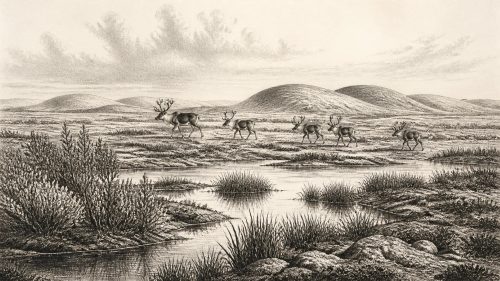
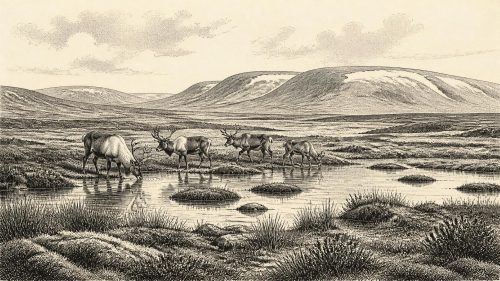
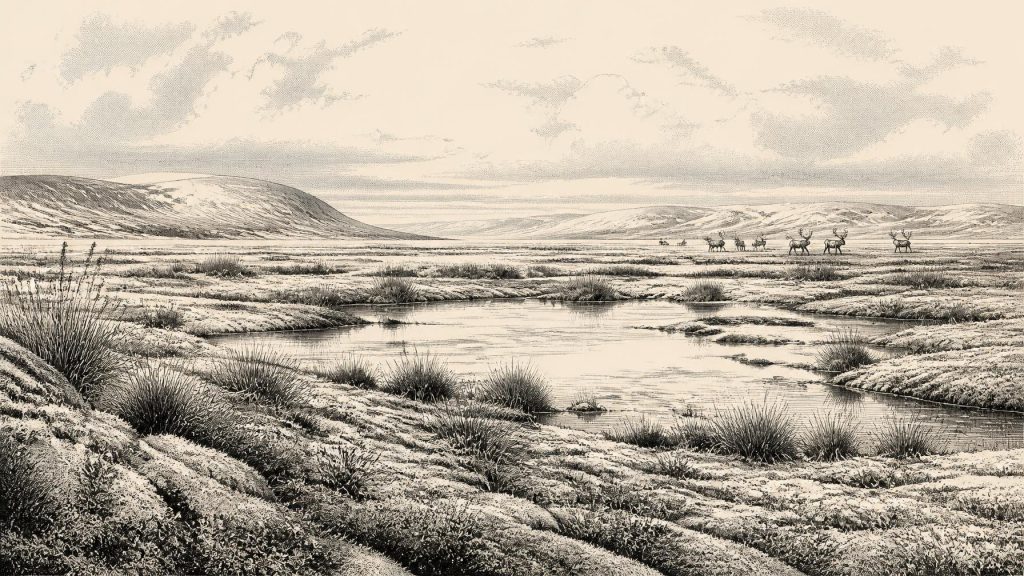
What Derryvree does demonstrate is unusually valuable. Between episodes of glaciation, a freshwater or wetland environment existed in what is now south Fermanagh. Its organic-rich layers contained freshwater mosses and sedges, while insect evidence indicated cold northern conditions. Earlier study also recovered pollen and plant macrofossils consistent with sparse, open, treeless vegetation. This was not the wooded Ireland familiar from later prehistory or from the modern island. It was a periglacial landscape: cold, exposed and structured by frost, shallow water, seasonal thaw and low-growing plant communities.
That conclusion should not be exaggerated into a national reconstruction. Derryvree is a local archive preserved beneath later glacial deposits, not a complete map of Ireland. The wetland tells us that this locality was not under overriding glacier ice while its organic mud accumulated. It does not prove that every Irish valley was ice-free at the same moment, that every coast had the same vegetation, or that the island’s present drainage pattern existed. Nor does it provide evidence for fields, livestock, dwellings or people. Its importance is ecological: it preserves a glimpse of the living communities that could occupy a cold Irish lowland during an unstable glacial interval.
In everyday terms, the scene was one of limited biological productivity but not lifelessness. Sedges and mosses could occupy saturated ground; hardy herbs grew in open patches; insects survived in and around the water. Winters were severe and summers short by later Irish standards. Local pools, streams and wet ground would have been important refuges for plants and small animals. The evidence is strongest for the wetland itself and its immediate surroundings. Any description of distant hills, coastlines or seasonal animal movements remains interpretation, informed by comparable north-west European environments rather than directly observed at Derryvree.
Ice in Motion, Not a Frozen Island
At this timescale, it is misleading to imagine either a wholly green Ireland or an island uniformly entombed beneath ice. Recent reconstructions of the British–Irish Ice Sheet stress that its growth was regionally uneven and often rapid. Ice expanded in the wider archipelago during the closing part of MIS 3, while a large Irish ice cap developed in northern uplands; the eventual maximum extent came later and was asynchronous from one sector to another. The last glacial maximum is generally placed much later than the Derryvree interval, broadly within c. 28,200–20,400 calibrated years BP.
Thus the most defensible picture around 31,053 BCE is one of regional change. Some Irish uplands may have supported substantial ice, while other places retained exposed ground, watercourses and habitats capable of supporting tundra or steppe-tundra life. Lower sea levels altered the surrounding shelves and made Ireland less geographically isolated than it is now, although the exact configuration of land, sea and possible routes changed through time. A lower sea level does not itself demonstrate an easy land crossing for people or animals at any particular date. It simply reminds us that modern coastlines are a poor guide to the geography of the Ice Age.
Castlepook’s Faunal Archive
Castlepook Cave provides the best-known Irish animal record relevant to this broad horizon. The limestone cave system near Doneraile was excavated principally in the early twentieth century, long before modern excavation standards, and later work has reassessed both its collections and chronology. More than 2,000 bones have been recovered. Direct dating and re-dating show that the assemblage accumulated over a long period, rather than in one occupation episode. Geological Survey Ireland describes dates for individual bones spanning roughly 45,700 to 19,950 years BP. It follows that its contents cannot be treated as a single community living together in 31,053 BCE.
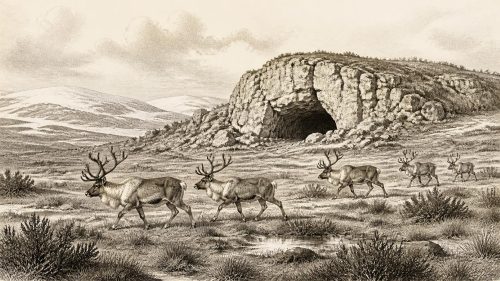
Even so, the range of animals is striking. Castlepook has produced remains of woolly mammoth, giant deer, reindeer, brown bear, wolf, Arctic fox, spotted hyaena and lemmings. These finds establish that Ireland formed part of a wider north-west European world in which large herbivores and cold-adapted carnivores entered or occupied suitable areas during the last glacial cycle. They also help explain the character of the open landscapes indicated by Derryvree: there was enough forage, cover and water in some places to support substantial mammals, alongside predators and scavengers.
The cave itself was not necessarily a place where those animals died naturally. Carnivores could drag carcass parts into chambers; water and sediment movement could redistribute bones; early excavations could disturb layers and associations. Spotted hyaenas are particularly relevant because their presence offers a plausible mechanism for gathering and modifying bones in a den. Consequently, a mammoth rib, reindeer limb or hyaena tooth proves the presence of an animal or its remains at the cave, but not the precise season of death, the composition of a local herd, or a human hunting event. This taphonomic caution is not a limitation to be hidden: it is central to reading cave evidence honestly.
The Reindeer Femur and Human Possibility
The most provocative object associated with this date is a reindeer femur from Castlepook. It has been presented as approximately 33,000 years old and as bearing a deep linear mark interpreted by zooarchaeologist Ruth Carden as having been made on fresh bone with a sharp stone tool. County Cork’s heritage publication describes the mark as evidence consistent with butchery; if that interpretation is confirmed, it would suggest that a person processed a reindeer in Ireland far earlier than the previously secure Late Upper Palaeolithic evidence.
That possibility is historically important, but it must remain conditional. A radiocarbon date establishes the age of the animal bone, not automatically the exact moment when a surface mark was made. Identifying a cut or chop mark requires microscopic and taphonomic assessment, especially in a collection affected by carnivores, water and antiquarian excavation. Nor has Castlepook yielded a securely associated stone-tool assemblage, hearth, dwelling floor, burial or repeatedly occupied camp of this age. Recent excavation has sought surviving sediments and faunal material, but the site cannot yet be described as a demonstrated Palaeolithic settlement.
There is therefore no responsible basis for narrating a hunt, naming a group, assigning a language or describing a permanent population in Ireland in 31,053 BCE. If people were present, the evidence presently fits no more than a brief and small-scale visit, perhaps linked to carcass processing or movement through a cold landscape. Even that is an interpretation, not a proven event. The securely dated cut-marked brown-bear bone from Alice and Gwendoline Cave in County Clare is much later, dating to c. 12,810–12,590 calibrated years BP. It remains vital as a benchmark for the evidence needed to demonstrate Palaeolithic human action clearly.
No Polities, but an Ecological Frontier
Political affairs, diplomacy, organised warfare, religion, trade and formal learning cannot be recovered for Ireland at this date. There are no known institutions, monuments, graves, artworks, toolkits or settlement plans from which to infer them. Nor should the absence of evidence be filled with imagined tribes, shamans or territorial kingdoms. Society, if any humans reached the island, is archaeologically invisible beyond the contested implication of one modified bone.
The most meaningful “politics” of the period was ecological rather than governmental: access to shelter, unfrozen water, game, routes across changing ground and safety from large carnivores. The economy recorded at Castlepook is an animal economy, not a human one—predation, scavenging and the circulation of bones through caves. The culture and learning visible to modern researchers belong chiefly to the investigators who recover, date and reinterpret these fragile remains. Their work has changed the question from whether Ice Age Ireland had life to how, when and where that life endured.
For 31,053 BCE, then, Ireland’s year-by-year record must remain deliberately modest. Derryvree gives firm evidence of a cold freshwater wetland between glacial advances. Castlepook gives firm evidence of an Ice Age fauna and a tantalising, still unproven indication of human butchery. These traces reveal a changing, inhabited landscape of mosses, sedges, reindeer and predators—not an Irish society that can yet be described in historical detail. The uncertainty is not empty space: it is the real boundary of the evidence.
Source References
Hover over a number to see the source. Select it to open the source.

- [1] A Reconsideration of the Radiocarbon Dating of the Marine Isotope Stage 3 Fauna from Southern Ireland
- [2] The Irish Quaternary Fauna Project
- [3] Castlepook Cave, County Geological Site Report CK032
- [4] Heritage Artefacts of County Cork
- [5] The Exploration of Castlepook Cave, Co. Cork. With 3 Plates.
- [6] Palaeoecology
- [7] Figure 6.— The Subdivision of the Quaternary Period in Ireland
- [8] Early Midlandian–Middle Midlandian, Pleistocene, Northern Ireland
- [9] Quaternary Deposits and Glacial Stratigraphy in Ireland
- [10] 2022:564 — Castlepook Cave, Castlepook South, Cork
- [11] First Evidence of a Late Upper Palaeolithic Human Presence in Ireland
- [12] New Insights on the Fauna of Ireland's Younger Dryas and Early Holocene from Alice & Gwendoline Cave
- [13] Growth and Retreat of the Last British–Irish Ice Sheet, 31,000 to 15,000 Years Ago: the BRITICE-CHRONO Reconstruction
- [14] Spatio-Temporal Dynamics of Speleothem Growth and Glaciation in the British Isles
- [15] The Deglaciation of the Western Sector of the Irish Ice Sheet from the Inner Continental Shelf to its Terrestrial Margin
- [16] The Timing and Magnitude of the British–Irish Ice Sheet Between Marine Isotope Stages 5d and 2
- [17] British–Irish Ice Sheet and Polar Front History of the Goban Spur, Offshore Southwest Ireland Over the Last 250,000 Years
- [18] The IntCal20 Northern Hemisphere Radiocarbon Age Calibration Curve (0–55 cal kBP)
- [19] IntCal Publications
- [20] Outreach and Education Resources
- [21] Freshwater Organic Deposits and Stratified Sediments Between Early and Late Midlandian (Devensian) Till Sheets, at Aghnadarragh, County Antrim, Northern Ireland
- [22] The Geological Heritage of County Leitrim
Primary Sources
- A Reconsideration of the Radiocarbon Dating of the Marine Isotope Stage 3 Fauna from Southern Ireland
- The Irish Quaternary Fauna Project
- Castlepook Cave, County Geological Site Report CK032
- Heritage Artefacts of County Cork
- The Exploration of Castlepook Cave, Co. Cork. With 3 Plates.
- Palaeoecology
- Figure 6.— The Subdivision of the Quaternary Period in Ireland
- Early Midlandian–Middle Midlandian, Pleistocene, Northern Ireland
- Quaternary Deposits and Glacial Stratigraphy in Ireland
- 2022:564 — Castlepook Cave, Castlepook South, Cork
- First Evidence of a Late Upper Palaeolithic Human Presence in Ireland
- New Insights on the Fauna of Ireland's Younger Dryas and Early Holocene from Alice & Gwendoline Cave
- Growth and Retreat of the Last British–Irish Ice Sheet, 31,000 to 15,000 Years Ago: the BRITICE-CHRONO Reconstruction
- Spatio-Temporal Dynamics of Speleothem Growth and Glaciation in the British Isles
- The Deglaciation of the Western Sector of the Irish Ice Sheet from the Inner Continental Shelf to its Terrestrial Margin
- The Timing and Magnitude of the British–Irish Ice Sheet Between Marine Isotope Stages 5d and 2
- British–Irish Ice Sheet and Polar Front History of the Goban Spur, Offshore Southwest Ireland Over the Last 250,000 Years
- The IntCal20 Northern Hemisphere Radiocarbon Age Calibration Curve (0–55 cal kBP)
- IntCal Publications
- Outreach and Education Resources
- Freshwater Organic Deposits and Stratified Sediments Between Early and Late Midlandian (Devensian) Till Sheets, at Aghnadarragh, County Antrim, Northern Ireland
- The Geological Heritage of County Leitrim