Derryvree’s Lemming Pools31356 BCE
31,356 BCE is not a recorded year but falls within MIS 3 during the Last Glacial Period. At Derryvree, County Fermanagh, inter-till freshwater sediments radiocarbon dated broadly to 36,900–31,700 calendar years before present preserve evidence of treeless, cold, wet tundra, pools and herb-rich vegetation during an ice-free interval. Southern caves, especially Castlepook, indicate a diverse cold-stage fauna including mammoth, reindeer, giant deer, predators and lemmings, although dates and occupations varied. A possibly cut-marked reindeer bone suggests transient Upper Palaeolithic human activity, not settlement. Lower sea levels and fluctuating ice created shifting access and habitats, leaving Ireland environmentally dynamic but elusive.

Dateline
The label 31,356 BCE is a modern chronological convenience, not a year for which Ireland has an annual record. No people on the island used this calendar; no written chronicle, ruler, settlement plan or datable event can be attached to a particular twelve-month period so far back. In archaeological terms it falls roughly 33,300 years before AD 1950, within the later part of the Last Glacial Period and broadly within Marine Isotope Stage 3 (MIS 3). The responsible history of Ireland at this point is therefore one of calibrated ranges, sediments, fossils and carefully limited inferences rather than year-specific narrative.
A Date Within a Range
The most relevant direct evidence is not a settlement but a buried landscape at Derryvree, near Maguiresbridge in County Fermanagh. Road works in 1969 cut through a drumlin, exposing freshwater silts and fine sands trapped between two thick layers of glacial till. The lower till had been laid down by an earlier ice advance; the sediments accumulated during a subsequent non-glacial interval; and a later advance sealed them beneath fresh till. It is an unusually valuable sequence because it preserves a phase of landscape history that later ice might otherwise have erased.
Organic material from these inter-till deposits, laboratory sample Birm-166, produced a conventional radiocarbon determination of about 30,500 ± 1,170 radiocarbon years before present. Later calibration has placed the deposit broadly between about 36,900 and 31,700 calendar years before present, approximately 34,950–29,750 BCE. The modern date 31,356 BCE lies within that wide span. That does not mean the sediments can be assigned to that year, nor that every part of Ireland shared the conditions recorded at Derryvree. It means that this local archive is among the best evidence for northern Irish conditions in the broad period to which the date belongs.
Open Ground and Fresh Water
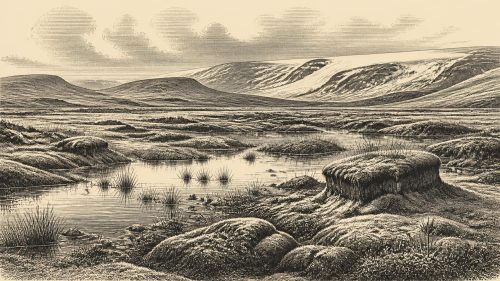
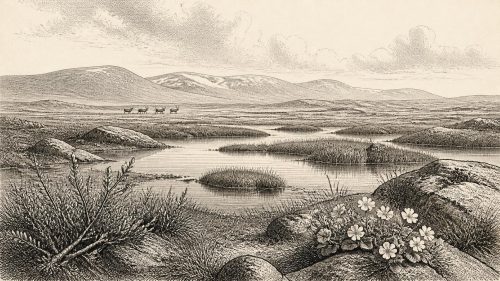
The Derryvree plant, pollen and insect remains indicate a treeless tundra or muskeg environment: cold, wet, peaty ground with open water, mossy margins and herb-rich vegetation. Sedges and grasses were important elements, while the wider plant assemblage included species capable of enduring short growing seasons, saturated soils and hard winters. Insects strengthened this reading, pointing to a wetland with pools and abundant decaying plant matter rather than an unbroken desert of snow and ice. The title image of a wholly ice-covered Ireland would therefore be misleading for this particular evidence.
Yet this was not a mild northern landscape. “Periglacial” describes conditions shaped by persistent cold at or beyond the margins of glacier ice: freeze-thaw action, seasonally frozen ground and a brief productive summer. Trees could not form the closed woodland familiar from later prehistoric Ireland. Shelter, fuel, edible plant resources and safe routes across wet ground would have been sharply seasonal and unevenly distributed. The contrast between freshwater sediments and the tills above and below them also records instability. Ice sheets did not simply arrive once and remain unchanged; they advanced, retreated or reorganised across a changing climate.
The Animal World of the Island
Southern Irish caves provide another, different body of evidence for this broad interval. Castlepook Cave near Doneraile, County Cork, has produced Ireland’s richest known assemblage of mammals from before the Last Glacial Maximum. Its bones include woolly mammoth, reindeer, giant deer, brown bear, wolf, fox and spotted hyaena, alongside cold-adapted lemmings and Arctic fox. Improved radiocarbon methods have shown that some cave fauna is markedly older than earlier determinations suggested, with important material belonging to MIS 3. Individual bones, however, span a long period. Castlepook was a repository used and disturbed by water, carnivores and early excavation, not a single, neatly sealed moment in time.
Accordingly, the fauna should be read as evidence that Ireland could support, or was repeatedly reached by, a varied cold-stage animal community. It does not prove that mammoths, hyaenas and every other recorded species occupied every district simultaneously in 31,356 BCE. Reindeer are particularly relevant because they suit open, cold country and because one Castlepook femur has been reported at roughly 31,000 BC. The cave evidence suggests a landscape with grazing animals, predators and scavengers moving through it, but not the stable, continuous wildlife population one might infer from a modern nature reserve.
The Castlepook Human Question
That reindeer femur has made this period exceptionally important for Irish prehistory. A deep mark on it has been interpreted as an incision made by a sharp stone tool during carcass processing. If that diagnosis is sustained, it would be evidence that one or more people handled a reindeer in Ireland during the Upper Palaeolithic, vastly earlier than the long-established post-glacial record. A County Cork heritage publication gives the specimen a broad date of about 31,000 BC, close enough to make it directly relevant to this article’s notional year.
The limits of the claim matter as much as its promise. The bone itself dates the life of the animal, not the precise minute when a possible cut was made. It derives from an old cave collection, not from a modern excavation of an undisturbed camp floor. No securely associated hearth, stone-tool assemblage, dwelling, human burial, food store or concentration of butchered animals has yet established a settlement at Castlepook at this age. Cave hyaenas and water also helped accumulate and alter bone deposits. The scientifically careful conclusion is therefore that the femur may record human butchery; it cannot presently demonstrate a permanent Irish population, a named people or uninterrupted occupation.
Society Beyond the Evidence
There is no evidence from Ireland around this date for political institutions, chiefs, territories, treaties, diplomacy or organised warfare. Equally, there is no Irish evidence for villages, farming, pottery, metalworking, monuments, formal religion, writing, schools, art or a trading system. Their absence from the record should not be converted into an assertion that people had no beliefs, language, kinship or cultural knowledge. It means that no surviving Irish evidence allows those aspects of life to be reconstructed responsibly for this time.
If people did reach the island, the reindeer bone permits only a modest inference: they may have been highly mobile hunter-gatherers undertaking a brief hunting or processing episode. Such a visit would have required practical knowledge of animals, weather, stone-working and movement through a severe landscape. Whether the visitors travelled by an overland route available during lower sea levels, crossed water, or arrived by some combination of routes cannot be demonstrated from Castlepook alone. Nor can the evidence establish exchange networks or relations with communities in Britain or continental Europe. These are questions for future discoveries, not facts already supplied by one marked bone.
Changing Coasts, Changing Prospects
At a time of much lower global sea level, the outlines of the Irish landmass and its surrounding shelves differed greatly from those of today. But ice, local sea level, land movement and shifting coastlines complicate any simple picture of a guaranteed land bridge. The island’s location at the Atlantic edge made climate and accessibility especially variable. Evidence from Derryvree, Greenagho, Crag Cave and Castlepook instead points to a patchwork of changing opportunities: cold but sometimes ice-free terrain, freshwater habitats, episodic milder phases and animal movements before the greatest expansion of the later British–Irish Ice Sheet.
The principal development relevant to 31,356 BCE was thus environmental rather than political: parts of Ireland were capable, at least intermittently, of sustaining tundra wetland and a substantial Pleistocene fauna during MIS 3. Derryvree’s sediments preserve that fact in remarkable detail. Castlepook raises the still-unresolved possibility that people were among the visitors to this Ice Age Ireland. Together they replace the old image of a uniformly blank and permanently frozen island with a more challenging one: a place of harsh seasonal landscapes, shifting ice margins and tantalisingly scarce evidence of life at Europe’s north-western edge.
Primary Sources
- A Middle Midlandian Freshwater Series at Derryvree, Maguiresbridge, County Fermanagh, Northern Ireland
- A Middle Midlandian Freshwater Series at Derryvree, Maguiresbridge, County Fermanagh, Northern Ireland
- A Reconsideration of the Radiocarbon Dating of the Marine Isotope Stage 3 Fauna from Southern Ireland
- The Irish Quaternary Fauna Project
- Castlepook Cave
- Occurrence of Mammalia Relicts at Site Castlepook Cave
- The Exploration of Castlepook Cave, County Cork
- Dublin Radiocarbon Dates II
- Heritage Artefacts of County Cork
- Irish Pleistocene Biostratigraphy
- Trimlines, Blockfields and the Vertical Extent of the Last Ice Sheet in Southern Ireland
- Last Glacial Maximum Cirque Glaciation in Ireland and Implications for Reconstructions of the Irish Ice Sheet
- Exploring Controls of the Early and Stepped Deglaciation on the Western Margin of the British Irish Ice Sheet
- Episodic Speleothem Deposition Tracks the Terrestrial Impact of Millennial-Scale Last Glacial Climate Variability in SW Ireland
- First Evidence of a Late Upper Palaeolithic Human Presence in Ireland
- First Evidence of a Late Upper Palaeolithic Human Presence in Ireland
- New Insights on the Fauna of Ireland’s Younger Dryas and Early Holocene from Alice & Gwendoline Cave
- The Subdivision of the Quaternary Period in Ireland
- Introduction to the Glacial Sand and Gravel Landscapes of Northern Ireland
- Pleistocene Vertebrates in the British Isles