
Derryvree’s Interstadial Waters31483 BCE
Around 31,483 BCE, Ireland lay within the climatically unstable Late Pleistocene, but evidence cannot define a single year or permanent human population. At Derryvree, County Fermanagh, freshwater sediments between glacial tills record an ice-free interval, broadly dated to 34,950–29,750 BCE, with cold, treeless wetlands, mosses, sedges and diverse local habitats. Cave formations and faunas indicate fluctuating conditions and episodic animal movements, including reindeer, mammoth, giant deer, bears and hyaenas. A marked reindeer bone from Castlepook Cave may indicate Upper Palaeolithic human processing, but remains unconfirmed. Ireland’s record documents shifting ice, environments and ecological opportunities, not settlements, politics or sustained occupation.
Dateline
The label 31,483 BCE is a modern chronological convenience, not a year that any person in prehistoric Ireland could have named, recorded or marked on a calendar. In archaeological terms it falls roughly 33,430 calendar years before 1950, within the later part of the Late Pleistocene and Marine Isotope Stage 3 (MIS 3), a highly unstable phase of the last Ice Age. At such depth of time, precision to a particular year is impossible. Radiocarbon measurements require calibration, have statistical uncertainty, and normally date organic remains rather than the exact moment of an event. The responsible approach is therefore to examine the broad date ranges that overlap this point, rather than invent a year-specific episode.
The Irish evidence is sparse but important. It consists chiefly of buried wetland sediments, cave faunas, glacial deposits and mineral formations in caves. These sources can illuminate climate, vegetation, animals and the shifting extent of ice. They cannot reveal a named community, a ruler, a battle, treaty, settlement plan, language, religion or trade system. Nor do they demonstrate a permanent human population. Ireland at this time was not a country in the political or cultural sense familiar from later prehistory; it was a changing north-western European landscape at the edge of an ice-age Atlantic world.
An Interval, Not a Date
The closest useful Irish environmental record is at Derryvree townland, near Maguiresbridge in County Fermanagh. Road works in 1969 cut through a drumlin and exposed an exceptional sequence: freshwater silts and fine sands, including organic-rich layers, lay between two thick sheets of till, the unsorted debris left by moving glacier ice. The basic sequence is clear. An earlier episode of glaciation deposited the lower till; an interval without ice at that location allowed water, mud, plants and animals to accumulate; a later ice advance sealed the deposit under another till sheet.
Organic material from the Derryvree deposit produced a conventional radiocarbon age of 30,500 years BP, with a large stated uncertainty. Modern calibration places it broadly at about 36,900–31,700 cal BP, or approximately 34,950–29,750 BCE. The nominal year considered here lies within that broad interval. Yet this does not make Derryvree a snapshot of 31,483 BCE. It is a time-window that may combine material accumulated over a considerable span; the date cannot be assigned to a particular season, generation or individual pool.
That distinction matters because Ireland’s climate was changing rapidly on millennial and sometimes shorter scales. Greenland ice-core records show alternating warmer interstadials and colder stadials across MIS 3. Irish deposits cannot be matched confidently to every one of these shifts, but they demonstrate that the island’s history was not a simple tale of one unbroken ice cover. Ice margins expanded and contracted; rivers altered their courses; exposed ground was reshaped by frost; and ecological opportunities opened or vanished according to region and climate.
A Treeless Freshwater Landscape
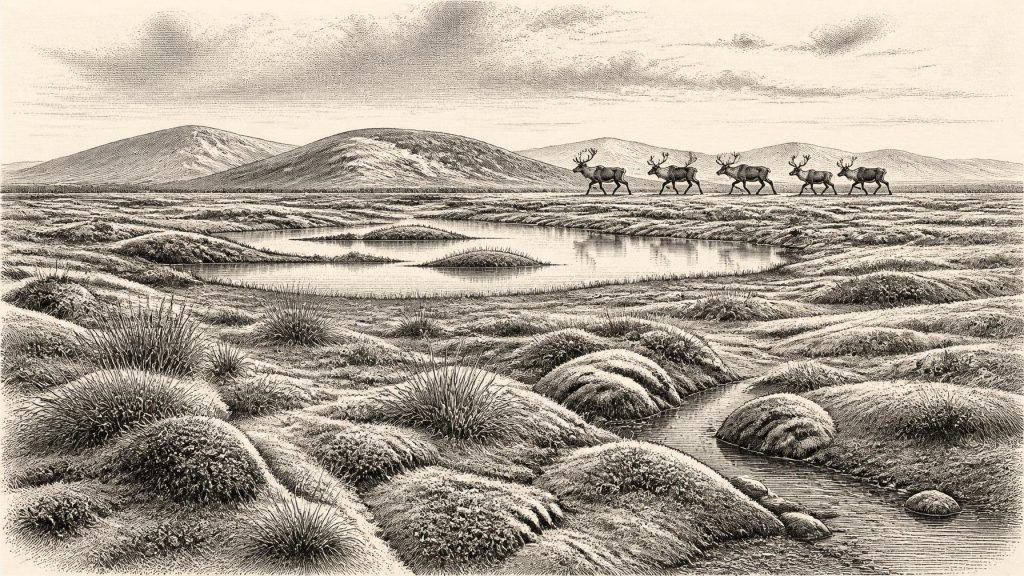
The Derryvree flora and fauna are the strongest direct guide to the kind of setting that could have existed in Fermanagh during the period represented by the deposit. Freshwater mosses and sedges, together with pollen, plant remains and insects of cold northern character, point to open tundra or muskeg-like terrain under a periglacial regime. Periglacial means intensely cold conditions around, rather than necessarily beneath, a glacier: repeated freezing and thawing disturbed soils, while seasonal snow, shallow water and saturated ground shaped the vegetation.
This was not simply a blank, snow-covered wilderness. Low vegetation could form varied local habitats. Sedges and mosses grew on wet ground; grasses and herbs occupied drier patches; dwarf shrubs may have found shelter in favourable places; pools and channels created freshwater niches. The surviving evidence supports an open, largely treeless environment rather than the closed oak, elm and hazel woods of later post-glacial Ireland. It also indicates that landscape diversity existed at small scales, with wetter basins, better-drained slopes and stream margins offering different resources.
Crag Cave in County Kerry provides a complementary, though not identical, climate archive. Uranium-thorium dates show that calcite formations in this shallow cave grew episodically during MIS 3. Such growth requires liquid water moving through the rock, and is interpreted as evidence that temperatures sometimes rose above the threshold at which this process could occur. It does not prove that every part of Ireland was mild, forested or ice-free at the same time. It does, however, reinforce the picture of a fluctuating rather than uniform glacial climate, in which temporary ameliorations could have transformed local drainage, vegetation and animal routes.
Animals at the Atlantic Edge
Animal bones from Castlepook Cave near Doneraile in north County Cork show that substantial mammals reached Ireland during favourable parts of MIS 3. The cave is the island’s richest known Late Pleistocene vertebrate site. Its wider Ice Age fauna includes woolly mammoth, giant deer or “Irish elk” (Megaloceros giganteus), reindeer, brown bear and spotted hyaena; later deposits also yielded colder-adapted animals including lemmings, Arctic fox and wolf. These remains do not all belong to one moment, nor need they represent animals living together in a single local ecosystem. Cave deposits can be disturbed by water, scavengers, denning carnivores and older excavations.
Improved radiocarbon work has nonetheless revised the chronology of southern Irish faunas. A reassessment of Castlepook samples found that several results were substantially older than dates obtained in the 1990s, and suggested that giant deer and spotted hyaena may have disappeared locally before the Last Glacial Maximum, around 40,000 cal BP. The target date of 31,483 BCE is therefore close in broad chronological terms to a period when the animal record is being actively re-evaluated, not a date at which a fixed list of species can safely be placed across the whole island.
Reindeer are especially significant because they suit open, cold environments and could have used broad grazing grounds. Mammoths and giant deer evoke impressive animals, but their fossils should not turn Ireland into an imagined permanent “mammoth-steppe” untouched by environmental variation. Their presence establishes movements of particular animals or populations through parts of the island during suitable phases. It does not establish abundance everywhere, continuous residency, or an ecosystem unchanged from Cork to Fermanagh.
Sea level was lower globally than today because much water was held in northern ice sheets. The outlines of coasts and the connections between Ireland, Britain and continental Europe differed accordingly. But neither lower sea level nor the occurrence of mainland animals allows a simple assertion of a continuous, easily crossed land bridge at this particular date. Glacial ice, marine channels, local sea level, terrain and seasonal conditions all changed. The routes by which animals arrived remain a subject of reconstruction rather than certainty.
The Castlepook Human Question
One artefact-like observation gives this era unusual importance in Irish archaeology. A reindeer femur from Castlepook has been reported by zooarchaeologist Ruth Carden as bearing a deep mark consistent with cutting or chopping fresh bone using a sharp stone implement. The bone has been publicised as approximately 33,000 years old, close to the broad timescale represented by 31,483 BCE. If the mark is confirmed as humanly made and securely connected with the bone’s age, it would indicate that a person processed a reindeer in Ireland during the Upper Palaeolithic.
That is an important but deliberately narrow conclusion. The find does not demonstrate a settlement, a camp, a hunting party’s size, a domestic group, a migration route or a lasting population. There is no associated hearth, stone-tool assemblage, dwelling, burial, artwork or undisturbed occupation floor from which to reconstruct daily life. The bone could not tell us whether people killed the animal, encountered a carcass, removed meat at the cave, or processed it elsewhere before its final deposition. Nor can it identify their language, ancestry, beliefs or social organisation.
The caution is strengthened by the history of Castlepook itself. Much of its older bone collection came from early twentieth-century excavation, before modern standards of stratigraphic recording. The cave also served as a repository shaped by natural processes and carnivores. Recent excavation has therefore aimed to discover whether intact Pleistocene deposits survive and whether fresh material can resolve the site’s complex history. Until corroborating evidence is recovered, Castlepook is best described as a proposed early signal of human activity, not proof of settled Palaeolithic Ireland.
No Politics, but a Human Possibility
For political affairs, warfare, diplomacy, religion, learning and formal exchange, the evidence is silent. There were no states, tribes or institutions in the historical sense that archaeology can identify in Ireland at this time. It would be misleading to supply imagined chiefs, hunting territories, seasonal rituals or alliances merely because small hunter-gatherer groups elsewhere in Upper Palaeolithic Europe had social lives and cultural traditions. Such comparisons can suggest possibilities, but they are not evidence from Ireland.
If people did enter Ireland during this broad period, they were almost certainly highly mobile foragers operating in a demanding landscape, rather than farmers or inhabitants of permanent villages. That is an inference from the environmental setting and from better-documented Upper Palaeolithic communities elsewhere, not a conclusion proved by a Castlepook bone. The secure Irish record provides no evidence for cultivation, livestock, pottery, metalworking, monuments, long-distance commerce or permanent houses around 31,483 BCE.
The most meaningful history of this notional year is therefore environmental and evidential. Beneath a Fermanagh drumlin, Derryvree preserves the remains of a cold freshwater world that existed between glacial advances. In Cork, cave bones record animals that crossed into, or persisted in, an Ireland far different from the modern island. A single marked reindeer bone raises the possibility that people were present too. Together, these traces show an Ireland of mobile ice, open wet ground and intermittent ecological opportunity—compelling precisely because the surviving evidence is fragmentary, and because it demands restraint as well as imagination.
Primary Sources
- A Middle Midlandian Freshwater Series at Derryvree, Maguiresbridge, County Fermanagh, Northern Ireland
- Early Midlandian–Middle Midlandian, Pleistocene, Northern Ireland
- The IntCal20 Northern Hemisphere Radiocarbon Age Calibration Curve (0–55 cal kBP)
- Episodic Speleothem Deposition Tracks the Terrestrial Impact of Millennial-Scale Last Glacial Climate Variability in SW Ireland
- A Reconsideration of the Radiocarbon Dating of the Marine Isotope Stage 3 Fauna from Southern Ireland
- The Irish Quaternary Fauna Project
- Castlepook Cave: County Geological Site Report
- 2022:564 — Castlepook Cave, Castlepook South, Cork
- Prehistoric Details
- The Subdivision of the Quaternary Period in Ireland
- Irish Pleistocene Biostratigraphy
- A Stratigraphic Framework for Abrupt Climatic Changes During the Last Glacial Period Based on Three Synchronized Greenland Ice-Core Records
- Pattern, Style and Timing of British–Irish Ice Sheet Advance and Retreat Over the Last 45,000 Years: Evidence from NW Scotland and the Adjacent Continental Shelf
- The Timing and Magnitude of the British–Irish Ice Sheet Between Marine Isotope Stages 5d and 2
- Late Pleistocene Chronostratigraphy and Ice Sheet Limits, Southern Ireland
- Maximum Extent and Dynamic Behaviour of the Last British–Irish Ice Sheet West of Ireland
- Timing and Pace of Ice-Sheet Withdrawal Across the Marine–Terrestrial Transition West of Ireland During the Last Glaciation
- The Deglaciation of the Western Sector of the Irish Ice Sheet from the Inner Continental Shelf to its Terrestrial Margin
- BRITICE Glacial Map, Version 2: A Map and GIS Database of Glacial Landforms of the Last British–Irish Ice Sheet
- Phylogeographic, Ancient DNA, Fossil and Morphometric Analyses Reveal Ancient and Modern Introductions of a Large Mammal: the Complex Case of Red Deer (Cervus elaphus) in Ireland
- The Colonization of Ireland: A Human Ecology Perspective
- First Evidence of a Late Upper Palaeolithic Human Presence in Ireland
- New Insights on the Fauna of Ireland’s Younger Dryas and Early Holocene from Alice & Gwendoline Cave
- The Mesolithic in Ireland: When Was It?