Fermanagh’s Intertill Mosses31499 BCE
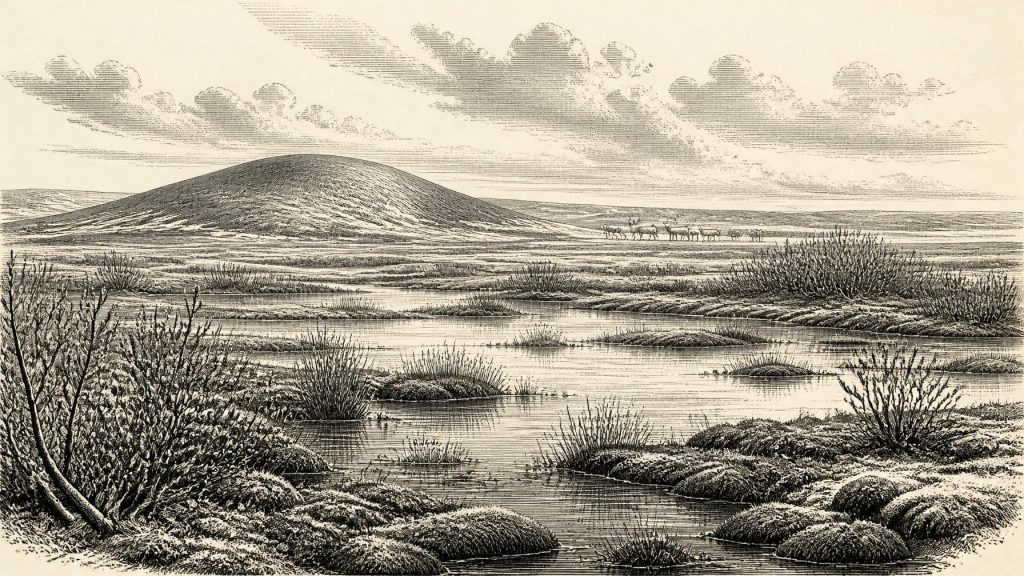
31,499 BCE is best understood as a broad later Marine Isotope Stage 3 interval, not a datable Irish year. Ireland experienced unstable Ice Age conditions, with shifting ice margins, lowered seas and locally varied open, tundra-like habitats. At Derryvree, Fermanagh, freshwater organic sediments between tills preserve evidence of sedges, mosses, herbs, shrubs and pools during an ice-free episode. Crag Cave calcite indicates intermittent milder conditions. Castlepook Cave documents reindeer, mammoth, giant deer and predators. A cut-marked reindeer bone may suggest human activity, but lacks secure context. Evidence supports dynamic environments and mobile fauna, not settlement, society or certain historical events.
Dateline
A Date Beyond Calendar History
31,499 BCE is a modern chronological label, not a year that can be matched to an Irish event. No calendar, writing, named people or contemporary narrative existed in Ireland at this depth of time. In the archaeological convention of calibrated years before present, where “present” is AD 1950, the label falls roughly 33,450 years ago. That apparent precision is misleading. Radiocarbon ages at this antiquity must be calibrated, have substantial uncertainties, and date sampled organic material rather than a whole landscape or an individual occurrence. The responsible frame is therefore a broad one: later Marine Isotope Stage 3 (MIS 3), within the last Ice Age, rather than a supposed Irish “year”.
The evidence is sparse, fragmented and geographically uneven. It consists principally of sediments buried below later glacial deposits, cave bones, pollen, plant macrofossils, insects, cave calcite and the physical imprint of moving ice. These sources can illuminate environments and animal communities over centuries or millennia. They cannot identify a political decision, battle, treaty, ruler, settlement or ritual in 31,499 BCE. Ireland’s history at this point is overwhelmingly environmental history, with a possible but unconfirmed human dimension.
Ice, Water and Open Ground
Ireland lay on the north-western fringe of Europe during a climatically unstable phase of the Late Pleistocene. MIS 3 was not one long, uniform freeze. Greenland ice-core records, North Atlantic sediments and Irish cave deposits indicate abrupt swings between colder stadials and relatively milder interstadials. These changes affected snowfall, permafrost, river flow, vegetation and the margins of the British–Irish Ice Sheet. A map showing all Ireland either entirely ice-covered or entirely ice-free cannot do justice to this shifting world.
The later Last Glacial Maximum, when the British–Irish Ice Sheet reached its greatest well-established extent, lay in the future. Yet ice was already an important force. Glaciers had repeatedly altered drainage, scoured older terrain and deposited till: an unsorted mixture of clay, sand, stones and boulders carried beneath or within ice. Much of whatever existed on the ground surface during MIS 3 was later removed, disturbed or deeply buried. That destructive history is the principal reason why direct evidence from Ireland is so rare.
Sea level was lower than it is now because so much water was held in global ice sheets, enlarging surrounding shelves and changing coastlines. But the precise configuration of routes between Ireland, Britain and continental Europe varied through time and remains a matter for reconstruction, not assumption. It is unsafe to picture a permanent, uncomplicated land bridge or to infer routine movement of people from lowered seas alone.
Derryvree’s Buried Wetland
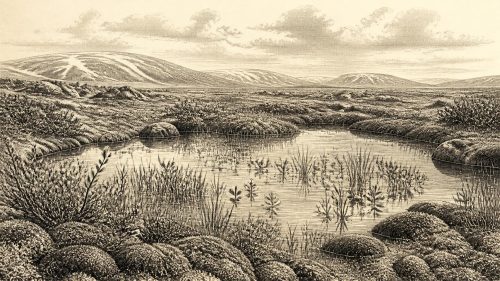
The closest Irish environmental archive to this notional date is at Derryvree, near Maguiresbridge in County Fermanagh. Roadworks in 1969 cut through a drumlin and revealed fine sand, silt and organic freshwater deposits between two distinct tills. The sequence matters because it records a period when the locality was not overridden by glacier ice: first came deposition of the lower till, then a freshwater and wet-ground interval, and later the burial of that deposit beneath another till.
Organic material from the Derryvree series produced a conventional radiocarbon age of about 30,500 radiocarbon years BP, with a large error range. Modern calibration translates such a result into a broad calendar-age probability distribution rather than one fixed year; published discussion places the horizon broadly in the later MIS 3 interval, extending across the approximate age represented by 31,499 BCE. The result does not prove that the pool, plants or sediments all formed in that numbered year. It establishes that this exceptional deposit offers a window on a relevant cold-stage episode.
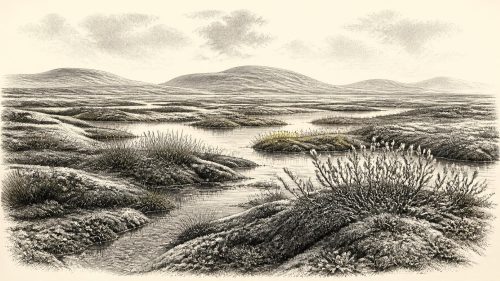
The biological remains show that even a severe glacial landscape could contain habitats of striking local variety. Pollen and plant macrofossils indicate open ground rather than closed forest, with sedges, grasses, herbs, mosses and low shrubs adapted to exposed, cold conditions. Freshwater plants and wetland mosses point to standing or slow-moving water and saturated margins. Finds such as mountain avens, Dryas octopetala, are consistent with northern or alpine-type vegetation. Such evidence should not be turned into a modern field guide: species occurred in particular microhabitats, and their remains may have been transported short distances. Still, the overall impression is securely of treeless, tundra-like country with pools, marshy hollows and seasonally productive edges.
Thaw Pulses and Permafrost
Crag Cave in County Kerry supplies a different kind of record. Its stalagmites and related cave calcite can grow only when liquid water penetrates soils and bedrock, conditions difficult to sustain under continuous deep freezing. Uranium-series dating shows episodic speleothem growth in south-west Ireland during the last glacial period, especially during milder Greenland interstadials. This does not demonstrate that every part of Ireland was mild at the same moment, nor does it date activity at Derryvree. It does show that Irish climatic conditions could change rapidly enough for frozen-ground regimes and biological productivity to alter markedly.
Accordingly, the country around this date was probably neither a featureless snowfield nor a stable tundra parkland. Seasonal contrast may have been acute. Wind exposure, altitude, drainage and proximity to ice margins would have made neighbouring districts very different. The survival of a wetland record under a Fermanagh drumlin and calcite growth in a Kerry cave are reminders that water, shelter and soil could preserve life in particular places even within a generally cold climate.
Animals in the Cave Record
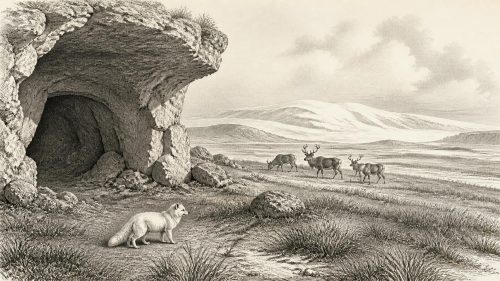
Castlepook Cave near Doneraile, County Cork, is Ireland’s most important known assemblage for the broader MIS 3 fauna. Historic excavations, later dating programmes and renewed fieldwork have identified remains including reindeer, giant deer, brown bear, wolf or fox, hare, lemming, spotted hyaena and woolly mammoth. Not every specimen belongs to the same episode. Cave deposits can combine material accumulated over long periods through animal denning, scavenging, water action, collapse and excavation disturbance. Individual dated bones are therefore more secure evidence for an animal’s presence than for a neatly contemporaneous community.
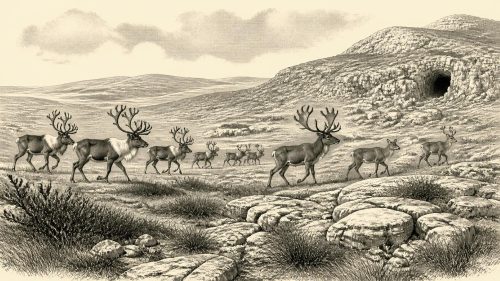
Even with that caution, Castlepook establishes that parts of Ireland supported a varied Pleistocene fauna before the maximum ice advance. Reindeer are particularly appropriate to the open, cold landscapes suggested by Derryvree, while mammoth, giant deer and predators point to a larger ecological network than any single wetland can reveal. Carnivores may have dragged carcass parts into caves; caves were not necessarily places where the animals died. The assemblage thus documents movement, predation, scavenging and repeated use of the landscape, not an intact hunting camp.
The Human Question
A reindeer femur from Castlepook has transformed discussion of Ireland’s earliest possible human presence. It has been dated to around 33,000 years ago and bears a deep linear mark interpreted by zooarchaeologist Ruth Carden as having been made on fresh bone by a sharp stone tool. If that interpretation is confirmed, it may indicate Upper Palaeolithic people processed a reindeer somewhere in the locality during the broader period. County Cork heritage material has rightly stressed the potential importance of the find.
But its limits are equally important. The bone came from an old cave collection rather than a modern excavation of an undisturbed occupation floor. The date is the age of the animal, not an exact timestamp for cutting, and the cave may have received the bone after its original deposition. No securely associated hearth, stone-tool assemblage, dwelling, grave or repeated food-processing area of comparable age has yet been found in Ireland. The specimen is therefore possible evidence of a brief human encounter with an animal, not proof of permanent settlement, a resident population or an established Irish hunting territory.
No Polities, No Proven Trade
There is no evidential basis for political affairs, diplomacy, organised warfare, institutions, formal religious practice, farming, villages, long-distance trade or learning in Ireland at this date. Nor can archaeology responsibly reconstruct the language, kinship system, stories or beliefs of any people who may have visited. If small Upper Palaeolithic groups did reach the island, comparison with better documented contemporaries elsewhere in north-west Europe suggests mobile foraging would be a plausible interpretation. Yet comparison is not evidence of an Irish social system.
The economic realities that can be observed are ecological. Animals exploited seasonal plants, grazing and shelter; predators and scavengers redistributed carcasses; and freshwater places concentrated biological resources. For hypothetical human visitors, reindeer and other large mammals would have offered food, hides, bone, sinew and fuel potential, but no Irish assemblage of tools or camp debris demonstrates how those resources were used. The absence of evidence is not proof of total absence, especially after later glacial erosion, but it sets firm limits on the story that can be told.
A Fragile Window
The most important development around 31,499 BCE was the persistence of locally habitable environments during an unstable Ice Age. Derryvree preserves mosses, sedges, water and open ground beneath later ice-laid sediment. Crag Cave records intermittent climatic amelioration. Castlepook demonstrates that large mammals and carnivores entered Irish landscapes, while one marked reindeer bone raises a compelling but unresolved question about people. Together, these traces replace an image of empty, unchanging ice with a more accurate one: a cold, dynamic island landscape of wetlands, open country, mobile fauna and scant surviving evidence. They do not, and cannot, supply the events of a single year.
Primary Sources
- A Middle Midlandian Freshwater Series at Derryvree, Maguiresbridge, County Fermanagh, Northern Ireland
- Early Midlandian–Middle Midlandian, Pleistocene, Northern Ireland
- Freshwater organic deposits and stratified sediments between Early and Late Midlandian (Devensian) till sheets, at Aghnadarragh, County Antrim, Northern Ireland
- Middle Midlandian Interstadial Deposits at Greenagho, Near Belcoo, County Fermanagh, Northern Ireland
- The Irish Quaternary Fauna Project
- A Reconsideration of the Radiocarbon Dating of the Marine Isotope Stage 3 Fauna from Southern Ireland
- Castlepook Cave, County Cork: 2022 Excavation Report
- Heritage Artefacts of County Cork
- New Insights on the Fauna of Ireland’s Younger Dryas and Early Holocene from Alice & Gwendoline Cave
- Episodic Speleothem Deposition Tracks the Terrestrial Impact of Millennial-Scale Last Glacial Climate Variability in SW Ireland
- Spatio-Temporal Dynamics of Speleothem Growth and Glaciation in the British Isles
- Late Pleistocene Chronostratigraphy and Ice Sheet Limits, Southern Ireland
- Timing and Pace of Ice-Sheet Withdrawal Across the Marine–Terrestrial Transition West of Ireland During the Last Glaciation
- The Timing and Magnitude of the British–Irish Ice Sheet Between Marine Isotope Stages 5d and 2
- Dating Constraints on the Last British-Irish Ice Sheet: A Map and Database
- The IntCal20 Northern Hemisphere Radiocarbon Age Calibration Curve (0–55 cal kBP)
- IntCal Publications
- Ice-Core Data Used for the Construction of the Greenland Ice-Core Chronology 2005 and 2021 (GICC05 and GICC21)
- European Vegetation During Marine Oxygen Isotope Stage 3
- Multi-Isotope Analysis of Bone Collagen of Late Pleistocene Ungulates Reveals Niche Partitioning and Behavioural Plasticity of Reindeer During MIS 3