Freshwater Layers31370 BCE
31,370 BCE is a modern label within a broad Late Pleistocene range, not a recoverable Irish year. Derryvree, County Fermanagh, preserves freshwater silts and organic deposits between glacial tills, demonstrating an ice-free interval with cold, open tundra, shallow water and hardy vegetation. Castlepook Cave, County Cork, contains MIS 3 fauna including mammoth, reindeer, giant deer, hyaena and wolf, although its disturbed remains span different periods. A marked reindeer femur may indicate early human butchery, but cannot establish settlement. Ireland’s evidence reflects glacial erosion and preservation biases. The period reveals climates, habitats and animal movements rather than societies, politics or culture.
Dateline
Modern calendar-year precision is not available for Ireland in 31,370 BCE. No one on the island kept a calendar, wrote an account or left an archaeological sequence that can be assigned to that individual year. The label is a modern convenience: counted back from the radiocarbon convention of AD 1950, it falls about 33,319 calibrated years before present. The responsible subject is therefore a broad Late Pleistocene interval, not an annual chronicle. Ireland lay in Marine Isotope Stage 3 (MIS 3), within the Irish ‘Middle Midlandian’: a long, climatically unstable phase of the last Ice Age.
The evidence nearest this notional date is thin but important. It comes principally from freshwater sediments sealed below a drumlin at Derryvree, near Maguiresbridge in County Fermanagh, and from animal bones recovered at Castlepook Cave near Doneraile in County Cork. These sites do not document a nation, a settlement or a named people. They do, however, show that parts of Ireland experienced a cold, changing, biologically active landscape before the Last Glacial Maximum reached its later extent.
A Date Within a Range
Radiocarbon dating is especially valuable for this period, but it does not produce the apparent certainty implied by a numbered BCE year. The principal Derryvree organic deposit returned a conventional radiocarbon determination of 30,500 ± 1,170 radiocarbon years BP. Radiocarbon years are not calendar years, because atmospheric carbon-14 concentrations have changed through time. When the determination and its substantial uncertainty are calibrated against modern curves, the result is a wide interval rather than a point: approximately 36,900–31,700 calibrated years BP, or about 34,950–29,750 BCE. The date 31,370 BCE lies within that broad bracket, but cannot be assigned to a particular layer, season, animal or human act.
This is not a minor technical qualification. The deposits and bones relevant to this entry accumulated across long spans, and some cave collections were excavated before modern recording methods existed. A cautious account must distinguish material evidence from interpretation. Sediments can securely show that water, plants and small animals occupied a particular locality during an ice-free phase. They cannot, by themselves, reveal the language, beliefs, kinship or political organisation of any people who may have passed through the wider landscape.
Freshwater Beneath a Drumlin
Derryvree provides the clearest Irish environmental archive for the period. Roadworks in 1969 cut through a drumlin, the streamlined hill of glacial sediment now characteristic of much of central and northern Ireland. The exposure revealed freshwater silts, fine sands and organic material trapped between two tills: unsorted deposits laid down by glacier ice. Its sequence provides a robust relative history. An earlier glacier deposited the lower till; an interval followed in which sediment settled in freshwater and organic remains accumulated; a later ice advance covered the deposit with a fresh layer of till.
The implication is precise in one sense and limited in another. It establishes that this part of Fermanagh was not continuously overridden by ice throughout the last glacial cycle. It does not prove that the whole island was ice-free at the same moment. Ice sheets are regional and mobile systems, and their margins, thickness and flow directions varied through time. At around this date Ireland should not be imagined either as a wholly ice-buried land or as a milder, familiar green island. The better picture is of strong local contrasts: glacier-influenced regions, periglacial ground affected by seasonal freezing, open terrain and waterlogged hollows could all occur within a changing north-west European environment.
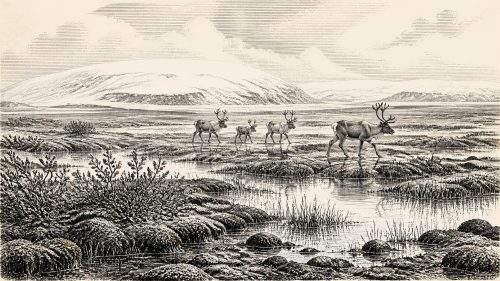
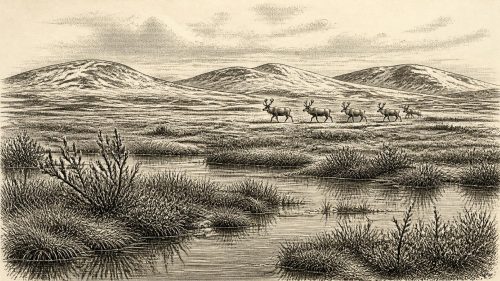
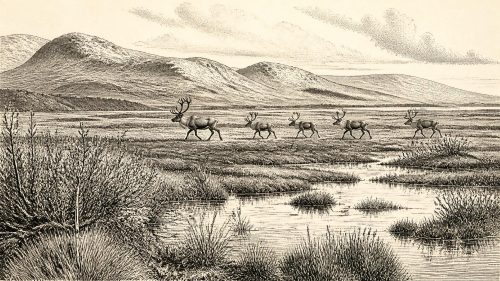
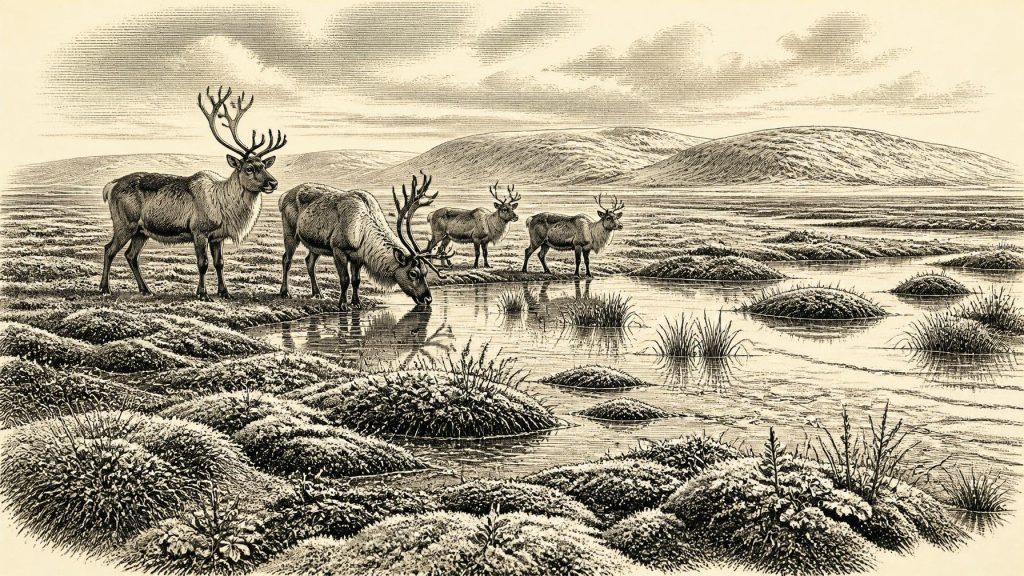
At Derryvree, pollen was poorly preserved, yet the surviving pollen, mosses and other plant macrofossils are unusually revealing. They indicate open tundra vegetation rather than woodland. Sedges, mosses and hardy herbs grew in and around shallow water, while aquatic and wet-margin plants point to standing or slow-moving freshwater. The assemblage has been compared with muskeg: saturated, organic-rich ground broken by pools and channels. This was not a lush marsh in a temperate climate. The growing season was short, frost was an important force in the soil, and dry ground may have supported only sparse cover. But it was a functioning habitat, not an empty expanse of permanent ice.
Animals in an Open Landscape
Castlepook Cave, long known as Mammoth Cave, offers a southern counterpart to the Fermanagh deposit. Antiquarian excavations led by Richard J. Ussher in the early twentieth century recovered a large and remarkable collection of animal bones. Subsequent study and radiocarbon dating have placed parts of the wider Castlepook fauna in MIS 3, though individual specimens represent different times and their original positions were often disturbed. The cave should therefore be treated as evidence that animals used the surrounding region over a long period, not as a snapshot of one herd, one hunt or one season.
The recorded fauna includes woolly mammoth, reindeer, giant deer, brown bear, spotted hyaena, wolf, fox, mountain hare and lemmings. Together these animals are consistent with an open, cold environment with varied food resources: grasses and herbs for large herbivores, rough cover for smaller mammals, and sufficient prey or carrion for predators and scavengers. Their presence also warns against treating prehistoric Ireland as an ecological backwater. At intervals during MIS 3, animal populations reached this western edge of Europe despite the severe climate and the changing geography of ice and sea.
Yet a list of species should not be turned into a cinematic ‘mammoth-steppe’ scene with every animal standing together. Some bones are older or younger than others; carnivores may have brought material into the cave; water, collapse and excavation may have moved it afterwards. Hyaena remains are particularly important because they suggest that caves could have been used by carnivores, not simply by animals dying naturally or by people sheltering there. Taphonomy—the study of how remains were accumulated, altered and buried—is central to every conclusion drawn from Castlepook.
The Human Question
The most provocative find associated with Castlepook is a reindeer femur reported in 2021 as around 33,000 years old and bearing a deep mark interpreted as damage made by a sharp stone tool during carcass processing. If the direct date and the identification of the modification as an anthropogenic chop or cut mark are sustained, it may indicate a very early Upper Palaeolithic human visit to Ireland. It would bring people close to the chronological horizon represented by 31,370 BCE, far earlier than the island’s previously accepted late-glacial evidence.
That possibility deserves attention, but not exaggeration. The femur was recovered from an old cave collection, rather than from a newly excavated, sealed occupation surface associated with tools, hearths or a dwelling. A single alteration on bone must be distinguished from carnivore damage, sediment abrasion, trampling, breakage during excavation and later handling. Nor have securely associated stone tools, human remains, repeated occupation deposits or an undisturbed butchery floor of this age been published from Ireland. The bone may eventually support the case for a brief visit by mobile hunters; at present it cannot demonstrate permanent settlement, continuous population or a ‘first Irish’ community.
No Polities, No Proven Trade
Consequently, political affairs, diplomacy and conflict cannot responsibly be reconstructed for Ireland at this date. There is no evidence for chiefs, territories, alliances, warfare or institutions. There is equally no evidence for farming, herding, pottery, metallurgy, houses, fields, monuments or exchange networks. The familiar categories of later Irish history simply do not yet apply. If people reached Ireland during MIS 3, they would have been small, highly mobile foraging groups operating in a demanding landscape, but this is an inference from the wider Upper Palaeolithic world, not something demonstrated by an Irish settlement.
The same restraint is required for religion, culture and learning. No Irish cave art, burial, ritual deposit, personal ornament or portable art can be dated securely to this horizon. The absence of such evidence does not prove that visitors lacked beliefs, stories, skills or social ties; it means that the surviving Irish record cannot identify them. What it does preserve is a deeper precondition for human history: places where freshwater endured between glacial advances, animals moved across open country, and changing climates repeatedly remade the possibilities of life.
An Uneven National Record
The contrast between Derryvree and Castlepook is itself instructive. Fermanagh preserves wetland evidence under glacial deposits; north Cork preserves cave fauna in limestone country. Their survival is exceptional. Later ice movement eroded many earlier land surfaces, while rising seas and coastal change altered or submerged other potential archaeological landscapes. Ireland’s sparse record is therefore not proof of an empty island in every phase. It is evidence filtered by preservation, discovery and the limits of early excavation.
For 31,370 BCE, the strongest conclusion remains modest and significant. Modern annual dating cannot recover a particular Irish event. Across a broad calibrated range embracing this nominal year, Derryvree records cold, open freshwater tundra between episodes of glaciation, while Castlepook shows that an Ice Age fauna occupied southern Ireland at intervals. A marked reindeer bone raises the possibility of a human encounter with that world, but does not yet turn it into a settled human landscape. The history of Ireland here begins not with kings or chronicles, but with silts, mosses, bones, ice and uncertainty carefully measured.
Source References
Hover over a number to see the source. Select it to open the source.

- [1] A Middle Midlandian Freshwater Series at Derryvree, Maguiresbridge, County Fermanagh, Northern Ireland
- [2] The Irish Quaternary Fauna Project
- [3] New Insights on the Fauna of Ireland's Younger Dryas and Early Holocene from Alice & Gwendoline Cave
- [4] Irish Pleistocene Biostratigraphy
- [5] Palaeoecology
- [6] Ireland's Palaeolithic Archaeology – Fleeting Footprints in a Frozen Land
- [7] Heritage Artefacts of County Cork
- [8] Archaeological Excavations at Castlepook Cave, Co. Cork, 2022
- [9] UCD School of Archaeology Research Day 2022
- [10] Vertical Dimensions and Age of the Wicklow Mountains Ice Dome, Eastern Ireland, and Implications for the Extent of the Last Irish Ice Sheet
- [11] Timing and Pace of Ice-Sheet Withdrawal Across the Marine–Terrestrial Transition West of Ireland During the Last Glaciation
- [12] The Deglaciation of the Western Sector of the Irish Ice Sheet from the Inner Continental Shelf to its Terrestrial Margin
- [13] Glacial Geomorphology in the Wicklow Mountains, Ireland
- [14] Dating Constraints on the Last British-Irish Ice Sheet: A Map and Database
- [15] The Last Glacial Maximum
- [16] The Last British-Irish Ice Sheet: A Review of the Evidence Utilised in the Compilation of the Glacial Map of Britain
- [17] The IntCal20 Northern Hemisphere Radiocarbon Age Calibration Curve (0–55 cal kBP)
- [18] OxCal Online
- [19] The Antiquity of Man in Ireland
- [20] Cenozoic: Tertiary and Quaternary (until 11,700 years before 2000)
Primary Sources
- A Middle Midlandian Freshwater Series at Derryvree, Maguiresbridge, County Fermanagh, Northern Ireland
- The Irish Quaternary Fauna Project
- New Insights on the Fauna of Ireland's Younger Dryas and Early Holocene from Alice & Gwendoline Cave
- Irish Pleistocene Biostratigraphy
- Palaeoecology
- Ireland's Palaeolithic Archaeology – Fleeting Footprints in a Frozen Land
- Heritage Artefacts of County Cork
- Archaeological Excavations at Castlepook Cave, Co. Cork, 2022
- UCD School of Archaeology Research Day 2022
- Vertical Dimensions and Age of the Wicklow Mountains Ice Dome, Eastern Ireland, and Implications for the Extent of the Last Irish Ice Sheet
- Timing and Pace of Ice-Sheet Withdrawal Across the Marine–Terrestrial Transition West of Ireland During the Last Glaciation
- The Deglaciation of the Western Sector of the Irish Ice Sheet from the Inner Continental Shelf to its Terrestrial Margin
- Glacial Geomorphology in the Wicklow Mountains, Ireland
- Dating Constraints on the Last British-Irish Ice Sheet: A Map and Database
- The Last Glacial Maximum
- The Last British-Irish Ice Sheet: A Review of the Evidence Utilised in the Compilation of the Glacial Map of Britain
- The IntCal20 Northern Hemisphere Radiocarbon Age Calibration Curve (0–55 cal kBP)
- OxCal Online
- The Antiquity of Man in Ireland
- Cenozoic: Tertiary and Quaternary (until 11,700 years before 2000)